What Is Order-to-Cash (O2C) Automation?
Order-to-cash (O2C) automation uses AI, workflow automation, RPA, machine learning, and analytics to automate and connect the business process from customer order through credit, invoicing, collections, payment, cash application, dispute management, and reconciliation.
For enterprise finance teams, the goal is to reduce manual work and delays across the O2C cycle, improve receivables visibility, accelerate cash collection, and support working-capital performance. The exact results depend on process maturity, data quality, systems, controls, and implementation scope.
Order-to-Cash Automation at a Glance
| Question | Short answer |
|---|---|
| What does O2C automation automate? | Order processing, credit, invoicing, collections, payment processing, cash application, disputes, deductions, reconciliation, and reporting. |
| What is the main objective? | Connect the O2C lifecycle so data and decisions move between teams and systems with less manual intervention. |
| What technologies are used? | AI, machine learning, generative AI, AI agents, RPA, workflow automation, APIs, analytics, OCR/document intelligence, and ERP integrations. |
| What business metrics matter? | DSO, cash application automation, unapplied cash, dispute cycle time, collection effectiveness, AR accuracy, cost to serve, and working-capital impact. |
| Who uses it? | CFOs, controllers, treasury, credit, collections, accounts receivable, shared services, GBS, and O2C process owners. |
What Are the Steps in an Automated O2C Process?
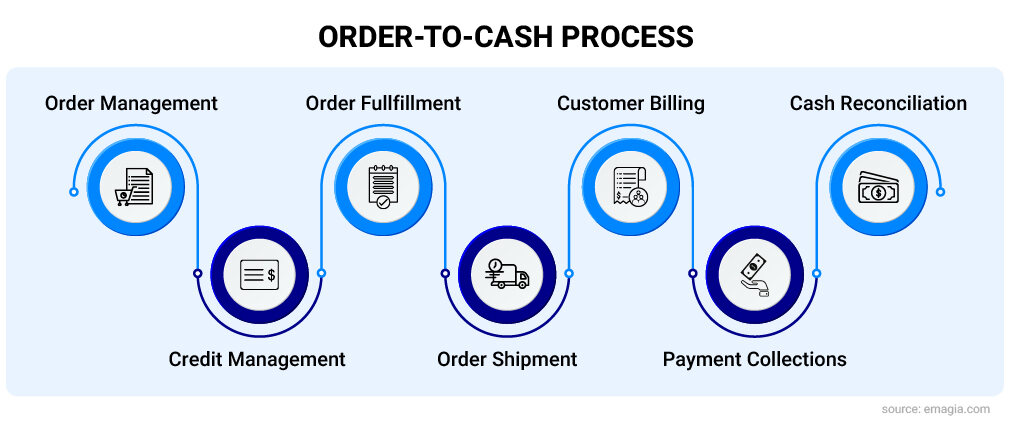
The exact sequence varies by organization, but an enterprise O2C automation program commonly connects these stages:
- Order capture and validation: capture order information and validate required data.
- Credit management: assess customer credit, exposure, limits, and approvals.
- Order fulfillment: coordinate fulfillment information that affects billing and revenue.
- Invoicing and billing: generate, validate, deliver, and track invoices.
- Collections: prioritize accounts and automate collection workflows.
- Payment and remittance processing: capture payment and remittance information from available channels.
- Cash application: match payments to invoices, accounts, and open items.
- Dispute and deduction management: identify, route, investigate, and resolve exceptions.
- Reconciliation and reporting: reconcile receivables and provide operational and financial visibility.
What Are the Benefits of O2C Automation?
Enterprise O2C automation can help finance organizations reduce repetitive work, improve process visibility, shorten cycle times, accelerate cash application, and manage exceptions more consistently. Common objectives include:
- Reduce manual O2C processing and handoffs.
- Improve cash application and reduce unapplied cash.
- Shorten collection and dispute-resolution cycles.
- Improve receivables visibility across business units and geographies.
- Support lower DSO and stronger working-capital management.
- Standardize workflows while preserving appropriate human approvals.
- Connect ERP, CRM, banking, payment, customer, and shared-service data.
- Give finance leaders more timely operational and exception-level insights.
How Is AI Used in Order-to-Cash Automation?
AI can support O2C activities where teams must interpret documents, identify patterns, prioritize work, or resolve exceptions. Typical use cases include:
- Extracting and interpreting unstructured remittance information.
- Predicting collection priorities and payment behavior.
- Matching payments with invoices and customer accounts.
- Classifying and routing disputes and deductions.
- Summarizing customer account activity for collections teams.
- Recommending next actions for exceptions.
- Supporting customer self-service through AI assistants.
- Generating finance insights from connected O2C data.
AI should be paired with business rules, authorization controls, auditability, exception handling, and human oversight where financial decisions or ERP postings require it.
O2C Automation vs. RPA: What Is the Difference?
RPA is commonly used to automate repeatable, rules-based tasks. O2C automation is broader: it connects multiple O2C activities, systems, data sources, workflows, controls, analytics, and increasingly AI capabilities across the revenue-to-cash lifecycle.
| Area | RPA | Enterprise O2C Automation |
|---|---|---|
| Primary focus | Repeatable tasks | End-to-end process orchestration |
| Data | Usually structured inputs | Structured and unstructured receivables data |
| Exceptions | Often escalated when rules fail | Can combine AI, workflows, rules, and human review |
| Scope | Individual activities | Connected O2C lifecycle |
| Business visibility | Task-level | Cross-process operational and financial visibility |
Enterprise O2C Automation Use Cases
Enterprise teams typically prioritize automation where transaction volumes, global complexity, fragmented data, or exception rates create significant manual effort.
- Global cash application: automate payment and remittance matching across banks, currencies, entities, and payment formats.
- Collections automation: prioritize accounts, recommend actions, and coordinate outreach workflows.
- Credit automation: support faster credit assessment, exposure monitoring, and approval workflows.
- Deduction management: classify deductions, collect evidence, route work, and track resolution.
- Dispute management: centralize dispute information and coordinate resolution across teams.
- Receivables reconciliation: connect transaction, payment, and customer data for more consistent reconciliation.
- Customer self-service: provide account, invoice, payment, and dispute information through digital channels.
How Do You Measure O2C Automation Success?
O2C automation should be measured against operational, cash, customer, and control outcomes rather than automation volume alone.
- Days Sales Outstanding (DSO)
- Cash application auto-match rate
- Unapplied cash balance and aging
- Collection effectiveness and promise-to-pay performance
- Dispute and deduction cycle time
- Invoice accuracy and exception rate
- Cost per transaction or cost to serve
- Manual touches and hours saved
- Customer response and resolution time
What Should You Look for in O2C Automation Software?
When evaluating enterprise O2C automation software, assess the platform against the actual process, systems, data, controls, and outcomes required by your organization.
- End-to-end O2C process coverage rather than a single point solution.
- ERP, CRM, bank, payment, and customer-system integrations.
- Support for multiple entities, currencies, geographies, and payment formats.
- AI and document intelligence for unstructured information.
- Configurable workflow, approval, escalation, and exception management.
- Audit trails, role-based controls, and human-in-the-loop capabilities.
- Real-time or near-real-time dashboards and operational analytics.
- Scalable architecture for enterprise transaction volumes.
- Clear measurement of automation, cash, productivity, and working-capital outcomes.
How Do You Implement O2C Automation?
- Baseline the current process: document systems, handoffs, cycle times, exceptions, costs, and KPIs.
- Prioritize high-value bottlenecks: identify activities where automation can remove significant manual effort or cash delays.
- Connect the data: integrate ERP, banking, CRM, payment, customer, and document sources.
- Design controls: define approval thresholds, exception queues, auditability, and human review.
- Automate and test: validate rules, AI outputs, workflows, integrations, and ERP posting behavior.
- Measure outcomes: compare results with the baseline and continuously improve the process.
Key Takeaway: O2C Automation Is More Than Task Automation
Enterprise O2C automation is the coordinated use of data, workflows, integrations, rules, AI, analytics, and human oversight across the order-to-cash lifecycle. The strongest programs connect process stages instead of optimizing isolated tasks, while keeping financial controls and measurable business outcomes at the center.
Order-to-cash (O2C) automation is the use of artificial intelligence (AI), robotic process automation (RPA), machine learning, and advanced analytics to automate the end-to-end receivables lifecycle—from order validation and credit approval to invoicing, collections, cash application, dispute resolution, and reconciliation.
For enterprise CFOs, O2C automation improves working capital performance by reducing Days Sales Outstanding (DSO), accelerating cash conversion, minimizing manual exceptions, and improving customer experience across global finance operations.
Key Business Outcomes of O2C Automation
- Reduce DSO by 30% or more
- Achieve 85%+ autonomous cash application match rates
- Accelerate credit decisions from days to minutes
- Lower receivables operating costs by 40%
- Improve real-time visibility across global AR operations
What Does Order-to-Cash Automation Include?
Enterprise O2C automation orchestrates the full receivables lifecycle across:
- Order capture and validation
- Credit risk assessment
- Invoice generation and delivery
- Collections workflow automation
- Cash application and remittance matching
- Dispute and deduction resolution
- AR reconciliation and reporting
This creates a unified finance operations layer across ERP, CRM, banking, and payment ecosystems.
How Order-to-Cash Automation Works
- Capture and validate customer orders
- Assess credit risk automatically
- Generate and deliver invoices
- Match incoming payments automatically
- Resolve deductions and disputes
- Reconcile receivables in real time
Integrated O2C Automation Replaces Automated AR
Enterprise finance leaders are shifting from isolated accounts receivable automation toward integrated, autonomous order-to-cash platforms that combine workflow orchestration, AI, analytics, and real-time receivables intelligence.
Manual O2C vs Basic AR Automation vs Autonomous O2C
| Capability | Manual O2C | Basic AR Automation | Autonomous O2C (Emagia) |
|---|---|---|---|
| Cash Application | Manual matching | Rule-based automation | AI autonomous matching |
| Exception Resolution | Human intervention | Limited workflows | Agentic AI reasoning |
| Multi-ERP Data Integration | Siloed | Partial | Cross-instance normalization |
| Remittance Processing | Manual extraction | Template dependent | Unstructured AI interpretation |
| Customer Self-Service | Manual support | Portal only | AI digital assistant |
See how autonomous O2C compares in real enterprise finance environments.
How Modern Enterprise O2C Architecture Works
Modern enterprise order-to-cash platforms unify structured and unstructured receivables data from ERP systems, customer communications, payment networks, and banking channels into a centralized finance intelligence layer.
This includes data from SAP, Oracle, NetSuite, Microsoft Dynamics, CRM systems, ACH payment files, SWIFT remittances, bank lockboxes, supplier networks, and customer portals.
By consolidating fragmented receivables data, enterprises can orchestrate credit, invoicing, collections, deductions, cash application, and reconciliation workflows in real time across global business units.
This architecture improves visibility, reduces manual handoffs, accelerates exception resolution, and enables better customer experiences through faster, more accurate receivables operations.
Challenges of Enterprise Order-to-Cash Automation
Enterprise order-to-cash automation is challenging because receivables data is fragmented across multiple systems, formats, and business units.
Large organizations often operate multiple ERP environments such as SAP, Oracle, NetSuite, Microsoft Dynamics, and legacy finance systems.
Enterprise-grade O2C automation requires cross-instance finance data normalization and unified visibility across structured and unstructured receivables data.
Transforming Order-to-Cash with Emagia Global Deployment: The ConvaTec GBS Success Story. Watch Now
AI Agents vs Traditional RPA in O2C Automation
Traditional robotic process automation (RPA) automates repetitive rule-based tasks but struggles when data is incomplete, inconsistent, or unstructured.
AI agents go further by reasoning through exceptions, interpreting remittance advice, predicting disputes, and autonomously recommending next actions.
For example, Emagia’s Gia AI assistant can help automate:
- Unstructured remittance interpretation
- Cash application exception resolution
- Collections prioritization
- Deduction workflow routing
- Customer self-service payment interactions
A Change in Human Involvement
Comprehensive, integrated automation markedly reduces the requirement for human involvement in traditional “work” such as repetitive information gathering, organizing, and reporting. Instead, humans can move to problem-solving and higher-order tasks.
Benefits of Overcoming O2C Automation Challenges
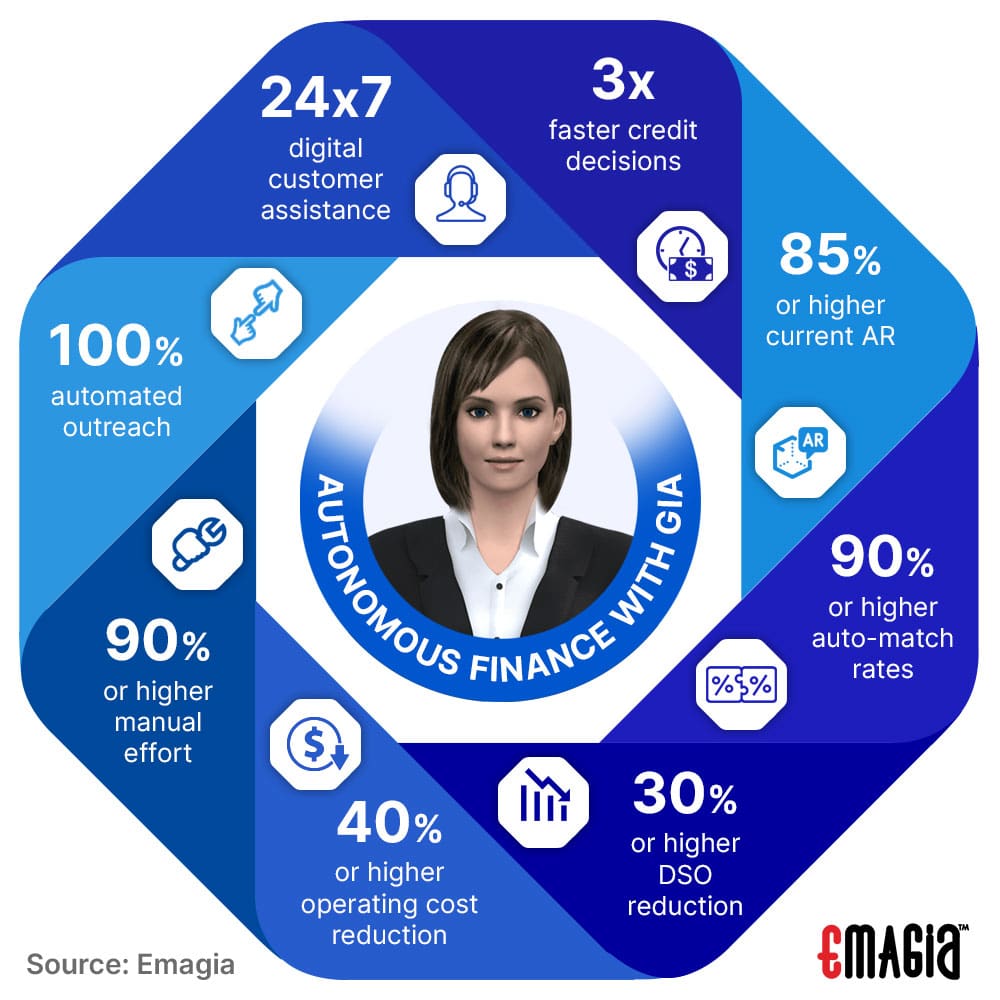 Integrated and hyper automated O2C platforms demonstrate such results as:
- Credit decisions in minutes and seconds rather than days or weeks
- Current AR of 85 percent or better
- Deduction processing in less than a week
- 85 percent or higher cash auto match
- Insights through visualizations and reporting
- 30+ percent reduction in DSO
- 40+ percent reduction in operations cost
- Customers experience high touch, high accuracy, and 24 X 7 X 365 digital assistance
Advanced automation technology provides cash forecasting and improves cash flow to support working capital management. With a stronger cash position and better forecasting, CFOs can manage debt, invest in product development, and finance initiatives.
From Process to Insight and Strategy
True O2C automation is here. The outcomes of an integrated and automated O2C process indicate the overall direction of finance work in general, which is away from managing process toward monitoring process, providing insights, and business strategizing. In addition, reporting will shift to real time, eventually eliminating the close processes. And efficiency gains will enable finance to shift its focus to the demands of enhanced customer experience and creating strategies for growth.
For more on how Emagia’s O2C Automation Platform can move your enterprise forward, Request an Enterprise O2C Assessment. 
What Enterprise O2C Platforms Must Deliver
- Autonomous cash application
- AI-powered collections prioritization
- Dispute and deduction automation
- Predictive cash forecasting
- Global multi-currency receivables support
- ERP and CRM integrations
- Real-time CFO dashboards
- Customer-facing AI assistants
Frequently Asked Questions (FAQs) about Order to Cash Automation
What is order to cash automation?
Order-to-cash automation uses AI, workflow automation, and analytics to automate receivables workflows from order processing through payment reconciliation, reducing manual work, improving cash flow, and accelerating collections.
Why is order to cash process automation important?
Order to cash process automation increases efficiency, shortens cycle times, reduces Days Sales Outstanding (DSO), improves working capital, and enhances the customer experience by minimizing manual tasks and enabling real-time insights.
What are the main steps in the order to cash process?
The O2C process includes order capture, credit approval, invoicing, payment collection, cash application, dispute management, and reconciliation.
What are the benefits of using order to cash software?
Order to cash software delivers faster cash collection, improved AR accuracy, automated exception handling, actionable analytics, reduced operational costs, and enhanced customer satisfaction.
Can O2C automation software integrate with existing ERP and CRM systems?
Yes. Modern O2C automation platforms integrate seamlessly with ERP, CRM, banking systems, and other enterprise applications, enabling a single, unified view of receivables and cash flow across the organization.
How does AI improve the order to cash process?
AI enhances O2C automation by automating cash application, predicting and resolving exceptions, extracting remittance data from multiple formats, and providing insights for better decision-making, reducing manual intervention significantly.
What is the role of RPA in order to cash automation?
Robotic Process Automation (RPA) automates repetitive, rule-based tasks such as invoice processing, data entry, and payment reconciliation, freeing staff to focus on exception handling and strategic activities.
What are common challenges in the O2C cycle?
Challenges include fragmented ERP systems, inconsistent data sources, delayed cash application, manual deduction and dispute management, cross-currency complexities, and lack of real-time visibility. Integrated O2C platforms solve these challenges through automation and AI.
How does order to cash automation impact working capital?
By speeding up cash collection, improving AR accuracy, and reducing DSO, O2C automation increases available cash, strengthens liquidity, and allows CFOs to reinvest in strategic initiatives.
What makes Emagia a leading order to cash automation solution?
Emagia combines AI-powered cash application, workflow automation, analytics, and ERP integrations to help enterprise finance teams accelerate collections and improve receivables visibility.
Can order to cash automation handle multi-currency and global operations?
Yes. Advanced O2C automation platforms manage multi-currency transactions, global receivables, and international remittance formats, ensuring consistent and efficient cash collection across regions.
What is the difference between invoice to cash and order to cash automation?
Invoice to cash focuses primarily on invoicing, payment receipt, and cash application. Order to cash automation encompasses the entire sales-to-cash process, including order capture, credit management, fulfillment, invoicing, payment, cash application, and reconciliation.
How can businesses measure the success of O2C automation?
Key metrics include reduction in DSO, percentage of automated cash application, dispute and deduction resolution time, operational cost savings, AR accuracy, and improved customer satisfaction.