Point of Sale (POS) transactions have revolutionized the way businesses conducts their sales and interact with customers. In a rapidly evolving digital landscape, POS transaction serves as the pivotal link between the buyer and the seller, facilitating seamless and secure payment processes. Whether it is a physical retail location or an online platform, POS systems play a crucial role in capturing transaction details, processing payments, and recording important data for analysis and decision-making. This introduction explores the fundamental concepts and significance of POS transactions, highlighting their impact on businesses and consumers alike.
What is POS (Point of Sale) Transaction?
In retail, a point of sale transaction signifies the pivotal moment when a customer engages in a purchase at a tangible brick-and-mortar store, employing either a payment card or an alternative electronic payment method. Within this exchange, a profound shift occurs, as the transaction becomes indelibly etched into the annals of the retailer’s infrastructure. Thai significant event is meticulously documented and logged by a sophisticated point of sale (POS) system, which diligently captures and preserves all the pertinent information surrounding the purchase. These details encompass a comprehensive record of the specific item(s) procured by the customer, their respective prices, and the chosen payment method, ensuring an accurate and reliable account of the transaction’s essential components.
Point of Sale Transaction Definition
A point of sale transaction, often called a POS transaction, is the process where a customer completes a purchase. This happens at the exact location where goods or services are sold. It marks the transfer of ownership from seller to buyer.
The point of sale transaction definition includes both physical and digital interactions. In physical stores, it involves scanning items and processing payment. Online, it occurs during checkout on websites or apps.
Understanding what is a point of sale transaction helps businesses optimize their sales flow. It ensures accurate recording of every exchange for inventory and financial tracking.
What is POS Transaction Meaning?
POS transaction meaning refers to the entire sequence from item selection to payment confirmation. It captures data like product details, customer info, and payment type.
This process is core to retail operations. It provides real-time insights into sales performance and customer behavior.
Why POS Transactions Matter in Modern Business
POS transactions drive revenue and efficiency. They enable quick payments, reducing checkout times. Businesses gain data for better decision-making.
Consumers benefit from secure, contactless options. This builds trust and encourages repeat purchases.
In 2026, with rising digital payments, POS systems integrate AI for fraud detection and personalization.
How Does a Point of Sale Transaction Work?
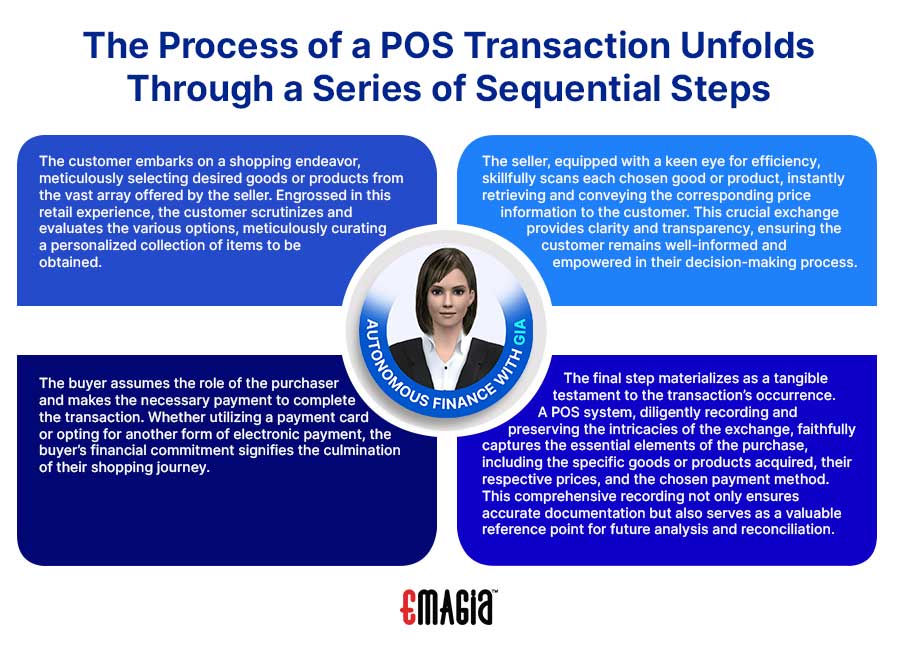
The process of a POS transaction unfolds through a series of sequential steps, ensuring a seamless exchange between a customer and a seller.
- The customer embarks on a shopping endeavor, meticulously selecting desired goods or products from the vast array offered by the seller. Engrossed in this retail experience, the customer scrutinizes and evaluates the various options, meticulously curating a personalized collection of items to be obtained.
- The seller, equipped with a keen eye for efficiency, skillfully scans each chosen good or product, instantly retrieving and conveying the corresponding price information to the customer. This crucial exchange provides clarity and transparency, ensuring the customer remains well-informed and empowered in their decision-making process.
- The buyer assumes the role of the purchaser and makes the necessary payment to complete the transaction. Whether utilizing a payment card or opting for another form of electronic payment, the buyer’s financial commitment signifies the culmination of their shopping journey.
- The final step materializes as a tangible testament to the transaction’s occurrence. A POS system, diligently recording and preserving the intricacies of the exchange, faithfully captures the essential elements of the purchase, including the specific goods or products acquired, their respective prices, and the chosen payment method. This comprehensive recording not only ensures accurate documentation but also serves as a valuable reference point for future analysis and reconciliation.
Step-by-Step POS Transaction Workflow
Every POS transaction follows a structured workflow. First, items are scanned or selected. Prices and totals calculate automatically.
Next, payment authorization occurs via card networks. Funds transfer securely to the merchant account.
Finally, receipts generate, and inventory updates in real-time. This workflow minimizes errors and speeds up service.
Technical Flow of a POS Payment
When a card swipes, the POS terminal sends data to the acquirer bank. It then routes to the card issuer for approval.
Approval returns in seconds. The system confirms the transaction type POS as successful or declined.
This backend process ensures security through encryption and tokenization standards.
Key Components of a POS Payment System
A POS payment system includes hardware like terminals and software for processing. Cash drawers and printers complete the setup.
Modern systems connect to cloud servers for data sync across locations. This supports multi-store operations seamlessly.
What are the Point of Sale (POS) Features
In the course of its operations, a business accumulated a wealth of data encompassing various elements such as sales, returns, customer loyalty, popular products, seasonal preferences, underperforming items, reorder thresholds, low inventory levels, exceptional employees, and the frequency of returning customers.
This valuable data can be effectively compiled and organized through the utilization of an efficient POS system. By leveraging this compiled data, management gains the necessary insights to make pivotal decisions pertaining to inventory management, marketing strategies, employee allocation, and nurturing customer relationships.
An efficient POS system or software plays a vital role in seamlessly integrating the data from various aspects of a business. This integration is particularly significant for a brand that operates multiple stores across different cities, as it enables the compilation of comprehensive data from both the stores and warehouses.
The POS terminal is comprised of essential components including a server, desktop, credit/debit card swiper, cash drawer, and a bill printer.
The POST installation company takes charge of configuring your system, encompassing both the hardware and software components.
With the advent of mobile or tablet point-of-sale POS systems, the ability to make payments for purchases within a store or restaurant extends beyond conventional wire setups. This newfound flexibility allows customers to settle their bills anywhere within the establishment without being constrained by physical wiring.
Advanced POS Features in 2026
Today’s POS systems offer inventory tracking and CRM integration. They analyze sales trends for predictive restocking.
Contactless payments and biometric verification enhance security. Loyalty program automation boosts retention.
POS System Definition and Capabilities
POS system definition covers hardware, software, and networks for transaction handling. It processes payments and manages operations.
Key capabilities include real-time reporting and multi-payment support. This makes it essential for what is POS in business contexts.
What are the Point of Sale (POS) Examples
POS systems are prevalent in various real scenarios, as exemplified by our everyday experiences. For instance, when making an online shopping order on platforms like Amazon, the utilization of POS software enables us to securely and conveniently complete our purchases.
With the increasing adoption of cashless payment methods and the transformative impact of the Covid-19 pandemic, the global electronic point of sale (POS) market is projected to witness substantial growth.
Point of sale POS systems is commonly observed in various hospitality establishments such as cages, bars, and hotels. These establishments often utilize POS setups not only as payment counters for billing purposes but also as cloud-hosted POS software solutions like Toast POS.
Numerous merchants offer the option of POS financing, particularly when purchasing high-value items like diamond rings. POS financing allows customers to conveniently split their payments into manageable installments. Notably, Forbes highlights Affirm, Afterpay, and Klarna as well-regarded sources of POS financing, offering flexibility and convenience to consumers seeking alternative payment solutions.
Real-World POS Transaction Examples
Consider a coffee shop using mobile POS. Customers pay via app, and the system updates inventory instantly.
In grocery stores, self-checkout kiosks handle high-volume POS transactions efficiently.
Common Use Cases for POS Transactions
Retail stores use POS for daily sales. Restaurants apply it for table-side billing.
E-commerce platforms integrate online POS terminals for seamless checkouts.
What are the Different Types of Point of Sale (POS) Transactions?
Online POS transactions refer to the act of a buyer acquiring goods or services through online platforms. For instance, a buyer who is logged into the Amazon app may select specific jewelry items for purchase. Upon completing the payment using a card or digital wallet, the POS transaction is duly recorded.
Offline POS transactions occur when a buyer physically visits a store to make a purchase of goods. Unlike online transactions, the buyer and seller engage in face-to-face interaction, and the payment is made directly in cash at the time of the transaction. This instantaneous exchange allows the seller to receive the cash immediately, eliminating the need for any further processing or waiting periods.
Return of Product: There are instances where a buyer may desire to return a product due to concerns regarding its quality or other related issues. In such cases, a request for reversal is initiated and forwarded to the card-issuing bank. Depending on the circumstances, the reversal of payment can be either partial or complete, depending on the specific terms and conditions set forth by the bank and the nature of the return request.
POS Transaction Types Explained
Transaction type POS includes sales, refunds, and voids. Each has unique processing rules.
POS transaction type meaning varies by context, like credit or debit authorization.
Online POS Transactions
Online POS transactions use virtual terminals. They support digital wallets like Apple Pay.
Security features like 3D Secure prevent fraud in these digital exchanges.
Offline POS Transactions
Offline POS transactions rely on local storage if networks fail. They sync later.
Cash payments define many offline scenarios, providing immediate liquidity.
Mobile and Contactless POS
Mobile POS uses smartphones for payments anywhere. Contactless taps speed up lines.
These types dominate post-pandemic retail trends.
RT POS and Batch Processing
RT POS means real-time processing for instant approvals. Batch processes settle at end-of-day.
Choosing depends on business volume and risk tolerance.
Point of Sale Payment Methods
Common POS payment methods include credit cards, debit cards, and mobile wallets. Cash remains viable for small transactions.
Point of sale payment options evolve with NFC tech for taps and QR codes.
What is POS Payment Meaning?
POS payment meaning is the act of tendering funds at purchase point. It finalizes the sale securely.
From swipes to digital transfers, it ensures merchant compensation.
Debit Card POS Transactions
Debit card POS meaning involves direct bank withdrawals. Funds deduct immediately from accounts.
POS debit means quick access to cash balances without credit risk.
Credit Card POS Processing
Point of sale credit card transactions authorize holds first. Merchants settle funds later.
What is POS credit mean? It’s deferred payment with interest potential.
POS Payment Processing Steps
POS payment processing starts with reader capture. Data encrypts and routes to processors.
Issuers approve or decline based on limits and fraud checks.
How Point of Sale Systems Work Technically
Point of sale systems work by integrating hardware with payment gateways. They communicate via APIs.
Cloud-based models sync data across devices for unified views.
POS on Bank Statements
POS on a bank statement appears as merchant names or codes. It indicates purchase locations.
What does POS on a bank statement mean? It’s proof of electronic spending.
Bank POS Meaning
Bank POS meaning refers to terminal networks banks support. They facilitate merchant acquiring.
POS in bank statement tracks transaction history for reconciliation.
What Does a POS Machine Do?
A POS machine reads cards, processes payments, and prints receipts. About POS machine includes its role in data capture.
It handles what is POS transaction in debit card scenarios efficiently.
POS Kassa and Global Variations
POS kassa is the term for checkout systems in some regions. Functionality remains universal.
POS Purchase Meaning and Definition
POS purchase meaning is buying at the sale point. What is a POS purchase captures immediate exchanges.
Point of sale purchase definition emphasizes location-specific transactions.
Challenges in POS Transactions
Common issues include network downtimes and fraud attempts. Hardware failures disrupt peaks.
Compliance with PCI DSS adds complexity for security.
Mitigating POS Transaction Failures
What happens when a POS transaction fails? Systems log errors for retry.
Backup offline modes maintain operations during outages.
What are the Point Of Sale (POS) Advantages
By encompassing sales and inventory tracking functionalities, this system offers valuable insights into your daily revenue. Not only does it enable you to monitor and analyze your sales performance, but it also provides timely information about stock levels, ensuring that you are aware of when to initiate the process of reordering inventory.
Through the analysis of customer, sales, employee, and inventory data, this system generates comprehensive reports. These reports serve as valuable tools for decision-making and strategy development. For instance, they allow businesses to identify their highest-selling items, enabling effective marketing strategies to further drive sales and ensure that these popular items remain adequately stocked to meet customer demand.
This system proves advantages in enhancing customer communication and cultivating strong customer relationships. By maintaining up-to-date information on regular buyers, businesses can leverage this data to establish loyalty programs.
The automation provided by this system streamlines and expedites the management of company paperwork, resulting in significant time savings. Additionally, this automation helps minimizes wattage and reduces costs associated with manual paperwork, contributing to overall cost savings for the company.
Quantitative Benefits and KPIs
POS advantages include 20-30% faster checkouts. Track KPIs like average transaction value and throughput.
Sales per square foot improves with data-driven stocking.
POS Metrics to Monitor
Key metrics: transaction volume, decline rates, average ticket size. Use for performance benchmarking.
- Transaction success rate: Aim for 99%+.
- Basket size: Measures upsell effectiveness.
- Refund ratio: Indicates product issues.
Comparisons: Traditional vs Modern POS
Traditional POS uses fixed terminals. Modern offers mobility and integrations.
Cloud POS scales better for SMBs, reducing upfront costs.
POS vs Cash Registers
Cash registers lack digital tracking. POS provides analytics and payment versatility.
Future Trends in POS Transactions
AI predicts demand from POS data. Blockchain secures cross-border payments.
Biometrics replace PINs for faster, safer auth. Voice commerce integrates with POS.
What is POS Sales in Emerging Tech?
POS sales evolve with AR try-ons influencing purchases. Metaverse stores use virtual POS.
How Emagia Enhances POS Transactions
Emagia’s platform integrates seamlessly with POS systems for automated order-to-cash processes. It captures point of sale data to streamline invoicing and payments.
Businesses gain real-time visibility into transactions across channels. This reduces disputes and accelerates cash flow.
Platform Capabilities
Emagia automates reconciliation of POS transactions with bank statements. AI detects anomalies in payment patterns.
Multi-entity support handles complex SMB operations globally.
Enterprise Use Cases
Retail chains use Emagia for centralized POS deposit tracking. It consolidates data from online and offline sales.
In hospitality, it manages split payments and financing options effortlessly.
Solving Real-World Challenges
Emagia resolves delayed POS payment matching. It cuts DSO by 40% through predictive collections.
Scalable for high-volume transaction pos environments, ensuring compliance and accuracy.
Conclusion on POS:
POS transactions have emerged as an indispensable component of modern commerce. With the ability to seamlessly process payment, capture vital transaction data, and facilitate efficient customer interactions, POS systems have transformed the way businesses operate. From traditional brick-and-mortar stores to e-commerce platforms, POS transactions provide convenience, security, and real-time insights into sales and inventory management.
Additionally, POS systems enable businesses to streamline operations, enhance customer experiences, and make informed decision based on valuable data analysis. As technology continues to advance, POS transactions will continue to evolve, shaping the future of commerce and further revolutionizing the way we buy and sell goods and services.
FAQs:
How Do I Record POS Transactions?
You should create an invoice voucher to record any transactions.
How is a POS Payment Processed?
The client should put their phone over the card terminal.
What is the definition of a POS Adjustment?
It is a refund of payment at a POS when clients give back purchased products.
What Happens When a POS Transaction Fails?
If the card is blocked or if there are network issues, a POS transaction can fail.
Can POS Transactions be Reversed?
Reversals can happen on POS transactions if there are errors in them.
What is a Point of Sale Transaction?
A point of sale transaction is the moment a customer pays for goods or services at the purchase location, processed via electronic systems.
What Does POS Mean on a Bank Statement?
POS on a bank statement means a point of sale purchase, showing electronic payment details including merchant and amount.
What is POS in Banking?
POS in banking refers to systems banks provide for merchants to accept card payments securely.
How Do Point of Sale Systems Work?
Point of sale systems scan items, process payments through networks, and update records in real-time.
What is a POS Machine?
A POS machine is a device that reads payment cards, authorizes transactions, and issues receipts.
What is POS Debit Meaning?
POS debit meaning is a direct deduction from a bank account during a point of sale purchase.
What are Common POS Payment Methods?
POS payment methods include credit/debit cards, mobile wallets, contactless taps, and cash.
What is Transaction Type POS?
Transaction type POS classifies electronic sales processed at checkout points.