
The Modernization Imperative
Most enterprise finance teams have automated pieces of their Order-to-Cash cycle. They’ve digitized invoicing, implemented payment portals, and deployed basic matching algorithms. Yet the Hackett Group’s 2025 research reveals a striking disconnect: $1.7 trillion remains trapped in excess working capital across the top 1,000 U.S. public companies, with an 18-day Days Sales Outstanding (DSO) gap between top and median performers.
$1.7T
Remains trapped in excess working capital across the top 1,000 U.S. public companies — Hackett Group, 2025
The reason: piecemeal automation creates islands of efficiency within an ocean of manual intervention. Each sub-process may be partially automated, but handoffs remain manual, exception handling remains human-dependent, and end-to-end intelligence is absent. Modernizing with agentic AI means replacing this fragmented approach with coordinated, goal-directed intelligence.
Step 1: Benchmark Your Current State Against 4 Critical Metrics
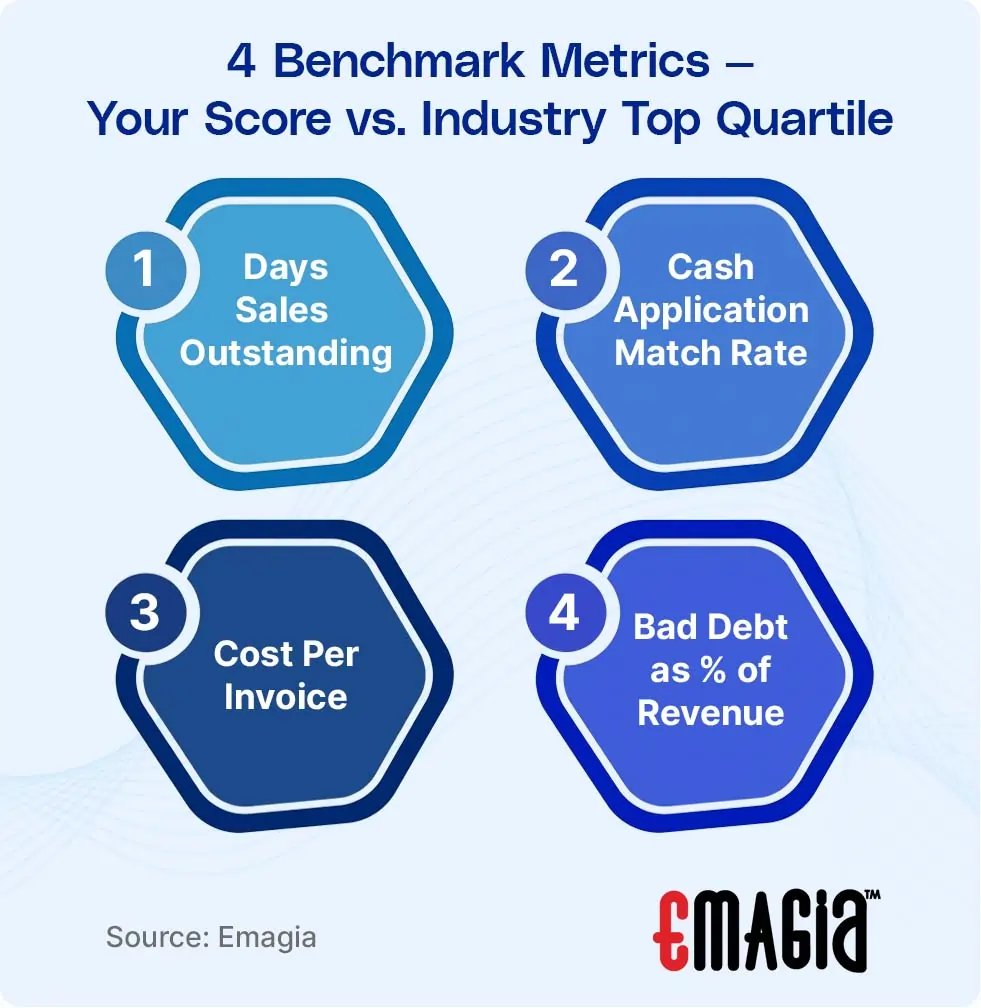
Metric 1:
Days Sales Outstanding.
Hackett Group reports top-quartile performers achieve DSO around 25 days; median sits near 43.5 days. An 18-day gap at enterprise scale represents hundreds of millions in trapped cash.
Metric 2:
Cash Application Match Rate.
Manual processes produce 50–70% match rates. AI-powered systems achieve 90–95%+ Straight-Through Processing (STP). Every percentage point translates directly to faster cash availability.
Metric 3:
Cost Per Invoice.
American Productivity and Quality Center (APQC) data shows a nearly 6x spread—top performers at $1.77, bottom performers at $10.89. If your cost exceeds $5, significant automation headroom exists.
Metric 4:
Bad Debt as % of Revenue.
Fortune 1000 analysis found average bad debt-to-sales of 1.49% in 2023, with a concerning 25.6% Compound Annual Growth Rate (CAGR). Best-in-class target below 0.5%.
Emagia’s Value Assessment Service benchmarks your Order-to-Cash against industry peers Order-to-Cash Value Assessment
Step 2: Prioritize High-Impact Agent Deployment
Not every Order-to-Cash function benefits equally. Prioritize where exception volume is highest, manual intervention cost is greatest, and learning data is most abundant:
Priority 1: Cash Application — highest Return on Investment (ROI) starting point. High transaction volumes and frequent mismatches create an ideal environment for AI agents.
Priority 2: Collections — greatest productivity multiplier. Agentic prioritization eliminates time wasted chasing self-curing accounts.
Priority 3: Deductions — outsized returns for retail/Consumer Packaged Goods (CPG). Manual resolution averages 30–70 days per line item.
Step 3: Integrate Across the Order-to-Cash Lifecycle
Full value emerges when agents communicate across functions. A credit agent detecting deteriorating payment patterns should trigger adjusted collection strategies. A cash application agent identifying systematic short payments should flag patterns for deduction analysis. This cross-functional intelligence separates modernization from point-solution automation.
Step 4: Establish Governance and Escalation Frameworks
Gartner warns that over 40% of agentic AI projects will be cancelled by the end of 2027—largely due to governance failures. Define clear escalation thresholds, monitor agent decision quality (not just outcomes), and maintain human-in-the-loop for high-stakes decisions.
Step 5: Measure Outcomes, Not Activity
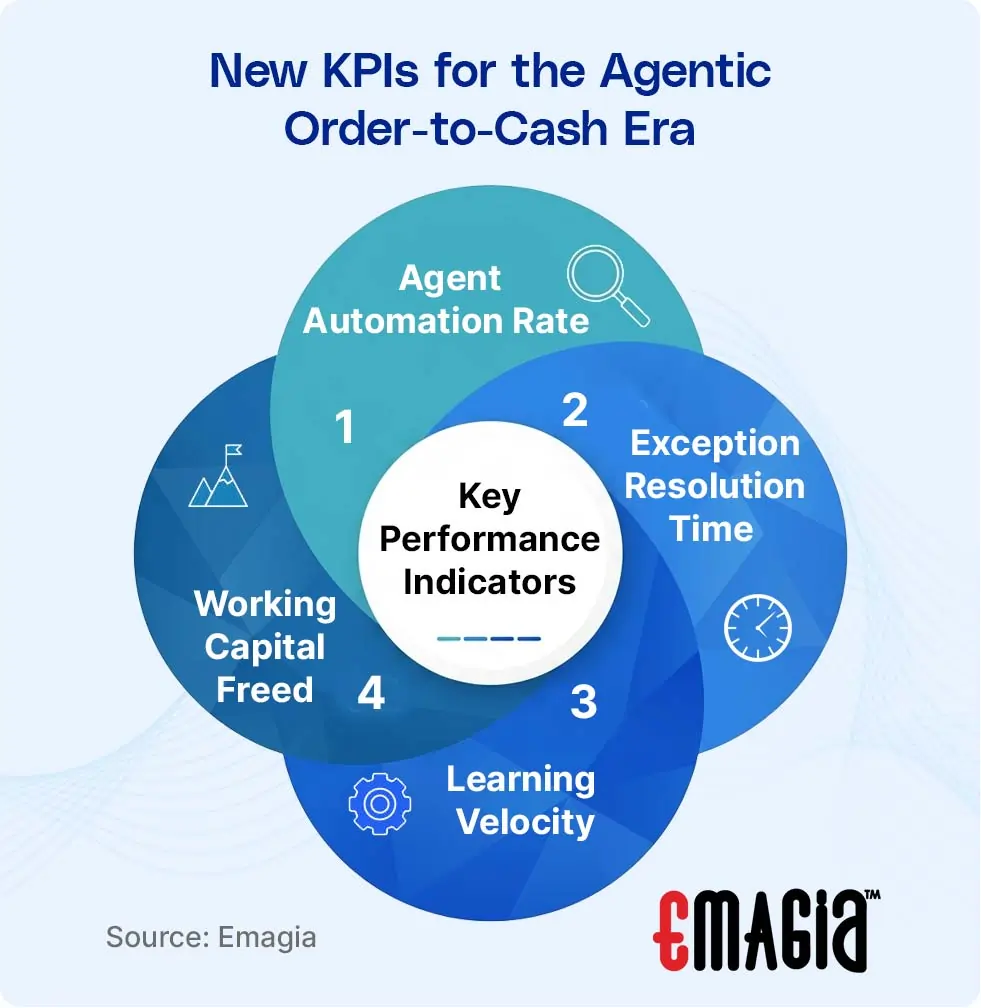
Key Performance Indicator (KPI) 1: Agent Automation Rate — percentage of transactions resolved without human intervention.
KPI 2: Exception Resolution Time — how quickly agents handle edge cases.
KPI 3: Learning Velocity — rate of accuracy improvement over time.
KPI 4: Working Capital Freed — actual cash released through faster processing.
Digital World Class organizations operate at 45% lower cost, deliver 74% faster executive insights, and spend 68% more time on forward-looking analysis.
— The Hackett Group
How Emagia Helps: The Modernization Engine
Emagia’s GIA Agent Orchestration Studio is the centralized command center for deploying, managing, and coordinating AI agents across the entire Order-to-Cash cycle:
No-code agent configuration enables finance teams—not IT departments—to set agent behaviors, escalation thresholds, and performance targets.
Pre-built integrations with 120+ financial systems and 170+ banks accelerate Step 3 (cross-lifecycle integration) from months to weeks.
Real-time performance dashboards track all four KPIs from Step 5, providing the measurement infrastructure that modernization requires.
ConvaTec’s transformation exemplifies the full framework: auto-apply rates rose from single digits to 90%+, on-time payments improved from <60% to 78–92%, and collections Full-Time Equivalent (FTE) dropped 45%—earning Hackett Group “world-class” designation.
See how global enterprises modernize Order-to-Cash with Emagia’s Autonomous Finance Platform Autonomous Finance Platform
3 Key Takeaways
- Modernization is a 5-step journey: Benchmark → Prioritize → Integrate → Govern → Measure. Skipping steps leads to the project cancellations Gartner warns about.
- Cash application is the highest-ROI starting point; collections delivers the greatest productivity multiplier across many industries, deductions offers outsized returns for retail/CPG.
- Digital World Class organizations—the destination of this framework—operate at 45% lower cost with 74% faster insights.