
Agentic AI for Order-to-Cash automation refers to autonomous AI agents that analyze financial data, make decisions, and execute order-to-cash processes such as credit evaluation, collections prioritization, dispute resolution, and cash application without human intervention. These intelligent agents continuously learn from enterprise data to optimize cash flow, reduce Days Sales Outstanding (DSO), and improve accounts receivable efficiency.
How the next evolution of enterprise AI is redefining what’s possible in credit, receivables, collections and cash applications
The Order-to-Cash Problem That Automation Alone Can’t Solve
Enterprise finance teams have spent the better part of a decade automating order-to-cash workflows. They’ve implemented rules-based engines for invoicing, deployed optical character recognition for remittance processing, and built dashboards to track Days Sales Outstanding. And yet, according to the Hackett Group’s 2025 U.S. Working Capital Survey, $600 billion remains trapped in accounts receivable across the largest 1,000 U.S. public companies—a 54% increase since 2018.
$600B
Trapped in accounts receivable across the largest 1,000 U.S. public companies — Hackett Group, 2025
The gap between automation’s promise and actual working capital performance points to a structural limitation: traditional automation follows predefined rules. It cannot adapt to ambiguity, learn from outcomes, or make judgment calls when exceptions arise. For enterprises managing multi-entity structures across dozens of countries, this rigidity is expensive.
Defining Agentic AI: Beyond Rules, Beyond Assistance
Gartner defines an AI agent as a system that can perceive its environment, reason about goals, take autonomous action, and learn from outcomes—without requiring step-by-step human instruction.
The distinction from prior technologies is fundamental:
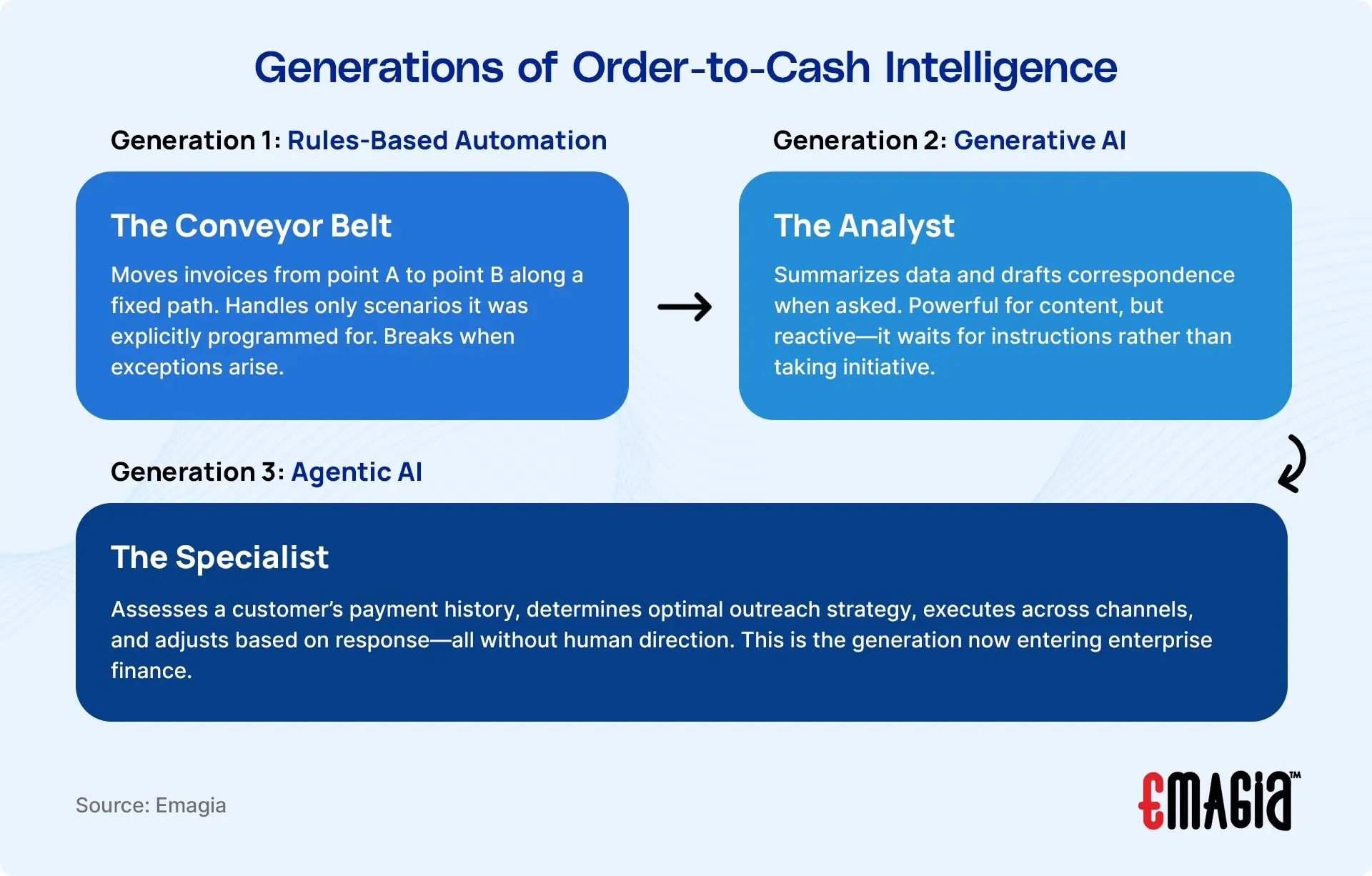
Generation 1: Rules-Based Automation (the Conveyor Belt). Moves invoices from point A to point B along a fixed path. Handles only scenarios it was explicitly programmed for. Breaks when exceptions arise.
Generation 2: Generative AI (the Analyst). Summarizes data and drafts correspondence when asked. Powerful for content, but reactive—it waits for instructions rather than taking initiative.
Generation 3: Agentic AI (the Specialist). Assesses a customer’s payment history, determines optimal outreach strategy, executes across channels, and adjusts based on response—all without human direction. This is the generation now entering enterprise finance.
40%
of enterprise applications will embed task-specific AI agents by end of 2026, up from < 5% in 2025 — Gartner
By 2028, Gartner expects 33% of enterprise software to include agentic capabilities, with at least 15% of daily work decisions made autonomously.
The 6 Agent Functions Inside Order-to-Cash
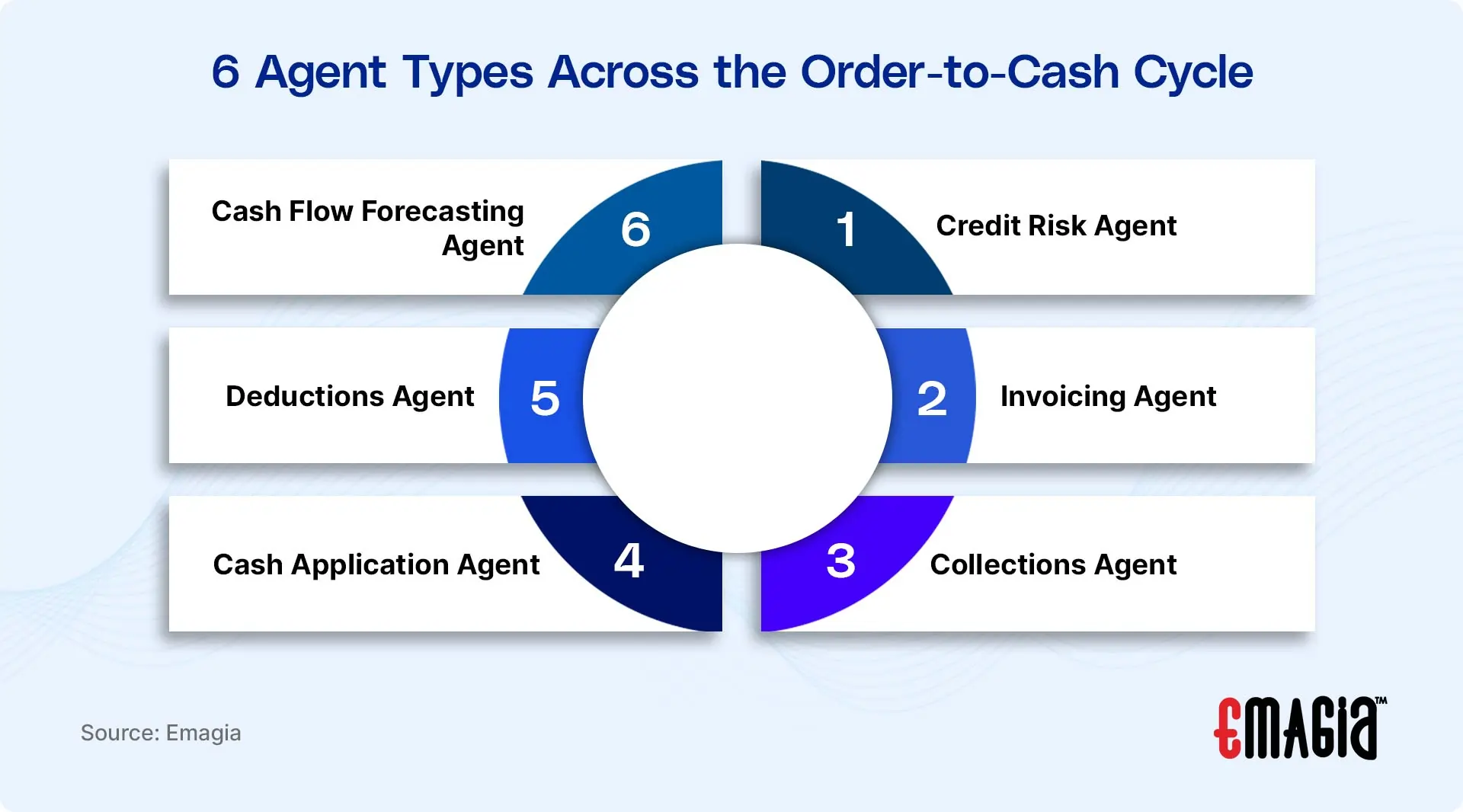
Agent 1: Credit Risk. Continuously monitors customer risk by integrating real-time financial data, payment behavior, and macroeconomic signals. Autonomously adjusts credit limits and flags deteriorating accounts.
Agent 2: Invoicing. Validates invoice data against purchase orders, contracts, and delivery confirmations before submission—reducing the errors that cause 61% of late payments (Forbes).
Agent 3: Collections. Segments customers by payment probability, determines optimal contact timing and channel, and autonomously escalates based on response patterns. Delivers up to 50% increase in collector productivity.
Agent 4: Cash Application. Parses remittance data across check, Automated Clearing House (ACH), wire, and electronic formats, matching payments at 90–95%+ straight-through processing rates. Emagia’s cash application engine achieves greater than 95% Straight-Through Processing (STP) rates across complex global operations, processing billions in receivables across 44+ countries.
Agent 5: Deductions. Classifies deductions by type, cross-references promotional agreements and proof-of-delivery, and auto-resolves valid claims—reducing resolution cycles from the industry-standard 30–70 days.
Agent 6: Cash Flow Forecasting. Continuously updates predictions based on real-time payment behavior, dispute resolutions, and seasonal patterns.
Why “Agents” Instead of More Automation?
The distinction matters because it changes the economics of Order-to-Cash at scale. American Productivity and Quality Center (APQC) benchmarking shows top performers process invoices at $1.77 each while bottom performers spend $10.89—a nearly 6x gap. Traditional automation narrows this gap but plateaus. Agentic AI breaks through because agents improve with experience.
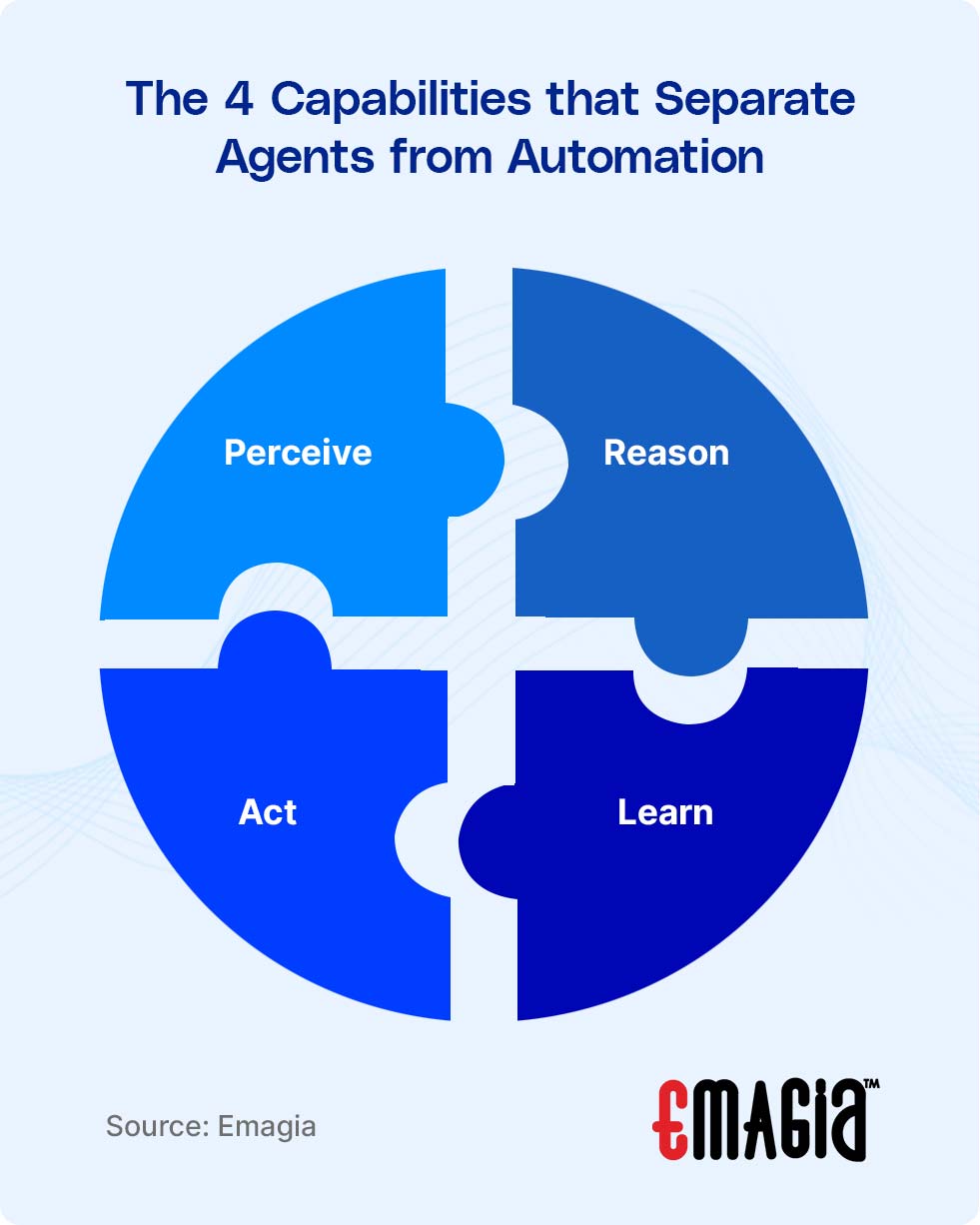
Four capabilities separate agents from rules:
Perceive: Agents ingest data from multiple sources simultaneously—ERPs, banks, customer portals, external credit databases—building a comprehensive picture of each transaction.
Reason: Rather than following IF/THEN logic, agents weigh probabilities, consider context, and select the optimal course of action for each unique situation.
Act: Agents execute decisions autonomously—applying payments, sending collection notices, adjusting credit limits—without waiting for human approval on routine actions.
Learn: Every outcome feeds back into the agent’s decision model. Match accuracy improves. Collection strategies refine. Credit assessments sharpen.
87% of CFOs at $1B+ companies expect AI to be extremely or very important to finance in 2026, with 54% citing AI agent integration as their top transformation priority. — Deloitte Q4 2025 CFO Signals
How Emagia Helps: Purpose-Built Agents for Enterprise Order-to-Cash
Emagia’s GIA Agent Orchestration Studio provides the infrastructure for deploying all six agent types across the Order-to-Cash cycle. The platform offers 150+ pre-built finance sub-agents purpose-designed for enterprise Order-to-Cash workflows—not generic AI adapted for finance.
A no-code interface that enables finance teams (not IT) to configure agent behaviors, escalation thresholds, and approval workflows.
Enterprise-grade data security—customer data stays private, never transmitted to public AI clouds.
Integration with 120+ financial systems, 170+ banks, and 135+ currencies—the data foundation agents require for global operations.
Emagia is recognized as an Everest Group Leader (2025) and Gartner Visionary in the Order-to-Cash space, with 15+ years of enterprise transformation experience.
Explore how Emagia’s AI agents transform Order-to-Cash operations for global enterprises: Explore Emagia AI Platform
3 Key Takeaways
- Agentic AI is not incremental automation—it is a structural shift. The technology perceives, reasons, acts, and learns autonomously.
- With $600 billion trapped in Accounts Receivable (AR) and 87% of CFOs prioritizing AI for finance, the window for competitive advantage through early adoption is narrowing.
- The enterprises that deploy purpose-built Order-to-Cash agents now will compound efficiency gains; those that wait will face an increasingly expensive status quo.