The fastest way for a CFO to reduce DSO is to get perfect consistency in follow-up using autonomous AI collections agents. Organizations that follow up with every delinquent account on a prescribed schedule with multiple follow-ups realize a 15-25% reduction in DSO within 90 days. For a $1B revenue enterprise, that’s a $40M+ working capital difference. Yet most organizations treat DSO reduction as a process optimization problem when it’s actually a collections execution problem.
What Is DSO and Why It’s the Wrong Problem to Optimize
DSO (Days Sales Outstanding) is the average number of days it takes to convert an invoice into cash after a sale. It is one of the key metrics tracked by credit and collection leaders. A higher DSO means that the company takes too long to collect cash, which can impact its working capital. Whereas a low DSO means, a company is quick to collect cash and add money to its revenue. On the other hand, if a company has a 50-day DSO, it takes twice as long to convert receivables in comparison to a company with a 25-day DSO. This gap alone is a $40M+ difference in working capital for a $1B revenue business.
Most financial leaders feel that collections repesents a process optimization problem. But in reality, it is a problem directly tied to consistent follow-ups done by collections teams.
Why Consistent Outreach Reduces DSO:
Traditional credit and collections automation is built around volume—connect with more accounts, send multiple reminders, and make more calls. Whereas modern-day autonomous collections optimize for something more radical:
McKinsey’s latest research on DSO benchmarks shows top quartile performers don’t necessarily call on more accounts than average performers. They call on accounts faster, more consistently, and more effectively. This model ensures consistent follow-up on customers after 30 days, documented payment promises, and automatic follow-ups. Dispute resolution is faster, and cash comes in on time.
This consistency is achieved by using autonomous collections agents driven by agentic AI. It helps scale up and ensure frictionless operations as these agents:
- Work 24/7 across all time zones
- Follow up periodically without fail no matter the time or workload
- Handle objections and negotiate payment plans on the go
- Capture results with 100% documentation
Result: Enterprises see a 15–25% DSO reduction within 90 days—not from working harder, but from working with perfect consistency.
The Research: What Actually Drives DSO Reduction
APQC research on DSO reduction strategies suggests that the single biggest factor in DSO improvement is follow-up consistency, not outreach volume or tactic aggressiveness.
- The top quartile of organizations follows up on each delinquent account on a predictable schedule: day 30, 45, 60, 75, and 90.
- Average organizations follow up haphazardly—some accounts are contacted weekly, others monthly, depending on the collector’s workload.
This inconsistency compounds itself. A customer that is 3 weeks past due with no communication may pay on day 60. The same customer, called consistently from day 30, may pay on day 35—a 25-day improvement that, multiplied across thousands of accounts, becomes a massive DSO swing.
Gartner research on collections automation showed that organizations that implemented perfect follow-up consistency (weekly contact for all delinquent accounts) saw an average DSO improvement of 12-18 days.
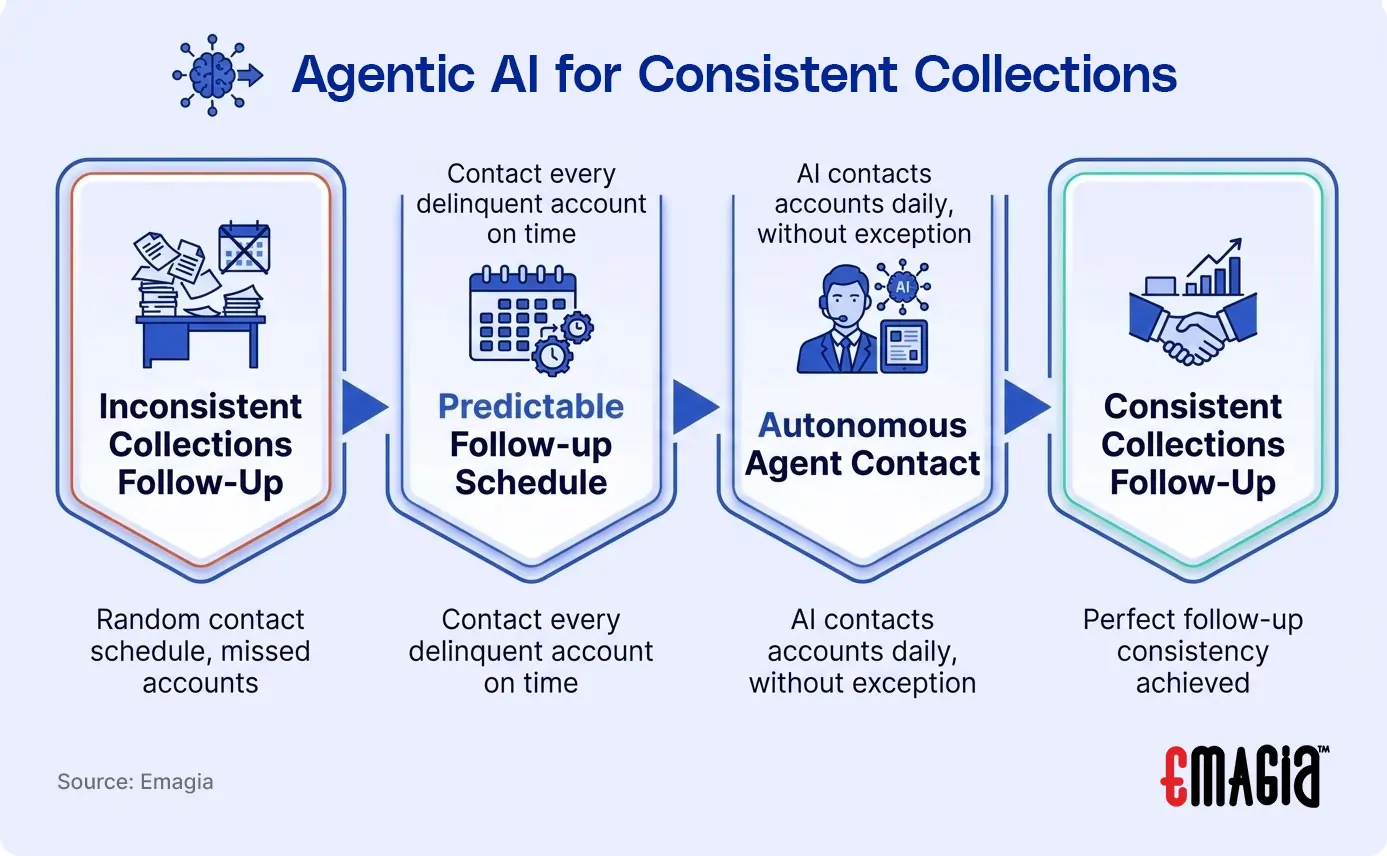
However, ensuring manual follow-up is done for all accounts is nearly impossible since workload of collectors may vary week to week. This leads to accounts getting missed and follow-ups getting slipped. But, with autonomous collections agents, collectors can eliminate this variability entirely, contacting every delinquent account on schedule, every day, without exception.
Consistent vs. Inconsistent Collections Follow-Up by Collectors
Flawless Execution: How AI Agents Achieve 100% Follow-Up Consistency
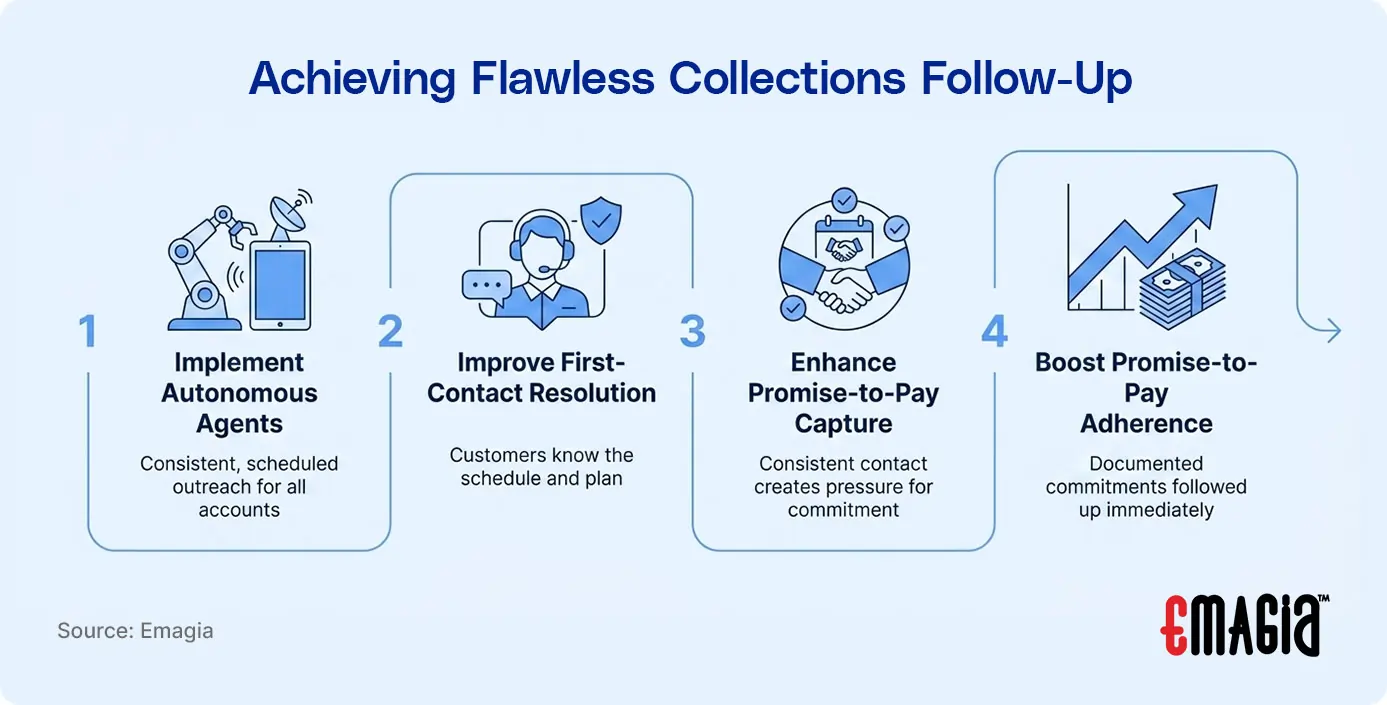
Autonomous credit and collections agents work on one simple premise: each delinquent account receives consistent, scheduled outreach. 30 days past due contact. Contact again 45 days. Again, 60 days— not aggression, consistency. Customers learn the schedule and plan accordingly, and payment is faster because of it.
APQC benchmarks show that organizations that use autonomous collections for perfect follow-up consistency have:
- Increase in first contact resolution by 25-35%
- 35-45% improvement in capturing promise to pay
- 40-50% improvement in promise-to-pay adherence
- 15-25% DSO reduction (sum of above)
That 15-25% reduction is $40-$65M of working capital for a company with $1B in revenue and a DSO of 50 days.
Gia Collect™: AI Super Agent for Autonomous Collections
Gia Collect™ is an AI outbound calling agent that works your priority (Alpha) accounts — every one, every time—without adding headcount. It is purpose-built to drive DSO reduction through perfect follow-up consistency:
- Contacts every priority account on a configurable schedule (day 30, 45, 60, etc.) without exception.
- Conducts natural, compliant collections conversations at each touchpoint in a human-like voice. The agent handles the conversation naturally—answering invoice questions, negotiating, capturing promises to pay, and logging disputes in real time. Captures every promise-to-pay and automatically follows up on the committed date.
- Maintains 100% documentation of all interactions for compliance and dispute resolution.
Organizations using Gia Collect report 15–25% DSO reduction within 90 days, 35–45% improvement in promise-to-pay capture, and 40–50% improvement in promise adherence — all from perfect follow-up consistency enabled by autonomous collections agents.
DSO improves not because collections got more aggressive, but because it got more consistent. The collections team becomes a cash-generation machine.
This is built for CFOs, VPs of Finance, Controllers, Credit & Collections Leaders, and GCC Finance Leaders looking to convert AR execution gaps into working capital without adding headcount.
FAQs
What is the fastest way for a CFO to reduce DSO?
The fastest path is achieving perfect follow-up consistency. Using AI agents to ensure every customer is contacted immediately and consistently upon delinquency can reduce DSO by 15–25% within the first 90 days.
Why does follow-up consistency impact cash flow more than outreach volume?
Customers prioritize payments to vendors who are the most consistent. Sporadic, manual outreach causes customers to delay payment. Predictable, persistent AI-driven outreach moves a vendor to the “top of the pile” for payment processing.
How does agentic AI provide 100% coverage of the AR ledger?
Unlike human teams, AI agents don’t get tired or overwhelmed. They audit the entire ledger every 24 hours and trigger outreach for every account that hits a pre-configured threshold, preventing “small” accounts from aggregating into a large DSO problem.
Can a CFO trust the financial data generated by AI agents?
Yes, if the AI is deterministic. Deterministic AI uses hard financial logic and raw ERP data to generate reports, ensuring every DSO calculation and recovery forecast is mathematically accurate and audit-ready.
What is the long-term impact of agentic AI on O2C liquidity?
Long-term, agentic AI creates a cash-generation machine: it permanently lowers baseline DSO, stabilizes monthly cash inflows, and gives the CFO the predictable liquidity needed for strategic reinvestment.