Managing global AR is complex. Learn how autonomous Order-to-Cash management streamlines multi-currency accounts and intercompany exclusions for faster cash.
Managing receivables across global entities is like solving a puzzle with pieces that constantly shift value. An invoice due in USD today is worth a different amount in EUR, GBP, or CNY tomorrow. Exchange rates fluctuate. Regional payment behaviors vary. Tax implications differ by jurisdiction. And buried underneath all this complexity is cash that your organization desperately needs—but can’t see clearly enough to recover.
For global CFOs, this isn’t a theoretical problem. It’s a liquidity crisis waiting to happen. And most organizations don’t realize how much trapped cash is hidden in their multi-currency, multi-entity receivables until it’s too late.
The Visibility Crisis: Why Disconnected O2C Data Masks Financial Risk
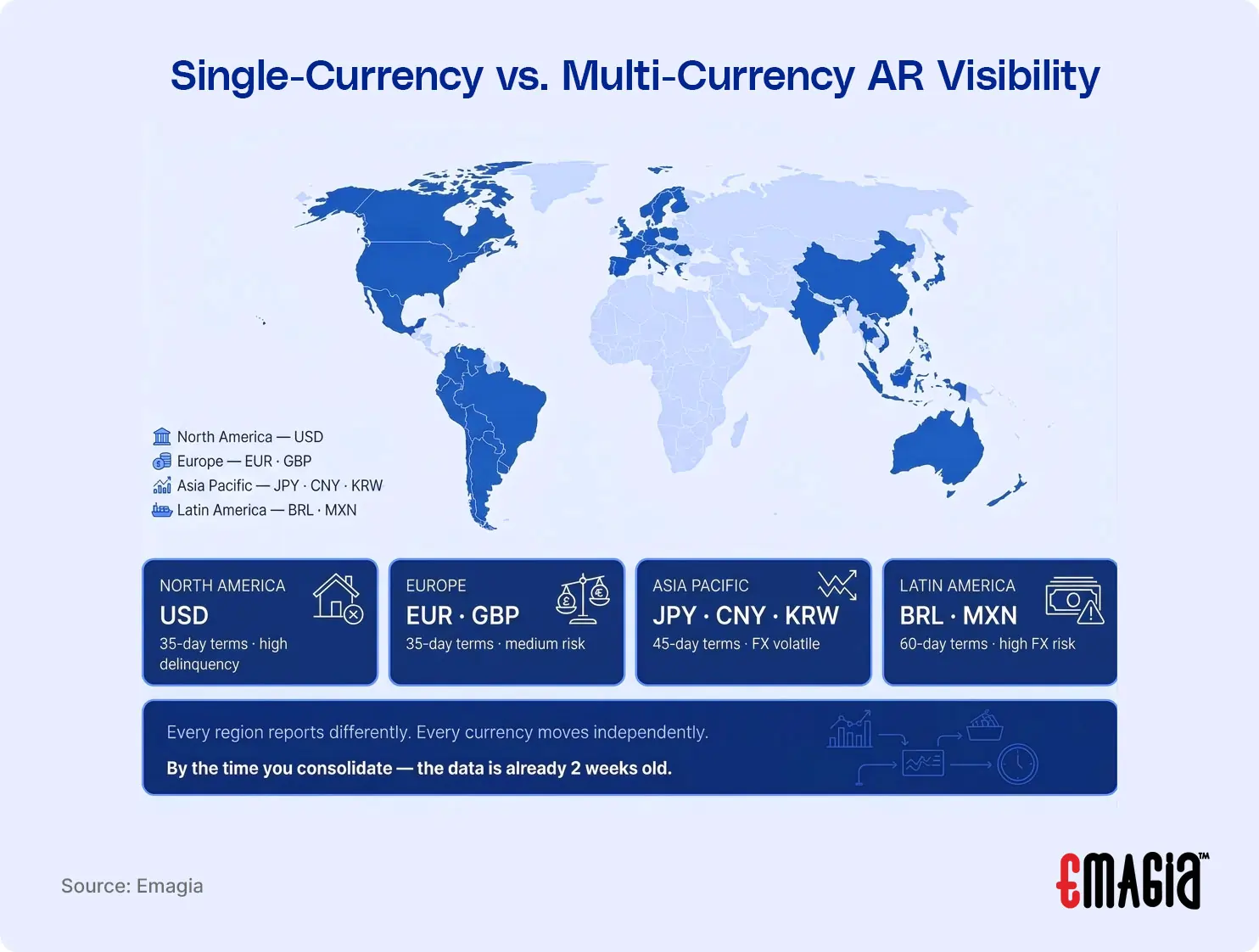
A global organization with operations in 15 countries faces a fundamental challenge: consolidated AR reporting is nearly impossible without manual, error-prone processes. Each region reports in local currency. Intercompany transactions obscure true third-party exposure. Exchange rate fluctuations create perceived aging that’s actually just currency movement. By the time you consolidate everything into a single view, the data is already stale.
McKinsey research on working capital optimization for global enterprises found that organizations managing multi-currency receivables spend an estimated 30–40% more time on AR consolidation than single-currency peers—yet they have 20–30% less visibility into true cash position. This creates a paradox: the more complex your AR environment, the less you actually understand it.
The cost? Deloitte’s research on global cash flow management found that multi-currency organizations leave an average $50–$150M in unrecovered cash sitting in aging buckets—simply because they can’t see which accounts represent true recovery opportunity versus which are just currency noise.
Eliminating Manual Reporting with Autonomous, Real-Time AR Consolidation
Consider a multinational with $200M in global receivables across 8 currencies and 5 business units:
- Legal entity consolidation problem: $50M is intercompany balances (internal transfers between BUs). These inflate reported delinquency but don’t represent real cash recovery opportunity.
- Currency impact problem: $30M is in emerging markets with volatile exchange rates. A 5% currency move creates $1.5M in “apparent aging” that’s not real aging.
- Regional payment behavior problem: Latin America averages 60-day payment cycles. Asia averages 45 days. Europe averages 35 days. Yet your aging report treats all regions equally.
- True third-party exposure: Only $120M is actually recoverable from real customers. But your leadership doesn’t know this—they see the $200M headline and assume that’s the number to manage.
Traditional approach: Manual audit. Spreadsheet consolidation. Month-end reporting. By the time you have clarity, accounts have aged further.
Modern approach: Deterministic AR intelligence that automatically consolidates global data, excludes intercompany balances, and normalizes for regional behavior—delivering true third-party past-due in real time.
This is the foundation of accelerating cash flow across global organizations: seeing your true receivables position, not an inflated shadow of it.
Clean Ledger Strategy: The Role of Automated Intercompany Exclusion
Here’s a scenario that plays out constantly in global finance: Your CFO reports to the board that you have $50M in past-due receivables. The board is concerned. Collections teams are mobilized. Months later, you realize that $30M of that “past-due” was actually intercompany transfers between subsidiaries—internal balance sheet transfers, not real customer delinquency.
The impact? Your board has an inflated view of collections risk. Your teams have wasted effort on internal accounts that don’t generate cash. Your forecast of “cash recovery opportunity” was fiction from day one.
Intelligent intercompany segregation solves this automatically. The system analyzes your customer master data and payment patterns, identifies which accounts are internal (subsidiary-to-subsidiary), and excludes them from your reported past-due. Leadership sees only true third-party exposure.
APQC benchmarks show that organizations implementing automated intercompany exclusion see:
- 15–25% reduction in reported past-due (removing the noise)
- More accurate DSO calculation (since you’re not counting internal transfers)
- Better cash forecasting (because your baseline numbers are real)
- Faster board reporting (no manual audit required)
For a global organization with $200M in receivables and $50M in intercompany transfers, automated exclusion reveals that your true third-party past-due is $35M, not $50M—a 30% difference in how you understand your cash position.
Empowering Shared Services with Single-Pane-of-Glass O2C Intelligence
Shared Services heads managing global AR consolidation face a unique challenge: they need a single source of truth that works across regions, currencies, and business units—but they can’t afford the massive ERP project or months of manual consolidation.
Real-time AR intelligence powered by agentic AI changes this. The moment a customer pays in one currency, the system updates your consolidated view. The moment an account ages past threshold in one region, your team knows. The moment intercompany balances shift, your reported third-party exposure adjusts automatically.
Organizations implementing autonomous O2C intelligence across global entities see:
- 50–70% reduction in AR consolidation time (from weeks to hours)
- 20–30% improvement in cash forecasting accuracy (from real data, not estimates)
- $10–$25M faster cash unlock (from better visibility into true recovery opportunity)
- Real-time DSO visibility (no more month-end surprises)
McKinsey research found that global organizations with integrated, real-time cash visibility across all entities achieved an average $20–$40M improvement in liquidity within 12 months—driven entirely by visibility, not operational changes.
Breaking the Consolidation Bottleneck to Shorten the Cash Conversion Cycle
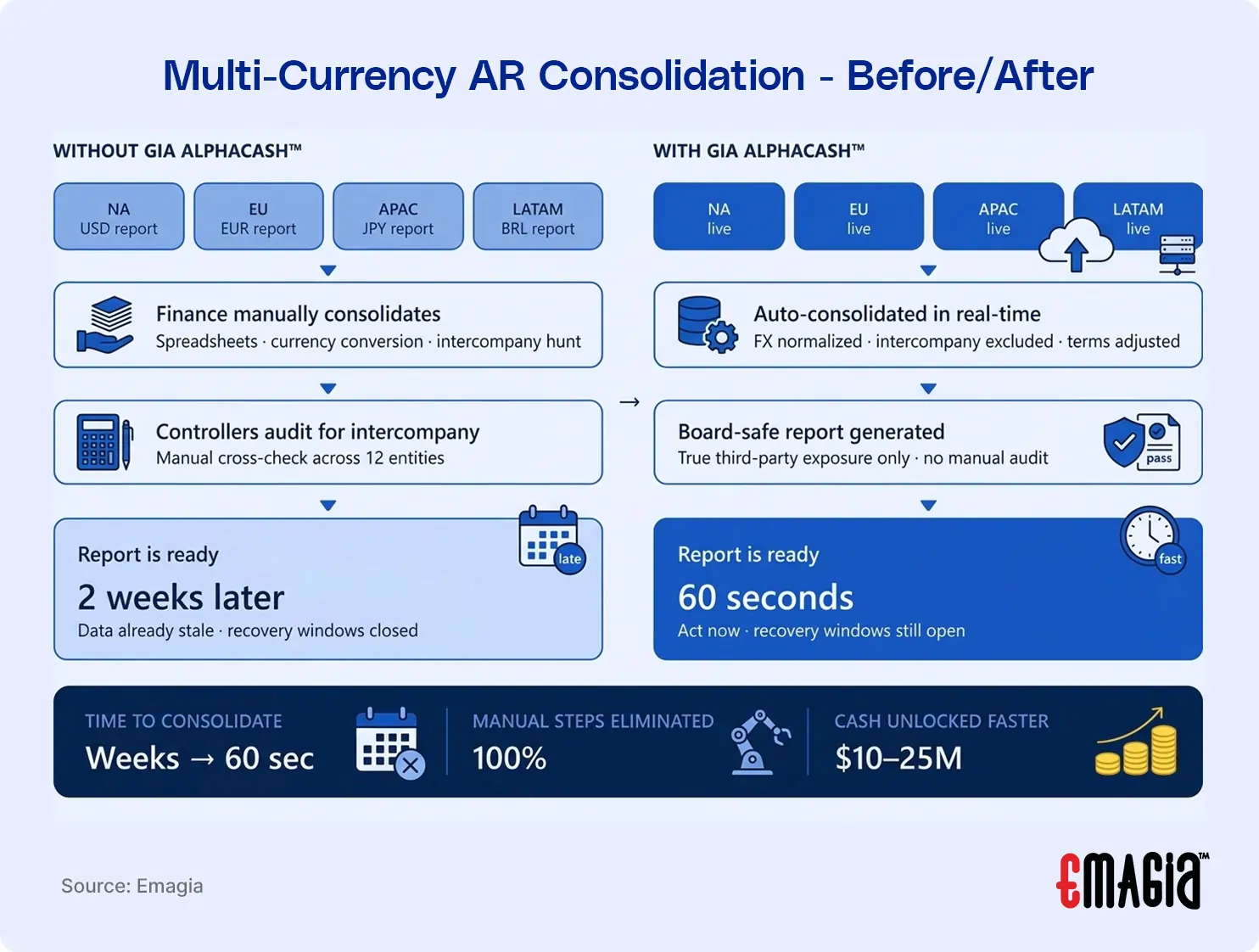
Most global organizations rely on a painful process: regional teams submit AR reports. Headquarters consolidates them. Finance standardizes currencies. Controllers audit for intercompany transfers. By the time the report is final, it’s already 2 weeks old.
This lag creates decision paralysis. Your CFO can’t see current cash position. Your collections teams don’t know which high-impact accounts to prioritize globally. Your cash forecast is based on data from two weeks ago.
Deterministic global AR intelligence eliminates this bottleneck. Real-time consolidation. Automatic intercompany exclusion. Currency-normalized aging. Board-safe reporting generated in seconds, not weeks.
This is autonomous O2C for global enterprises: intelligence that works across boundaries, in real time, with zero manual consolidation.
Scaling Strategic O2C Operations with Centralized Agentic AI
Gia AlphaCash™ is built specifically for global CFOs and Shared Services heads managing complex, multi-currency AR. It connects to all your ERP systems across regions (SAP, Oracle, NetSuite, etc. via API or direct connector), consolidates global receivables in real time, automatically detects and excludes intercompany accounts by customer-name match, and delivers a single source of truth showing only true third-party exposure across all currencies and business units. Organizations using Gia AlphaCash see 50–70% reduction in consolidation time, 20–30% improvement in cash forecasting, and an average $10–$25M faster unlock in trapped cash simply from having accurate visibility. No manual audits. No spreadsheet consolidation. No month-end surprises. Just deterministic, real-time, multi-currency cash intelligence that your board can trust and your teams can act on immediately.
FAQ
Q: How does the system handle intercompany accounts?
A: Gia AlphaCash automatically detects intercompany accounts by customer-name match and excludes them from reported past-due, so you see only true third-party exposure.
Q: Does this work with multiple ERP systems?
A: Yes. The system connects to SAP, Oracle, NetSuite, JD Edwards, MS Dynamics, and others via pre-built connectors or API.
Q: How quickly can we consolidate global AR?
A: Real-time. The moment regional data updates, your consolidated global view updates. No month-end delay.
Q: Does this account for currency fluctuations?
A: Yes. The system normalizes for exchange rate movements, so aging is based on true payment date, not currency movement.
Q: What if we have different payment terms by region?
A: The system accounts for regional payment behavior and adjusts DSO calculations accordingly, giving you an apples-to-apples view across regions.
Q: Can this help us forecast cash across multiple currencies?
A: Yes. With accurate third-party exposure and regional payment behavior built in, cash forecasting becomes significantly more accurate.