Manual follow-ups are a bottleneck. Explore how autonomous O2C agents eliminate administrative overhead and drastically improve your order-to-cash efficiency.
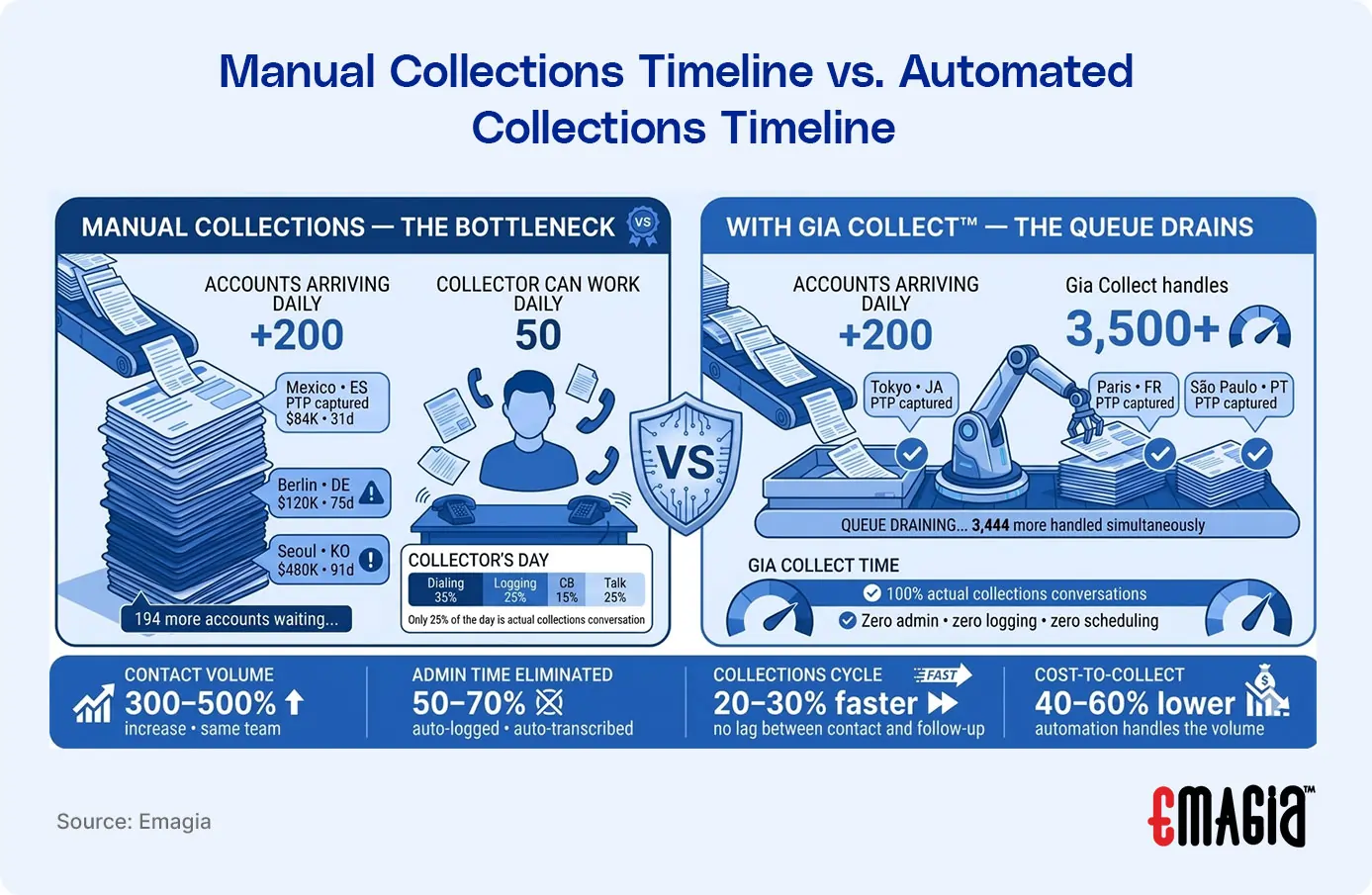
Your collections team is drowning in manual work. They spend mornings dialing accounts, leaving voicemails, manually logging call notes into your ERP. They spend afternoons following up on callbacks, sending reminder emails, tracking promises-to-pay in spreadsheets. By end of day, they’ve touched maybe 50–100 accounts. Meanwhile, your AR aging report shows 10,000 accounts past due. The math is simple: at current manual pace, it would take 100+ days to contact every delinquent account once.
This is the manual outreach bottleneck—and it’s costing your organization millions in uncollected cash and operational inefficiency. According to Gartner research on credit and collections automation, manual collections operations spend an estimated 60–70% of time on administrative tasks (dialing, logging, scheduling callbacks) and only 30–40% on actual collections conversations. For every hour spent negotiating payment with a customer, collectors spend 1.5–2 hours on manual administrative overhead.
Credit and collections automation powered by autonomous collections agents eliminates this bottleneck entirely. Instead of your team manually dialing 50 accounts per day, agentic AI can initiate contact with 1,000+ accounts simultaneously, handle the conversations, capture outcomes, and log everything automatically. Your team moves from being execution-focused to outcome-focused.
Quantifying the Hidden Labor Costs in Your Manual O2C Workflow
Manual credit and collections workflows create multiple inefficiencies that compound over time. First, there’s the contact lag: by the time your team gets to an account, it’s aged further. A 60-day account might be 70 days by the time it’s called. APQC benchmarks show that every day of delay reduces collection probability by 1–2%. Missing the optimal collection window costs real cash.
Second, there’s the inconsistency problem. Some collectors call accounts immediately. Others batch calls and do them weekly. Some document promises-to-pay. Others rely on memory. Some follow up consistently. Others move on after one failed attempt. This inconsistency in O2C operations creates unpredictable results and makes forecasting cash virtually impossible.
Third, there’s the data quality problem. Manual note-taking in collections creates “he-said, she-said” scenarios. A customer claims they promised to pay Friday. Your notes say Tuesday. There’s no objective record of the conversation. Disputes escalate. Recovery slows.
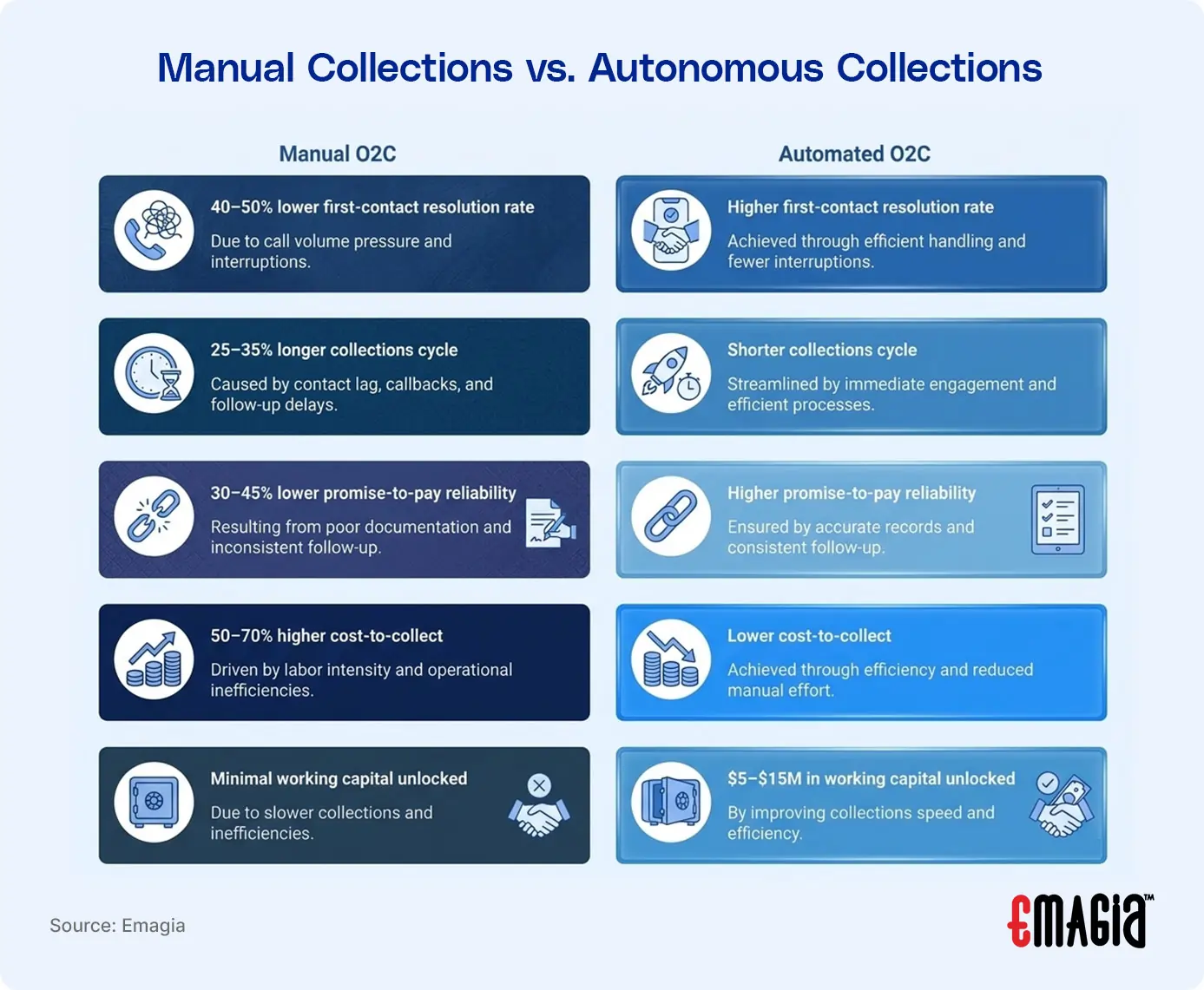
McKinsey research on collections operations optimization found that organizations with purely manual credit and collections have:
- 40–50% lower first-contact resolution rate (conversations interrupted by call volume pressure)
- 25–35% longer collections cycle (from lag, callbacks, follow-up delays)
- 30–45% lower promise-to-pay reliability (due to poor documentation and follow-up inconsistency)
- 50–70% higher cost-to-collect (due to labor intensity and inefficiency)
For an enterprise with $100M in receivables and a 55-day DSO, moving to automated O2C could unlock $5–$15M in working capital simply by improving collections speed.
How Autonomous AI Agents Eliminate the O2C Outreach Bottleneck
Autonomous collections agents work fundamentally differently from manual collections. Instead of your team dialing one account at a time, agents can initiate simultaneous contact with thousands of accounts. Instead of logging calls manually, every interaction is automatically transcribed, summarized, and stored. Instead of scheduling callbacks and follow-ups manually, the agent immediately escalates based on outcome—dispute, promise-to-pay, callback needed, etc.
Here’s the operational shift: Manual collections teams spend 60% of time on administration, 40% on conversations. Autonomous collections inverts this—100% of agent time is spent on actual customer conversations because administrative overhead is zero.
APQC benchmarks show that organizations deploying autonomous O2C collections agents see:
- 300–500% increase in daily contact volume (more accounts reached per day)
- 50–70% reduction in administrative overhead (auto-logging, auto-transcription, auto-summarization)
- 25–35% improvement in first-contact resolution rate (focused conversation without time pressure)
- 20–30% faster collections cycle (no lag between contact, outcome capture, and follow-up)
For a Shared Services team managing 50,000 accounts with manual collections, this could translate to handling 200,000+ accounts simultaneously with autonomous O2C agents.
Transforming O2C from a Manual Cost Center to a High-Velocity Recovery Engine
Gia Collect™ eliminates the manual O2C bottleneck by automating the entire outreach and documentation process. It initiates outbound AI calls, texts, and emails to priority accounts automatically with no manual scheduling. It conducts natural collections conversations—answering questions, addressing objections, capturing promises-to-pay—without human intervention. It logs everything automatically: 100% transcription, speaker-separated dialogue, sentiment scoring, outcome classification. Your collections team moves from administrative execution to strategic exception handling. Organizations using Gia Collect report 300–500% increase in daily contact volume, 50–70% reduction in administrative time, and 20–30% faster collections cycle purely from eliminating manual outreach bottlenecks. No more dialing, logging, or scheduling callbacks manually. Just autonomous, scalable, documented collections execution.
FAQ
What is the hidden cost of manual outreach in O2C?
The hidden cost includes not just salary, but the “opportunity cost” of lost cash. When staff spend 80% of their time on manual data entry and repetitive calls, they miss the strategic windows to recover high-value “Alpha Accounts,” leading to higher DSO.
How do autonomous agents eliminate the O2C outreach bottleneck?
The bottleneck is human bandwidth. AI agents remove this by executing all initial outreach and routine follow-ups autonomously. This ensures 100% of your past-due accounts are contacted on day one, rather than waiting for a human to find the time.
Can Agentic AI improve the ROI of a collections department?
Yes. By moving the department from a “cost center” (high headcount, low volume) to a “high-velocity recovery engine” (AI-driven volume), you increase the total cash recovered per dollar spent on operations.
How much time can AI agents save a credit and collections team?
Organizations using AI agents typically see a 60–80% reduction in administrative tasks. This time is redirected toward strategic credit analysis and complex dispute resolution that requires human judgment.
What happens to manual workflows when AI agents are deployed?
Manual workflows are replaced by “Exception-Based Management.” Instead of working through a daily task list, your team only gets involved when the AI flags a complex issue, ensuring human talent is used only where it adds the most value.