Quick Answer: Organizations deploying autonomous AI agents for credit and collections can increase account volume by 300-500% without headcount increases. By routing high-volume, low-dollar accounts to AI agents and letting humans focus on complex disputes and high-value negotiations, finance teams can scale their collection processes efficiently. This is changing the way SSCs are transforming their multi-region finance operations for a very long time, the only way to scale collections was to hire additional personnel. More accounts lead to hiring more collectors. More regions meant hiring more financial staff. And multiple languages forced companies to hire specialised language experts. That linear equation breaks down in 2026, with Agentic AI transforming the way teams work.
Scale your finance operations efficiently. Learn how AI-driven O2C tools allow your credit and collections team to handle 10x the volume without hiring more staff.
For Shared Services heads managing credit and collections across global organizations, scaling has always meant one thing: hiring more people. More accounts mean more collectors. More regions mean more headcount. More languages mean more specialized teams. This linear equation has governed collections automation strategy for decades. Yet in 2026, this equation is breaking down.
Credit and collections automation powered by agentic AI is enabling organizations to scale collections operations without scaling headcount. For the first time, global Shared Services teams can handle exponential growth in account volume while maintaining or even reducing collections team size. The mechanism is simple: autonomous collections agents handle the high-volume, low-dollar accounts that were historically too expensive for human collectors to pursue. Meanwhile, your human teams focus on complex disputes, relationship management, and high-value negotiations. The result? Collections at scale without the headcount crisis.
According to Gartner research on collections automation, organizations implementing autonomous recovery solutions saw an average 25–40% increase in collections volume without increasing headcount. McKinsey’s research on credit and collections found that global enterprises saved an average $2–$5M annually by shifting low-dollar account volume to autonomous collections agents while keeping high-value accounts with human collectors. For a global Shared Services center, this is transformational.
Can You Scale Collections Without Hiring More Staff?
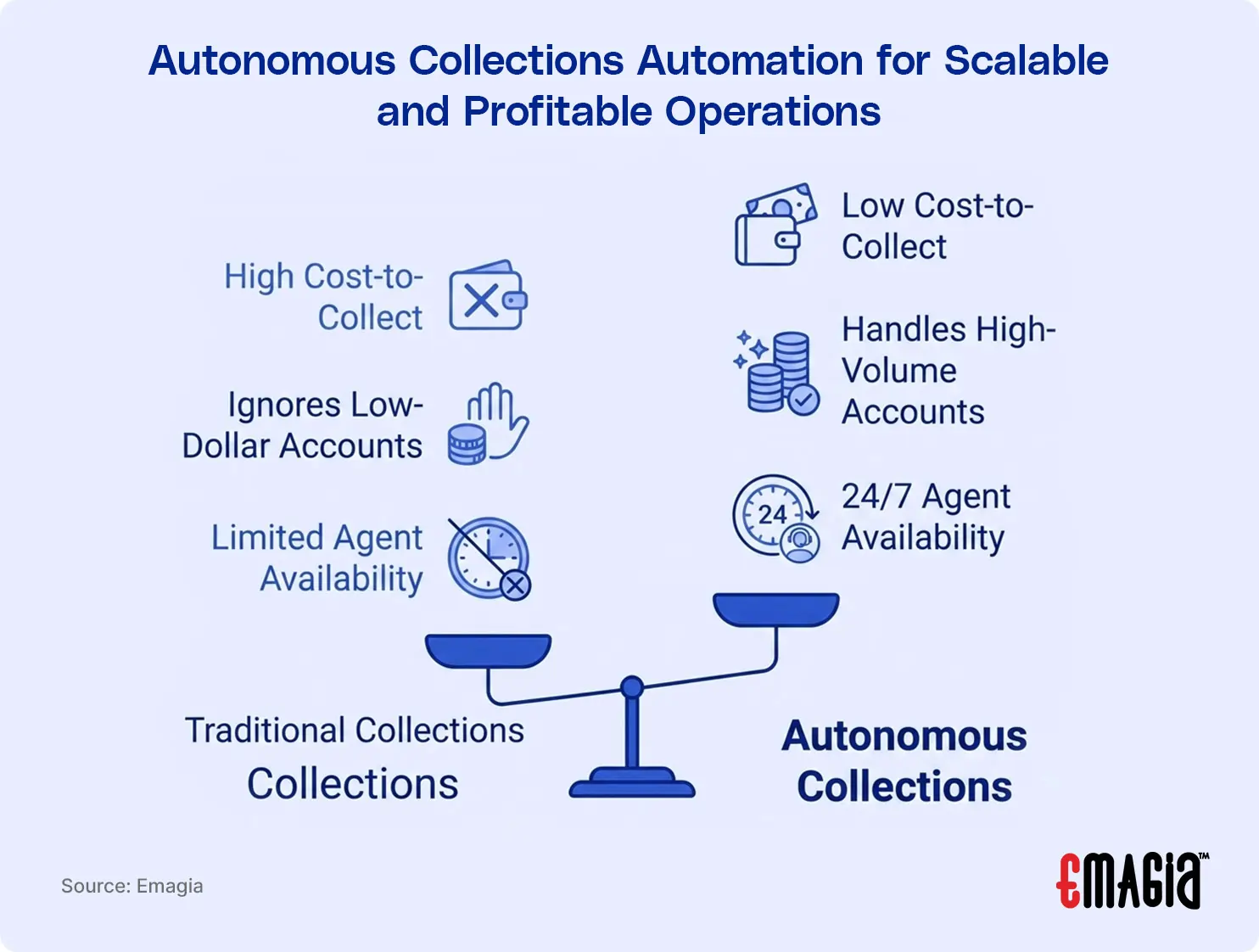
The traditional approach to scaling credit and collections operations is straightforward: hire more collectors, open new centers, add languages, expand hours. But this approach has become economically unviable. A global Shared Services center in a low-cost region might employ collectors at $15–$25/hour, but the cost of managing them—training, quality assurance, attrition, supervision—often reaches $40–$60 per hour fully loaded. For low-dollar accounts (under $1,000), this economics is unsustainable.
Gartner’s research on shared services automation found that the average cost-to-collect for accounts under $1,000 is 35–50% of the recovery amount—meaning you lose money on those accounts if pursued manually. Yet these “low-dollar” accounts collectively represent enormous volume. A company with 100,000 past-due accounts might find that 60,000 are under $1,000. Traditional collections ignores them as uneconomical. Autonomous collections automation makes them profitable.
This is why credit and collections automation powered by agentic AI is reshaping Shared Services strategy. Autonomous collection agents can work 24/7 across all time zones, handle unlimited concurrency, and pursue high-volume, low-dollar accounts profitably. They free your human collectors to focus on complex cases, high-value relationships, and strategic recovery efforts.
How Do Autonomous Collections Agents Let You Scale Without Adding Headcount?
Autonomous credit and collections agents operate fundamentally differently from traditional collections automation tools. They don’t just send automated emails or trigger alerts. They conduct natural, compliant conversations with customers—answering questions, addressing objections, capturing promises-to-pay, and logging disputes—all without human intervention.
Here’s how this enables scaling: Traditional Shared Services teams can handle approximately 200–300 accounts per collector per month (accounting for contact rates, conversation time, follow-up, and administrative overhead). With autonomous collections agents, a global Shared Services center can now handle 10,000–50,000 account touches per month depending on volume and complexity mix. The agents handle the routine outreach. Your team handles the exceptions.
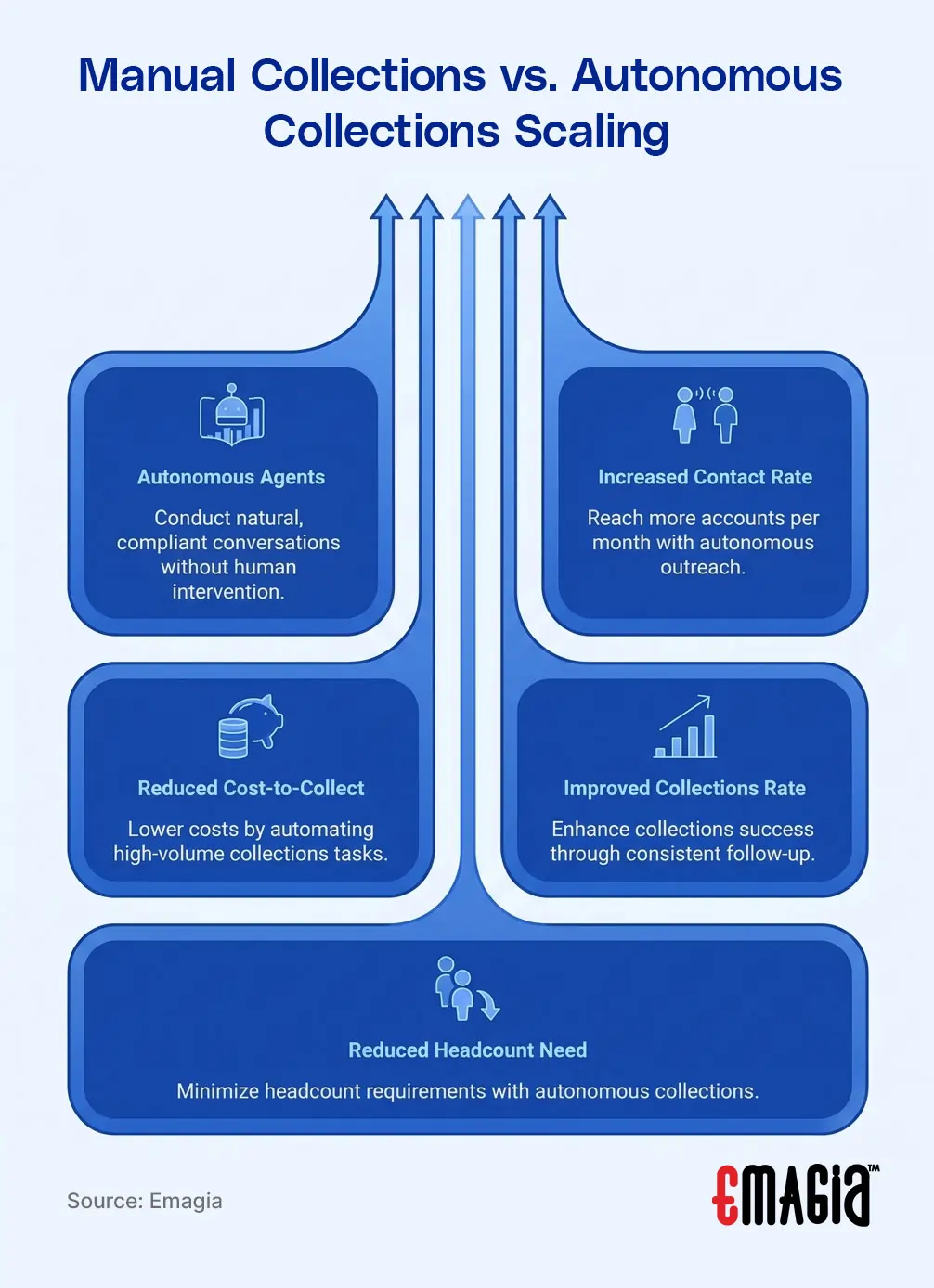
APQC benchmarks show that organizations deploying autonomous collections as a complement to manual collections see:
- 300–500% increase in account contact rate (more accounts reached per month)
- 40–60% reduction in cost-to-collect (due to automation handling high-volume volume)
- 25–35% improvement in collections rate (from increased contact frequency and follow-up consistency)
- 20–30% reduction in collections headcount need (as volume shifts to autonomous handling)
For a global Shared Services center managing 200,000 past-due accounts, this could translate to handling an additional 500,000 accounts annually without adding staff.
Agentic AI vs. Standard Automation: Choosing the Right Engine for O2C
Traditional collections automation sends templated emails and makes dialed calls. It’s efficient, but it’s not intelligent. Autonomous collections agents are conversational, adaptive, and compliant. They:
- Conduct natural conversations: Handle customer objections, negotiate payment plans, answer invoice questions in real time
- Adapt to customer language: Support 23+ languages with real-time language switching if customer responds in different language
- Capture actionable outcomes: Promise-to-pay dates and amounts, disputes logged with context, payment terms negotiated
- Maintain compliance: Adhere to GDPR, FDCPA, local collections regulations, operating hour restrictions by time zone
- Log everything: 100% transcript capture, sentiment analysis, interaction summaries sent to customers and stored in your system
This is fundamentally different from collections automation which triggers alerts and sends messages. This is autonomous collections execution—agents that actually conduct collections conversations.
McKinsey research on autonomous collections agents found that organizations achieve:
- 50–70% higher first-contact resolution rate (agents answer questions immediately)
- 30–40% improvement in promise-to-pay capture rate (natural negotiation vs. robotic messaging)
- 20–30% faster collections cycle (immediate follow-up without manual scheduling)
Which is the Best AI Agent for Credit and Collections Automation?
Gia Collect™ is built specifically for Shared Services heads managing credit and collections at scale across global organizations. It operates 24/7 across all time zones, places outbound AI voice calls, texts, and emails to priority accounts automatically, conducts natural conversations in 23+ languages with real-time language adaptation, and captures promises-to-pay, disputes, and interaction summaries without manual logging. Organizations using Gia Collect report 300–500% increase in account contact volume without adding headcount, 40–60% reduction in cost-to-collect, and 25–35% improvement in collections rate purely from higher contact frequency and consistency. Your Shared Services team scales without the headcount crisis. Your collections function becomes a profitable, scalable operation instead of a labor-intensive cost center.
FAQ
How does Agentic AI help scale O2C without adding staff?
Agentic AI functions as a digital workforce that autonomously manages high-volume, low-complexity accounts. By handling thousands of simultaneous customer interactions and follow-ups, it allows the existing team to focus on high-value exceptions, effectively increasing capacity without increasing OpEx.
What is the difference between Agentic AI and standard RPA in collections?
Standard RPA follows rigid, linear scripts and fails when a customer provides an unexpected response. Agentic AI uses reasoning to understand context, handle objections, and negotiate payment terms, allowing it to complete the O2C cycle without human intervention.
Can AI agents handle high-volume credit and collections outreach?
Yes. AI agents are specifically designed to provide 100% coverage across your entire ledger. They can perform personalized outreach at a scale impossible for human teams, ensuring that no invoice—regardless of size—is left uncollected.
How do autonomous agents protect margins during business growth?
As sales volume increases, the cost-to-collect typically rises with headcount. Autonomous agents decouple growth from labor costs by absorbing the increased workload of the O2C cycle, allowing you to scale revenue while keeping collection costs flat.
Is it difficult to integrate AI agents into existing ERP systems?
No. Modern Agentic AI for O2C is designed to sit on top of existing ERPs (like SAP or Oracle). It audits the ledger in real-time and executes actions based on that data, requiring minimal disruption to your current tech stack.