Cash application is the process of matching customer payments to open invoices and posting them into an ERP system. It helps businesses reduce unapplied cash, improve cash flow visibility, accelerate working capital, and lower Days Sales Outstanding (DSO). Modern AI-powered cash application automates invoice matching, remittance capture, exception handling, and cash posting.
While traditional automation matches structured data, autonomous cash application goes further by understanding intent—reconciling payments even when remittance data is missing by analyzing historical customer behavior and patterns.
Unlike rule-based systems, autonomous cash application uses agentic AI to achieve over 95% straight-through processing (STP), enabling real-time reconciliation and instant credit availability.
What Is Cash Application?
Cash application is a core component of the accounts receivable (AR) process, ensuring that incoming payments are accurately matched to customer invoices and recorded in the ERP system. Until payments are properly applied, businesses cannot fully utilize the cash for operations, investment, or credit replenishment.
In today’s digital environment, multiple payment channels and remittance formats increase complexity. Without efficient systems, delays in cash application can impact working capital, customer credit availability, and revenue continuity.
Cash Application vs. Cash-Basis Accounting: A Key Distinction
It is crucial to distinguish the operational process of ‘cash application’ from the financial reporting method of ‘cash-basis accounting.’ Cash application is a core function within accounts receivable where incoming payments are matched to outstanding invoices. Its primary goal is operational efficiency and accuracy in managing receivables. In contrast, cash-basis accounting is a bookkeeping method where revenue is recognized only when cash is received, and expenses are recognized only when cash is paid out. While related, cash application is the ‘how’ of processing a payment, whereas the accounting method determines ‘when’ that payment is formally recognized as revenue in the financial statements. This article focuses exclusively on the operational process of cash application.
Cash Application: Quick Overview
At a high level, cash application involves capturing remittance data, matching payments to invoices, resolving discrepancies, and posting transactions into ERP systems.
Cash application is also known as invoice matching, cash posting automation, or accounts receivable (AR) payment reconciliation in enterprise finance. It plays a critical role in the order-to-cash cycle.
This process is a key part of the order-to-cash cycle and is closely linked to accounts receivable automation strategies.
What are the steps in the cash application process?
- Receive payment and remittance
- Capture and extract remittance data
- Match payment to invoices
- Handle exceptions (short pays, deductions)
- Post to ERP system
The CFO’s Strategic Lever: Turning Cash Application into Working Capital Acceleration
For enterprise CFOs and shared services leaders, cash application is not just an operational task—it directly impacts working capital, liquidity forecasting, and revenue acceleration.
When payments are not applied quickly:
- Days Sales Outstanding (DSO) increases
- Customer credit limits remain blocked
- Forecasting accuracy declines
- Unapplied cash accumulates
- Revenue recognition is delayed
Revenue recognition is delayed or complicated: Under accounting standards like ASC 606, the collectibility of payment is a key criterion for recognizing revenue. Unapplied cash sits in a suspense account, creating uncertainty about which specific performance obligations have been satisfied. Timely and accurate cash application provides the definitive link between a payment and an invoice, serving as crucial evidence that collection has occurred and allowing for prompt and compliant revenue recognition.
High-performing finance organizations treat cash application as a strategic working capital lever. AI-enabled automation restores customer credit availability faster, improves real-time cash visibility, and reduces the cost per transaction across global shared services.
Faster cash application enables instant credit replenishment, allowing customers to place new orders sooner and directly accelerating revenue and sales velocity.
Effective cash application directly supports credit management and improves decision-making across finance operations.
How is Cash Application Used?
Cash application is an integral part of the broader accounts receivable (AR) process, as it effectively allocates incoming payments to their respective customer accounts and outstanding invoices. Until cash is appropriately assigned, businesses are unable to utilize it for various purposes.
Faster cash utilization allows companies to meet financial obligations, replenish customer credit limits, fund operations, and support strategic investments. Delays in applying cash can restrict liquidity and slow revenue generation.
The key elements of cash application are the invoice, the payment, and the remittance advice. In B2B transactions, suppliers often extend credit to buyers with defined credit limits. Until payments are applied and posted against invoices, credit lines remain constrained, which can delay additional purchases and impact revenue flow.
Delays in applying cash impact revenue generation and customer credit availability. An efficient cash application process shortens the order-to-cash cycle, reduces past-due receivables, and improves customer experience by preventing unnecessary collection calls.
The Direct Link to Real-Time Credit Management
One of the most immediate impacts of efficient cash application is on customer credit management. In B2B commerce, customers operate on defined credit limits. When a payment is received but not applied, it remains as ‘unapplied cash,’ and the customer’s outstanding balance does not decrease. Consequently, their available credit line is not replenished. This can block new sales orders, creating friction with valuable customers who have paid on time but are unable to make new purchases due to system delays. AI-powered cash application systems that integrate with credit modules solve this by posting payments in real-time, instantly freeing up the customer’s credit line and allowing the sales cycle to continue without interruption.
Detailed Cash Application Process Explained
1. Receiving Payment and Remittance
Upon receiving a customer’s payment, you typically receive a remittance advice indicating the specific invoice(s) the payment is intended for. For payments made by check, the remittance information may be included in the memo line or an accompanying document attached to the check.
Electronic payments, on the other hand, are more complex. With methods such as ACH, EFT, wire transfers, and virtual cards, the remittance advice may arrive separately in various formats. It is important to note that buyers are not obligated to provide remittance advice, although it is considered a courteous practice. Therefore, there is a possibility of receiving a payment without any associated remittance information.
“Upon receiving a customer’s payment, you typically receive a remittance advice indicating the specific invoice(s) the payment is intended for.”
2. Matching the Payment with the Right Invoice
Once a payment is received from a customer, you will compare it with your accounting system to ensure that it is correctly linked to the corresponding invoice. Even when a payment is accompanied by a remittance, the process of matching the payment to the correct invoice can still become intricate.
A single payment can encompass multiple invoices, sometimes exceeding 40 to 50 invoices. Alternatively, you can encounter a situation where the payment does not precisely match the invoice amount. This occurs when a customer has made a partial payment due to a discount or an issue with their order. In such a case, additional investigation by your accounts receivable team is necessary.
Business Impact of Cash Application Automation
Automated cash application improves invoice matching accuracy and accelerates payment posting into ERP systems. This reduces Days Sales Outstanding (DSO), minimizes reconciliation delays, and enhances real-time cash flow visibility across accounts receivable workflows.
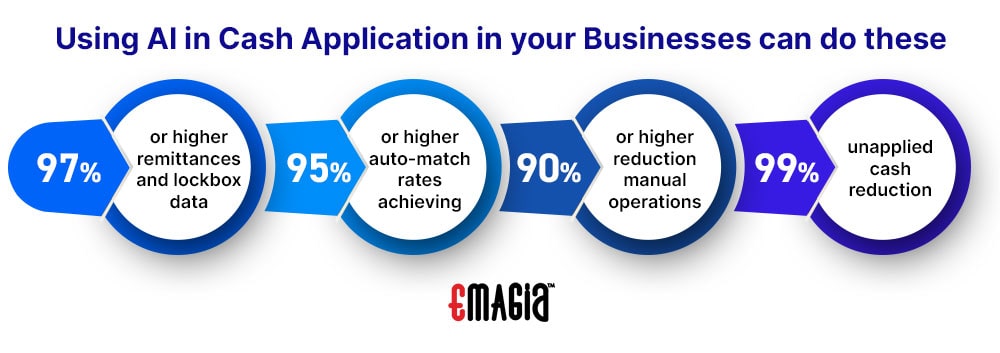
Enterprises transitioning to autonomous cash application achieve up to 90%+ reduction in unapplied cash—significantly outperforming traditional rule-based automation systems.
When selecting a cash application solution, enterprises evaluate automation rates, accuracy, ERP integration, scalability, and impact on working capital performance.
Organizations adopting AI in finance are able to significantly improve cash visibility and reduce manual reconciliation efforts.
Real-World Use Cases of Cash Application
These use cases are commonly seen in enterprise accounts receivable and collections management environments.
- Applying bulk payments across multiple invoices in manufacturing
- Handling deductions in retail and CPG industries
- Managing multi-currency payments in global enterprises
- Automating remittance capture from emails and portals
Enterprise Cash Application Benchmarks
Want to achieve 90%+ auto-cash posting? Discover how AI-powered cash application transforms enterprise accounts receivable.
Leading enterprises typically achieve:
- 90–95% automated cash posting
- 30–50% reduction in manual effort
- 10–20% reduction in DSO
- 40–60% faster exception resolution
- Significant reduction in unapplied cash balances
Organizations still relying on manual processes often experience:
- High reconciliation delays
- Increased write-offs
- Customer disputes due to misapplied cash
- Higher lockbox and operational costs
Cost of Manual Cash Application in Enterprise Environments
Manual cash application increases operational cost due to labor-intensive reconciliation, exception handling, and rework. Enterprises processing thousands of payments daily often experience rising lockbox fees, overtime costs, and higher write-offs due to misapplied cash.
- Higher cost per transaction
- Increased write-offs from delayed dispute resolution
- Customer dissatisfaction due to credit holds
- Reduced finance team productivity
AI-powered automation reduces cost per transaction while improving match accuracy and scalability across global shared services centers.
What are the Elements of Cash Application?
There are three elements of cash application: Invoice, Payment, and Remittance Advice.
Invoice: The invoice is the document sent to the customer detailing product or service provided and requesting payment per terms and has a corresponding entry in the AR ledger. Invoice document records the money earned by and owed to the company through the sale of products or services on credit. Payment: Payment is the transfer of funds from the buyer to the supplier. There are many payment methods in business-to-business (B2B) transactions, including paper checks, ACH, wire transfer, credit card, virtual card, and a host of digital payment methods. Remittance Advice: Remittance advice is the data describing what the payment is being made for. Also known as remittance information or simply remittance, remittance advice is sent along with the payment and includes the invoice number. While the remittance advice is sent with the payment for digital payments, in other modes of payment, this information is sent separately from the actual payment transaction. Customers might send the remittance info in several ways and various formats. These formats could include email, PDF, image file, phone call, or web portal. 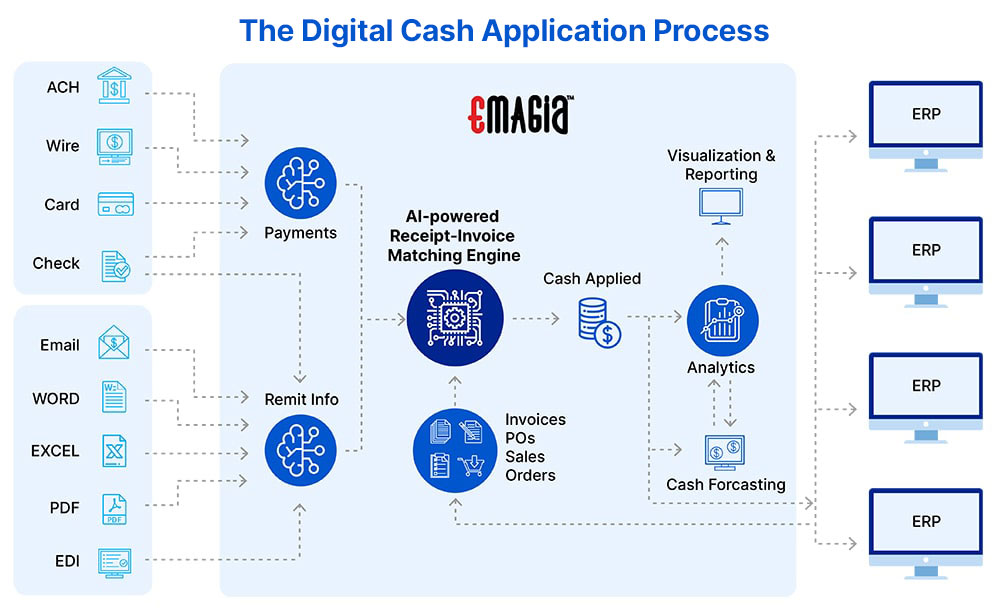
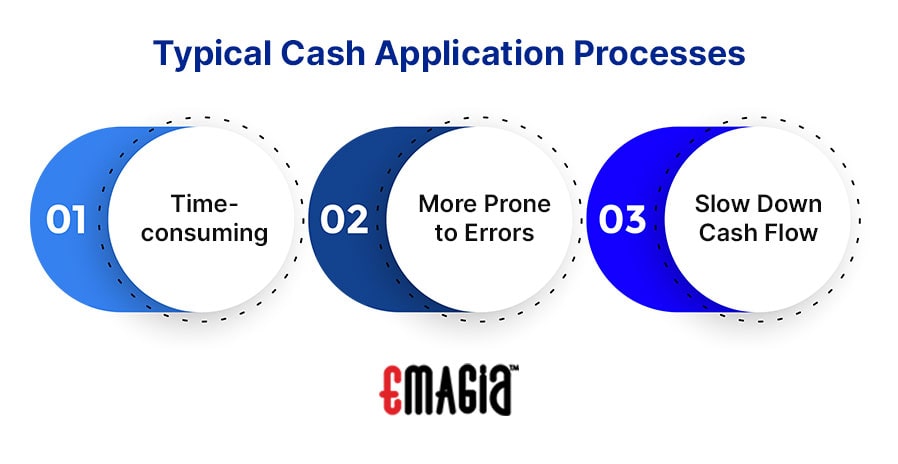
What’s Wrong with Typical (read: manual) Cash Application Processes
1. Time-consuming
When manually performing cash applications, it becomes necessary to allocate personnel to meticulously analyze and input remittance data, especially in cases where the information is either missing or difficult to decipher. To mitigate such challenges, numerous businesses opt for receiving payments via checks, as these often come with an accompanying remittance advice.
2. More Prone to Errors
Despite having meticulous staff, errors are bound to occur when manually inputting data. If a customer notices recurring errors, it can potentially jeopardize the relationship between the parties involved.
3. Slow Down Cash Flow
A manual cash application process increases the time between a sale and the recording of a payment, resulting in higher days of sales outstanding. Delays in cash application also hinder the ability to obtain an accurate and current overview of outstanding receivables.
Manual vs Rule-Based vs AI-Powered Cash Application
The evolution of cash application technology significantly impacts match rates, operational efficiency, and working capital performance. The table below compares manual processes, rule-based automation, and AI-powered cash application systems used by modern enterprises.
Cash application processes range from manual methods to fully autonomous AI-driven systems, each offering different levels of accuracy, scalability, and efficiency.
| Capability | Manual Process | Rule-Based Automation | AI-Powered Cash Application | Autonomous / Agentic AI |
|---|---|---|---|---|
| Auto-Match Rate | 60–75% | 75–85% | 90–99% | 95–99%+ with continuous learning |
| Remittance Capture | Manual data entry | Template-based extraction | AI + NLP extraction | Understands unstructured intent (emails, notes, missing remittance) |
| Exception Handling | Fully manual | Rule-triggered workflows | AI-assisted resolution | Autonomous resolution using learned patterns |
| ERP Integration | Manual posting | Semi-automated | Straight-through processing (STP) | Real-time autonomous posting with validation |
| Scalability | Limited by headcount | Moderate | High scalability | Enterprise-scale with minimal human dependency |
| Impact on DSO | High DSO | Moderate improvement | Significant reduction | Maximum DSO reduction through real-time reconciliation |
| Operational Cost | High labor cost | Reduced cost | Low cost | Lowest cost with near-touchless processing |
| Human Dependency | Very high | High | Medium | Minimal (AI agents act as digital coworkers) |
Summary: AI-powered cash application achieves the highest accuracy, lowest cost, and fastest processing—making it the preferred model for enterprise finance teams.
While automation significantly improves matching rates, unresolved discrepancies can still result in unapplied cash. Understanding the root causes is critical for enterprise finance teams.
Agentic AI vs Rule-Based Automation in Cash Application
| Capability | Rule-Based Automation | Agentic AI (Autonomous Cash Application) |
|---|---|---|
| Decision Making | Predefined rules | Learns and adapts from historical behavior |
| Handling Missing Remittance | Fails or requires manual input | Predicts intent using customer patterns |
| Exception Resolution | Manual or rule-triggered | Autonomous resolution with continuous learning |
| Adaptability | Static | Self-learning and evolving |
| Business Impact | Moderate efficiency gains | Near-touchless processing and maximum working capital optimization |
Common Causes of Unapplied Cash in Enterprise AR
- Missing or incomplete remittance information
- Short payments due to deductions
- Payment reference errors
- Multiple invoices paid in lump sum
- Timing differences between bank and ERP systems
- Customer disputes or pricing discrepancies
AI-powered automation reduces unapplied cash by analyzing payment patterns, historical allocations, and customer behavior to predict matching intent.
What Causes Unapplied Cash?
Unapplied cash occurs when a customer payment is received but cannot be matched to a specific invoice or account balance. The most common causes include missing remittance advice, short payments, deductions, incorrect invoice references, customer disputes, timing differences between banking and ERP systems, and bulk payments covering multiple invoices. Reducing unapplied cash is a critical objective of modern cash application automation because unresolved payments can delay revenue recognition, increase DSO, and restrict customer credit availability.
Understanding the Objectives of the Cash Application Process
- Speed: The primary goal is to expedite cash application to minimize days of sales outstanding (DSO) and enable the company to utilize the funds as early as possible.
- Accuracy: Analysts must prioritize cash application accuracy. Errors in cash application can result in dissatisfied clients and disrupt the tracking of cash flow and working capital.
- Standardization: Standardization poses a challenge for global enterprises, as different payment methods and cash remittance file formats across various regions make it difficult to consistently apply cash throughout the organization.
What Makes Cash Application Complex?
Cash application becomes complex in enterprise environments due to multiple payment channels, remittance formats, currencies, and ERP systems. Remittance data often arrives in unstructured formats such as PDFs, emails, EDI files, or bank statements.
The Challenge of Emerging Payment and Remittance Formats
Beyond traditional payment methods, the B2B landscape is evolving with new options like virtual cards and B2B Buy Now, Pay Later (BNPL) platforms. Each of these introduces unique cash application challenges. Virtual cards, for example, generate single-use numbers and often have remittance data embedded within transaction details that are separate from the payment itself. B2B payment portals and networks aggregate payments but may provide remittance reports in proprietary formats that require specific integration or manual download. This fragmentation of payment and data sources makes a centralized, intelligent data capture system essential.
Unlike traditional OCR systems that rely on structured templates, advanced AI can interpret unstructured human-readable remittance data—such as emails, free-text notes, and incomplete payment references—understanding intent rather than just extracting fields.
Incomplete remittance information, partial payments, deductions, and cross-referencing with purchase orders or sales orders further increase manual intervention and exception handling.
- Data capture from emails, documents, bank files and vendor portals which is very cumbersome
- Matching invoices to receipts is often complex and time-consuming involving several rules
- Data entry and posting into different ERP systems is very tedious and error-prone
Given the number of payment methods and the remittance information coming in different methods and formats—often in unstructured documents such as PDF, Word, or image files—capturing this information poses a huge challenge in cash application.
Further, while matching, some remittance information might be incomplete, complicating the process and requiring contact with the customer to clarify. A thorough matching process requires reference to other customer information (ex: customer purchase orders or internal sales orders along with invoices). In addition, customer history can provide important clues. These all have required human intervention in the crucial effort to match payments to charges correctly, and they make cash application complex.
Cash Application in Global Shared Services Environments
Large enterprises operating global business services (GBS) centers face additional complexity:
- Multi-currency transactions
- Multiple banking relationships
- Regional tax variations
- Diverse remittance formats
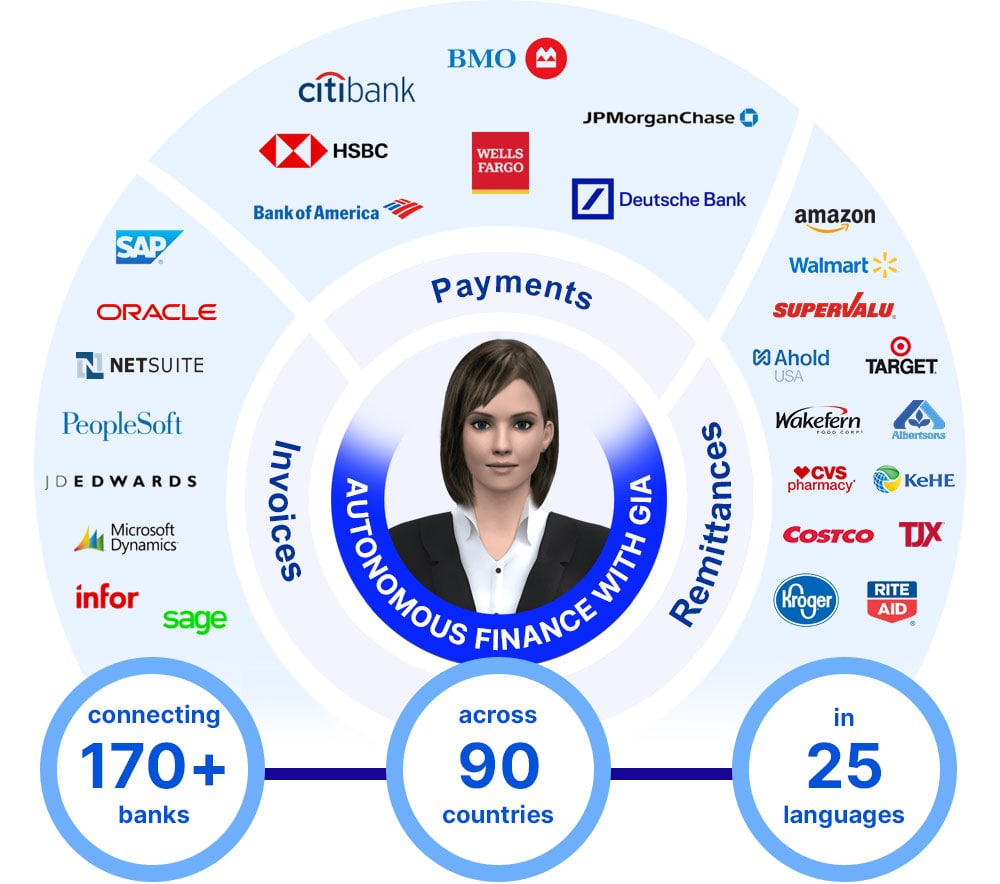
- Multi-ERP landscapes (SAP, Oracle, NetSuite, legacy systems)
Without automation, global shared services teams struggle to standardize reconciliation processes across regions. AI-powered platforms enable centralized control while maintaining local compliance.
Operational Challenges in Manual Cash Application
1. Lockbox Fees Become Too High of an Expense
Bank lockbox services consolidate all client checks in a centralized location, reducing the time it takes for checks to clear. Dedicated lockbox teams handle each check and input the relevant information into an electronic file shared with the cash application team.
However, lockbox key-in services incur charges based on the number of keystrokes required. Considering the cost of $1-3 per check, the cash application process can become expensive. Apart from the high lockbox key-in fees, this manual intervention consumes significant man-hours to reprocess a check already processed by the lockbox services.
2. Manual Payment-Remittance Linking
When it comes to electronic payments, customers transmit cash remittances through channels such as emails, EDIs, or A/P portals. Cash application teams then face the challenge of manually extracting or downloading this remittance from different sources and in various file formats.
The next step involves mapping these remittances to the corresponding incoming payments. This process is time-consuming and can significantly impact the efficiency of cash application analysts. Delays can cascade into slower cash visibility, which affects financial planning and working capital management.
3. Invoice Matching and Exception Handling
Cash application analysts are responsible for correlating payments with invoices using the information provided in the remittance such as invoice numbers, purchase orders, or shipment details.
However, complications arise when remittances contain inaccurate or incomplete invoice numbers, making it difficult for analysts to accurately match invoices with payments. In such a situation, payments are applied at an account level rather than at an individual invoice level. Manual exception handling can be time-intensive and prone to human error, increasing the risk of misapplied cash.
How Cash Application Impacts Business Relationships
Handling deductions and short payments is one of the most complex aspects of cash application. Customers may short-pay an invoice for numerous valid reasons, including claiming trade promotions, accounting for damaged goods, taking early payment discounts, or disputing freight charges. In the remittance advice, they will often include a reason code or a brief note explaining the deduction. A manual process requires an analyst to not only identify the short payment but also to interpret the reason and correctly code it in the ERP to route it to the right department for resolution.
Cash application analysts are then tasked with manually identifying these short payments and mapping customer-specific reason codes to the corresponding reason codes within their specific ERP system. Companies utilize multiple ERP systems, including SAP, JD Edwards, Microsoft, or legacy systems, each with its unique configurations.
Analysts also have to handle exceptions or adjust the file as necessary before posting it to the appropriate ERP systems. Delays or errors can negatively impact customer trust, reporting accuracy, and overall business relationships.
Preserving Trust Through Accurate Discount and Fee Management
The timing of cash application is critical for managing early payment discounts and late payment fees. If a customer pays within the discount window but the payment isn’t applied for several days, the system may incorrectly flag the invoice as partially paid, leading to disputes. Conversely, a delay in applying a payment can trigger an erroneous late fee, frustrating a customer who paid on time. Automated systems that apply cash on the day of receipt ensure that discounts are honored correctly and late fees are assessed fairly, which is fundamental to maintaining trust and a positive customer relationship.
KPIs That Define World-Class Cash Application
- Auto-match rate above 90%
- Unapplied cash below 5% of total receipts
- Exception resolution within 24–48 hours
- Cost per transaction below industry benchmarks
- Real-time ERP posting accuracy
Tracking these KPIs is essential for optimizing working capital management across the organization.
Finance organizations that achieve these metrics typically operate highly automated, AI-enabled cash application environments.
How a Global Medical Supplies Leader Achieved Over 90% Auto-cash Posting. Download Case Study
Auto-Cash Posting in Enterprise AR
Auto-cash posting refers to the automatic application of customer payments to open invoices without manual intervention. Enterprises achieving high auto-posting rates reduce reconciliation delays, improve reporting accuracy, and accelerate working capital cycles.
Modern AI-powered cash application systems continuously learn from historical matching patterns to increase auto-posting performance over time.
The 5 Stages of Cash Application Maturity
Most enterprises operate at Stage 2 or 3 of cash application maturity, relying on lockbox services or rule-based automation. However, leading organizations are rapidly transitioning to Stage 5 Autonomous Finance—where AI agents handle reconciliation, exception resolution, and ERP posting with minimal human intervention.
- Manual Reconciliation: Spreadsheet-based, heavy human effort.
- Lockbox & Basic Automation: Bank key-in services + ERP posting.
- Rule-Based Auto-Cash: Predefined matching rules with moderate automation.
- AI-Assisted Matching: Machine learning improves match rates and reduces exceptions.
- Autonomous Cash Application: Touchless processing with predictive analytics and real-time ERP posting.
Organizations progressing toward Stage 5 achieve near real-time cash visibility and world-class working capital performance.
Operational Benefits of AI-Powered Cash Application
1. Less Time Spent Obtaining Remittances from Different Sources
Cash application software offers the convenience of gathering remittances from various sources such as lockboxes, AP portals, emails, and PDFs, eliminating the need for manual collection. These software platforms can extract relevant information such as invoice numbers, dates, and dollar amounts from the remittance data.
In cases where remittance is absent, but previous transactions have been made by the same customer, AI-enabled cash application software can accurately associate the payment with the correct account by leveraging data such as the numbers present at the bottom of a check.
2. Payments Matched with Invoices
Automated cash application eliminates manual intervention by matching a large volume of payments and invoices. Recent advancements in cash application software resulted in impressive match rates exceeding 90%.
Where there is a one-to-one match and it is not possible, AI software can determine which invoices are being paid. By analyzing potential combinations of invoices and considering the customer’s available credits, the software makes informed decisions. In cases where uncertainty remains regarding how to allocate customer payments, software that supports in-platform collaboration offers a convenient solution. This feature allows users to leave comments directly on invoices, facilitating communication with colleagues or customers without disrupting workflow.
Role of AI in Cash Application Process
AI-powered cash application is often categorized under accounts receivable automation, finance automation, and order-to-cash optimization solutions used by enterprise finance teams.
AI-powered cash application software uses machine learning to match payments with invoices even when remittance information is incomplete. This enables straight-through cash posting and reduces manual exception handling in enterprise accounts receivable environments.
From Automation to Agentic AI in Cash Application
Traditional AI automates tasks, but agentic AI introduces autonomous digital assistants that actively manage workflows. In cash application, agentic systems can interpret unstructured remittance intent, resolve deductions, and continuously learn from customer behavior—functioning as digital coworkers within finance teams.
What Is Straight-Through Processing (STP) in Cash Application?
Straight-through processing refers to automatically matching and posting payments without human intervention.
AI-driven STP in accounts receivable:
- Extracts remittance data automatically
- Identifies invoice matches
- Posts transactions into ERP systems
- Flags only true exceptions
Higher STP rates directly reduce DSO, lower operational costs, and improve audit readiness.
Cash Application as a Strategic Working Capital Lever
In large enterprises, cash application is directly linked to working capital optimization. Faster cash posting improves liquidity, restores customer credit limits sooner, and enhances forecasting accuracy. Organizations that achieve high straight-through processing rates typically outperform peers in DSO, operational efficiency, and audit readiness.
Finance organizations that modernize cash application typically see measurable improvements in liquidity ratios, forecast reliability, and operational efficiency. In digital finance transformation programs, cash application modernization is often prioritized alongside credit automation and collections optimization.
Impact on Working Capital Management
Effective cash application is fundamental to optimizing working capital. By rapidly converting receivables into usable cash, it directly improves a company’s liquidity position. This has several downstream financial benefits. Firstly, a consistently low Days Sales Outstanding (DSO) and a clean aging report are key indicators of financial health that lenders and investors scrutinize. Companies with strong AR metrics often qualify for more favorable terms on lines of credit or other working capital financing. Secondly, real-time cash visibility allows treasury teams to make more accurate cash forecasts, reducing the need for costly cash buffers and enabling better investment decisions.
Faster cash posting improves liquidity by restoring customer credit availability sooner. Automated reconciliation enables finance teams to optimize working capital across the Order-to-Cash cycle.
ERP Integration in Cash Application
Cash application systems integrate with ERP platforms such as SAP or Oracle to automate invoice matching and payment reconciliation. ERP-to-bank straight-through processing improves posting accuracy and reduces operational workload across finance teams.
Modern enterprises often operate multi-ERP environments, such as SAP in one region and Oracle in another. Autonomous cash application platforms unify reconciliation across these systems without requiring complex manual coordination.
Enterprise ERP integration enables automated journal posting, real-time ledger updates, and standardized reconciliation across multi-entity environments. Seamless ERP connectivity ensures compliance, reduces audit risk, and eliminates manual data transfer between banking platforms and financial systems.
After understanding the operational challenges, performance benchmarks, and strategic impact of cash application, the next step for many enterprises is selecting a solution that enables automation at scale.
Seamless integration with ERP systems is critical for end-to-end financial automation and reporting accuracy.
How Emagia’s AI-Powered Cash Application Transforms Enterprise Accounts Receivable
This solution is part of a broader cash application software platform designed for enterprise finance teams.

Emagia’s AI-driven cash application solution modernizes enterprise accounts receivable by automating invoice matching, remittance capture, exception handling, and ERP posting. Designed for global, high-volume environments, it enables touchless processing while improving accuracy and working capital performance.
Core Capabilities
- AI-Powered Invoice Matching: Automatically matches payments to open invoices, including partial payments, deductions, and multi-invoice transactions.
- Intelligent Remittance Capture: Uses AI and NLP to extract data from emails, PDFs, bank files, EDI feeds, and customer portals.
- Automated Exception Resolution: Identifies mismatches and recommends resolutions based on historical payment behavior.
- Seamless ERP Integration: Integrates with SAP, Oracle, JD Edwards, NetSuite, and legacy systems to enable straight-through posting.
- Real-Time Cash Visibility: Provides dashboards and analytics to monitor applied and unapplied cash across entities and regions.
Enterprise Use Cases
- Global Multi-Currency Operations: Handles payments across geographies, currencies, and languages.
- High-Volume Transaction Environments: Automates thousands of daily payments while flagging only true exceptions.
- Deductions & Short Payments: Accurately applies partial payments and supports dispute workflows.
- Cross-border agentic reconciliation: AI agents automatically handle multi-currency payments, tax variations, and regional compliance without manual intervention.
Business Impact
- 90%+ auto-match rates
- Reduction in Days Sales Outstanding (DSO)
- Lower cost per transaction
- Faster exception resolution
- Improved audit readiness and compliance
By leveraging artificial intelligence and predictive analytics, Emagia enables enterprises to achieve near-touchless cash application, improve liquidity visibility, and accelerate digital finance transformation.
Conclusion:
Cash application is a foundational process within enterprise accounts receivable, directly influencing liquidity, customer credit availability, and working capital performance. Manual methods increase operational risk, delay cash visibility, and elevate costs.
AI-powered automation enables faster invoice matching, higher straight-through processing rates, and improved financial accuracy across multi-entity environments. By modernizing cash application, enterprises strengthen liquidity management, reduce operational complexity, and accelerate digital finance transformation.
For CFOs and finance leaders, optimizing cash application is not just an operational upgrade—it is a strategic imperative for sustainable working capital performance.
Frequently Asked Questions (FAQs)
Is cash application the same as cash-basis accounting?
No, they are different concepts. Cash application is the operational process of matching a customer payment to a specific invoice in the accounts receivable ledger. Cash-basis accounting is a formal accounting method where revenue and expenses are recorded only when cash changes hands. An efficient cash application process is vital for companies regardless of whether they use cash-basis or accrual-basis accounting.
What is the difference between cash application and cash posting?
Cash application matches customer payments to invoices, while cash posting records the transaction in the ERP. In automated systems, both occur simultaneously through straight-through processing.
What causes unapplied cash in enterprise accounts receivable?
Unapplied cash typically results from missing remittance information, short payments, deductions, incorrect invoice references, timing differences between bank and ERP systems, or customer disputes. AI-powered automation reduces unapplied cash by analyzing payment patterns and predicting invoice matches.
What KPIs measure cash application performance?
Key cash application KPIs include auto-match rate, unapplied cash percentage, Days Sales Outstanding (DSO), exception resolution time, cost per transaction, and straight-through processing rate. High-performing enterprises monitor these metrics to optimize working capital.
What is automated cash application in accounts receivable?
Automated cash application uses AI to match incoming customer payments to open invoices and post transactions into ERP systems in real time. This improves reconciliation speed, reduces unapplied cash, and increases accuracy across accounts receivable operations.
How does cash application automation reduce Days Sales Outstanding (DSO)?
Cash application automation accelerates invoice matching and payment posting, restoring customer credit availability faster. This reduces reconciliation delays and helps finance teams lower Days Sales Outstanding (DSO) across the Order-to-Cash cycle.
How does AI improve invoice matching in cash application?
AI-powered cash application software uses machine learning to analyze payment references and remittance data to identify matching patterns. This improves invoice matching accuracy and reduces manual exception handling.
What is straight-through cash posting?
Straight-through cash posting refers to automatically applying incoming payments to invoices without manual intervention. AI-driven automation enables touchless reconciliation by matching payments and posting validated transactions into ERP systems.
How does cash application integrate with ERP systems?
Cash application systems integrate with ERP platforms such as SAP or Oracle to automate payment reconciliation and invoice matching. ERP-to-bank straight-through processing improves posting accuracy across finance operations.
How does automated cash application improve working capital?
Automating the cash application process accelerates payment reconciliation and improves cash visibility. This enables finance teams to optimize liquidity and manage working capital more effectively across the Order-to-Cash cycle.
What are the enterprise benefits of AI-powered cash application software?
AI-powered cash application software improves posting accuracy, reduces operational workload, accelerates reconciliation, and enhances real-time visibility into applied and unapplied cash across enterprise accounts receivable environments.