
AI-Native Cash Application Software for Enterprises
Cash application software automates the process of matching incoming customer payments with open accounts receivable invoices. It captures payment and remittance details from sources such as bank files, lockboxes, emails, PDFs, EDI, and customer portals, matches receipts to open invoices, routes exceptions for review, and supports posting approved cash applications to ERP systems. Emagia’s platform is designed for global enterprises, with published coverage of 170+ connected banks across 90 countries and 15 languages.
- AI-powered payment-to-invoice matching
- Remittance data capture from emails, PDFs, EDI, portals, and bank files
- Exception workflows for partial payments, short pays, and deductions
- ERP cash posting and receivables visibility
- Designed for complex, multi-entity enterprise operations
Built for enterprise accounts receivable teams managing complex payment and remittance workflows.
Automate Enterprise Cash Application with Emagia
World-Class Digital O2C Leaders Excel with Emagia


What Is Cash Application Software?
Cash application software automates the process of matching incoming customer payments to outstanding invoices in accounts receivable. It brings payment and remittance information together, identifies the invoices a payment relates to, and helps finance teams apply and post receipts with less manual reconciliation.
Emagia’s AI-powered cash application software is designed for enterprise finance teams processing payments and remittance information across multiple channels, entities, and regions. It combines remittance capture, payment matching, payment splitting, exception handling, and ERP cash posting in a connected workflow.
Explore the Emagia Cash Application product capabilities or learn the fundamentals in our cash application guide.
How AI Improves Cash Application Automation
- Learns from historical payment patterns to improve match rates over time
- Handles partial payments, short pays, consolidated payments, and deductions
- Extracts remittance data using OCR and Natural Language Processing (NLP)
- Reduces manual intervention and exception workload
- Improves DSO and working capital visibility
Emagia’s AI-powered cash application platform includes intelligent remittance capture, advanced invoice matching, automated payment splitting, exception handling, ERP-native posting, and deduction management—delivering end-to-end automation for enterprise order-to-cash operations.
Why Manual Cash Application Is Holding You Back – (Key Challenges)
As payment volumes grow and remittance information arrives through different channels and formats, manual cash application can create delays, data-entry errors, and inconsistent reconciliation workflows. These issues make it harder for accounts receivable teams to apply cash promptly and maintain accurate receivables records.
Below are the biggest hurdles enterprises face when managing cash application manually:
Manual matching of payments to open invoices is time-consuming and resource-draining. Teams spend hours scanning through emails, PDFs, and bank files, slowing down the cash posting cycle and impacting liquidity.
Typing errors, missed invoice numbers, or misapplied payments are common when data is handled manually. These inaccuracies trigger reconciliation delays, compliance risks, and customer disputes.
Customers pay using a wide array of formats, from ACH and wires to checks and portals, often with incomplete or confusing remittance details. Manual teams struggle to keep up, which results in more exceptions.
As transaction volumes grow, finance teams are overwhelmed with routine work, leaving little time for strategic activities like dispute resolution, customer engagement, or performance improvement.
Data lives in silos, emails, ERPs, bank statements, and spreadsheets, making it hard to track progress, maintain audit trails, or drive consistent processes across regions.

Who is AI-Powered Cash Application Software for?
- Enterprise CFOs seeking faster working capital recovery
- VP Finance and Controllers driving digital transformation
- Global Shared Services leaders managing multi-ERP environments
- AR and Cash Application managers reducing manual workloads
- GBS organizations standardizing global O2C processes
How Cash Application Automation Helps CFOs
For CFOs and finance transformation leaders, cash application automation can improve the timeliness and consistency of receivables processing. The impact depends on payment volumes, remittance quality, ERP configuration, matching rules, and the proportion of transactions that can be processed without manual review.
- Accelerate cash flow: Faster payment posting improves liquidity.
- Support DSO improvement: Timely payment allocation gives finance teams a more current view of receivables.
- Improve financial forecasting: Real-time AR data supports better treasury planning.
- Lower operational costs: Automation reduces manual reconciliation workloads.
- Enhance compliance: Automated audit trails and ERP integration ensure accurate reporting.
AI-powered cash application platforms like Emagia help finance leaders transform accounts receivable from a manual process into a strategic working capital optimization engine.
Key Features of Emagia Cash Application Software
How Gia Supports Cash Application When Remittance Is Missing
Missing remittance information is a common reason payments remain unidentified or unapplied. Emagia describes Gia as a digital finance assistant for cash application that can use digitally assisted voice, chat, and email correspondence to contact customers and collect remittance information.
When payment details are incomplete, this assisted outreach can help the AR team obtain the information needed to investigate and complete the matching workflow. The available channels and actions should be confirmed for the specific Emagia deployment.
- Support customer outreach to request missing remittance details.
- Help collect invoice references and payment explanations.
- Connect remittance follow-up with the wider cash application process.
- Keep unresolved or ambiguous items available for human review.
Why this matters to AR teams
Instead of treating missing remittance as a dead end, teams can use a structured follow-up process to retrieve payment details, reduce manual email chasing, and return the information to the cash application workflow.
Request a Cash Application ROI Assessment
Review your payment volumes, remittance sources, manual processing effort, exception rates, and ERP environment with an Emagia specialist to build an ROI estimate based on your operating baseline.
Top Benefits of Emagia Auto Cash Application Software
Auto Match Cash Posting
Eliminate manual processing by leveraging Emagia’s AI-powered Auto-Match engine that connects payments to open invoices in real time. Reduce delays, minimize human error, and accelerate cash flow by enabling faster, touchless reconciliation across global entities.
Intelligent Exception Management
Emagia’s automation identifies exceptions such as short payments, duplicate entries, and missing remittance data and routes them to the appropriate resolution workflows. This ensures faster issue handling, fewer escalations, and quicker posting for all payment types.
High Automation Accuracy
Our advanced invoice matching algorithms maximize automation rates even for complex remittance formats. By reducing the need for human intervention, finance teams benefit from higher match rates, improved data accuracy, and consistent global operations.
Significant Time & Cost Savings
Emagia can automate supported tasks such as remittance capture, payment matching, and exception routing. The amount of manual effort reduced depends on transaction volume, data quality, and workflow configuration. This reduces operational overhead and frees up teams to focus on high-impact finance initiatives.
Industries Using Cash Application Software
Cash application automation is widely used in industries with high payment volumes and complex remittance formats.
- Manufacturing and industrial enterprises
- Distribution and wholesale organizations
- Healthcare and life sciences companies
- SaaS and technology companies
- Logistics and transportation firms
- Global shared services organizations
Enterprise ERP Integrations
Emagia is designed to connect cash application workflows with enterprise ERP environments. Confirm the supported product version, integration method, and deployment scope for your specific ERP instance during solution evaluation.
- SAP S/4HANA and ECC
- Oracle ERP Cloud and E-Business Suite
- NetSuite
- Microsoft Dynamics
- Infor and other enterprise systems
For multi-entity, multi-currency, and multi-country environments, validate regional banking formats, data requirements, and entity-level posting rules as part of implementation planning.
Experience the Emagia Edge
Transform your cash application from a back-office function into a strategic growth lever.
How to Choose the Best Cash Application Software
When evaluating cash application automation solutions, enterprises should consider several key capabilities that impact automation rates, scalability, and long-term ROI.
AI-powered invoice matching
Machine learning improves match rates over time.
Remittance data capture
Ability to extract payment details from emails, PDFs, portals, and EDI.
ERP integration
Confirm supported ERP versions, integration methods, posting controls, and implementation scope for platforms such as SAP, Oracle, NetSuite, and Microsoft Dynamics.
Exception management
Automated workflows to resolve short payments and deductions.
Global scalability
Support for multi-currency, multi-country, and multi-entity environments.
Analytics and reporting
Real-time dashboards for monitoring match rates, unapplied cash, and AR performance.
Rolling Out Emagia Cash Application Software: A Practical Playbook
Deploying Emagia’s intelligent cash application software platform is a strategic initiative designed to transform how your enterprise processes incoming payments. With advanced AI, machine learning, and deep ERP connectivity, Emagia helps you accelerate cash flow, minimize manual friction, and enhance operational agility. Below are essential steps to activate a high-impact rollout and ensure value realization from day one.
Pinpoint Operational Gaps
Begin by mapping out inefficiencies in your current payment reconciliation cycle. Look for friction points like delayed posting, spreadsheet-based remittance tracking, or excessive exception handling. Use this insight to define success parameters, like faster turnaround, improved hit rates, and streamlined audit trails.
Select a Scalable Intelligence Platform
Avoid traditional tools with bolt-on automation. Instead, adopt a future-ready platform like Emagia, built natively on cognitive AI and data orchestration. Look for capabilities such as NLP-based remittance interpretation, contextual matching engines, and multilingual data ingestion to support diverse customer payment behaviours.
Engage Cross-Functional Decision Makers
Successful transformation requires buy-in beyond finance. Involve business systems architects, treasury managers, compliance officers, and regional AR leads. Aligning across these roles ensures robust implementation and faster time-to-value.
Establish a Clean Data Foundation
Ensure your master data—customers, open receivables, bank formats, and remittance sources are harmonized and validated. Emagia’s intelligent ingestion framework reduces prep time and standardizes disparate sources into a unified, AI-readable format.
Customize Automation Blueprints
Leverage Emagia’s configurable rules engine to tailor match logic, smart splits, deduction triggers, and exception workflows. Run simulated data through the engine to validate behaviour before activating live transactions.
Onboard Teams with Enablement Tools
Equip your AR operations with interactive dashboards, user-friendly interfaces, and in-app guidance. Provide use-case-based learning paths so teams can quickly shift from manual processes to intelligent exception management.
Track, Refine, and Amplify Outcomes
Use Emagia’s performance cockpit to monitor KPIs like invoice-match accuracy, auto-application ratio, and daily unapplied cash volumes. Fine-tune logic, address edge cases, and scale best practices across entities for exponential gains.
How Cash Application Software Works
Cash application automation connects payment information, remittance details, invoice records, exception workflows, and ERP posting in a repeatable process.
1. Capture payment data
Collect incoming payment information from supported bank files, lockboxes, payment channels, and portals.
2. Extract remittance details
Read invoice references, customer identifiers, amounts, and deductions from available remittance documents and data feeds.
3. Identify invoices
Compare payment and remittance information with customer accounts and open receivables.
4. Match and allocate payments
Apply configured rules and intelligent matching to full, partial, consolidated, and multi-invoice payments.
5. Review exceptions
Route unmatched items, short payments, missing references, and deductions to the appropriate teams.
6. Post to the ERP
Post matched and approved transactions through the configured ERP integration and retain the relevant transaction history.
Cash Application Examples: How Enterprise Teams Handle Complex Payments
The following are illustrative scenarios that show where automation can assist. Actual results depend on the remittance data received, customer master data, configured matching rules, and ERP workflow.
One payment covering multiple invoices
A customer sends one ACH payment for several open invoices. The system reads the available remittance references, compares them with open receivables, and allocates the payment according to configured rules. Unmatched amounts can be flagged for review.
Payment received without remittance
A bank receipt arrives without enough invoice detail to identify the payment. The team can investigate the receipt and use Gia-assisted customer correspondence to request the missing remittance information, subject to the configured deployment.
Short payment or deduction
A customer pays less than the invoice balance. The available payment is matched where possible, while the difference is identified for deduction or exception handling under the organization's business rules.
Remittance received in different formats
Payment details arrive through email attachments, PDFs, spreadsheets, EDI, or bank-related files. Remittance capture consolidates available details into a structured format for downstream matching and review.
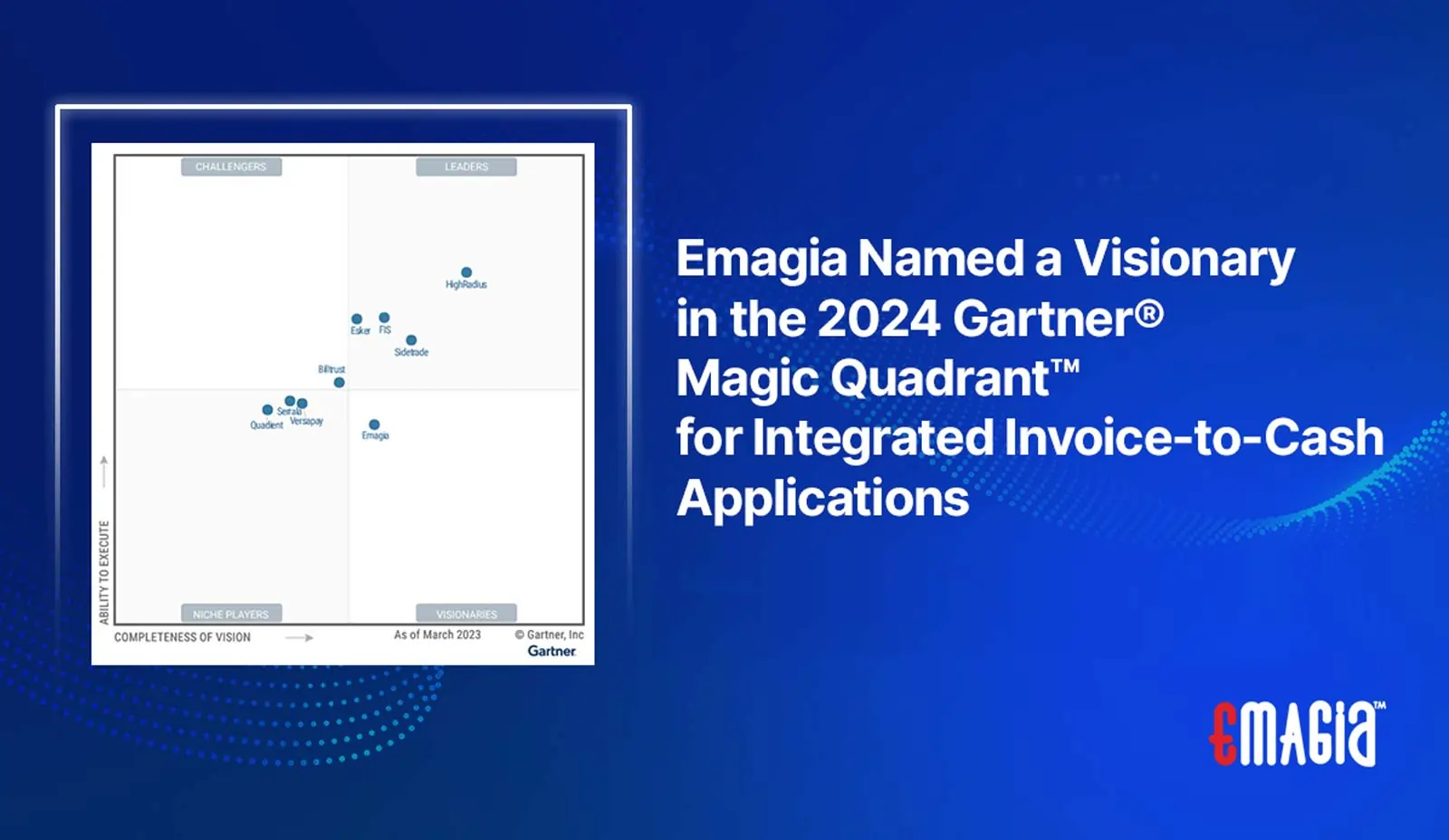
Recognized by Leading Industry Analysts

Cash Application Software FAQs
What is cash application software?
Cash application software matches incoming customer payments to open invoices in accounts receivable. It uses payment data, remittance information, and matching rules to help finance teams allocate receipts and update customer accounts.
What should enterprises look for in cash application software?
Evaluate remittance capture, invoice matching, payment splitting, exception handling, ERP integration, auditability, security, reporting, and support for your transaction volumes and global operating model. Ask vendors to demonstrate these capabilities with representative data.
What types of payments and remittances can Emagia handle?
Emagia describes remittance capture from emails, EDI, PDFs, spreadsheets, customer portals, and bank statements. Confirm the exact payment types, file formats, and channels supported for your environment with Emagia.
Can Emagia post payments directly to my ERP system?
Emagia describes integrations with major ERP environments, including SAP, Oracle, and Microsoft Dynamics. Confirm the supported product version, integration approach, posting controls, and implementation requirements for your ERP instance.
What is straight-through processing in cash application?
Straight-through processing (STP) is the share of eligible cash application transactions completed without manual intervention. Agree on which transactions count as eligible, how exceptions are treated, and the measurement period before comparing STP results.
How does Emagia reduce unapplied cash?
Emagia’s remittance capture and matching workflows are designed to identify payment references and match available information to open invoices. Transactions with missing or incomplete details can be routed for review, helping teams investigate unapplied cash.
Is it scalable for global operations?
Emagia positions its platform for enterprise and global shared-services environments. During evaluation, confirm the languages, currencies, regional bank formats, entities, and ERP configurations required for your deployment.
How can an enterprise estimate cash application automation ROI?
ROI depends on the current cost of cash application, payment volumes, automation coverage, implementation effort, and the value assigned to faster and more consistent receivables processing. Build the business case from your own baseline rather than relying on a universal payback period.
Does Emagia support deductions handling?
Emagia describes capabilities for identifying short payments and deductions and routing them into related workflows. Confirm the deduction reason codes, approval steps, and hand-off rules supported for your organization's configuration.
How secure is Emagia’s cash application platform?
Review Emagia’s current security documentation, available certifications or attestations, data-processing terms, access controls, encryption standards, and audit capabilities with your security and procurement teams. Confirm which controls and certifications apply to the product and deployment being evaluated.
Digital World-class Leaders Use Emagia Cash Application Automation Software

Driving world-class efficiency in global accounts receivables operations spanning across

170+
Connected Banks

1000
Customers

90
Countries

Achieving world-class digital Order-to-Cash performance globally in 15 months

>95%
Cash app
Rates

$4B
in Receivables
44
Countries