AI-Native Accounts Receivable
Automation Software
Accelerate Cash Flow. Reduce DSO. Maximize Collections.
Emagia’s AI-native accounts receivable automation software connects credit, invoicing, collections, cash application, deductions, and receivables analytics to help enterprise finance teams manage the invoice-to-cash lifecycle with greater visibility and less manual work.
World-Class Digital AR Leaders Excel with Emagia


The Top Autonomous AR Solution — Rapid ROI


Why Trust Emagia for Accounts Receivable Automation?
Emagia’s Accounts Receivable Software enables finance leaders to transform legacy A/R operations into agile, intelligent, and touchless digital processes. Powered by AI, ML, and advanced analytics, Emagia’s platform reduces manual effort, improves cash flow visibility, and drives faster collections.
What Is Accounts Receivable Automation?
Accounts receivable automation software is a finance technology platform that uses rules, integrations, intelligent document processing, machine learning, and AI-assisted workflows to automate the work involved in getting paid. It can support customer credit assessment, invoice delivery, payment tracking, collections, cash application, deductions and dispute resolution, and accounts receivable reporting.
Accounts receivable automation software connects finance teams with the data and workflows they need to manage outstanding invoices, apply incoming payments, prioritize collection activities, and monitor receivables performance. By reducing repetitive manual work and improving visibility across the receivables lifecycle, automation can help organizations manage cash flow and working capital more effectively.
Emagia brings together AI-native capabilities for credit, collections, cash application, deductions, invoicing, and analytics on an enterprise accounts receivable platform.
How Does Accounts Receivable Automation Work?
Accounts receivable automation connects key activities across the order-to-cash process. The exact workflow varies by organization, ERP environment, customer requirements, and payment channels. A typical automated receivables process includes the following stages:
1. Credit Evaluation and Customer Onboarding
Use customer information, credit data, and payment behavior to support credit assessment, onboarding, and ongoing risk monitoring.
2. Invoice Generation and Delivery
Generate, validate, and deliver invoices through the channels and formats required by customers, with visibility into invoice delivery.
3. Payment Tracking and Collections
Monitor outstanding invoices, prioritize collection activities, and coordinate customer follow-ups based on aging, risk, and payment behavior.
4. Cash Application and Reconciliation
Capture payment and remittance information, match incoming payments to open invoices, and support accurate cash posting.
5. Deductions and Dispute Management
Identify, categorize, assign, and track customer deductions and disputes through resolution workflows.
6. Receivables Reporting and Analytics
Monitor aging, DSO, collections performance, disputes, and cash application metrics to support finance decisions.
How an AI-Native Accounts Receivable Platform Connects Your Finance Operations
An enterprise accounts receivable automation system should connect the systems where invoices, payments, remittance details, and customer interactions already exist. The goal is to coordinate receivables work and return accurate updates to the financial system of record.
1. Connect finance data
Bring together ERP customer and invoice data, bank statements, lockbox files, payment channels, email, EDI, and customer or payment portals.
2. Capture and interpret
Capture invoice, payment, and remittance information. Use configured rules, OCR, intelligent document processing, and AI capabilities to organize data and identify exceptions.
3. Coordinate AR workflows
Support credit decisions, collections prioritization, cash application, deduction workflows, customer communication, and receivables analytics.
4. Resolve exceptions
Route unmatched payments, missing remittance details, disputes, and approval tasks to the appropriate finance team members.
5. Update the system of record
Synchronize supported receivables outcomes with the ERP and connected finance systems, subject to the configured integration and controls.
6. Monitor performance
Give finance leaders visibility into aging, DSO, collections, deductions, unapplied cash, and other receivables performance indicators.
Integration note: Emagia’s existing product content identifies SAP, Oracle, Microsoft Dynamics, and NetSuite environments, along with customer and payment portals. Confirm the exact connector, data flow, and integration scope for each deployment.
Traditional AR Processes vs. Connected Accounts Receivable Automation
Many finance teams still manage receivables through a combination of ERP functions, spreadsheets, email, bank files, and disconnected point solutions. An integrated AR automation platform connects these activities into a more coordinated process.
| Receivables activity | Manual or disconnected process | Connected AR automation approach |
|---|---|---|
| Credit management | Separate customer files, manual reviews, and periodic risk checks. | Centralized customer information, configurable credit workflows, and ongoing risk visibility. |
| Invoicing | Manual invoice preparation, delivery follow-ups, and limited delivery visibility. | Automated invoice validation and delivery through supported channels, with status visibility. |
| Collections | Static aging lists, manual account prioritization, and repetitive reminders. | Prioritized worklists, customer payment context, and configurable collection communication. |
| Cash application | Manual remittance review, spreadsheet matching, and delayed exception handling. | Payment and remittance capture, matching support, exception routing, and ERP update workflows. |
| Deductions and disputes | Email-based research, inconsistent reason coding, and fragmented ownership. | Structured reason capture, assignment, workflow tracking, and resolution visibility. |
| Reporting | Reports assembled from multiple systems and refreshed at different intervals. | Consolidated receivables dashboards and performance views across supported workflows. |
Key Features of Emagia Accounts Receivable Software
Benefits of Emagia Accounts Receivable Automation
Emagia’s AI-Native Accounts Receivable solution is designed for the digitally ambitious enterprise. It’s more than automation, it’s a transformation engine that empowers finance teams to operate with precision, foresight, and control. From intelligent credit decisions to autonomous collections and predictive insights, Emagia unlocks the full potential of receivables management.
Experience the Emagia Edge
Transform your receivables from a back-office function into a strategic growth lever.
Common Challenges in Accounts Receivable Management
Manual and fragmented A/R processes remain a silent barrier to financial agility and growth. From inconsistent follow-ups to prolonged dispute cycles, these inefficiencies compound over time—impacting cash flow, increasing operational costs, and frustrating customers. Here are the most common challenges finance leaders face without a modern A/R automation platform like Emagia:
Tracking overdue invoices manually often leads to uncoordinated communication and missed collection opportunities. Without intelligent prioritization, high-risk accounts may be overlooked, extending DSO and impacting cash predictability.
What This Leads To:
- Delayed payments and cash inflow disruptions
- Missed early intervention with delinquent accounts
- Inconsistent collector productivity and visibility gaps
Manual reconciliation of payments against invoices—often across emails, spreadsheets, and bank statements—is slow, error-prone, and resource-intensive. This outdated method delays cash application and occupies teams with non-strategic work.
What This Leads To:
- Slower cash posting and cash flow forecasting
- Higher risk of misapplied or unallocated payments
- Less time for strategic tasks like credit monitoring or risk assessment
Managing customer deductions and chargebacks manually often creates bottlenecks and revenue leakage. Without automated routing and resolution workflows, disputes linger unresolved, creating friction with customers and causing financial write-offs.
What This Leads To:
- Extended deduction cycle times
- Increased risk of write-offs and revenue loss
- Disconnected collaboration between sales, finance, and customer service
In the absence of a unified A/R dashboard, finance teams struggle to get a real-time view of receivables performance. Decisions are often reactive, based on delayed reports and siloed data across systems.
What This Leads To:
- Inaccurate cash flow forecasts
- Poor visibility into aging, disputes, and collector performance
- Delayed decision-making and missed growth opportunities
Legacy A/R processes rely heavily on institutional knowledge and manual judgment. As finance teams scale, this model becomes unsustainable—limiting operational agility and introducing risks tied to human error or team attrition.
What This Leads To:
- Inconsistent processes across geographies or teams
- Risk of losing key knowledge during staff turnover
- Difficulty scaling operations without proportional hiring

It’s Time to Reimagine Receivables
With Emagia’s AI-Native A/R automation platform, you can eliminate these pain points, drive transformation across the receivables lifecycle, and empower your team with tools built for the digital finance era.
How Emagia’s AR Automation Software Addresses These Challenges
In today’s fast-moving and often unpredictable economy, manual A/R isn’t just inefficient, it’s outdated. Delays in collections, cash posting errors, unresolved disputes, and fragmented data cost businesses far more than they realize. At Emagia, we believe A/R shouldn’t be a reactive cost center, it should be a predictive growth engine.
With our AI-Native platform, Emagia redefines receivables management—eliminating repetitive tasks, enhancing visibility, and driving faster cash flow. Here’s how we empower finance teams to move from manual to monumental:
Smarter Collections with Autonomous Prioritization
Your best collectors shouldn’t be guessing who to follow up with next. Emagia’s intelligent collections engine uses behavioral analytics and risk profiles to generate dynamic, auto-prioritized worklists. Every action is data-driven, timely, and optimized to reduce Days Sales Outstanding (DSO).
What You Gain:
- Precision-targeted follow-ups for faster recoveries
- Reduced DSO and collection fatigue
- Real-time visibility into collector performance and aging
Frictionless Cash Application with AI Matching
Stop matching payments manually. Emagia’s intelligent cash application automates complex payment matching—even when remittances are incomplete or scattered across formats. Using AI and machine learning, the system improves with every transaction, delivering unmatched automation accuracy.
What You Gain:
- Support high levels of straight-through payment processing across supported formats.
- Same-day cash posting for real-time liquidity insights
- Reduced manual workload and reconciliation errors
Intelligent Dispute Resolution That Doesn’t Miss Revenue
Disputes and deductions shouldn’t turn into write-offs. Emagia automates the entire lifecycle—capturing, categorizing, routing, and resolving cases at speed. Teams collaborate effortlessly, and nothing gets lost in the shuffle.
What You Gain:
- Faster dispute resolution and fewer write-offs
- Full audit trails and root cause analysis
- Recovery of revenue that would otherwise slip away
A Unified View of Your A/R Universe
Most CFOs struggle with scattered receivables data across ERPs, portals, and spreadsheets. Emagia centralizes it all into one intelligent dashboard. With AI-Native insights, you’ll know what’s coming in, what’s at risk, and what to act on—before it becomes a problem.
What You Gain:
- Predictive analytics for cash flow and risk management
- Custom dashboards and global visibility in one view
- Confidence in every receivables decision
Plug-and-Play with Your ERP, Scaled for Global Finance
Emagia integrates effortlessly with SAP, Oracle, Microsoft Dynamics, and more—without disrupting existing systems. Whether you’re scaling across geographies or centralizing shared services, our platform flexes to your needs.
What You Gain:
- Fast, secure deployment with minimal IT dependency
- Cloud-native architecture built for global enterprises
- Scalable automation across regions, teams, and currencies
Seamlessly Connect with Your Current ERP Systems


How AI Transforms Accounts Receivable Automation
AI is not just a new tool, it’s a new mindset for enterprise finance. In the accounts receivable function, artificial intelligence plays a transformative role: replacing outdated, manual routines with real-time intelligence, predictive power, and autonomous execution.
At Emagia, we embed AI deep into every layer of A/R to turn it from a cost center into a value creator—boosting speed, accuracy, and financial agility across the receivables lifecycle.
Here’s how AI reshapes A/R with Emagia:
01.
Collections that Think Ahead, Not Just Catch Up
Traditional collections chase overdue invoices. Emagia’s AI goes further—it predicts who is likely to delay payment, why, and when action should be taken. The system auto-generates intelligent, risk-weighted worklists based on behavioral analytics, customer history, and payment patterns.
With Emagia, you get:
- Predictive collections strategy based on real-time insights
- Prioritized outreach focused on impact, not volume
- Reduced follow-up cycles and improved recovery rates
02.
Cash Application That Handles Complexity with Ease
In today’s enterprise, payment data arrives from multiple sources—banks, portals, emails, PDFs. Emagia’s AI adapts in real time to match payments with open invoices, even when remittance data is inconsistent or incomplete.
What sets us apart:
- Support high levels of straight-through payment processing across supported formats.
- Zero-touch posting with continuous machine learning
- Accelerated cash visibility for better treasury decisions
03.
Forecasting, Not Firefighting: The Predictive Power of AI
Most A/R teams react to problems after they occur. Emagia flips the model—AI-powered dashboards forecast risk, highlight anomalies, and surface trends before they become issues. It’s finance intelligence that helps you plan, act, and lead with confidence.
Unlock the ability to:
- Predict delinquencies and at-risk accounts
- Refine credit policies using behavioral scoring
- Forecast cash flows with near real-time accuracy
04.
Connected Data, Coordinated Action
AI connects everything—collections, credit, deductions, and disputes—into one cohesive intelligence layer. It eliminates silos between teams and systems, turning fragmented data into synchronized action.
AI-driven A/R with Emagia results in:
- Cross-functional alignment between finance, sales, and service
- End-to-end transparency in customer account activity
- Faster resolution of disputes and fewer missed opportunities
Accounts Receivable Automation for Enterprises
Enterprise accounts receivable teams often manage high invoice volumes, multiple business units, complex customer requirements, and payments received through different channels. An enterprise AR automation platform should support consistent receivables workflows while giving finance teams visibility across customers, regions, and operations.
Emagia’s accounts receivable platform brings together credit management, collections, cash application, deductions management, digital invoicing, and analytics. Its capabilities are designed to help enterprise finance teams coordinate receivables activities and manage the customer payment lifecycle.
ERP Integrations and Implementation
Accounts receivable automation should work with an organization’s existing finance systems and processes. Emagia’s platform content identifies integrations with SAP, Oracle, NetSuite, Microsoft Dynamics, and other ERP environments. Integration scope, data requirements, and implementation timelines depend on each organization’s systems, workflows, and project requirements.
Accounts Receivable Automation for CFOs, Controllers, and AR Teams
The right accounts receivable automation solution should make work easier for the people who own cash flow, customer credit, collections, payment reconciliation, and receivables performance.
CFOs and VPs of Finance
Improve visibility into receivables, working capital, aging, cash application, and collection performance to support financial planning and decisions.
Controllers and AR Directors
Standardize receivables processes, monitor exceptions, manage controls, and track performance across teams and business units.
Credit Managers
Organize customer onboarding, credit information, approval workflows, and ongoing account-risk reviews.
Collections Managers
Prioritize customer accounts, coordinate follow-ups, monitor promises to pay, and identify accounts that need attention.
Cash Application Teams
Capture remittance details, match incoming payments, investigate exceptions, and improve visibility into unapplied cash.
Global Shared Services
Coordinate receivables processes across entities, regions, payment sources, and finance teams with consistent workflows and reporting.
Business Outcomes to Measure in an Accounts Receivable Automation Program
Transforming your accounts receivable with Emagia goes beyond automation, it delivers measurable, enterprise-grade results. From reducing financial friction to improving working capital, here’s how our intelligent A/R platform moves the needle on the KPIs that matter most to CFOs and finance leaders.
Reduced Days Sales Outstanding (DSO)
Time is cash. Emagia’s AI-driven workflows prioritize follow-ups, streamline disputes, and automate invoicing to help businesses get paid faster. The result: a meaningful reduction in DSO—unlocking working capital and accelerating cash inflow.
Business Impact:
- Faster invoice-to-cash cycle
- Lower dependency on external financing
- Improved liquidity for reinvestment
Lower Past-Due Receivables
Overdue invoices drain time and revenue. Emagia’s intelligent collections engine uses predictive analytics to engage high-risk accounts earlier and automate follow-ups with precision. That means fewer accounts slip through the cracks—and your receivables stay current.
Business Impact:
- Minimized aging buckets
- Reduced write-off exposure
- Stronger customer payment discipline
Improved Collection Effectiveness Index (CEI)
It’s not just about collecting more—it’s about collecting smarter. Emagia optimizes each collector’s workflow, guiding them to the right accounts at the right time. With automation doing the heavy lifting, your team becomes faster, sharper, and more productive.
Business Impact:
- Higher CEI performance across collection teams
- Increased invoice recovery rates
- Reduced cost-to-collect
Reduced Bad Debt Ratio
Bad debt isn’t just a number—it’s lost potential. With AI-based risk scoring and real-time visibility, Emagia enables early intervention on at-risk accounts. Intelligent insights drive better credit decisions and preserve revenue before it turns into a loss.
Business Impact:
- Lower financial risk and improved AR aging profile
- Fewer accounts moving to collections or write-offs
- Greater control over customer credit exposure
The ROI of Emagia: Tangible, Trackable, Transformational
Emagia turns accounts receivable from an administrative function into a strategic advantage. From working capital gains to bottom-line impact, every automated workflow is a step toward financial excellence.
Proven Accounts Receivable Automation: Unisys Global Shared Services
A published Emagia customer case study provides a concrete example of how a global shared-services organization approached receivables transformation.
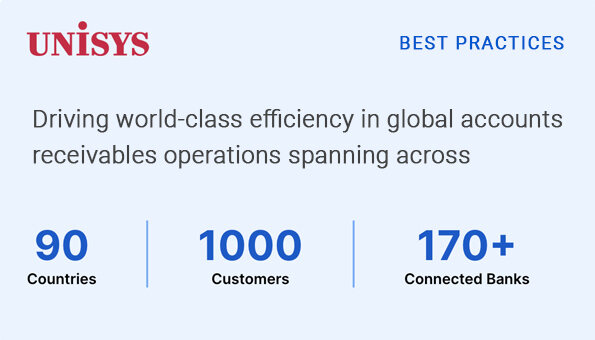
Unisys: Global AR operations across 90 countries
According to Emagia’s published Unisys case study, the deployment supported receivables operations for more than 1,000 customers and helped the organization standardize cash application, collections, and dispute resolution.
- Deployment across 90 countries and 7 languages.
- 90% cash-application auto-match rate across 170 banks.
- More than $2.95 billion in accounts receivable processed annually.
- Collection efficiency of 80% and above current AR, as reported in the case study.
90%
Cash application auto-match rate reported in the Unisys case study
$2.95B+
Annual AR processed in the reported deployment
90
Countries included in the deployment
Choosing the Right Accounts Receivable Automation Software
A useful evaluation should go beyond a feature checklist. Map the platform to your invoice-to-cash process, current ERP landscape, payment channels, exception volumes, control requirements, and business outcomes.
- Which receivables processes need automation first?
- Can the solution connect to our ERP, banks, lockboxes, and customer portals?
- How does it handle missing remittance data and unmatched payments?
- How are deductions, disputes, and collection exceptions assigned?
- Can finance leaders track DSO, aging, unapplied cash, and collections performance?
- What security, audit, and access controls are available?
- What customer deployments demonstrate results at a similar scale?
- What are the implementation responsibilities, timeline, and success measures?
FAQs: Emagia’s AI-Native Accounts Receivable Management Software
What is accounts receivable automation?
Accounts receivable automation is the use of software, integrations, and intelligent workflows to streamline credit, invoicing, collections, cash application, deductions, dispute resolution, and receivables reporting. Accounts receivable automation software helps finance teams manage the invoice-to-cash process with less manual work and better visibility.
Which accounts receivable processes can be automated?
Depending on the platform and business requirements, organizations can automate credit evaluation, invoice generation and delivery, payment reminders, collections prioritization, cash application, deduction and dispute workflows, and receivables reporting.
What is the difference between accounts receivable automation and accounts receivable management?
Accounts receivable management is the broader discipline of setting policies, overseeing customer balances, managing credit and collections, and monitoring receivables performance. AR automation uses software and workflows to streamline repeatable activities within that discipline.
What are the benefits of accounts receivable automation software?
Accounts receivable automation software can reduce repetitive work, improve invoice and payment visibility, support more consistent collections, accelerate payment matching, and help finance teams manage exceptions. Actual results depend on transaction volumes, data quality, integrations, process design, and adoption.
How does AI improve accounts receivable automation?
AI can analyze payment behavior and receivables data to help prioritize collection activities, identify at-risk accounts, match payments with open invoices, and surface trends for finance teams. Emagia’s page describes AI-driven capabilities across credit, collections, cash application, deductions, and analytics.
What should enterprises look for in an accounts receivable automation platform?
Evaluate end-to-end AR process coverage, ERP and bank connectivity, remittance capture, collections workflows, cash application, deductions management, analytics, security controls, scalability, implementation support, and customer evidence. The best AR automation software is the one that fits your receivables complexity and finance operating model.
Can Emagia integrate with ERP systems such as SAP, Oracle, NetSuite, and Microsoft Dynamics?
Emagia’s platform content identifies integrations with SAP, Oracle, NetSuite, Microsoft Dynamics, and other ERP environments. Confirm the specific connector, data flows, integration scope, and implementation requirements for your organization with Emagia.
How can accounts receivable automation help improve cash flow and reduce DSO?
Automation can support faster invoice delivery, prioritized collections, timely dispute handling, and more efficient cash application. These capabilities can help reduce avoidable delays in the invoice-to-cash cycle, although DSO and cash-flow results vary by customer, payment behavior, and process scope.
How long does Emagia implementation take?
Implementation timelines depend on the ERP environment, data quality, integration requirements, workflow scope, and organizational readiness. Emagia should confirm the project plan and expected go-live timeline for each deployment.
How does Emagia address security and compliance?
The existing Emagia page describes encryption, role-based access, and audit trails, and references GDPR and SOX requirements. Ask Emagia for current security documentation, certifications, and the controls applicable to your deployment and regulatory environment.