O2C Automation: Complete Guide to AI-Native Order-to-Cash
O2C automation, or Order-to-Cash automation, is the use of software, workflow automation, artificial intelligence, machine learning, analytics, and system integration to streamline activities from customer order through fulfillment, invoicing, collections, payment, cash application, and reconciliation.
Modern O2C automation connects traditionally fragmented processes so finance, sales, operations, customer service, and accounts receivable teams can work with more consistent data and coordinated workflows. Depending on the solution, automation can support order management, credit management, invoicing, collections, dispute and deduction management, cash application, reconciliation, and O2C analytics.
What Is O2C Automation?
O2C automation is the application of digital workflows, AI, machine learning, analytics, and system integrations to automate and coordinate the Order-to-Cash lifecycle.
The Order-to-Cash cycle begins with a customer order and can include credit assessment, order processing, fulfillment, shipping, invoicing, accounts receivable, collections, dispute resolution, payment processing, cash application, reconciliation, and reporting.
Traditional O2C environments often depend on spreadsheets, email, manual data entry, disconnected applications, and repetitive reconciliation. These approaches can create delays and make it difficult to maintain a consistent view of customer orders, invoices, receivables, payments, and exceptions.
O2C automation addresses these issues by connecting data and workflows across the revenue cycle. The objective is not simply to automate every task. It is to create a more connected operating model in which routine transactions are processed automatically and exceptions are surfaced to the appropriate finance professional.
O2C Automation vs. Traditional Automation
Traditional automation often uses predefined rules to execute repetitive tasks. More advanced O2C platforms combine rules-based automation with machine learning, generative AI, predictive analytics, and increasingly agentic AI.
| Approach | Primary Role |
|---|---|
| Manual processing | People perform data entry, review, matching, follow-up, and reconciliation. |
| RPA and workflow automation | Software executes predictable, rules-based tasks and workflows. |
| AI and machine learning | Systems identify patterns, make predictions, classify information, and support decisions. |
| Agentic AI | AI agents can coordinate multi-step activities within defined goals, policies, controls, and human-approval boundaries. |
How O2C Automation Works
A modern O2C automation environment connects transaction data from systems such as ERP, CRM, order management, billing, banking, payment, and customer-service platforms.
Typical automated O2C flow:
Customer Order → Credit Assessment → Order Processing → Fulfillment → Invoice → Payment → Accounts Receivable → Collections & Disputes → Cash Application → Reconciliation → Analytics
Automation can be introduced at individual stages or across the complete lifecycle. The greatest process visibility comes when these stages share data and workflow context rather than operating as isolated point solutions.
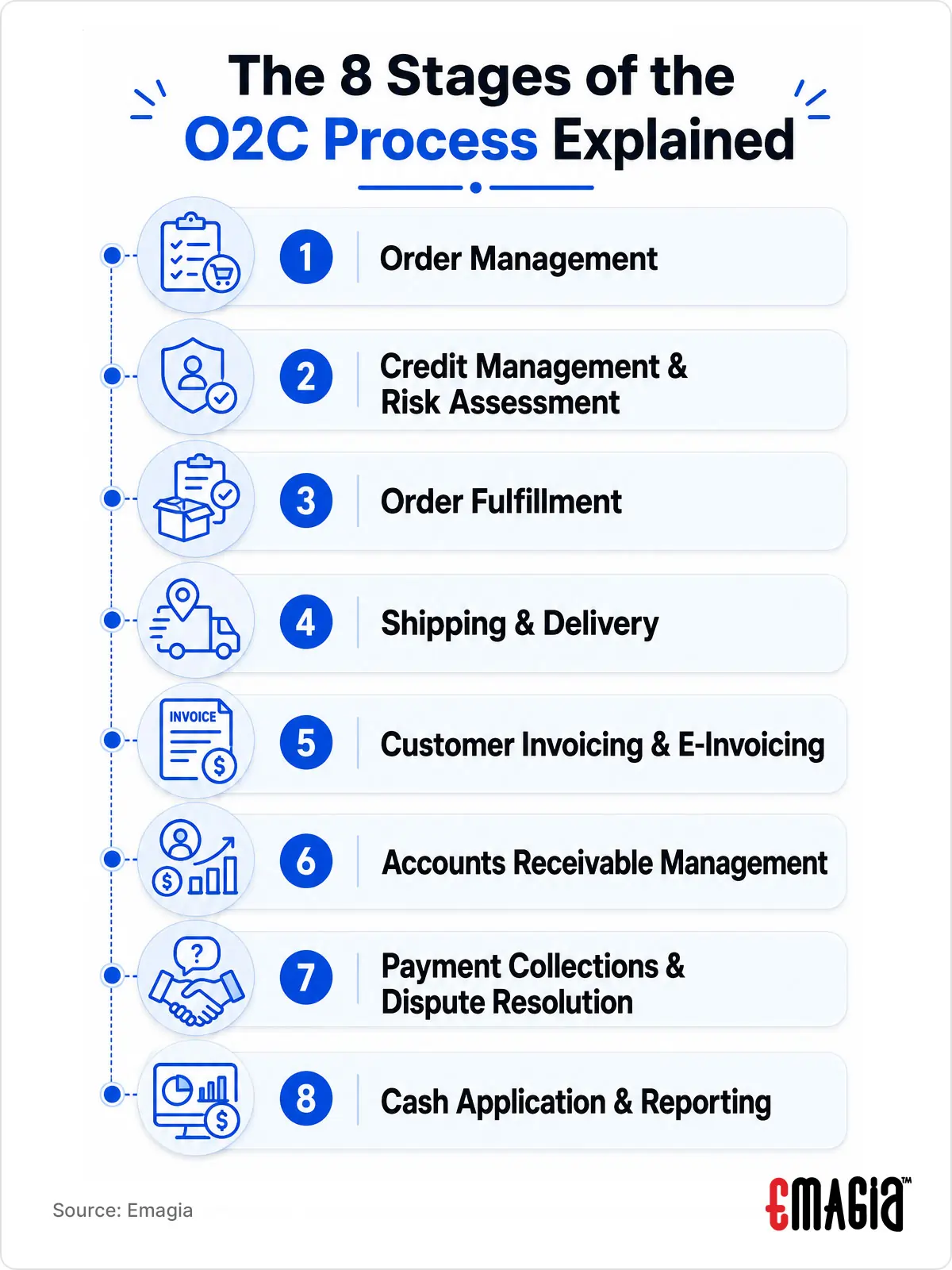
The 8 Stages of the O2C Process Explained
A typical Order-to-Cash process can be organized into eight major stages. Organizations may structure these stages differently depending on their industry, systems, customer contracts, and operating model.
Order Management
The cycle begins when a customer places an order. Automation can validate customer, product, quantity, pricing, and order information; route approvals; and connect order data with downstream systems. Reducing manual re-entry at this stage can help prevent downstream fulfillment and billing problems.
Credit Management & Risk Assessment
Before fulfillment, organizations may assess customer creditworthiness, available exposure, payment behavior, and applicable credit terms. AI and workflow automation can support the collection and analysis of information while routing credit decisions and exceptions to appropriate reviewers. See credit review for additional context.
Order Fulfillment
After approval, the organization fulfills the order. Automation can connect order management with inventory, warehouse, service-delivery, and fulfillment systems to reduce duplicate data entry and identify discrepancies before they affect billing.
Shipping & Delivery
For physical products, shipping and delivery information can feed downstream O2C workflows. Digital workflows can track delivery status, manage documentation, and trigger appropriate billing activities according to business rules and customer agreements.
Customer Invoicing & E-Invoicing
Invoice automation generates and distributes invoices using order, fulfillment, contract, and customer information. Validation against available source data can help identify errors before invoices are delivered. E-invoicing capabilities can also support customers and jurisdictions that require electronic invoice submission.
Accounts Receivable Management
AR automation provides visibility into open invoices, aging, customer balances, payment behavior, and collection activity. Automated workflows can generate statements, schedule reminders, prioritize work, and surface accounts requiring attention.
Payment Collections & Dispute Resolution
Collections automation can help prioritize accounts based on available customer, invoice, payment, and risk information. Dispute and deduction workflows can route exceptions, capture supporting information, track ownership, and monitor resolution. Digital invoicing and payments can also reduce friction between invoicing and payment.
Cash Application & Reporting
Cash application matches incoming payments with customer accounts and invoices. Automation can capture remittance information, identify likely matches, process standard transactions, and route unmatched or complex payments for review.
O2C reporting then brings together information about receivables, collections, disputes, cash application, payment behavior, and other operational indicators to help finance teams understand process performance.
Manual O2C vs. Automated O2C
The difference between manual and automated O2C is not simply the amount of software involved. It is the way information, decisions, transactions, and exceptions move through the process.
| O2C Dimension | Manual Process | Automated O2C |
|---|---|---|
| Order processing | Manual entry, validation, email, and approval workflows | Digital validation, routing, workflow automation, and system integration |
| Credit management | Manual information gathering and review | Automated data collection, risk analysis, workflows, and decision support |
| Invoice generation | Manual preparation and delivery | System-generated invoices using connected transaction data |
| Collections | Spreadsheet and email-driven follow-up | Prioritized worklists, workflow automation, analytics, and assisted communications |
| Cash application | Manual payment-to-invoice matching | Intelligent matching with exception workflows |
| Disputes | Email and spreadsheet tracking | Centralized case management, routing, ownership, and escalation |
| Reporting | Manual data consolidation | Connected dashboards and analytics |
| ERP integration | Exports, imports, and manual reconciliation | Connected data exchange and workflow orchestration |
What Does O2C Automation Software Do?
O2C automation software coordinates and automates activities across the Order-to-Cash lifecycle. Depending on the platform, capabilities may include:
- Order capture and validation
- Customer onboarding
- Credit assessment and monitoring
- Order and fulfillment workflows
- Invoice generation and delivery
- E-invoicing
- Accounts receivable monitoring
- Collections prioritization and workflow
- Dispute and deductions management
- Payment and remittance capture
- Cash application and invoice matching
- Reconciliation
- O2C analytics and reporting
- AI-assisted decision support
- Agentic workflow automation
The exact scope differs between platforms. Buyers should therefore evaluate whether a solution covers the specific O2C activities they need rather than assuming every product provides the same capabilities.
Benefits of O2C Automation
Faster Processing
Automation can reduce repetitive data entry, routing, matching, reconciliation, and follow-up activities across the O2C lifecycle.
Improved Cash-Flow Visibility
Connected O2C data provides finance teams with more timely visibility into receivables, collections, payments, disputes, and cash application.
Reduced Manual Work
Automation shifts repetitive transaction processing toward digital workflows, allowing finance professionals to focus more on exceptions, analysis, controls, and customer relationships.
Better Invoice Accuracy
Automated validation and system-generated invoices can reduce avoidable errors and rework when source data is accurate and properly integrated.
More Efficient Collections
Analytics and intelligent prioritization can help collectors focus attention on accounts where follow-up is most important.
Improved Cash Application
Intelligent payment matching can process routine transactions automatically while directing complex or unmatched payments to human reviewers.
Stronger Exception Management
Centralized workflows make it easier to identify, assign, escalate, and resolve O2C exceptions.
Greater Scalability
Digital workflows can help organizations process increasing transaction volumes without relying entirely on proportional increases in manual effort.
How AI and Agentic AI Transform O2C
O2C automation has evolved from basic rules-based processing toward AI-assisted and increasingly agentic workflows. RPA remains useful for predictable, repetitive activities, while AI can analyze information, identify patterns, make predictions, generate content, and assist with decisions.
AI for Credit Management
AI can help analyze customer information, payment behavior, financial data, and risk indicators to support credit assessment and monitoring. Human approval and governance remain important for decisions with material financial consequences.
AI for Collections
AI can analyze customer and invoice information to help prioritize collection activities, identify accounts requiring attention, and support personalized communications.
Generative AI for Dispute Management
Generative AI can assist finance professionals by summarizing customer interactions, analyzing dispute information, drafting communications, and organizing supporting documentation. Organizations should establish appropriate approval and governance controls before allowing AI-generated actions to be executed automatically.
AI for Cash Application
AI-powered cash application can analyze payment amounts, customer identifiers, invoice references, remittance information, and historical patterns to identify potential matches. Complex or low-confidence transactions can be routed to human reviewers.
Emagia describes its AI cash application as a machine-learning capability for intelligent payment matching.
AI for Cash-Flow Forecasting
AI can analyze historical payment behavior, receivables data, customer patterns, and other available information to support cash-flow forecasting. Forecast quality depends on the quality, completeness, and relevance of the underlying data.
What Agentic AI Adds
Agentic AI extends traditional automation by allowing AI agents to coordinate multiple steps toward a defined goal. In O2C, an agent may analyze a situation, retrieve relevant information, recommend or perform an approved action, update a workflow, and escalate an exception according to defined policies.
Current enterprise O2C vendors are increasingly positioning agentic AI around end-to-end process orchestration rather than isolated task automation.
Agentic AI vs. RPA in O2C
| RPA | Agentic AI |
|---|---|
| Follows predefined rules | Can reason across a defined task or goal |
| Best for repetitive, predictable activities | Useful for more variable, multi-step workflows |
| Requires explicit workflow logic | Can use context and AI models within guardrails |
| Primarily executes actions | Can analyze, recommend, coordinate, and execute approved actions |
| Often works at task level | Can coordinate across multiple O2C tasks |
Key O2C Metrics and KPIs to Track
Measuring O2C automation requires a balanced set of operational, financial, efficiency, quality, and customer metrics. A single KPI should not be treated as proof of successful automation.
| KPI | What It Measures | Why It Matters |
|---|---|---|
| Days Sales Outstanding (DSO) | Average time required to collect receivables | Provides a view of collection performance and working-capital efficiency |
| Collections Effectiveness Index (CEI) | Effectiveness of collecting available receivables | Helps evaluate collections performance |
| Cash Conversion Cycle (CCC) | Time involved in converting inventory investment into cash | Provides a broader working-capital view than O2C alone |
| Touchless Cash Application Rate | Share of payments matched without manual intervention | Measures cash-application automation effectiveness |
| Invoice Accuracy Rate | Percentage of invoices processed without identified errors | Helps identify billing-quality issues |
| Dispute Resolution Time | Time required to resolve disputes or deductions | Highlights bottlenecks affecting payment |
| Past-Due Receivables | Receivables that have passed their due dates | Shows collection exposure |
| Exception Volume | Transactions requiring manual review or intervention | Shows where automation or process improvement may be needed |
ERP Integration for O2C Automation
ERP integration is a critical part of O2C automation. A platform that automates one process but requires repeated exports, imports, or manual reconciliation can recreate the very inefficiencies automation is intended to remove.
O2C automation may need to exchange information with ERP, CRM, order-management, warehouse, billing, banking, payment, customer-portal, and analytics systems.
Common enterprise ERP environments include SAP, Oracle, Microsoft Dynamics, NetSuite, JD Edwards, and PeopleSoft. The appropriate integration architecture depends on the organization’s existing technology environment and requirements.
When evaluating an O2C automation platform, organizations should verify the actual integration method, supported ERP versions, data flows, security model, synchronization frequency, error handling, and governance capabilities rather than assuming that every listed ERP has identical integration depth.
How to Implement O2C Automation
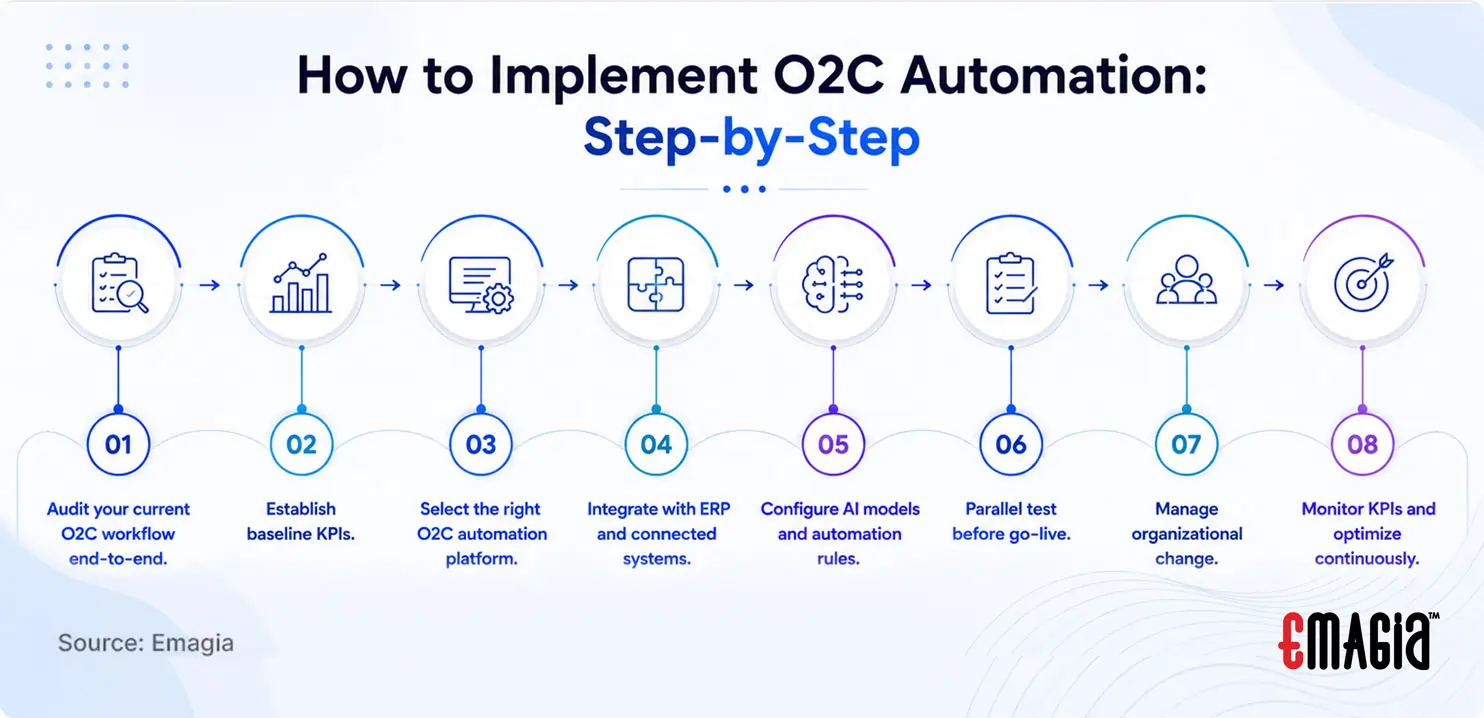
- Map the current O2C process. Document the process from order entry through cash posting. Identify manual handoffs, duplicate data entry, bottlenecks, exceptions, systems, and ownership.
- Establish baseline KPIs. Measure current DSO, collections performance, invoice accuracy, cash-application performance, dispute volumes, exception volumes, and relevant operating costs.
- Prioritize automation opportunities. Start with processes that are high-volume, repetitive, measurable, and suitable for automation.
- Select an O2C automation platform. Evaluate end-to-end coverage, ERP integration, AI capabilities, workflow management, analytics, controls, security, scalability, and implementation requirements.
- Integrate connected systems. Connect ERP, CRM, billing, payment, banking, customer portals, and other relevant systems.
- Configure workflows and controls. Define automation rules, approval requirements, exception routing, escalation paths, permissions, and human-review checkpoints.
- Test before full deployment. Validate data flows, matching results, invoice quality, workflows, exception handling, permissions, and reporting before expanding automation.
- Manage organizational change. Prepare finance teams for the shift from repetitive transaction processing toward exception management, analysis, controls, and strategic work.
- Monitor and continuously improve. Review KPI trends and exception patterns and use those insights to identify the next opportunities for process improvement and automation.
Common O2C Automation Challenges and How to Overcome Them
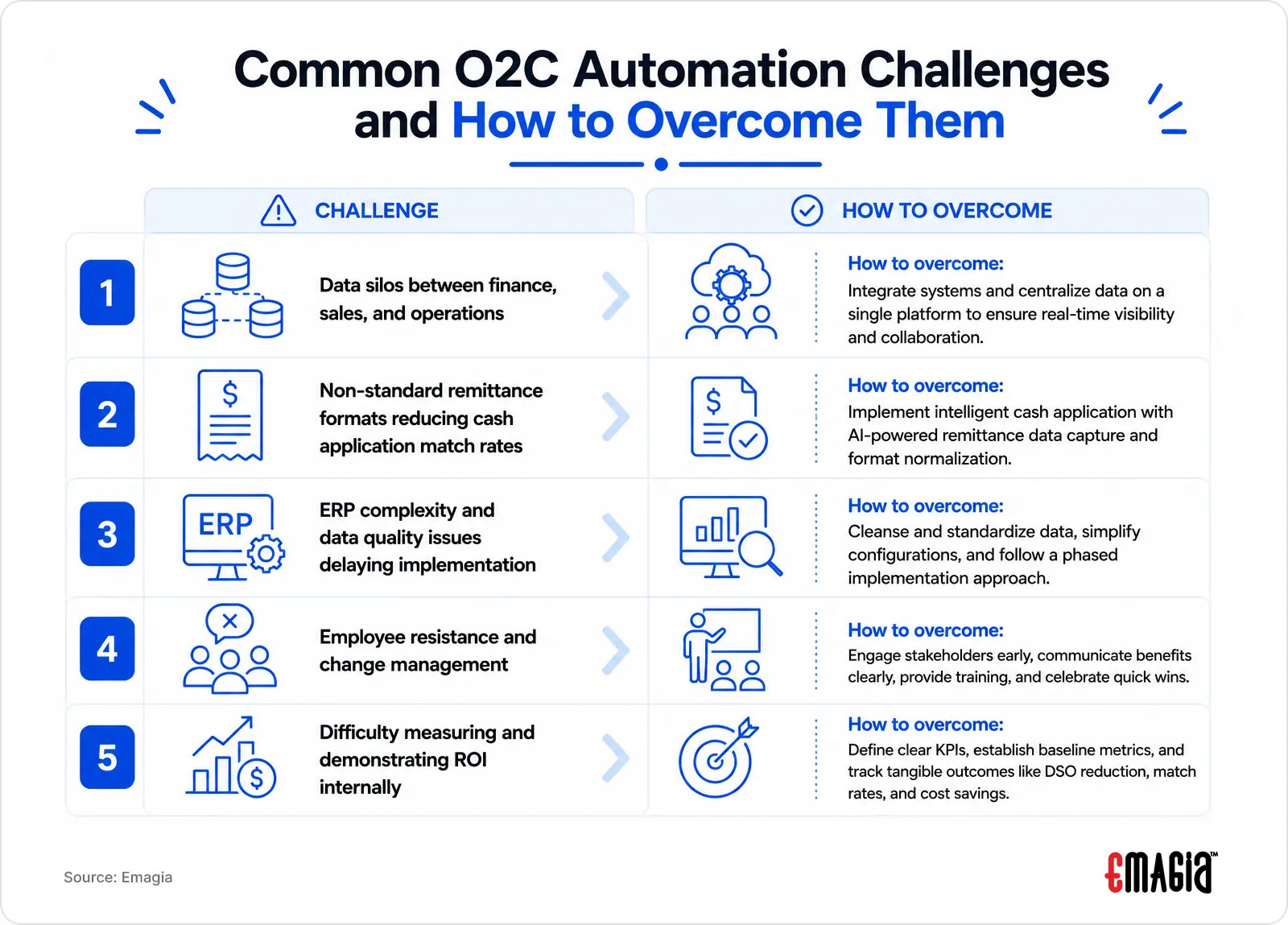
Data Silos
Challenge: Customer, order, invoice, payment, collections, and ERP data may exist in separate systems.
Approach: Use appropriate integrations and establish consistent data flows between systems.
Unstructured Remittance Data
Challenge: Payment information may arrive through email, portals, bank files, PDFs, EDI, or other formats.
Approach: Use intelligent data capture and payment-matching capabilities while routing uncertain transactions to human reviewers.
ERP Complexity
Challenge: Legacy systems, multiple ERP instances, customized workflows, and inconsistent master data can complicate automation.
Approach: Evaluate integration architecture, data quality, security, and implementation requirements before deployment.
Employee Adoption
Challenge: Automation changes finance roles and workflows.
Approach: Involve finance teams in process design, establish clear responsibilities, provide training, and position automation around higher-value work and exception management.
Measuring ROI
Challenge: Organizations may struggle to separate automation outcomes from other operational changes.
Approach: Establish a documented baseline before implementation and measure the same KPIs after deployment.
Industries That Benefit From O2C Automation
O2C automation can benefit organizations across industries, particularly businesses with high transaction volumes, complex customer relationships, multiple payment channels, significant receivables portfolios, or geographically distributed finance operations.
The automation priorities can differ by industry. Manufacturing and consumer-goods businesses may place significant emphasis on deductions, disputes, order fulfillment, and payment matching. Healthcare may require specialized billing and compliance workflows. Technology and SaaS businesses may focus on subscription billing, collections, payment processing, and receivables visibility.
How to Evaluate O2C Automation Software
Choosing an O2C automation platform requires more than comparing feature lists. Finance leaders should evaluate how well the platform fits their operating model, technology environment, transaction complexity, and governance requirements.
| Evaluation Area | Questions to Ask |
|---|---|
| O2C coverage | Does the platform support the O2C functions that matter to the organization? |
| ERP integration | Does it integrate with the organization’s ERP environment and related systems? |
| AI capabilities | Where is AI actually used, and what decisions or workflows does it support? |
| Exception management | Can the system identify, route, prioritize, and track exceptions? |
| Human oversight | Can users review, approve, override, and audit automated decisions? |
| Analytics | Can finance leaders monitor operational and financial KPIs? |
| Security and controls | Are permissions, auditability, data protection, and governance appropriate? |
| Scalability | Can the solution support transaction volumes, entities, currencies, regions, and business growth? |
| Implementation | What data, integrations, configuration, change management, and support are required? |
How Emagia’s AI-Native O2C Automation Platform Works
Emagia positions its O2C platform around AI-powered automation across the Order-to-Cash lifecycle. Its current product architecture includes capabilities spanning credit, receivables, collections, deductions, cash application, customer payments, generative AI, and O2C analytics.
The platform is designed to move beyond isolated task automation toward connected, intelligent O2C workflows.
Credit Risk Management
AI-powered credit scoring, credit workflows, risk monitoring, and decision support.
Receivables & AR Automation
Receivables visibility, aging analysis, payment tracking, and automated AR workflows.
Collections Management
AI-assisted prioritization, collection workflows, customer communications, and performance analytics.
Deductions Management
Deduction identification, classification, routing, dispute workflows, and resolution management.
Cash Application
AI and machine-learning capabilities for payment matching, remittance processing, and cash-application workflows.
Customer EIPP Portal
Digital customer capabilities for invoicing, payments, and related interactions.
GiaGPT — Generative AI for Finance
Natural-language interaction with finance information and AI-assisted insights and communications.
Advanced O2C Analytics
Dashboards, receivables analytics, O2C performance visibility, and cash-flow insights.
Emagia’s current public O2C positioning emphasizes AI-powered automation across credit, invoicing, collections, cash application and receivables, with a broader autonomous-finance direction.
Frequently Asked Questions About O2C Automation
What is O2C automation?
O2C automation is the use of software, workflow automation, AI, machine learning, analytics, and system integration to streamline the Order-to-Cash lifecycle. It can support order management, credit, fulfillment, invoicing, accounts receivable, collections, disputes, cash application, reconciliation, and reporting.
What are the 8 stages of the Order-to-Cash process?
A typical eight-stage O2C model includes order management, credit management and risk assessment, order fulfillment, shipping and delivery, customer invoicing, accounts receivable management, payment collections and dispute resolution, and cash application and reporting.
What is the difference between O2C automation and accounts receivable automation?
Accounts receivable automation generally focuses on downstream finance activities such as invoicing, collections, disputes, and cash application. O2C automation is broader and can include activities beginning with customer orders and credit management and continuing through fulfillment, billing, receivables, payment, and reconciliation.
How does AI improve O2C processes?
AI can support O2C through predictive credit analysis, collections prioritization, intelligent document processing, payment matching, dispute analysis, forecasting, analytics, and exception management. Agentic AI can extend this by coordinating multi-step activities within defined policies and controls.
What is the difference between RPA and agentic AI in O2C?
RPA generally follows predefined rules to automate predictable tasks. Agentic AI can use AI models and contextual information to coordinate multi-step activities toward defined goals, while appropriate human oversight and governance remain important.
What ERP systems can O2C automation integrate with?
Enterprise O2C platforms may integrate with ERP environments such as SAP, Oracle, Microsoft Dynamics, NetSuite, JD Edwards, and PeopleSoft. Actual integration depth, supported versions, architecture, and data flows should be verified with the individual vendor.
What KPIs should I track for O2C automation?
Important O2C KPIs include DSO, Collections Effectiveness Index, Cash Conversion Cycle, touchless cash-application rate, invoice accuracy, dispute resolution time, past-due receivables, and exception volume. The right KPI set depends on the organization’s goals and operating model.
How do you implement O2C automation?
Start by mapping the current process and establishing KPI baselines. Then prioritize automation opportunities, select a suitable platform, integrate connected systems, configure workflows and controls, test the solution, manage organizational change, and continuously monitor performance.
What are the biggest O2C automation challenges?
Common challenges include fragmented data, ERP complexity, inconsistent master data, unstructured remittance information, complex exceptions, employee adoption, integration requirements, and difficulty establishing reliable ROI baselines.
How does O2C automation affect DSO?
O2C automation can support DSO improvement by reducing process delays, improving invoice accuracy, prioritizing collections, accelerating dispute resolution, and improving payment application. The actual impact varies by organization and depends on process maturity, customer behavior, technology, and implementation quality.
Key Takeaways
- O2C automation connects and automates activities across the Order-to-Cash lifecycle.
- A typical O2C lifecycle includes order management, credit, fulfillment, shipping, invoicing, AR, collections and disputes, cash application, and reporting.
- Modern O2C automation combines workflow automation with AI, machine learning, analytics, and increasingly agentic AI.
- ERP and enterprise-system integration is critical for maintaining connected data and reducing manual reconciliation.
- Effective automation should handle routine transactions automatically while routing exceptions to the appropriate people.
- O2C performance should be measured with multiple KPIs rather than relying on a single benchmark.
- AI can support credit, collections, disputes, cash application, forecasting, analytics, and exception management.
- Successful implementation requires process mapping, baseline measurement, integration, governance, testing, change management, and continuous optimization.
O2C automation is ultimately about more than replacing manual tasks. The strategic opportunity is to create a connected, intelligent, and measurable Order-to-Cash operating model that gives finance teams better visibility, more efficient workflows, and greater control over receivables and cash.
Explore the O2C Platform Download Datasheet Read the O2C Deep Dive


