Managing accounts receivable in Asia requires finance teams to balance diverse markets, currencies, payment practices, customer expectations, regulatory environments, and cross-border transactions. For businesses operating across Asia-Pacific, effective AR management is not simply about collecting overdue invoices. It involves credit management, accurate invoicing, digital payments, collections, cash application, dispute resolution, cash-flow forecasting, and consistent financial controls.
Asia’s diverse business environment makes standardizing accounts receivable processes more complex than operating within a single market. At the same time, digital payments, cloud platforms, analytics, artificial intelligence, and automation are creating new opportunities to improve receivables visibility and working-capital management.
This strategic outlook examines the fundamentals of managing accounts receivable in Asia, the region-specific challenges finance teams face, and the role of digitization, automation, analytics, and AI in building more scalable AR operations.
What Is Accounts Receivable?
Accounts receivable (AR) represents money a business expects to receive from customers for goods or services that have already been delivered but not yet paid for.
The accounts receivable process generally begins when a business completes a sale and issues an invoice. It continues through invoice delivery, payment monitoring, collections, cash application, dispute resolution, and reconciliation until the receivable is settled.
For organizations operating across Asia, this process can involve multiple countries, currencies, languages, banks, payment methods, ERPs, tax requirements, and customer processes.
Example of Accounts Receivable in Asia
Consider a medical-products manufacturer that sells supplies to a retail distributor in another Asian market. After delivering the products, the manufacturer issues an invoice with agreed payment terms.
The unpaid invoice becomes an accounts receivable balance until the distributor makes the payment. The finance team then needs to receive the payment, identify the customer and invoice, apply the cash correctly, reconcile the transaction, and update the accounting records.
If the transaction crosses borders, additional considerations may include foreign currency, bank processing, payment references, remittance information, local payment methods, and differences in customer payment practices.
What Are the Main Goals of Accounts Receivable Management?
The primary objective of accounts receivable management is to ensure that customers pay accurately and on time while maintaining strong controls and customer relationships.
A well-managed AR process should help organizations:
- Collect customer payments according to agreed terms.
- Maintain accurate customer and invoice balances.
- Identify overdue and at-risk receivables early.
- Reduce unnecessary manual collection activity.
- Resolve disputes and deductions efficiently.
- Apply incoming cash accurately.
- Improve visibility into expected cash inflows.
- Control credit exposure and bad-debt risk.
- Support working-capital management.
- Provide reliable information for finance and management decisions.
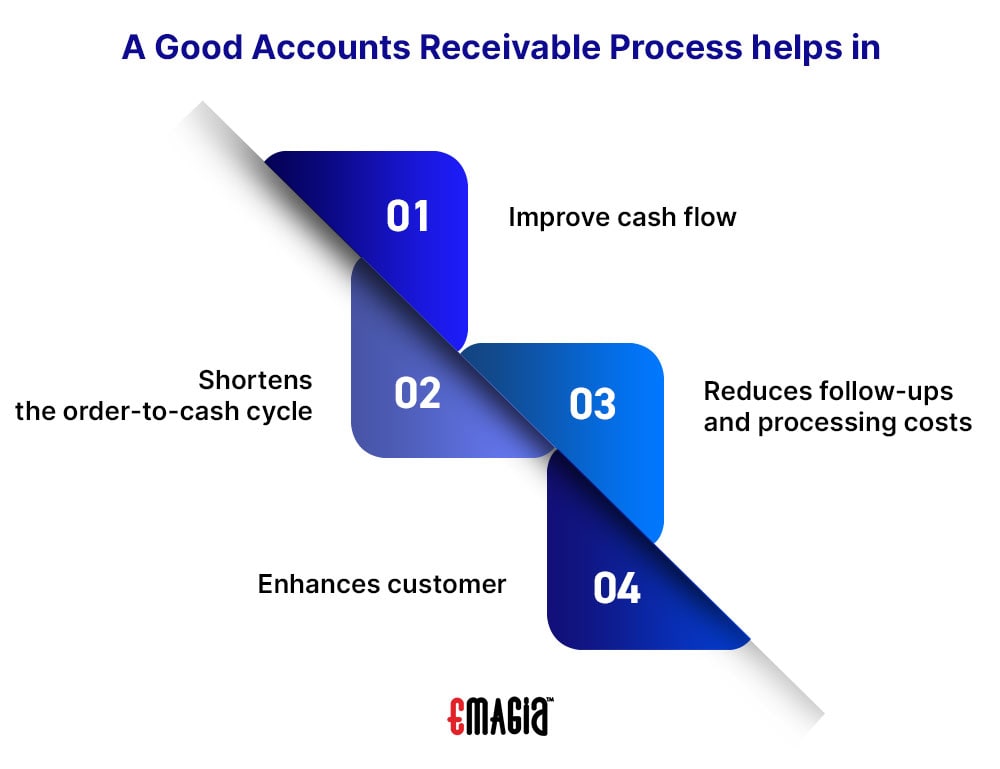
A Strong AR Process Can Help
- Improve cash-flow visibility
- Shorten the order-to-cash cycle
- Reduce manual processing and follow-up effort
- Improve payment application accuracy
- Strengthen customer communication
- Identify receivables risks earlier
Why Is Managing Accounts Receivable in Asia Complex?
Asia is not a single homogeneous market. Businesses operating across the region may have to manage different currencies, languages, banking systems, payment methods, business practices, regulatory environments, and customer expectations.
For multinational companies and regional enterprises, this complexity can make it difficult to standardize AR operations while still accommodating local requirements.
1. Multiple Countries and Currencies
Cross-border businesses may receive payments in multiple currencies and through different banking channels. Finance teams need accurate exchange-rate handling, payment identification, reconciliation, and reporting across entities and markets.
2. Different Payment Methods
Customers may use bank transfers, local payment networks, digital payment methods, cards, checks, lockboxes, or other mechanisms depending on the country and industry.
This diversity creates additional requirements for payment capture, remittance processing, cash application, and reconciliation.
3. Cross-Border Transactions
Cross-border receivables can introduce additional complexity around payment references, banking intermediaries, currencies, settlement timing, documentation, and customer communication.
4. Different Customer Payment Practices
Payment terms and payment behavior can vary by industry, market, customer size, and commercial relationship. Finance teams therefore need visibility into customer-specific payment patterns rather than relying exclusively on standardized collection schedules.
5. Language and Communication Challenges
Regional AR teams may interact with customers in multiple languages. Customer communications, remittance information, invoices, supporting documents, and collection interactions may therefore need multilingual capabilities.
6. Fragmented Financial Systems
Large Asian enterprises may operate multiple ERP instances, banking relationships, shared-service centers, customer portals, and regional finance systems. Fragmentation can make it difficult to establish a unified view of receivables.
7. Credit and Payment Risk
Economic conditions, customer financial strength, industry volatility, and extended payment terms can affect the collectability and timing of receivables. Strong credit assessment and continuous monitoring can help finance teams manage exposure.
Key Accounts Receivable Challenges for Asian Businesses
The regional environment creates both challenges and opportunities for AR transformation.
- Delayed customer payments: Late payments can tie up working capital and increase collection workload.
- High receivables volumes: Growing businesses may generate more invoices and payment transactions than manual teams can efficiently manage.
- Unapplied cash: Missing or incomplete remittance information can make payment matching difficult.
- Invoice disputes: Pricing, quantity, delivery, tax, and contractual differences can delay payment.
- Manual collections: Email, spreadsheets, and manual follow-ups can limit collector productivity.
- Multiple ERPs: Different business units may maintain separate financial systems.
- Cross-border reconciliation: International payments can require additional investigation and reconciliation.
- Compliance requirements: Finance teams must manage applicable local and cross-border regulatory requirements.
- Cybersecurity: Digital finance transformation increases the importance of protecting financial and customer data.
- Limited real-time visibility: Fragmented systems can make it difficult for CFOs to see the current state of receivables and expected collections.
What CFOs in Asia Need From Modern AR Operations
Modern AR management is increasingly connected to broader finance transformation. Recent Asia-Pacific CFO research highlights digital transformation and operational efficiency as important priorities, while recent working-capital research points to continued demand for more flexible and digital financial tools.
For AR specifically, this means finance leaders need more than basic invoice processing. They need visibility, automation, analytics, and controls that can operate across complex customer and organizational environments.
Real-Time Receivables Visibility
CFOs and AR leaders need a consolidated view of outstanding receivables, overdue balances, collection activity, disputes, deductions, unapplied cash, and expected payments.
Predictive Cash-Flow Insights
Historical payment behavior and current receivables information can help finance teams develop more informed expectations about customer payments and working capital.
Automated Collections
Automation can help prioritize collection activities, generate follow-ups, track promises to pay, and route exceptions to the appropriate team members.
Intelligent Cash Application
Automated payment matching can reduce manual work associated with identifying customers, invoices, remittances, and payment exceptions.
Digital Customer Interactions
Digital customer portals, payment options, automated notifications, and AI-assisted communication can make it easier for customers to access invoices, statements, payment information, and collection communications.
How to Improve Accounts Receivable Management in Asia
The fundamentals of effective AR management remain consistent across markets: establish appropriate credit controls, issue accurate invoices, communicate payment expectations clearly, monitor receivables, collect proactively, resolve disputes, apply cash accurately, and continuously analyze performance.
1. Strengthen Credit Controls
Credit decisions should consider customer financial information, payment history, exposure, risk, and approved credit limits. Monitoring should continue after customer onboarding because creditworthiness and payment behavior can change.
2. Improve Invoice Accuracy
Accurate invoices reduce avoidable disputes and make it easier for customers to approve and pay invoices. Organizations should validate pricing, quantities, tax information, customer details, purchase orders, and other required fields before invoices are issued.
3. Make Collections More Proactive
Rather than waiting until invoices become significantly overdue, AR teams can use payment behavior, aging, customer risk, and invoice value to prioritize accounts and initiate appropriate communications earlier.
4. Automate Cash Application
Automated cash application can capture payment and remittance information, match payments with invoices, identify exceptions, and post results to financial systems.
5. Centralize Dispute Management
Disputes should be captured, categorized, assigned, investigated, and tracked through resolution. Understanding recurring dispute causes can also help organizations address problems upstream in sales, order management, billing, logistics, or customer service.
6. Improve Customer Payment Experience
Digital payment options, electronic invoices, customer portals, automated reminders, and clear account information can reduce friction in the payment process.
7. Use AR Analytics
AR dashboards can help finance teams monitor DSO, aging, collection effectiveness, dispute values, unapplied cash, customer payment behavior, and other receivables KPIs.
Digitization and Automation in Asian Accounts Receivable
Digitization is particularly valuable when AR teams manage multiple countries, systems, payment methods, and customer communication channels.
Moving away from paper-based documents and disconnected spreadsheets can improve the consistency and availability of financial information. Digital invoicing and payment workflows can also make it easier to track transactions and provide customers with timely information.
Automation applications can further reduce repetitive work across collections, cash application, deductions, disputes, credit, invoicing, and reporting.
AI and Intelligent Automation for AR in Asia
AI can extend traditional workflow automation by helping finance teams interpret data, identify patterns, prioritize work, extract information from documents, and support customer interactions.
AI-Powered Collections
AI can help prioritize accounts based on payment behavior, risk, value, aging, and other signals. Emagia currently offers Gia Collect, an AI-powered collections agent designed for global collections operations and multilingual customer interactions.
AI-Powered Cash Application
Payment matching becomes more complex when finance teams process transactions from multiple banks, lockboxes, customer portals, and payment channels. Emagia’s current cash application platform supports bank and remittance integrations, AI-driven matching, remittance aggregation, deductions processing, and ERP posting.
Intelligent Document Processing
AR teams often receive invoices, remittance advice, checks, bank statements, and other documents in structured and unstructured formats. Gia Docs AI is positioned by Emagia as an intelligent document-processing capability for extracting and processing finance-document data.
Digital Finance Assistants
Gia is Emagia’s AI-powered digital finance assistant, designed to support finance users and customer interactions across Order-to-Cash activities such as credit, collections, deductions, and cash application.
How Automation Can Address Regional AR Challenges
| AR Challenge | Automation Opportunity | Potential Operational Benefit |
|---|---|---|
| Multiple payment channels | Payment and remittance aggregation | More centralized payment visibility |
| Manual cash application | AI-powered payment matching | Less manual matching and exception work |
| Delayed collections | Automated prioritization and follow-ups | More consistent collection activity |
| Unstructured documents | Intelligent document processing | Faster data extraction and reduced manual entry |
| Multiple languages | Multilingual digital communication | More scalable customer engagement |
| Disputes and deductions | Workflow-based case management | Improved ownership and resolution visibility |
| Fragmented ERP environments | Enterprise integrations | More connected receivables information |
| Limited cash visibility | AR analytics and forecasting | Better management insight into receivables trends |
Managing Accounts Receivable Across Multiple Asian Markets
Organizations operating across Asia should balance global standardization with local flexibility.
Standardize the Core Process
Organizations can establish common policies for credit, invoicing, collections, dispute management, cash application, approval workflows, and reporting.
Allow Local Process Variations
Local teams may still need flexibility for payment methods, languages, customer communication, banking requirements, currencies, documentation, and regulatory processes.
Create a Common Data Model
A consistent structure for customers, invoices, payments, disputes, deductions, collection activities, and credit information can improve reporting across countries and business units.
Centralize Analytics
Regional finance leadership benefits from consolidated reporting that allows receivables performance to be compared across entities and markets while retaining local operational detail.
Key Accounts Receivable Metrics for Asia-Pacific Businesses
Regional AR teams should monitor metrics that reveal both operational performance and working-capital risk.
- Days Sales Outstanding (DSO): Measures the average time taken to collect receivables.
- Receivables aging: Shows how much outstanding AR is current versus overdue.
- Collection effectiveness: Measures how effectively the organization converts receivables into cash.
- Unapplied cash: Measures payments received but not yet matched or applied.
- Dispute value: Shows the receivables amount tied up in customer disputes.
- Promise-to-pay performance: Tracks customer commitments and actual payment behavior.
- Collection productivity: Measures collector workload and effectiveness.
- Bad-debt exposure: Helps monitor potentially uncollectible receivables.
- Cash forecast accuracy: Compares expected customer receipts with actual collections.
Why the Future of AR Management in Asia Is Digital
The direction of finance transformation in Asia is increasingly toward connected digital workflows, analytics, automation, and AI. This does not mean every AR activity should become fully autonomous. Rather, organizations can automate repetitive work while keeping human oversight for exceptions, complex customer situations, credit decisions, disputes, and other judgment-intensive activities.
Current Emagia product capabilities illustrate this broader direction: its autonomous O2C platform brings together credit, receivables, collections, deductions, cash application, payments, intelligent document processing, and analytics within a connected finance environment.
How Emagia Helps Manage Accounts Receivable
Emagia provides AI-powered automation and analytics for enterprise Order-to-Cash and accounts receivable operations. Its current platform includes capabilities for credit, collections, deductions, cash application, payments, document processing, and O2C analytics.
Enterprise AR Automation
Emagia’s platform is designed to provide a connected view across receivables and Order-to-Cash processes, helping finance teams automate repetitive workflows and monitor receivables performance.
AI Collections
Gia Collect supports automated customer outreach, promise-to-pay capture, dispute logging, and multilingual collections interactions across global operations.
Intelligent Cash Application
Emagia’s cash application capabilities connect payment sources and remittance information with AI-powered invoice matching, exception handling, deductions processing, and ERP posting.
Intelligent Document Processing
Gia Docs AI can extract information from finance documents such as invoices, remittances, checks, bank statements, and lockbox files, helping reduce manual document-data processing.
Frequently Asked Questions
What are the main challenges of managing accounts receivable in Asia?
Common challenges include multiple currencies, languages, payment methods, banking systems, cross-border transactions, fragmented ERPs, different customer payment practices, disputes, credit risk, and limited visibility across regional operations.
How can businesses improve accounts receivable management in Asia?
Businesses can improve AR by strengthening credit controls, improving invoice accuracy, automating collections and cash application, centralizing dispute management, offering digital payment options, integrating financial systems, and using analytics to monitor receivables performance.
Why is AR automation important for Asian businesses?
AR automation can help organizations manage large transaction volumes and regional complexity by reducing repetitive work, connecting payment and receivables information, improving visibility, and standardizing core processes across markets.
How does AI help accounts receivable management?
AI can support collections prioritization, payment matching, document processing, payment forecasting, dispute analysis, customer communication, and other receivables workflows. Human oversight remains important for complex or judgment-based decisions.
How can companies manage AR across multiple Asian countries?
A practical approach is to standardize core policies, data structures, KPIs, and workflows while allowing local flexibility for currencies, languages, payment methods, banking processes, customer requirements, and regulatory considerations.
What AR metrics should CFOs monitor?
Important metrics include DSO, aging, collection effectiveness, unapplied cash, dispute value, promise-to-pay performance, bad-debt exposure, collection productivity, and cash-forecast accuracy.
Can digital payments improve accounts receivable performance?
Digital payment options can reduce payment friction and provide more structured transaction data, although the effect depends on customer adoption, payment infrastructure, reconciliation processes, and the specific markets involved.
Conclusion
Managing accounts receivable in Asia requires a combination of strong financial controls, proactive collections, accurate invoicing, efficient cash application, effective dispute management, digital payments, analytics, and scalable technology.
The region’s diversity makes a one-size-fits-all AR model difficult. Enterprises need to standardize the core receivables process while allowing appropriate local variations for currencies, payment methods, languages, banking environments, and customer requirements.
Digitization and AI can help finance organizations move beyond manual AR operations toward more connected, data-driven workflows. The opportunity is not simply to automate individual tasks, but to create a more visible, scalable, and responsive Order-to-Cash operation across the region.