Credit Management Software: Definition, Features, Benefits, and How It Works
What Is Credit Management Software?
Credit management software is a financial technology platform that helps businesses assess customer creditworthiness, automate credit approvals, monitor credit exposure, and manage credit-related collections. It enables finance teams to make more consistent credit decisions, reduce financial risk, and improve cash flow across the order-to-cash process.
Modern AI-powered credit management systems can analyze customer payment history, internal ERP data, and external credit information to help finance teams identify risk and make more informed credit decisions.
- Automate customer credit applications and approval workflows
- Assess customer credit risk using data and predictive analytics
- Monitor customer payment behavior and credit exposure
- Support bad debt prevention and working capital management
- Integrate credit processes with ERP, accounts receivable, and order-to-cash systems
For enterprise finance teams, credit management software helps balance revenue growth with credit risk while improving visibility and control over customer receivables.
In B2B commerce, credit management extends beyond maintaining customer records. A modern credit management solution brings customer data, credit policies, risk assessment, approvals, monitoring, and collections into a centralized workflow. This allows finance teams to make faster and more consistent decisions while maintaining appropriate controls over accounts receivable.
Organizations can also connect credit management with deduction management solutions and other order-to-cash processes to improve visibility across the customer financial lifecycle.
What Is Credit Management?
Credit management is the process of evaluating customers before extending credit, establishing appropriate credit terms and limits, monitoring credit exposure, and ensuring that customers pay according to agreed terms.
The objective is to support sales while controlling the financial risk associated with extending credit. Effective credit risk management therefore connects sales, credit, accounts receivable, and collections activities.
A centralized credit management system can replace disconnected spreadsheets and manual processes with standardized workflows, data visibility, approval controls, and audit trails. Organizations looking for software credit management capabilities should evaluate how well the platform supports their complete credit lifecycle.
Why Do Businesses Need Credit Management Software?
Businesses that sell on credit must balance customer growth with the risk of delayed or non-payment. Manual credit reviews can make it difficult to maintain consistent policies, monitor exposure, and respond quickly when customer risk changes.
Credit management software helps finance teams centralize customer credit information and automate repeatable activities.
- Reduce manual credit reviews and spreadsheet-based processes
- Improve visibility into customer credit exposure
- Accelerate credit application and approval workflows
- Identify potential credit risks earlier
- Support proactive bad debt management
- Improve receivables visibility and cash flow management
For larger organizations, credit management platforms can also become an important component of an overall order-to-cash automation strategy.
How Credit Management Software Works
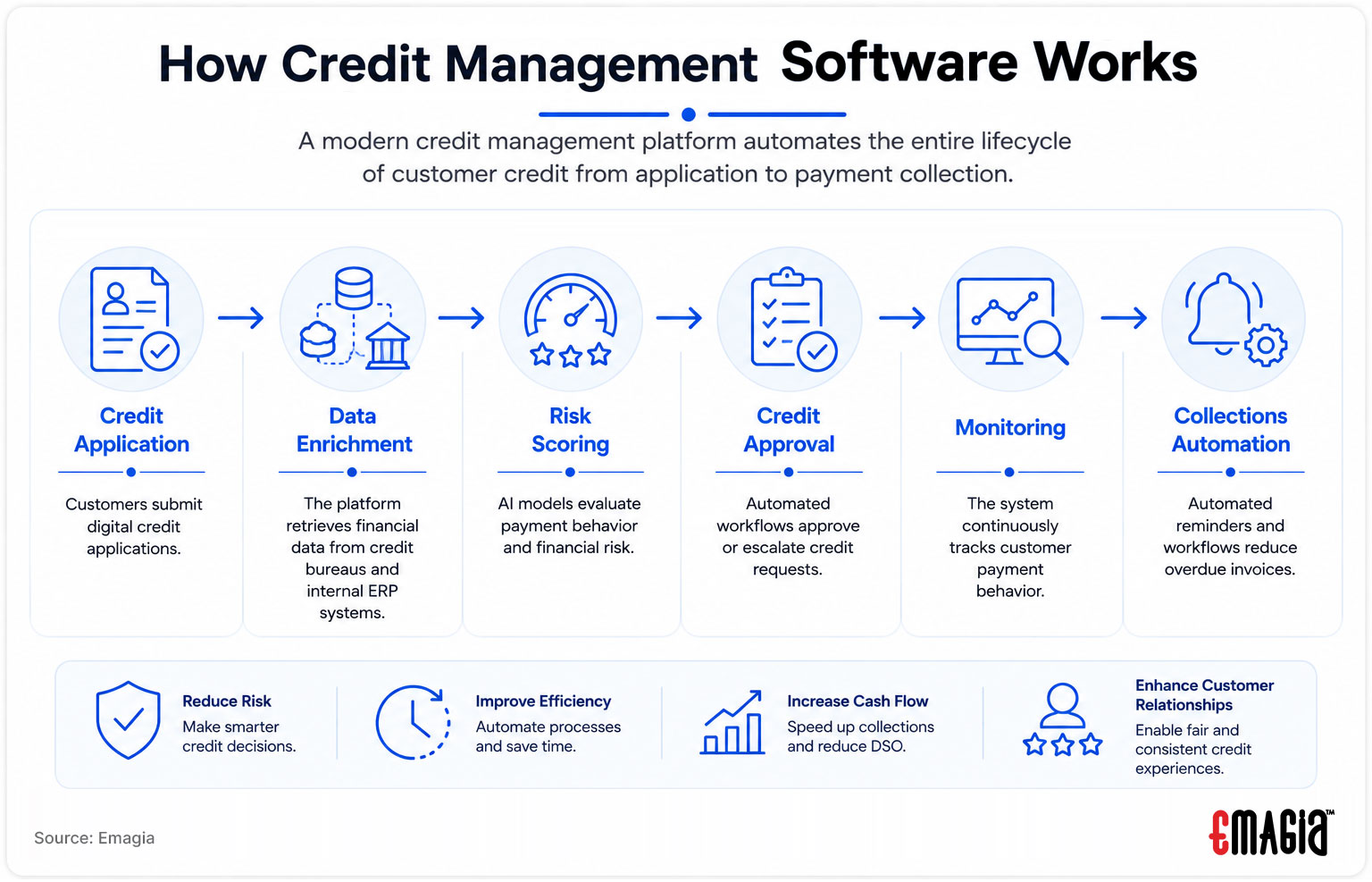
A modern credit management platform supports the customer credit lifecycle from application and evaluation through monitoring and collections.
- Credit application: Customer information is collected through a digital credit application.
- Data enrichment: Internal ERP information and relevant external credit data are brought together.
- Risk assessment: Credit data and payment behavior are analyzed to support a credit decision.
- Credit approval: Requests are approved automatically when predefined rules are met or routed for manual review when necessary.
- Credit limit management: Approved limits and terms are recorded and synchronized with relevant financial systems.
- Ongoing monitoring: Customer payment behavior and credit exposure are monitored over time.
- Collections: Overdue accounts can be routed into collections workflows and follow-up activities.
Key Features of Credit Management Software
1. Credit Risk Assessment
Credit risk assessment is a core capability of credit management. Modern platforms can combine customer financial information, payment history, credit data, and other relevant signals to help finance teams evaluate creditworthiness.
Credit risk software can also support automated scoring and risk classification, helping credit teams apply consistent policies across customers and accounts.
2. Digital Credit Applications and Approvals
Digital workflows simplify customer onboarding by replacing paper-based or email-driven credit applications with structured data collection and approval processes.
An automated workflow can route applications according to credit policies, approval thresholds, risk levels, and exceptions. This can help credit teams reduce administrative work while maintaining appropriate human oversight.
3. Credit Limit Management
Credit management software helps organizations establish, review, and monitor customer credit limits. Finance teams can use customer payment performance and risk information to determine whether existing limits remain appropriate.
4. Automated Collections
Credit management software can connect credit and collections activities so that overdue accounts are handled through consistent workflows.
Automated reminders, task assignment, follow-up scheduling, and customer prioritization can help collections teams focus their attention on accounts that require intervention.
5. Reporting and Analytics
Credit teams need visibility into customer exposure, payment behavior, overdue balances, risk levels, and collections performance. Credit management platforms provide reporting and analytics that help finance leaders identify trends and make data-driven decisions.
Advanced analytics can also support scenario analysis, allowing finance teams to evaluate how changes in credit policies, customer risk, or market conditions could affect receivables and liquidity.
6. ERP and Financial System Integration
Integration is essential for enterprise credit operations. Modern credit management software can connect with ERP, CRM, accounts receivable, and other financial systems to maintain consistent customer, credit limit, and payment information.
Integration reduces duplicate data entry and helps ensure that credit decisions are reflected in downstream order-to-cash processes.
Credit Management Software vs. Manual Credit Processes
| Capability | Manual Credit Management | Credit Management Software |
|---|---|---|
| Credit Applications | Paper, email, or spreadsheet-based processes | Digital applications and workflow automation |
| Credit Approvals | Manual review and routing | Rules-based approval and escalation workflows |
| Risk Assessment | Limited or fragmented information | Centralized data and risk analysis |
| Customer Monitoring | Periodic reviews | Ongoing monitoring and alerts |
| Collections | Manual follow-ups | Automated reminders and task workflows |
| Reporting | Spreadsheet-based reporting | Centralized dashboards and analytics |
Benefits of Credit Management Software
The primary benefit of credit management software is better control over the customer credit lifecycle. By bringing data and workflows together, organizations can improve decision consistency, reduce manual effort, and gain greater visibility into financial risk.
Improved Credit Decision-Making
Credit teams can use centralized customer information, payment history, risk indicators, and credit policies to make more informed decisions about credit approvals, terms, and limits.
Better Cash Flow Visibility
Credit management is closely connected to accounts receivable and collections. By identifying risk earlier and supporting timely follow-up, credit teams can contribute to more predictable receivables and cash flow.
Reduced Credit Risk
Continuous monitoring helps organizations identify changes in customer payment behavior and credit exposure. Early identification gives finance teams an opportunity to review credit terms or take appropriate action before problems become larger.
Greater Operational Efficiency
Automating repetitive activities such as application processing, data gathering, approvals, reporting, and follow-up allows credit professionals to spend more time on complex customer and risk decisions.
Stronger Policy Compliance
Standardized workflows help organizations apply credit policies consistently. Approval rules, escalation paths, documentation, and audit trails can also improve governance across credit operations.
Impact of Credit Management Automation
Credit management automation can affect several areas of finance operations, including credit approval speed, manual workload, customer risk visibility, collections prioritization, and receivables management.
- Faster processing of customer credit applications
- More consistent application of credit policies
- Earlier identification of customer risk signals
- Better visibility into credit exposure
- Reduced manual administrative work
- Improved coordination between credit, sales, accounts receivable, and collections
Actual results vary according to the organization’s starting processes, data quality, technology environment, customer portfolio, and implementation approach. Specific percentage improvements should therefore be validated against the organization’s own baseline.
How AI Is Changing Credit Management
Artificial intelligence is expanding the role of credit management software from workflow automation to predictive decision support.
AI-powered platforms can analyze large volumes of customer and payment information to identify patterns that may be difficult to detect through manual reviews alone.
AI-Powered Risk Analysis
AI can help analyze payment behavior, customer history, and other available data to support credit risk assessment and prioritization.
Early Warning Signals
Continuous analysis can help identify changes in customer behavior that may warrant attention from a credit professional.
Intelligent Credit Recommendations
AI can provide recommendations that help finance teams evaluate credit limits, customer risk, and appropriate follow-up actions. Human review remains important for material or exceptional credit decisions.
Agentic AI in Credit Management
Agentic AI introduces the possibility of software agents performing defined multi-step credit workflows, such as gathering information, analyzing customer data, preparing recommendations, and routing exceptions for human approval.
Organizations adopting agentic AI should establish appropriate governance, approval controls, auditability, data security, and human oversight before allowing AI systems to execute consequential financial actions.
Key Metrics and KPIs for Credit Management
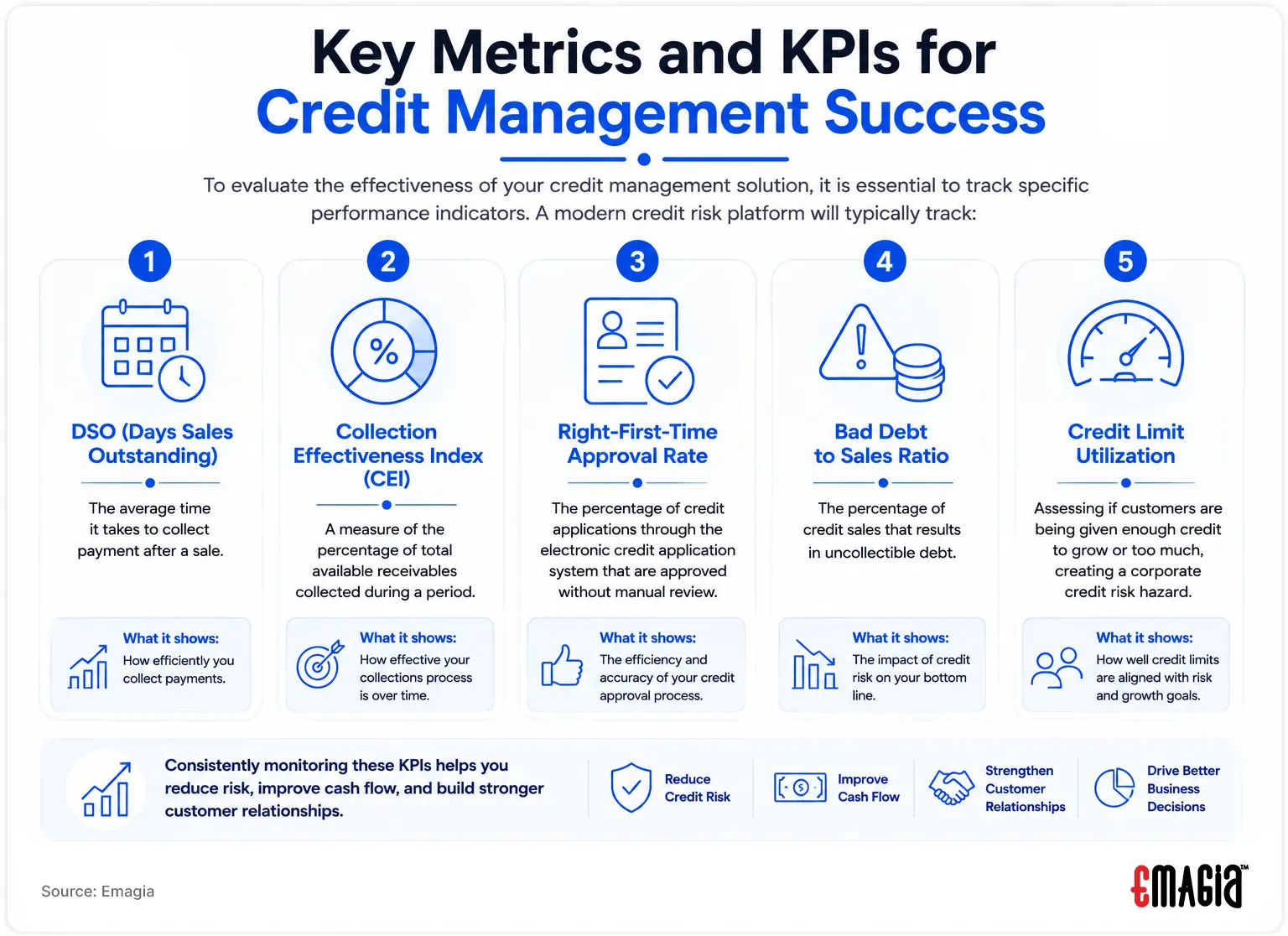
Finance leaders should measure credit management performance using KPIs that connect credit decisions with receivables, risk, and cash flow outcomes.
- DSO (Days Sales Outstanding): Measures the average time required to collect receivables.
- Collection Effectiveness Index (CEI): Measures collection effectiveness over a defined period.
- Bad Debt to Sales Ratio: Indicates the proportion of sales that becomes uncollectible.
- Credit Limit Utilization: Shows how much of a customer’s available credit is being used.
- Credit Approval Cycle Time: Measures how long it takes to process and approve credit applications.
- Overdue Receivables: Tracks balances that remain unpaid beyond agreed payment terms.
How to Choose the Best Credit Management Software
When evaluating credit management software, finance leaders should focus on the capabilities that align with their credit policies, customer volume, risk requirements, ERP environment, and order-to-cash strategy.
- AI and Credit Risk Analysis: Evaluate how the platform analyzes customer risk and payment behavior.
- ERP Integration: Confirm that the software can integrate with the organization’s ERP and financial systems.
- Credit Workflow Automation: Look for configurable application, approval, escalation, and credit limit workflows.
- Real-Time Monitoring: Determine whether the platform provides timely visibility into changes in customer risk and payment behavior.
- Reporting and Analytics: Evaluate dashboards, KPI reporting, risk analysis, and scenario modeling.
- Scalability: Consider whether the platform can support multiple entities, regions, currencies, and customer segments.
- Security and Governance: Review access controls, auditability, data protection, and human approval mechanisms.
Workflow: The Lifecycle of a Digital Credit Application
An online credit application software can transform customer onboarding by creating a structured workflow from application submission to credit activation.
- Submission: The customer completes a digital credit application.
- Data Enrichment: Relevant customer, financial, and credit information is collected.
- Scoring: The credit scoring engine evaluates available information against defined policies.
- Adjudication: The application is automatically approved when requirements are met or routed to a credit professional for review.
- Activation: Approved credit limits and customer information are synchronized with the relevant financial systems.
Credit Management Software Use Cases
Credit management software is particularly useful for businesses that extend credit to customers and need to manage significant receivables exposure.
Manufacturing
Manufacturers often manage large distributor and customer networks. Credit management software can help evaluate customer creditworthiness, establish appropriate limits, monitor payment behavior, and coordinate credit and collections activities.
Wholesale and Distribution
Wholesale and distribution businesses frequently extend trade credit. Automated credit workflows can help distributors manage credit limits, accelerate approvals, and reduce delays in order processing.
Technology and SaaS Companies
Technology companies serving enterprise customers may manage complex payment terms and global accounts. Credit management software can help finance teams standardize credit assessments and monitor payment performance.
Logistics and Supply Chain
Logistics and transportation companies depend on timely customer payments. Credit risk analytics can help these organizations monitor customer exposure and identify accounts that may require closer attention.
Global Enterprises
Multinational organizations can use credit management platforms to standardize policies, workflows, and reporting across regions while maintaining visibility into global customer exposure.
Who Uses Credit Management Software?
Credit management software supports multiple roles across finance and the broader order-to-cash organization.
- Chief Financial Officers (CFOs): Monitor financial risk, working capital, and overall credit performance.
- VP Finance and Controllers: Establish policies, controls, and governance.
- Credit Managers: Assess customers, manage limits, and monitor credit exposure.
- Accounts Receivable Managers: Connect credit decisions with receivables performance.
- Collections Managers: Prioritize overdue accounts and coordinate collection activities.
- Shared Services Leaders: Standardize credit operations across business units and regions.
How Credit Management Software Fits into the Order-to-Cash Process
Credit management is an important part of the order-to-cash process. Credit decisions made before an order is fulfilled can directly influence downstream receivables and collections activities.
Within the order-to-cash lifecycle, credit management software can connect:
- Credit Risk Management: Evaluating customer creditworthiness before extending credit.
- Accounts Receivable Management: Monitoring outstanding invoices and payment behavior.
- Collections Management: Supporting reminders, follow-ups, and dispute-related workflows.
- Cash Application: Connecting incoming payments with outstanding invoices.
- Financial Analytics: Providing visibility into credit exposure, delinquency, and working capital performance.
Connecting these activities can provide finance teams with a more complete view of customer financial performance and credit risk.
Credit Management Software: Emagia
Emagia provides AI-driven credit management capabilities designed to help enterprises manage credit risk as part of their broader order-to-cash operations.
The platform is positioned around intelligent automation, credit risk analysis, customer monitoring, digital credit workflows, and integration with enterprise financial processes.
Key Credit Management Capabilities
- AI-Powered Credit Risk Assessment: Supports analysis of customer creditworthiness and payment behavior.
- Digital Credit Applications: Helps streamline customer credit onboarding and information collection.
- Credit Decision Support: Helps credit teams evaluate applications against business policies and available data.
- Customer Risk Monitoring: Supports ongoing visibility into customer credit performance.
- Collections Automation: Connects credit processes with downstream receivables and collections workflows.
- ERP Integration: Helps connect credit information with enterprise financial systems.
For organizations managing large B2B customer portfolios, an integrated credit management platform can help reduce fragmented data, standardize workflows, and improve collaboration between credit, sales, accounts receivable, and collections teams.
Leading Credit Management Software Platforms
Organizations evaluating credit management software may compare vendors based on credit risk capabilities, workflow automation, integrations, analytics, scalability, and broader order-to-cash functionality.
- Emagia – AI-driven credit risk management and order-to-cash automation
- HighRadius – credit and collections automation platform
- Billtrust – AR automation and B2B payments platform
- Esker – cloud-based accounts receivable and credit management solutions
- CR Software – credit risk management and collections software
The right platform depends on the organization’s credit policies, customer portfolio, ERP environment, geographic footprint, automation requirements, and governance needs.
Future Trends in Credit Management
Credit management is increasingly moving toward predictive analytics, AI-assisted decision-making, workflow automation, and continuous customer risk monitoring.
Generative and Agentic AI
Generative AI can assist credit professionals with summarization, customer communications, analysis, and decision preparation. Agentic AI may extend this capability by coordinating defined multi-step workflows under appropriate controls.
Continuous Risk Monitoring
Rather than relying only on periodic customer reviews, organizations are moving toward continuous monitoring of payment behavior and other available risk signals.
Greater Integration Across Order-to-Cash
Credit, accounts receivable, collections, cash application, and financial analytics are increasingly being connected so finance teams can manage customer risk using a more complete view of the order-to-cash lifecycle.
Frequently Asked Questions About Credit Management Software
What is credit management software?
Credit management software is a digital platform that helps businesses assess customer creditworthiness, automate credit applications and approvals, manage credit limits, monitor customer risk, and support collections.
How does credit management software improve cash flow?
It can support cash flow by helping businesses make informed credit decisions, identify customer risk earlier, automate collections workflows, and improve visibility into receivables and payment behavior.
Can credit management software integrate with ERP systems?
Yes. Enterprise credit management platforms are commonly designed to integrate with ERP, CRM, accounting, and accounts receivable systems so customer and credit information can flow across financial processes.
What is the difference between credit management software and accounting software?
Accounting software primarily records and manages financial transactions. Credit management software focuses on customer creditworthiness, credit policies, credit limits, risk monitoring, approvals, and credit-related workflows.
What is credit scoring software?
Credit scoring software uses defined models and available customer information to assess creditworthiness and assign a risk score or classification. It is often used as part of a broader credit management system.
What are the benefits of AI in credit management?
AI can help finance teams analyze customer data, identify risk patterns, prioritize accounts, generate recommendations, and automate selected credit workflows. Human oversight remains important for significant or exceptional credit decisions.
How does a B2B credit management system differ from B2C credit management?
A B2B credit management system typically supports commercial customers, larger credit exposures, negotiated payment terms, account-level credit limits, and more complex customer relationships. B2C credit processes often rely on more standardized consumer credit models.
What should businesses consider when selecting credit management software?
Key considerations include credit risk analytics, application and approval workflows, credit limit management, ERP integration, customer monitoring, reporting, scalability, security, auditability, and integration with the broader order-to-cash process.
Get Started With Credit Management Automation
Organizations looking to modernize credit operations can evaluate how automation, AI-driven risk analysis, digital credit applications, and integrated order-to-cash workflows can improve visibility and control.
Transform Credit Risk Management with AI
Emagia’s AI-driven credit management software helps enterprises automate credit workflows, monitor customer risk, and connect credit operations with the broader order-to-cash lifecycle.


