O2C (Order to Cash) is the broader end-to-end business process that begins with a customer order and extends through fulfillment, invoicing, collections, cash application, and revenue-related activities. Invoice to Cash (I2C) is a narrower phase within O2C that begins around invoicing and focuses on billing, payment collection, cash application, and related accounts receivable activities.
In simple terms: O2C covers the broader order-to-revenue journey, while Invoice to Cash focuses on converting an invoice into collected and properly applied cash.
| Comparison | Order to Cash (O2C) | Invoice to Cash (I2C) |
|---|---|---|
| Scope | End-to-end revenue cycle | Financial collection phase within O2C |
| Starts with | Customer order | Invoice generation |
| Primary focus | Order execution, fulfillment, billing and cash realization | Billing, payments, collections, cash application and receivables |
| Key teams | Sales, operations, logistics and finance | Billing, Accounts Receivable, treasury and collections |
Understanding the distinction matters because a company can have efficient order fulfillment while still experiencing problems with invoicing, collections, cash application, disputes, or unapplied cash. These downstream issues can delay cash realization even when orders are being fulfilled successfully.
What Is the Difference Between O2C and I2C?
The main difference between O2C and I2C is scope. Order to Cash covers the broader process from receiving and fulfilling a customer order through billing and payment collection. Invoice to Cash concentrates on the post-invoice financial activities required to turn billed amounts into collected and correctly applied cash.
O2C therefore provides the broader process framework, while Invoice to Cash represents a more focused part of that framework.
The terminology can vary between organizations. In finance, Invoice to Cash is sometimes abbreviated as I2C, but the acronym can also refer to “Inter-Integrated Circuit” in electronics. For this article, I2C means Invoice to Cash.
The distinction is also reflected in enterprise process models: SAP describes Invoice to Cash as a substage of the broader Order to Cash process.
O2C vs I2C at a Glance
The easiest way to understand the relationship is to think of O2C as the larger process and Invoice to Cash as one of its financially focused stages.
| Feature | Order to Cash (O2C) | Invoice to Cash (I2C) |
|---|---|---|
| Definition | End-to-end process for converting customer orders into collected revenue | Process focused on converting invoices into collected and applied cash |
| Starting point | Customer order or sales order | Invoice generation |
| Ending point | Cash realization and related financial processing | Collection, cash application and account settlement |
| Scope | Broad | Narrower |
| Order management | Included | Generally outside the core scope |
| Fulfillment | Included | Generally outside the core scope |
| Invoicing | Included | Included |
| Collections | Included | Included |
| Cash application | Included | Core activity |
| Dispute management | May be included | Commonly included |
What Does O2C Stand For?
O2C stands for Order to Cash. It describes the connected business activities that take place from the time a customer places an order through fulfillment, invoicing, payment collection, and cash realization.
O2C is therefore not a single accounting task. It is a cross-functional business process involving multiple teams and systems.
For a broader explanation of the process, see the Order to Cash business process.
What Are the Main Stages of the O2C Process?
Although O2C workflows differ between organizations and industries, a typical process includes the following stages:
- Order entry and validation: The customer order is received, reviewed and validated.
- Credit management: Customer creditworthiness, limits and payment terms may be assessed before or during order processing.
- Fulfillment and delivery: Products are picked, packed and shipped, or services are delivered or provisioned.
- Invoicing and billing: The customer is billed according to the applicable commercial terms.
- Collections: Finance teams monitor outstanding invoices and follow up on overdue balances.
- Cash application: Customer payments are matched and posted against the appropriate receivables.
- Deduction and dispute management: Short-pays, deductions and invoice disputes are investigated and resolved.
- Financial reporting and reconciliation: Transactions are reconciled and reflected appropriately in financial reporting.
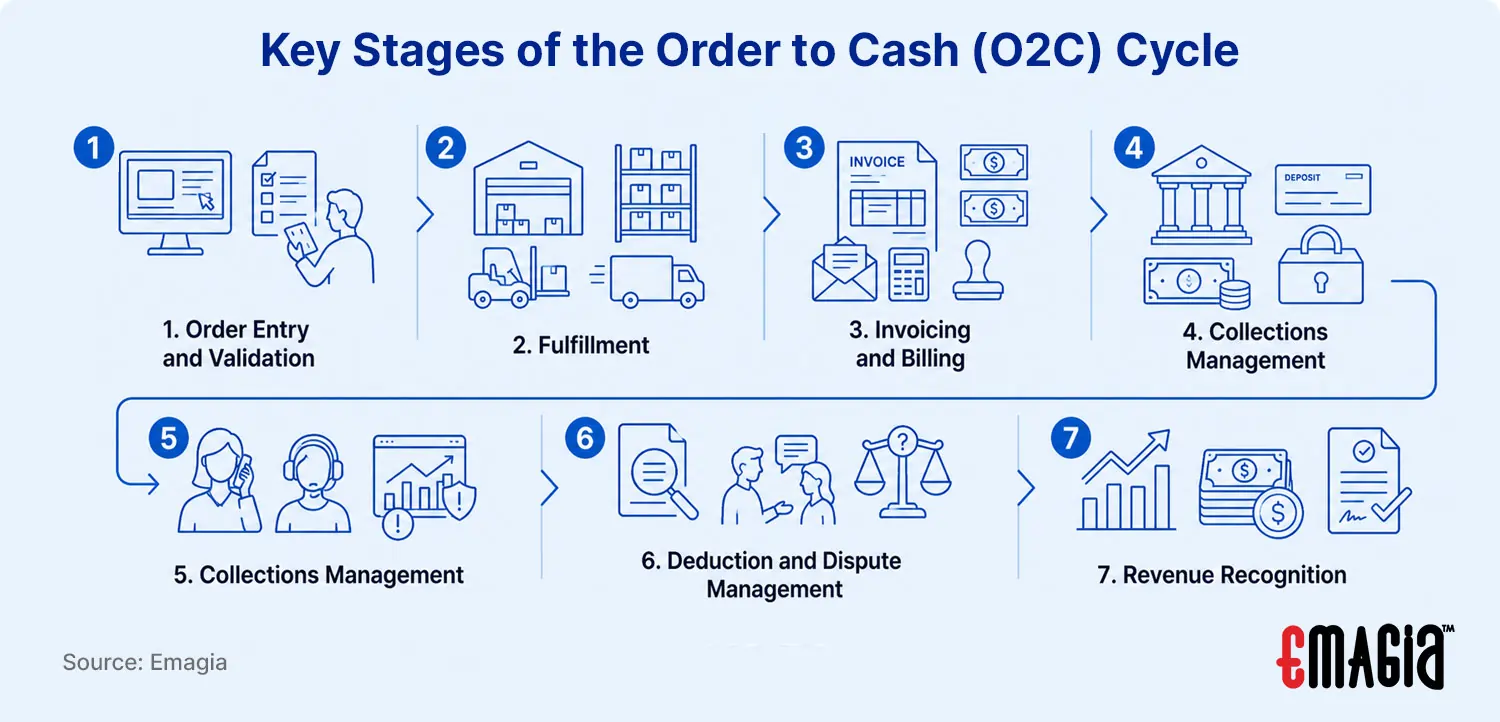
Every stage can affect the speed and accuracy with which a company converts sales into cash. A delay early in the process can create downstream consequences for billing, collections and cash flow.
What Is Invoice to Cash (I2C)?
Invoice to Cash is the financial process that begins with invoicing and continues through payment collection, cash application, and related accounts receivable activities.
It focuses on what happens after a customer is billed: delivering the invoice, receiving payment, managing outstanding balances, resolving payment issues, and applying cash accurately to customer accounts.
Because Invoice to Cash is narrower than O2C, it does not normally encompass the entire order-entry and fulfillment lifecycle.
What Are the Main Activities in Invoice to Cash?
1. Invoicing and Billing
The process begins with creating and delivering an accurate invoice based on the applicable order, contract, pricing, tax, quantity and payment terms.
Invoices may be delivered through email, customer portals or electronic invoicing channels such as Electronic Invoice Presentment and Payment (EIPP).
2. Payment Processing
Customers may pay through multiple channels, including checks, ACH, wire transfers, credit cards, virtual cards and other electronic payment methods.
3. Remittance Processing
Payment information and remittance advice may arrive through different channels and in different formats. Finance teams need to interpret that information to determine which invoices a payment should settle.
4. Cash Application
Cash application is the process of matching incoming customer payments with outstanding invoices and posting the payment to the appropriate Accounts Receivable accounts.
Accurate cash application reduces unapplied cash, improves receivables visibility and helps maintain accurate customer account balances.
5. Collections Management
Collections teams monitor outstanding and overdue invoices, prioritize accounts and communicate with customers to secure payment.
Collection performance is commonly evaluated using metrics such as Days Sales Outstanding (DSO).
6. Deduction and Dispute Management
Customers may pay less than the invoiced amount because of pricing differences, damaged goods, promotional deductions, service issues or other disputes. These exceptions need to be investigated, documented and resolved.
7. Reconciliation
Payments need to be reconciled against bank records, customer accounts and the Accounts Receivable ledger to maintain accurate financial information.
How Are O2C and I2C Related?
Invoice to Cash is generally treated as a focused component or sub-process within the broader Order to Cash lifecycle.
A simplified relationship looks like this:
Order → Fulfillment → Invoice → Payment → Cash Application → Account Settlement
The broader O2C process covers the entire journey, while Invoice to Cash concentrates on the portion beginning around invoicing and continuing through collection and application of payment.
Think of O2C as the umbrella and Invoice to Cash as one of the major financial processes underneath it.
Why Does the O2C vs I2C Distinction Matter?
The distinction is important when companies are diagnosing process problems, assigning ownership, selecting technology, and measuring financial performance.
For Process Design
Teams need to know whether a problem originates in order management, fulfillment, billing, collections, cash application, or another stage.
For Technology Selection
An ERP may support broad O2C activities, while specialized Accounts Receivable automation can focus more deeply on collections, cash application, deductions and related receivables workflows.
For Performance Management
O2C and Invoice to Cash can require different metrics. Order fulfillment time, invoice accuracy, DSO, collection effectiveness and cash application rates provide different views of process performance.
For Organizational Ownership
O2C can involve sales, operations, logistics and finance, whereas Invoice to Cash is more closely associated with billing, Accounts Receivable, collections and treasury.
How O2C and I2C Affect Cash Flow
Both processes influence how quickly sales are converted into cash.
Problems with order validation or fulfillment can delay invoicing. Billing errors can create disputes. Missing remittance information can create unapplied cash. Ineffective collections can increase overdue receivables and DSO.
This means cash flow performance is influenced by the entire revenue cycle rather than by collections alone.
Key Financial Outcomes
- Faster cash conversion: Efficient processes can reduce unnecessary delays between sale and collection.
- Better working capital: Faster collections can reduce the amount of capital tied up in receivables.
- Improved cash visibility: Accurate payment processing and application provide better visibility into collected and outstanding cash.
- Lower operational effort: Automation can reduce repetitive manual activities.
- Better customer experience: Accurate billing and payment processing can reduce avoidable disputes and incorrect collection contacts.
Where Do O2C and I2C Processes Commonly Break Down?
Understanding the difference between O2C and I2C also makes it easier to identify bottlenecks.
Siloed Systems and Manual Handoffs
When order management, ERP, billing, payment and Accounts Receivable systems operate independently, teams may have to move information manually between applications.
This can create duplicate data entry, inconsistent information and limited end-to-end visibility.
Billing Errors
Incorrect pricing, quantities, tax information or payment terms can lead to invoice disputes and delayed payment.
These problems can push additional work into the Invoice to Cash process.
Unapplied Cash
Payments can remain unapplied when remittance information is missing, incomplete, fragmented or difficult to interpret.
Manual matching becomes particularly challenging when companies process high payment volumes across multiple banks, currencies and payment channels.
Slow Collections
Reactive collection strategies, inconsistent follow-up and limited customer prioritization can contribute to overdue receivables and higher DSO.
Disputes and Deductions
Unresolved deductions and disputes can prevent invoices from being fully collected and increase the workload of Accounts Receivable teams.
How Can Companies Improve O2C and Invoice to Cash?
Improvement should begin with identifying the specific bottlenecks rather than attempting to automate every process in the same way.
- Map the end-to-end process: Identify where orders, invoices, payments and exceptions move between teams and systems.
- Standardize processes: Establish consistent workflows for billing, collections, cash application and dispute resolution.
- Improve data quality: Reduce duplicate and inconsistent customer, order, invoice and payment information.
- Automate repetitive work: Use technology for high-volume activities such as payment matching, reminders, reconciliation and data extraction.
- Prioritize exceptions: Give finance teams visibility into payments, disputes and accounts requiring human intervention.
- Connect systems: Integrate ERP, CRM, billing, banking and AR applications where appropriate.
- Monitor performance: Track metrics such as DSO, collection effectiveness, invoice accuracy, unapplied cash and cash application rates.
Technology for O2C and Invoice to Cash
Technology plays different roles across the revenue cycle. ERP platforms can provide the foundation for transaction processing, while specialized applications can automate particular O2C and Invoice to Cash activities.
ERP Systems
ERP systems commonly support core processes such as order management, inventory, billing, Accounts Receivable and general ledger activities.
Accounts Receivable Automation
AR automation focuses on improving finance activities such as collections, cash application, deduction management, reconciliation and receivables reporting.
- Intelligent cash application: Automates matching of incoming payments with invoices.
- Collections automation: Supports customer prioritization and payment follow-up.
- Deduction management: Helps teams track and resolve short-pays and disputes.
- Receivables analytics: Provides visibility into DSO, aging, collections and cash application performance.
AR automation can support the broader revenue cycle by helping finance teams accelerate cash conversion and reduce manual work. See cash flow forecasting software for additional information on cash visibility.
Billing and Revenue Management
Billing platforms can automate invoice creation, recurring billing, usage-based billing and other complex invoicing requirements.
Accurate billing is important because invoice errors can create downstream collection and dispute problems.
Integration
Integration connects information across CRM, ERP, billing, banking and Accounts Receivable systems.
A connected architecture can provide finance teams with better visibility across the revenue cycle and reduce manual handoffs between applications.
How Automation Changes the O2C and I2C Operating Model
Automation does not eliminate the need for finance expertise. Instead, it can shift teams away from repetitive transaction processing toward exception management, analysis, customer communication and process improvement.
Before Automation
- Manual payment matching
- Spreadsheet-based collection tracking
- Manual remittance interpretation
- Repeated data entry
- Fragmented reporting
- Reactive exception management
With Intelligent Automation
- Automated payment matching
- Prioritized collection workflows
- Automated data extraction
- Integrated financial information
- Real-time or near-real-time visibility
- Human review focused on exceptions
The appropriate level of automation depends on transaction volume, process complexity, system landscape, data quality and business requirements.
O2C and I2C Metrics to Monitor
Organizations should measure the processes using a balanced set of operational and financial metrics.
| Metric | What It Helps Measure |
|---|---|
| Days Sales Outstanding (DSO) | Average time associated with collecting receivables |
| Cash Application Rate | How much incoming cash is successfully matched and applied |
| Unapplied Cash | Payments received but not yet assigned to customer invoices |
| Collection Effectiveness | How effectively outstanding receivables are being collected |
| Invoice Accuracy | Quality and correctness of invoices issued to customers |
| Dispute Resolution Time | Time required to resolve billing disputes and deductions |
Monitoring these metrics together provides a more complete view than relying on a single O2C or AR metric.
How Emagia Supports O2C and Invoice to Cash Automation
Emagia’s AI-powered Autonomous Finance platform is designed to automate key Accounts Receivable and revenue-cycle activities, particularly within the financial stages of the O2C process.
Its capabilities can support organizations that need to improve visibility, reduce manual processing and manage high-volume receivables operations.
Cash Application
Intelligent cash application can help match incoming payments with outstanding invoices and reduce the amount of cash that remains unapplied because of missing or fragmented remittance information.
Collections
AI-supported collections can help finance teams prioritize accounts, automate routine communications and focus human attention on accounts requiring judgment or intervention.
Dispute and Deduction Management
Automation can help classify, route and track disputes and deductions, making it easier for teams to identify root causes and coordinate resolution.
Credit Risk Management
Credit decisions influence the upstream portion of the O2C cycle. Emagia’s Credit Risk Management capabilities can support finance teams in assessing customer credit risk and managing exposure.
Analytics and Visibility
Connecting receivables information across workflows can provide finance leaders with greater visibility into collection performance, DSO, cash application and other revenue-cycle metrics.
Integration
Integration between financial systems and automation platforms can reduce manual handoffs and improve the flow of information across the revenue cycle. Emagia also addresses manual data extraction from financial documents.
The right technology approach depends on the organization’s existing ERP, process maturity, transaction volumes, data quality and automation requirements.
Frequently Asked Questions About O2C vs I2C
What does O2C stand for?
O2C stands for Order to Cash. It describes the broader business process from receiving a customer order through fulfillment, invoicing, payment collection and cash realization.
What does I2C stand for in finance?
I2C can be used to mean Invoice to Cash in finance. In this context, it describes the process beginning around invoicing and continuing through payment collection, cash application and related receivables activities. The acronym I2C also has a different meaning in electronics: Inter-Integrated Circuit.
Is I2C part of O2C?
Yes. When I2C is used to mean Invoice to Cash, it is generally treated as a narrower process or substage within the broader Order to Cash lifecycle.
What is the main difference between O2C and I2C?
O2C has a broader scope, while I2C focuses on the invoice-to-payment portion of the revenue cycle. O2C can include order entry, credit, fulfillment, invoicing, collections and cash application. I2C focuses primarily on invoicing, payment processing, collections and cash application.
Does O2C include cash application?
Yes. Cash application is commonly considered part of the Order to Cash process. It involves matching incoming customer payments with the appropriate invoices and updating Accounts Receivable records.
What is the relationship between cash application and Invoice to Cash?
Cash application is a core Invoice to Cash activity. It connects incoming customer payments with outstanding invoices so that customer accounts and receivables records remain accurate.
What happens when cash application is inefficient?
Manual or inaccurate cash application can increase unapplied cash, delay account reconciliation, reduce visibility into customer balances and create unnecessary collection activity.
Which software is used for O2C?
Organizations commonly use ERP, CRM, billing, Accounts Receivable automation, collections, cash application and dispute management technologies across the O2C lifecycle. The appropriate technology depends on the company’s process requirements and existing systems.
Can a company have efficient O2C but poor Invoice to Cash performance?
Yes. A company can process orders and fulfill deliveries efficiently while still experiencing billing errors, slow collections, manual cash application or unresolved disputes. These downstream issues can delay cash realization.
How can companies improve Invoice to Cash?
Common approaches include improving invoice accuracy, automating payment matching, strengthening collections workflows, resolving disputes faster, reducing unapplied cash, integrating financial systems and monitoring receivables KPIs.
Key Takeaways: O2C vs I2C
- O2C means Order to Cash.
- Invoice to Cash is commonly used for the financial portion of O2C that begins around invoicing and continues through collection and cash application.
- O2C has a broader end-to-end scope than Invoice to Cash.
- Cash application is a core activity within Invoice to Cash.
- Billing accuracy, collections, disputes and unapplied cash can influence the speed of cash realization.
- ERP systems and specialized AR automation can work together across the revenue cycle.
- Organizations should measure O2C and Invoice to Cash using multiple operational and financial KPIs.
- The best technology strategy depends on the organization’s process complexity, transaction volume, systems and business requirements.
Optimize Your End-to-End Revenue Cycle
O2C and Invoice to Cash should not be viewed as competing processes. Invoice to Cash is an important financial component of the broader revenue cycle, and its performance can influence liquidity, working capital, customer experience and finance-team productivity.
Organizations looking to modernize receivables can evaluate automation across cash application, collections, deductions, disputes, credit and analytics.
Explore Emagia’s Autonomous Finance approach
Explore Credit Risk Management
Learn about Cash Flow Forecasting
Conclusion
O2C and Invoice to Cash are closely connected but have different scopes. Order to Cash represents the broader journey from customer order through fulfillment, invoicing, collections and cash realization. Invoice to Cash focuses more specifically on the financial activities surrounding invoicing, payment collection, cash application and receivables management.
For finance and operations leaders, the distinction is useful because different bottlenecks require different solutions. Order management and fulfillment problems require operational improvements, while billing errors, slow collections, unapplied cash and disputes require targeted financial-process improvements.
By connecting processes, improving data quality, reducing manual handoffs and applying automation where it provides measurable value, organizations can create a more visible and efficient revenue cycle.