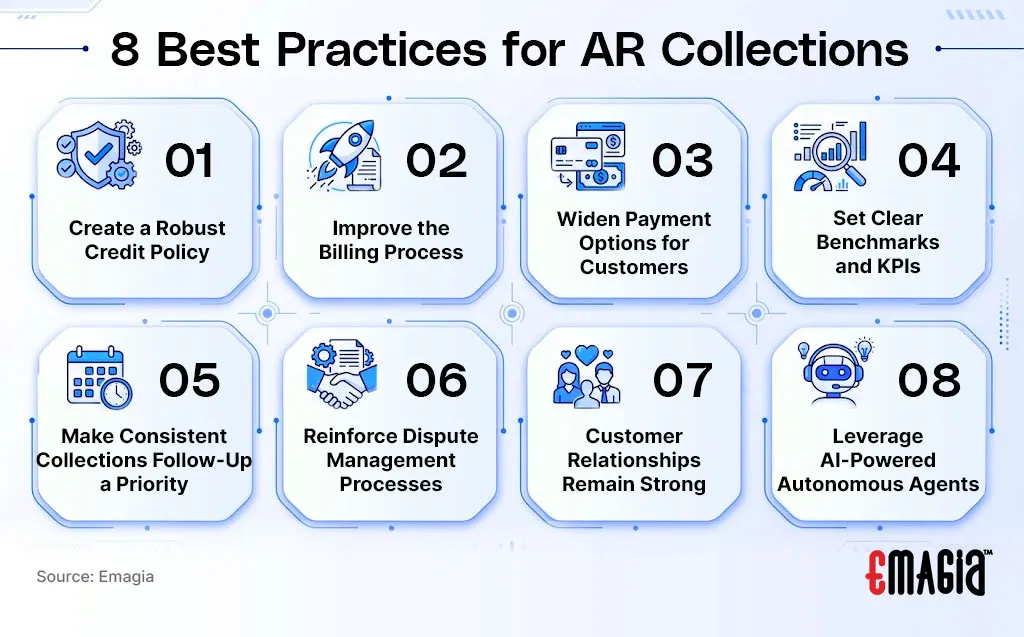
Quick Answer: The eight best practices for AR collections are: Creating a strong credit policy. Refining payment methods. Optimizing the invoicing process. Setting benchmarks and KPIs. Focusing on collections based on risk. Improving dispute management. Building strong customer relationships. Utilizing AI and automation in their collections process.
Introduction
For CFOs and GCC finance leaders, cash flow management is essential to maintaining financial health. The main goal is optimizing accounts receivable (AR) collections, ensuring that outstanding payments are collected on time in an efficient manner.
The AR collection process involves invoicing, issuing statements, following up on payments, and applying cash. However, many organizations are slowed by weak collection processes due to poor reporting systems that provide an unclear picture of which receivables are collectible, which are at risk of delay, and which are likely to default.
Top finance companies constantly upgrade their AR strategies by implementing best practices and digital finance solutions to accelerate collections and boost cash flow efficiency.
Different industries face different collection challenges. For example, manufacturing companies have a longer cash conversion cycle, making the management of accounts receivable more complex. Manufacturers purchase raw materials, turn those materials into finished goods, and sell the goods. Then they wait for the customer to pay. This creates a long lag between outlay and receipt of revenue.
A long cycle brings with it several challenges, such as
- Extended production and delivery lead times resulting in delayed payments.
- Volatility of cash flow that can impact supply chain operations.
- Customer relationships can get hampered due to payment disputes or process inefficiencies.
To address these and other risks, more and more businesses are turning to AI-powered receivables management solutions that automate cash application, collections, and dispute resolution, reducing manual workload and increasing real-time visibility into finances.
Eight Best Practices for AR Collections
A good collections strategy contributes in accelerating cash inflows, improving working capital management, and decreasing the risk of bad debt. Here are eight best practices that finance leaders can implement to boost AR collections and mitigate financial risk.
1. Create a Robust Credit Policy
Lack of clear credit policies is one of the main causes of collection inefficiencies. Organizations should:
- Establish clear credit terms such as when payment is due, late payment penalties, and rewards for early payment.
- Real-time data analysis to continuously assess customer creditworthiness.
- Link credit policies with the company’s cash conversion cycle and risk tolerance.
- Utilize AI-driven credit assessment tools to dynamically adjust credit limits and reduce risk exposure.
- Review credit policies on a regular cadence, since customer risk profiles change over time and a policy set and defined at onboarding can become obsolete.
2. Improve the Billing Process
Late or incorrect invoicing often leads to late payments. Some notable best practices may include:
- Automatically generate and send invoices through ERP systems or digital invoicing tools.
- Ensure invoices include purchase order references, tax details, payment instructions, and clearly stated due dates.
- Actively follow up on outstanding invoices before they become overdue.
- Use of customer self-service portals to minimize disputes and improve transparency of payments.
- Send invoices as close to the point of delivery, or service completion, as possible. The longer the time period between delivery and invoicing, the easier it is for a customer to deprioritize payment.
3. Widen Payment Options for Customers
Offering multiple payment options increases the probability of timely payments. Best practices include:
- Supports ACH, credit/debit cards, bank transfers, and digital wallets.
- Encourage online payments that increase collection efficiency by up to 30%
- Provide automated recurring payments for high-frequency transactions.
- Track real-time payment and dispute resolution through customer portals
4. Set Clear Benchmarks and KPIs
Tracking AR performance at adequate intervals allows finance leaders to enhance processes to achieve maximum efficiency. Some of the key metrics that need to be tracked regularly for collections include:
- Days Sales Outstanding (DSO): Indicates the average number of days to receive payment on accounts receivable.
- Average Days Delinquent (ADD): Shows the number of days past due that a payment was made.
- Collection Effectiveness Index (CEI): Measures the efficiency of the collection process.
- AR Aging Reports: Divide outstanding receivables by aging to help focus collection efforts.
It is important to review these metrics consistently at regular intervals of time. This aids in catching a negative trend early and gives collections teams time to act before it compounds. Efficient collections team, also benchmark performance against their own historical trends over time, as “healthy” DSO and CEI vary dramatically by industry, deal size, and geography.
5. Make Consistent Collections Follow-Up as a Priority
It is essential that not all past-due accounts are treated equal. High-risk accounts need to be given priority using:
- Automated account segmentation based on risk scores and payment history.
- Predictive analytics for forecasting potential defaults.
- Customizable dunning strategies for follow-up frequency and messaging depending on the risk level.
In practice, this involves scoring accounts on multiple signals—payment history, order size, industry risk, and broader market conditions—to flag accounts that are likely to become delinquent before they are actually overdue. This allows collectors to work proactively on accounts at risk, instead of only reacting after a payment has been missed.
Emagia’s Gia AlphaCash™ applies this kind of prioritization directly to a company’s own AR data, surfacing the small set of “Alpha Accounts” responsible for the largest share of past-due balances, so collections effort is concentrated where it has the greatest cash impact.
6. Reinforce the Dispute Management Processes
Payment disputes are a common cause of collection delays. A few best practices which can be adopted to reduce them include:
- Reducing invoice mistakes by ensuring maximum accuracy.
- Tracking and resolving disputes in real time using AI-driven dispute resolution tools.
- Enabling collaborative resolution via customer portals where customers can dispute charges digitally and finance teams respond efficiently.
7. Customer Relationships Remain Strong
A collections analyst needs to be firm, but relationship management is equally important for long-term financial success. A few essential things to keep in mind are:
- Identifying and resolving potential friction points before they hamper the relationship with the customer.
- Determining AR service quality by conducting customer satisfaction surveys
- Continuing to be involved via automated reminders and tailored communications.
- Ensuring AR and Sales teams have a shared view of a customer’s payment status, which prevents sales from having conversations around upsell/renewal with an account that is being pursued by collections team.
8. Leverage AI-Powered Autonomous Agents
Modern AR platforms provide autonomous agents, which improve the collections process by:
- Speeding up invoice and cash application through AI-powered processing.
- Automating alerts and follow-ups based on customer payment patterns
- Improving credit risk assessment with predictive analytics.
- Providing dashboards and reporting tools for real-time insight into collections performance.
Emagia’s Gia Collect™ is one example of this shift in practice: an autonomous AI agent that places outbound collections calls, converses naturally with customers in over 23 languages, and captures promise-to-pay commitments in real time. It also identifies customer-raised disputes during the conversation and routes them to the appropriate team for review, while every call is transcribed and logged automatically for a complete audit trail. Run on its own or paired with Gia AlphaCash™’s account prioritization, Gia Collect™ lets collections teams reach every priority account consistently, including outside standard business hours, without adding headcount.
Setting Your Own AR Benchmarks
Good DSO, CEI, and bad debt levels vary for each industry, deal size, payment terms, and geography. Given this variance, it is important that finance teams establish their own internal baseline for each metric, rather than chasing a generic industry standard. It is imperative that enterprises set their own improvement targets relative to their own performance to ensure proper tracking and cash flow efficiency. This becomes all the more prominent for for multi-entity or multi-currency organizations, where blended averages across business units can mask performance problems in any single region.
Conclusion
In today’s rapidly evolving business landscape, manual AR processes are no longer sustainable. Despite recognizing collections as a critical revenue function, fewer than 40% of companies have adopted AR automation, according to industry research. Resistance to change and lack of internal alignment remain the most cited barriers.
However, companies that embrace AI-driven AR automation can achieve:
- Faster collections and improved cash flow
- Streamlined Process Workflows
- Reduced operational costs
- Increased financial visibility with real-time performance tracking.
Emagia’s AI-native collections agent is one such example, which seamlessly integrates with ERP systems such as Oracle, SAP and Microsoft Dynamics, enabling finance teams to optimize workflows and reduce manual intervention.
By implementing these eight best practices, finance leaders can transform AR collections from a reactive function into a strategic, value-driven process.
FAQs
What is Days Sales Outstanding (DSO)?
Days Sales Outstanding (DSO) measures how quickly receivables are converted into cash.
What is the Collection Effectiveness Index (CEI)?
The Collection Effectiveness Index (CEI) assesses how much of the total receivables were collected in a given period.
What is the Accounts Receivable Turnover Ratio?
The Accounts Receivable Turnover Ratio indicates how efficiently receivables are managed.
What is the Bad Debt to Sales Ratio?
The Bad Debt to Sales Ratio measures the percentage of revenue lost due to uncollectible accounts.