The conversation in finance leadership has matured. A year ago, CFOs were asking whether AI agents belonged in their operations. Today, the question is more demanding: how do we govern them, measure them, and hold them to the same standard of accountability we apply to every other business investment?
That question deserves a rigorous answer. And the answer, we would argue, begins not with technology architecture but with strategic goal-setting — specifically, with the discipline of Objectives and Key Results.
What OKRs Are — and What They Were Built to Do
Objectives and Key Results is a goal-setting framework developed at Intel in the 1970s by Andy Grove and later popularized at Google, where it became fundamental to how the company scaled from startup to global enterprise. The framework is deceptively simple in structure and demanding in practice.
An Objective is a qualitative statement of what the organization intends to achieve. It is ambitious, directional, and time-bound — typically to a quarter or a fiscal year. It answers the question: where are we trying to go?
Key Results are the quantitative measures that define whether the objective has been met. Each key result is specific, measurable, and independently verifiable. Together, they answer: how will we know we got there?
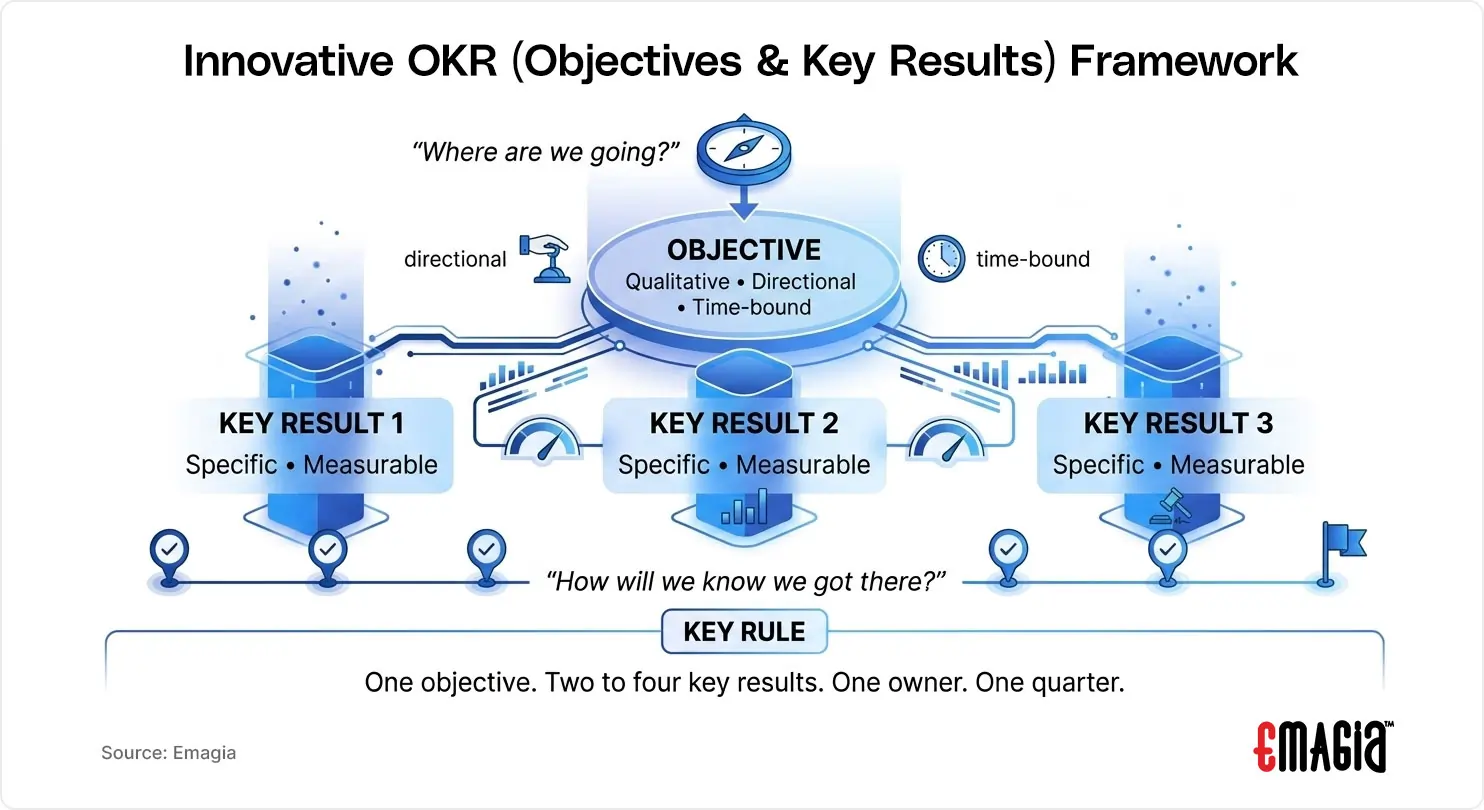
The power of OKRs lies not in their simplicity but in what they require of leadership. They force alignment — across functions, across levels of the organization — on what success actually means before work begins. They distinguish between activity (what we are doing) and impact (what we are changing). And they create a review discipline that keeps the organization honest when results diverge from intention.
For CFOs, none of this is unfamiliar. Every capital allocation decision, every operational transformation, every M&A integration involves some version of this logic: define the outcome, define how you will measure it, hold someone accountable for the number. OKRs formalize that instinct into a repeatable management system.
Why AI Agent Deployments Need This Framework
The adoption of AI agents in enterprise finance is accelerating. Across Order-to-Cash, Accounts Payable, and the broader Record-to-Report cycle, organizations are deploying intelligent agents to automate invoice processing, cash application, collections outreach, remittance reconciliation, credit decisioning, and customer communication. The technology is capable. The business case, in many instances, is compelling.
And yet a significant share of these deployments underdeliver — not because the technology fails, but because the governance structure around it is insufficient. Organizations deploy agents with well-defined functional specifications and poorly defined business outcomes. They measure what the agent does rather than what it changes. They evaluate performance in terms of system uptime and processing volume rather than DSO reduction, working capital improvement, or finance cost as a percentage of revenue.
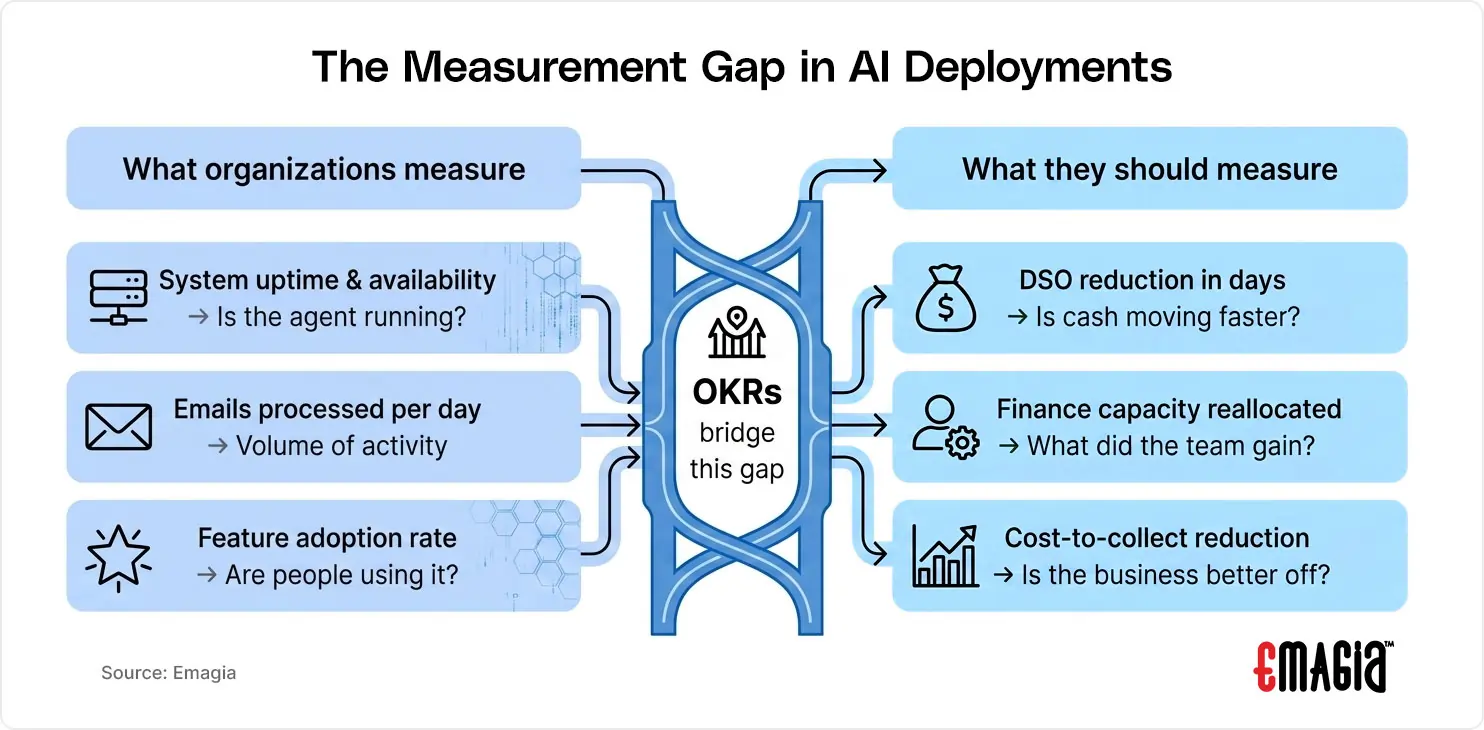
The result is what might be called a measurement gap: the AI is running, the dashboards are populated, and the CFO is left without a clear answer to the question every board will eventually ask — what did this actually deliver?
The OKR framework closes that gap. It does so by forcing three disciplines that AI deployments typically lack:
Outcome-first design. Before any agent goes live, the OKR framework requires finance leadership to articulate the business objective the agent is intended to serve. Not the workflow it will automate — the outcome it will move. This is a meaningful distinction. Automating invoice matching is a workflow. Reducing DSO by five days is an outcome. The former is a feature; the latter is a result.
Cascading accountability. OKRs work at multiple levels simultaneously. A CFO-level objective around cash velocity cascades into a treasury team objective around collections effectiveness, which cascades further into an operational key result around agent auto-resolution rates. Each layer of the organization knows how its work connects to the strategic goal — and owns a number that reflects that connection.
Structured cadence. OKRs are reviewed quarterly, with variance explained and priorities adjusted. Applied to AI agents, this cadence transforms what is often a passive monitoring posture — checking dashboards — into an active management posture, where finance leadership interrogates results, identifies underperformance, and makes deliberate decisions about investment, configuration, and expansion.
An OKR Architecture for AI Agents Across Finance
Below is a practical framework for CFOs deploying AI agents across the Order-to-Cash function. It is organized around four strategic objectives, each supported by measurable key results that connect agent performance to finance outcomes.
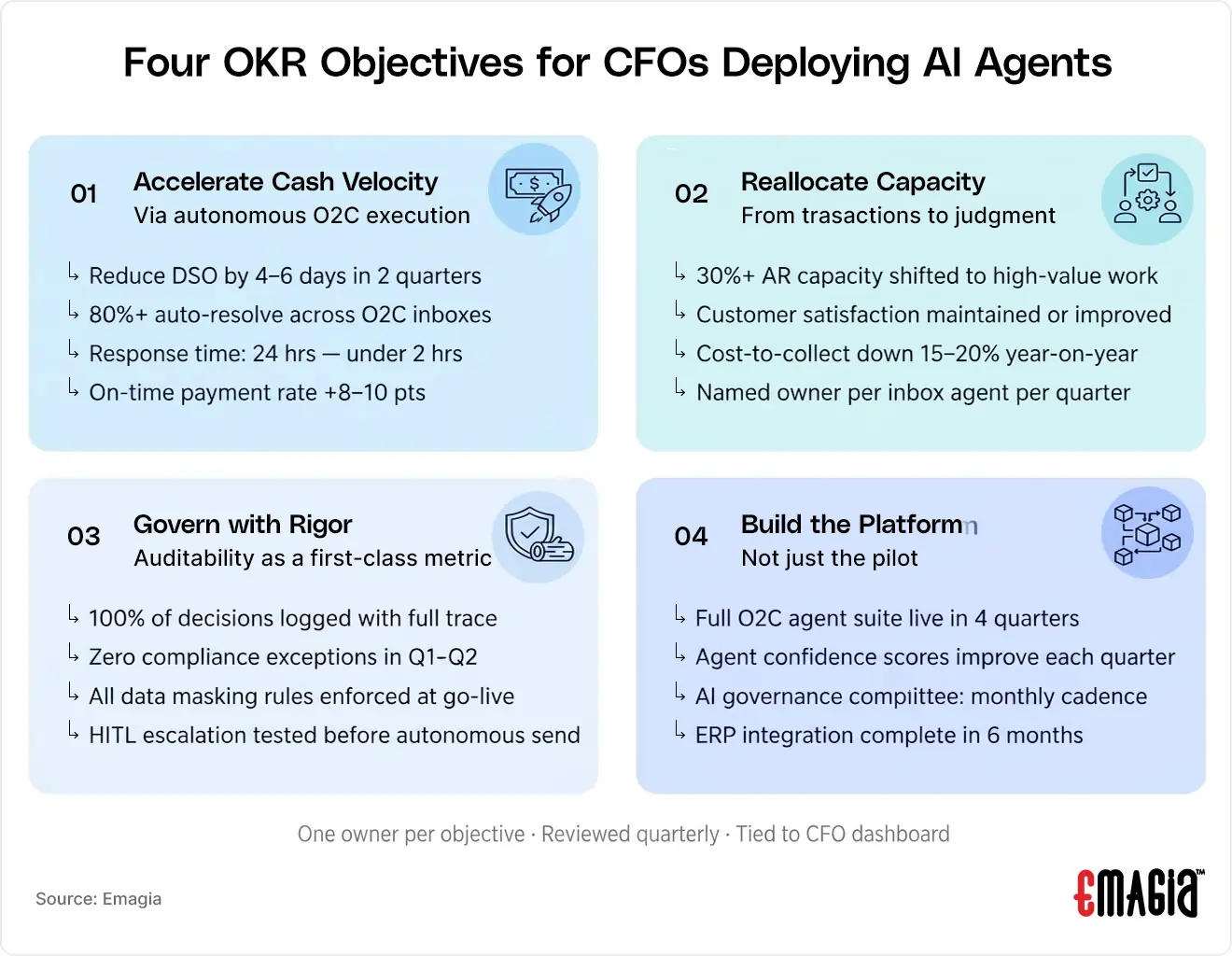
Objective 1: Accelerate cash velocity through autonomous Order-to-Cash execution
This is the anchor objective — the one that connects AI deployment directly to the CFO’s primary mandate. Every agent deployed in O2C should have a traceable line to this objective, whether through faster payment application, earlier dispute resolution, or more responsive customer communication.
Key Results:
- Reduce Days Sales Outstanding by 4–6 days within two quarters of full agent deployment
- Achieve 80% or greater auto-resolution rate across O2C customer-facing inboxes — order inquiries, remittance processing, collections follow-ups — within 90 days of go-live
- Reduce average customer response time from 24 hours or more to under 2 hours, measured across all agent-handled communications
- Increase on-time payment rate by 8–10 percentage points through proactive, agent-driven collections outreach
Objective 2: Reallocate finance capacity from transactional execution to high-judgment work
AI agents do not eliminate the need for skilled finance professionals. They change what those professionals spend their time on. This objective captures that shift — and holds the organization accountable for ensuring that the capacity returned by automation is reinvested productively, not simply absorbed by other transactional work.
Key Results:
- Reallocate 30% or more of AR team capacity from email-based inquiry handling and manual cash application to exception management, dispute resolution, and strategic customer engagement within two quarters
- Maintain or improve customer satisfaction scores across all agent-handled interactions, measured through post-resolution surveys
- Reduce cost-to-collect by 15–20% on a year-over-year basis, net of technology investment
Objective 3: Establish enterprise-grade governance and auditability as a non-negotiable baseline
CFOs carry fiduciary responsibility for the decisions made by their finance function. When AI agents make — or meaningfully influence — those decisions, that responsibility does not transfer to the technology. It remains with the CFO. This objective treats governance not as a compliance overhead but as a first-class performance dimension.
Key Results:
- 100% of agent decisions logged with a complete decision trace — email parsed, ERP data retrieved, policy applied, action taken — from the first day of production operation
- Zero compliance exceptions attributable to agent error or data exposure in the first two quarters of deployment
- All sensitive financial data masking rules — account numbers, internal system codes, approver identities — validated and enforced prior to go-live across every agent configuration
- Human-in-the-loop escalation protocols tested and confirmed operational before any agent is permitted to send external communications autonomously
Objective 4: Build a scalable agentic finance platform, not a portfolio of isolated pilots
The organizations that extract the most sustained value from AI in finance are those that approach early deployments as the foundation of a broader platform — not as proofs of concept to be evaluated in isolation. This objective reflects that longer horizon.
Key Results:
- Expand from initial agent deployment to a connected suite of O2C AI agents — covering order management, credit management, collections, remittance, dispute resolution, and customer payments — within four quarters
- Achieve measurable improvement in agent confidence scores each quarter through structured continuous learning loops informed by human reviewer feedback
- Establish a cross-functional AI governance committee — including finance, technology, legal, and operations — with a documented monthly review cadence and clear escalation authority
- Complete integration between agent-layer outputs and core ERP workflows within six months, eliminating manual handoffs between automated and human-managed processes.
Translating Framework into Practice
The most common failure mode for OKRs in any context is the annual ritual: objectives set in January, reviewed in December, with the months in between producing no meaningful accountability. Applied to AI, that failure mode is particularly costly, because agents learn from production data and compound both their effectiveness and their errors over time.
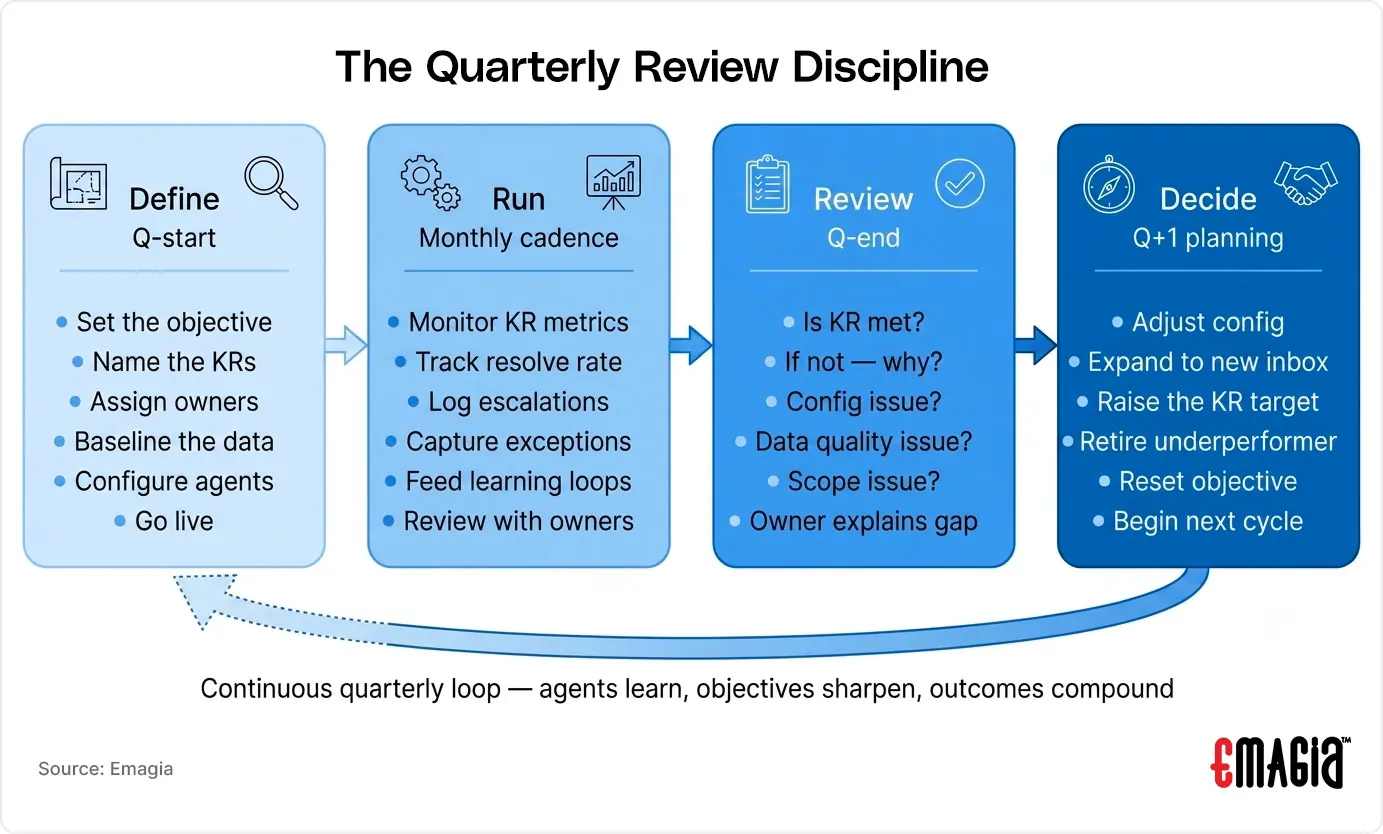
CFOs who get this right build AI agent performance into the same operational review rhythm as any other business-critical function. Auto-resolution rates, escalation ratios, confidence score trends, DSO impact, and cost-per-transaction belong on the finance leadership dashboard — reviewed monthly, with variance explained, and with owners prepared to answer for the numbers.
The quarterly OKR review should ask three questions of every deployed agent: Is it delivering the key result it was designed to move? If not, is the gap a configuration problem, a data quality problem, or a scoping problem? And what is the decision — adjust, expand, or retire?
That discipline — defining the outcome, measuring it rigorously, and reviewing it with the same seriousness applied to any other investment — is what separates finance organizations that deploy AI from those that scale it.
A Final Word on Finance Leadership
Technology vendors will tell CFOs what their agents can do. The OKR framework helps CFOs define what they need their agents to deliver — and build the accountability infrastructure to ensure that delivery is measured, managed, and continuously improved.
The agents will do the work. The framework ensures the work is the right work.
Emagia Autonomous Finance platform deploys seven specialized O2C AI agents — across Order Management, Credit, Billing, Collections, Deductions, Cash Application, and Customer Payments — with full auditability and enterprise-grade governance built in.Emagia Corporation is the leader in Autonomous Finance, processing over $1T in enterprise receivables annually across 90+ countries. Learn more at emagia.com.


See AI Agents in Action
Learn how Autonomous Finance AI Agents automate cash application, collections and customer communications.
Ready to Measure AI Success in Finance?
Discover how AI Agents help CFOs improve DSO, cash flow and operational efficiency with measurable business outcomes.