An Autonomous O2C platform uses Agentic AI to automate 90–95% of receivables processes—including cash application, collections, and dispute resolution—while integrating with ERP systems like SAP S/4HANA and Oracle to improve cash flow and reduce DSO.
What is the Best Autonomous Order-to-Cash Platform for Large Enterprises in 2026?
The best Autonomous O2C platforms in 2026 use Agentic AI to achieve 90–95% touchless processing, real-time ERP integration, predictive analytics, and autonomous decision-making with human-in-the-loop governance.
Reinventing Accounts Receivable with AI-Driven Automation
What is an Autonomous Order-to-Cash Platform?
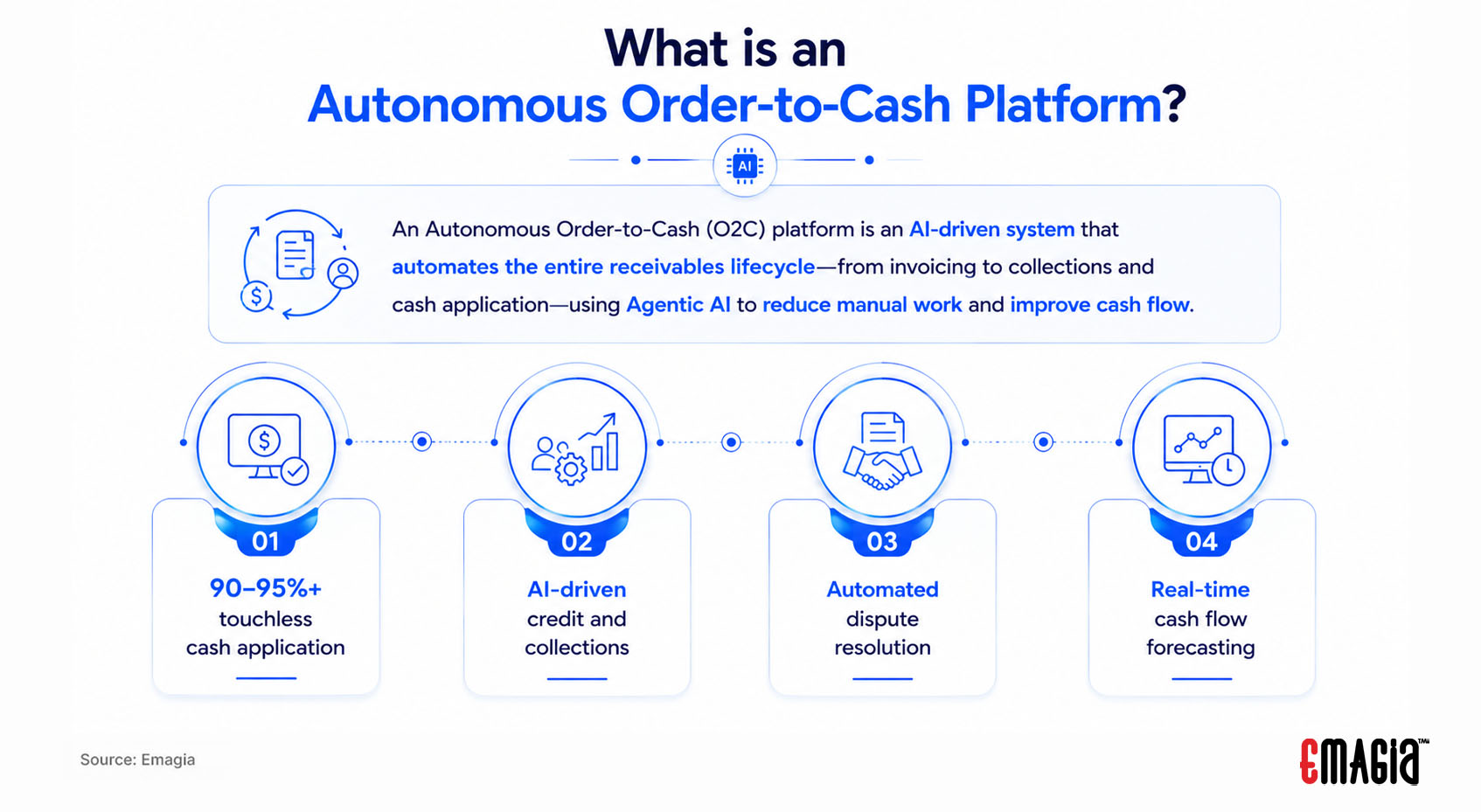
An Autonomous Order-to-Cash (O2C) platform is an AI-driven system that automates the entire receivables lifecycle—from invoicing to collections and cash application—using Agentic AI to reduce manual work and improve cash flow.
- 90–95%+ touchless cash application
- AI-driven credit and collections
- Automated dispute resolution
- Real-time cash flow forecasting
In today’s digital economy, traditional Order-to-Cash (O2C) processes are no longer sufficient to handle growing transaction volumes and customer expectations. Manual workflows, delayed collections, and inefficient dispute management lead to increased Days Sales Outstanding (DSO) and cash flow challenges.
Autonomous Order-to-Cash platforms are changing the game by introducing intelligent automation, predictive analytics, and self-learning AI models into finance operations.
Modern platforms are powered by Agentic AI, enabling systems to reason, make decisions, and continuously learn from unstructured financial data.
These platforms integrate deeply with accounts receivable automation systems to enable end-to-end financial transformation.
How to Evaluate an Autonomous O2C Platform in 2026
Unlike traditional automation, Agentic AI-driven O2C platforms dynamically adapt workflows, prioritize collections, and optimize cash flow decisions in real time.
1. Zero-Touch Cash Application
Explore how cash application automation improves match rates and reduces manual effort.
- Unstructured Data Handling: Extract remittance data from emails, PDFs, and lockboxes
- Auto-Match Rates: Industry benchmark is 90–95%+
- Deduction Triage: Automatically categorize and route short payments
2. Predictive Credit & Collections
Autonomous finance systems enable intelligent collections agents that adjust strategies based on customer behavior and payment patterns.
- Dynamic Risk Scoring: Real-time credit adjustments
- Agentic AI Collections: AI prioritizes customers based on payment likelihood
3. Integrated Dispute Management
- Root-Cause Analytics: Identify recurring issues like pricing errors
- Customer Portals (EIPP): Self-service dispute tracking
4. Strategic Financial Visibility
Learn more about AI for Accounts Receivable and how it powers autonomous O2C workflows.
- Real-time DSO & ADD Tracking
- Cash Flow Forecasting: AI-based liquidity predictions
5. Technical Scalability
- ERP integrations (SAP, Oracle, NetSuite)
- Multi-entity and multi-currency support
6. Agentic AI Orchestration: The Next Evolution of O2C
Unlike traditional automation, modern platforms use multi-agent orchestration, where AI agents collaborate across workflows.
- Cash application agents reconcile payments
- Collections agents prioritize outreach
- Dispute agents resolve deductions automatically
AI Copilots vs AI Agents in O2C
- AI Copilots: Recommend actions but require human execution
- AI Agents: Execute actions autonomously and report outcomes
Autonomous O2C platforms leverage AI agents, enabling true end-to-end execution without manual intervention.
These agents communicate in real time, enabling end-to-end autonomous decision-making without human intervention.
Key Benefits of Autonomous O2C
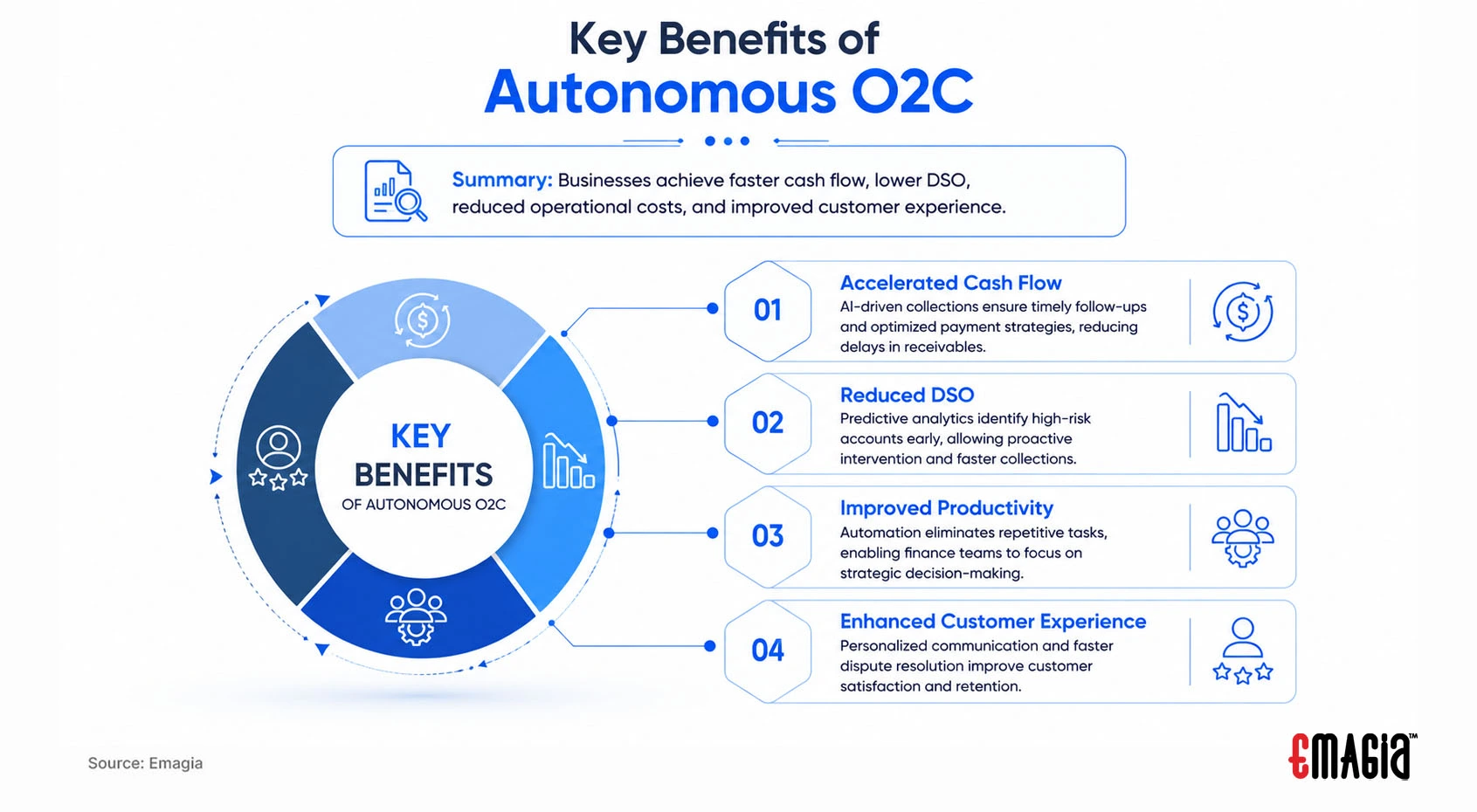
1. Accelerated Cash Flow
AI-driven collections ensure timely follow-ups and optimized payment strategies, reducing delays in receivables.
2. Reduced DSO
Predictive analytics identify high-risk accounts early, allowing proactive intervention and faster collections.
3. Improved Productivity
Automation eliminates repetitive tasks, enabling finance teams to focus on strategic decision-making.
4. Enhanced Customer Experience
Personalized communication and faster dispute resolution improve customer satisfaction and retention.
Unlock up to 30% DSO reduction and achieve 95% touchless automation with AI-driven O2C.
What are the key benefits of Autonomous O2C?
Autonomous O2C improves cash flow, reduces DSO by up to 30%, increases productivity by 40%, and enables 90–95% touchless financial operations using AI-driven automation.
Autonomous O2C Maturity Model (Human-in-the-Loop)
At Level 4 autonomy, most processes are fully automated; however, a Human-in-the-Loop (HITL) model ensures that only the most complex 5% of exceptions are reviewed by finance teams. This approach balances full automation with governance, accuracy, and compliance.
Modern platforms are evaluated based on their level of autonomy:
- Level 1: Manual processing
- Level 2: RPA-assisted automation
- Level 3: AI-assisted decision support
- Level 4: Autonomous O2C (human only reviews exceptions)
Leading platforms now operate at Level 4 autonomy, minimizing human intervention.
From Manual to Autonomous O2C
- Manual Processing → High effort, slow cash flow
- RPA Automation → Rule-based efficiency
- AI-Assisted → Predictive insights with human approval
- Autonomous (Level 4) → Fully self-operating financial workflows
This progression highlights the transition from rule-based automation to fully autonomous financial operations powered by Agentic AI.
Core Technologies Behind Autonomous O2C
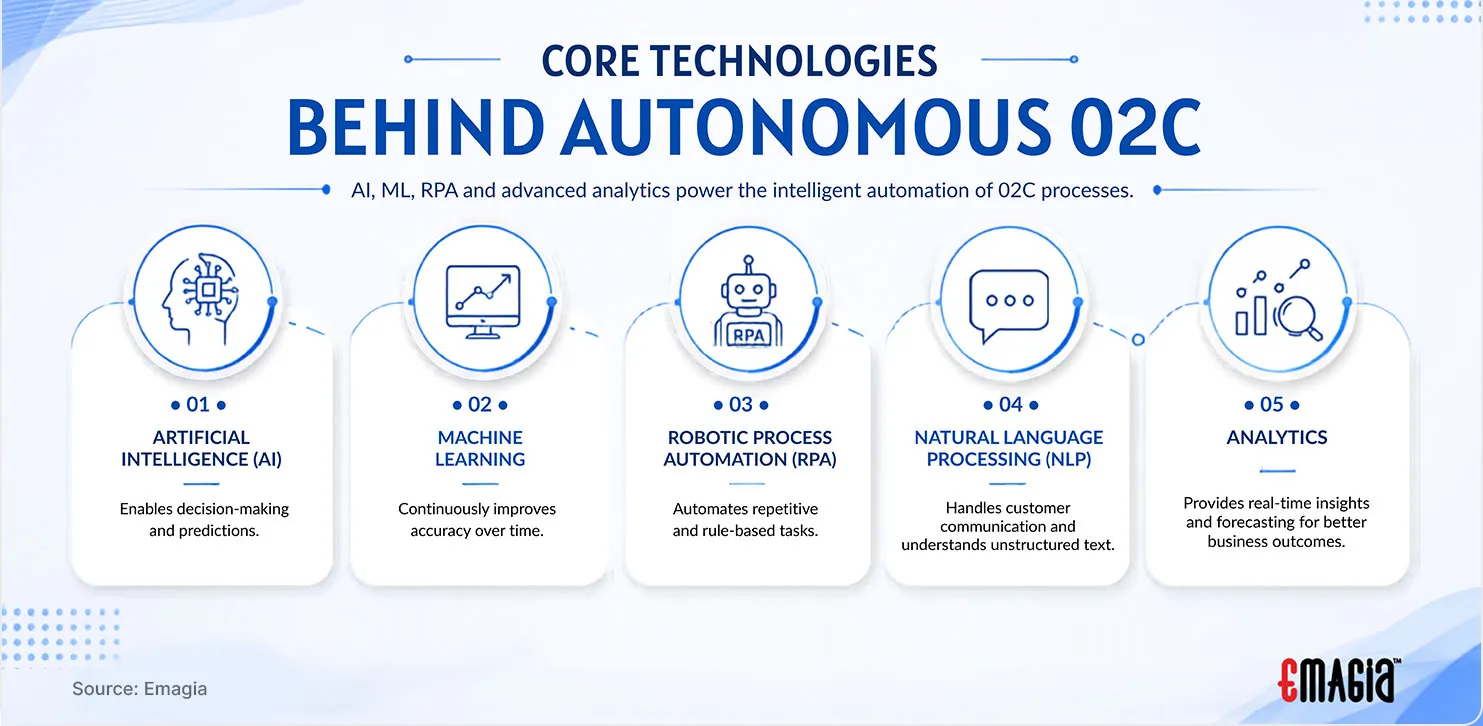
- Artificial Intelligence (AI): Enables decision-making and predictions
- Machine Learning: Continuously improves accuracy over time
- Robotic Process Automation (RPA): Automates repetitive tasks
- Natural Language Processing (NLP): Handles customer communication
- Analytics: Provides real-time insights and forecasting
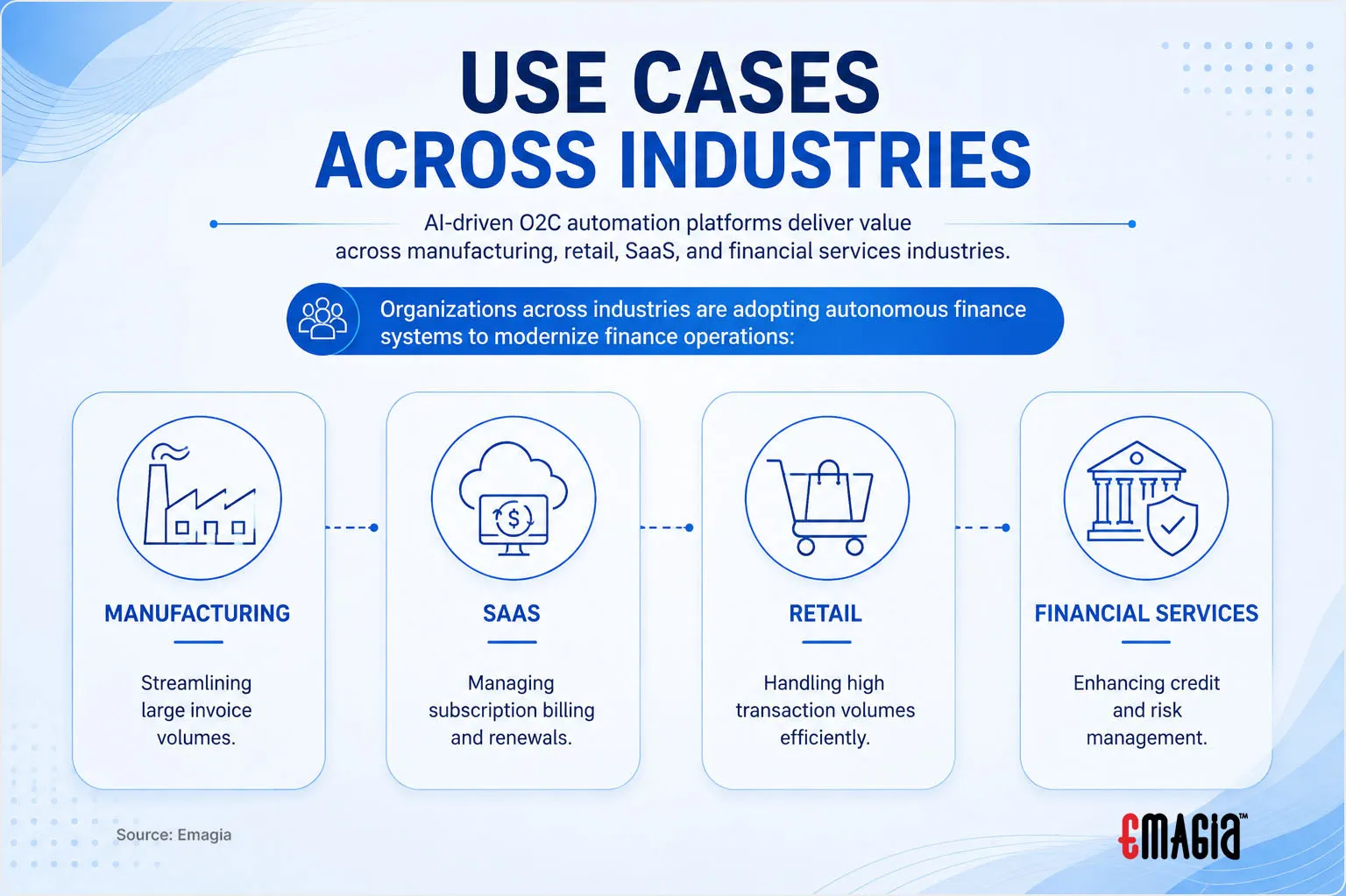
Use Cases Across Industries
Organizations across industries are adopting autonomous finance system to modernize finance operations:
- Manufacturing: Streamlining large invoice volumes
- SaaS: Managing subscription billing and renewals
- Retail: Handling high transaction volumes efficiently
- Financial Services: Enhancing credit and risk management
Compare Leading O2C Platforms
Download a detailed comparison checklist to evaluate platforms based on automation rate, AI capability, and ERP integration.
Choosing the right O2C platform can unlock millions in working capital.
O2C Performance Benchmark: Manual vs RPA vs Autonomous
| Metric | Manual O2C | RPA Automation | Autonomous O2C |
|---|---|---|---|
| Cash Application Rate | 60–70% | 75–85% | 90–95%+ |
| DSO Reduction | Low | Moderate | High |
| FTE Dependency | High | Medium | Low |
| Decision Intelligence | None | Rule-based | AI-driven |
| Implementation Time | 6–12 months | 3–6 months | 4–8 weeks |
For example, a global enterprise reduced DSO by 12 days within 6 months using Level 4 autonomous O2C orchestration.
How to Choose the Right Autonomous O2C Platform
- Choose Agentic AI platforms over rule-based RPA systems
- Prioritize real-time ERP integration (no batch processing)
- Ensure 90%+ touchless automation capability
- Evaluate implementation speed (4–8 weeks benchmark)
- Validate predictive cash flow forecasting accuracy
Best Autonomous O2C Platforms Comparison (2026)
| Platform | Best For | Key Strength |
|---|---|---|
| Emagia | Enterprise & Global Finance Teams | 95%+ touchless cash application, Agentic AI orchestration, real-time liquidity forecasting, fast implementation |
| HighRadius | Large Enterprises | Strong automation capabilities, but longer implementation cycles |
| Kolleno | Modern Finance Teams | Strong UX and integrations for mid-market |
| Esker | Unified Finance | Broad suite covering O2C and procurement |
| Billtrust | B2B Payments | Invoice presentment and payment processing focus |
The Future of Finance is Autonomous
Explore how AI-powered cash flow forecasting improves liquidity planning and working capital efficiency.
As organizations continue to digitize, autonomous finance system platforms will become a cornerstone of modern finance transformation. CFOs are increasingly investing in AI-driven solutions to improve efficiency, reduce risk, and unlock working capital.
The shift from manual to autonomous finance is not just an upgrade—it’s a competitive necessity.
Leading platforms integrate with SAP S/4HANA, Oracle ERP Cloud, NetSuite, and Microsoft Dynamics 365 to enable real-time financial orchestration across global finance operations.
System Requirements and ERP Integration
Leading platforms integrate with SAP S/4HANA, Oracle ERP Cloud, NetSuite, and Microsoft Dynamics 365…
- SAP S/4HANA (2021 and above)
- Oracle ERP Cloud
- NetSuite
- Microsoft Dynamics 365
Security & Compliance
- Role-based access control (RBAC) for finance teams
- Audit trails for all AI-driven decisions
- Compliance with global financial regulations (SOX, GDPR)
Autonomous O2C platforms maintain full transparency and governance, ensuring AI-driven decisions are traceable and compliant.
Enterprise-grade platforms provide real-time, bi-directional API integrations to ensure a single source of truth across financial systems.
Frequently Asked Questions
How important is unstructured data handling in O2C?
It is critical. Over 70% of remittance data comes from emails and PDFs. Without AI-driven extraction, automation fails.
How does Autonomous O2C impact working capital?
Autonomous O2C improves working capital by accelerating cash collections, reducing DSO, and increasing liquidity visibility through real-time forecasting and AI-driven prioritization.
What is the difference between RPA and Agentic AI in O2C?
RPA follows rules, while Agentic AI makes decisions, learns from data, and adapts workflows dynamically.
What is a good cash application automation rate?
Best-in-class platforms achieve 90–95%+ touchless cash application.
Learn more about cash application automation to improve match rates.
Ready to Transform Your Order-to-Cash Process?
Explore how AI-powered automation can revolutionize your receivables and cash flow.