A Collections Agent plays a critical role in protecting enterprise liquidity, accelerating cash flow, and managing customer credit risk. In modern finance organizations, the role has evolved from a reactive function to a strategic driver of working capital optimization.
This comprehensive guide is written for enterprise CFOs, controllers, shared services leaders, AR managers, credit and collections managers, and digital transformation executives evaluating advanced order-to-cash automation strategies.
The objective of this article is to provide a complete, structured, and authoritative understanding of the Collections Agent role, from foundational definitions to advanced AI-driven automation models.
Definition and Scope of a Collections Agent
A Collections Agent is responsible for recovering outstanding receivables, reducing Days Sales Outstanding (DSO), and protecting enterprise working capital through structured customer engagement and predictive prioritization.
A Collections Agent is a finance professional or automated system responsible for managing outstanding receivables and ensuring timely customer payments in accordance with agreed credit terms.
In enterprise environments, this role includes proactive engagement, dispute coordination, risk monitoring, and structured follow-ups designed to reduce Days Sales Outstanding (DSO) and minimize bad debt exposure.
Scope Within the Order-to-Cash Cycle
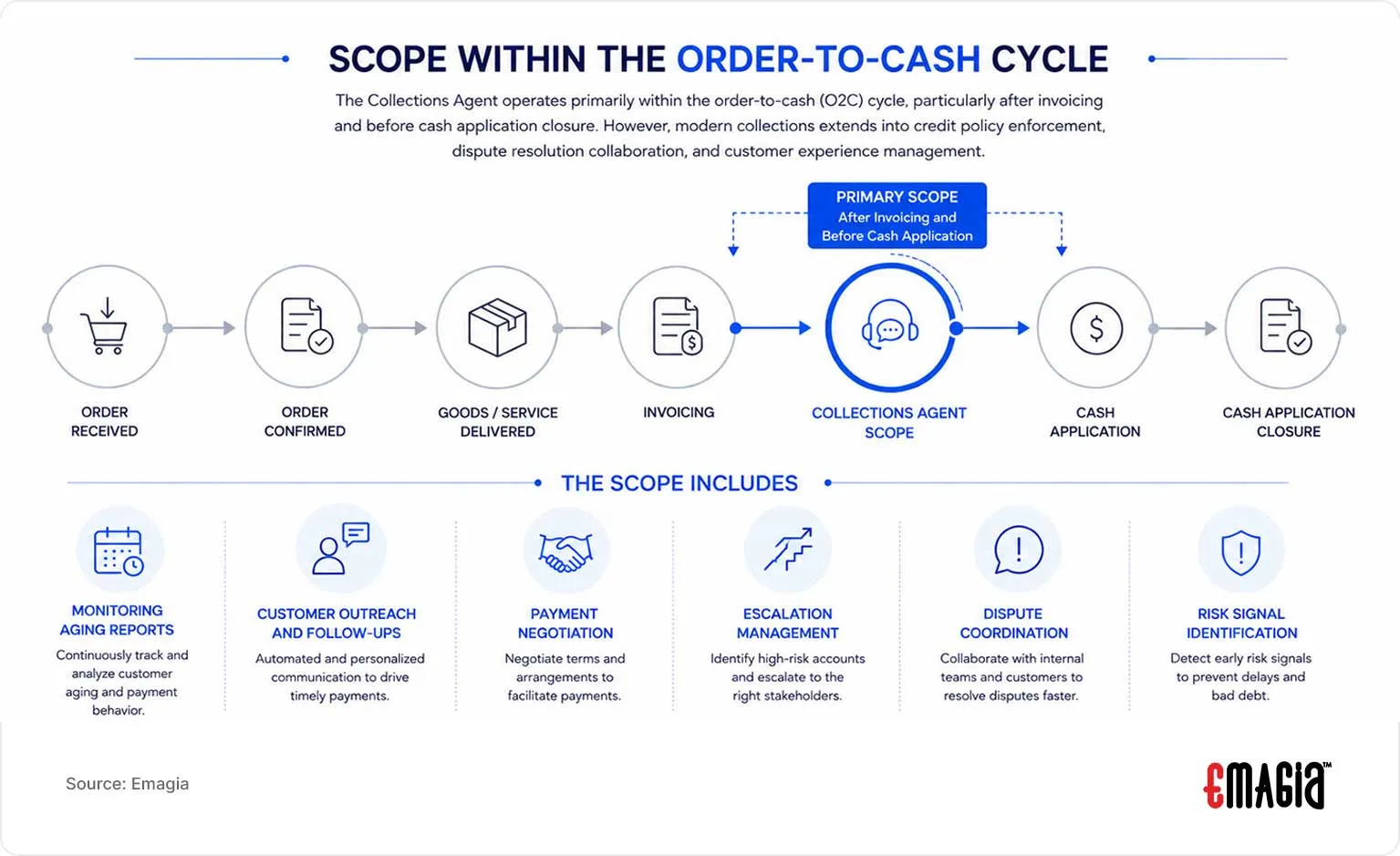
The Collections Agent operates primarily within the order-to-cash (O2C) cycle, particularly after invoicing and before cash application closure. However, modern collections extends into credit policy enforcement, dispute resolution collaboration, and customer experience management.
The scope includes:
- Monitoring aging reports
- Customer outreach and follow-ups
- Payment negotiation
- Escalation management
- Dispute coordination
- Risk signal identification
Human Collections Agent vs Digital Collections Agent
Traditionally, a Collections Agent referred to a human finance professional. In today’s enterprise landscape, the term increasingly includes AI-driven or autonomous digital agents capable of performing outreach, prioritization, and risk analysis.
This distinction is essential for transformation strategy decisions.
Executive Definition: Collections Agent
A Collections Agent is a finance professional or AI-powered digital system responsible for accelerating customer payments, reducing outstanding receivables, lowering Days Sales Outstanding (DSO), and protecting enterprise working capital.
In modern order-to-cash environments, Collections Agents increasingly operate as predictive, AI-driven systems that prioritize accounts, automate outreach, detect risk signals, and optimize cash flow performance at scale.
The Strategic Importance of Collections in Enterprise Finance
Working Capital Optimization
Collections directly impacts working capital by reducing outstanding receivables and accelerating liquidity conversion.
For CFOs, effective collections translates to improved cash forecasting accuracy, reduced borrowing needs, and stronger balance sheet resilience.
Risk Management and Credit Control
Collections Agents provide early warning signals for customer financial distress, enabling proactive risk mitigation.
Late payments often precede credit deterioration, making collections a frontline risk intelligence function.
Customer Relationship Management
Enterprise collections must balance firmness with relationship sensitivity. Strategic collections enhances customer engagement through structured communication rather than adversarial enforcement.
Key Financial KPIs Impacted by a Collections Agent
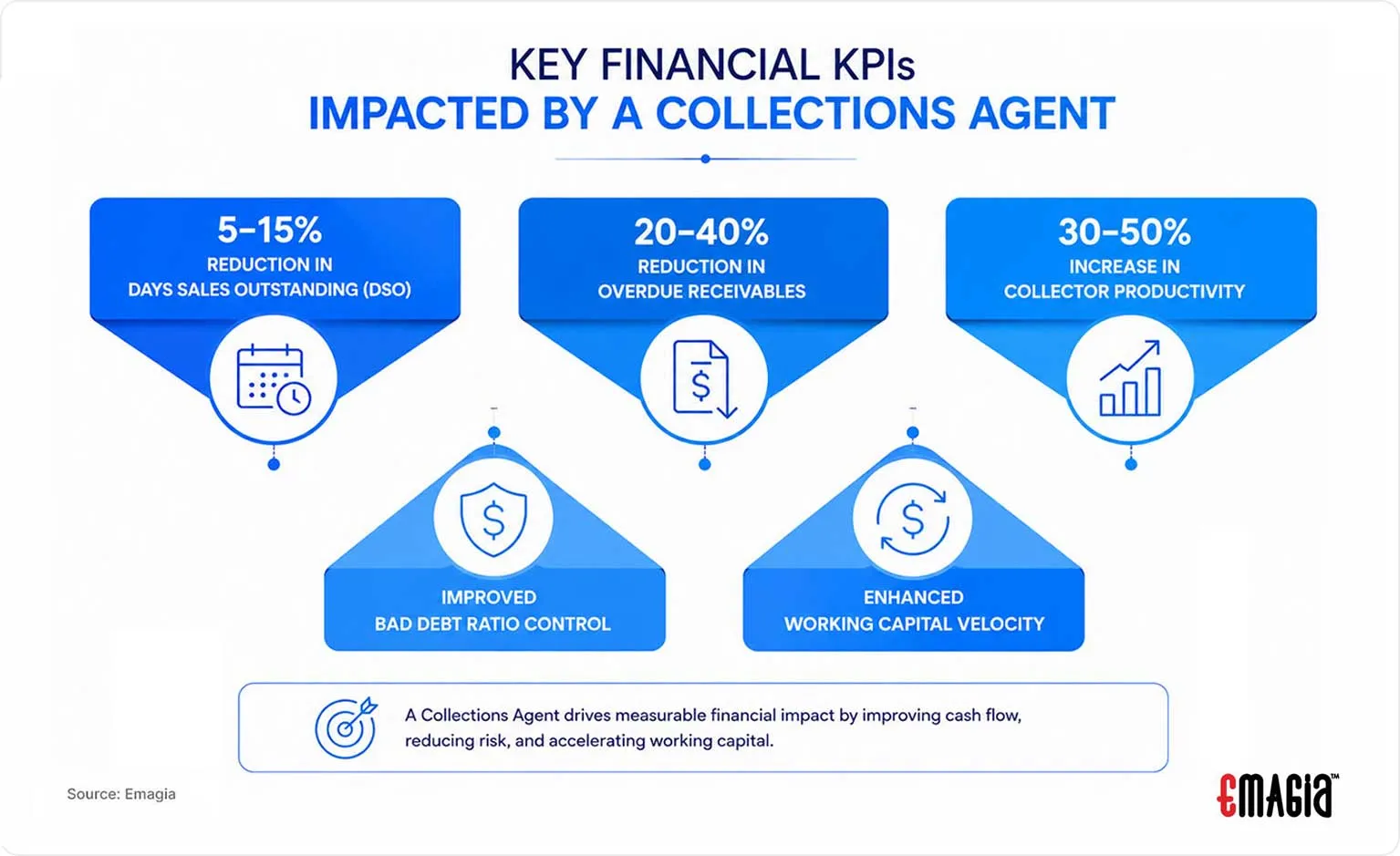
- 5–15% reduction in Days Sales Outstanding (DSO)
- 20–40% reduction in overdue receivables
- 30–50% increase in collector productivity
- Improved bad debt ratio control
- Enhanced working capital velocity
See How Global Enterprises Reduce DSO by 10–15% With AI-Driven Collections
Explore how autonomous digital agents transform collections into a predictive cash acceleration engine.
For CFOs and finance leaders, collections performance directly influences liquidity resilience, borrowing capacity, and enterprise cash forecasting accuracy.
Why Collections Transformation Is Accelerating in 2025
Global enterprises are facing increasing working capital pressure, supply chain volatility, and tighter liquidity conditions. As a result, CFOs are prioritizing predictive collections automation to improve cash flow visibility, reduce borrowing costs, and strengthen balance sheet resilience.
Digital Collections Agents powered by artificial intelligence enable proactive engagement strategies that outperform manual and rule-based approaches in scale, accuracy, and speed.
Core Responsibilities of a Collections Agent
Monitoring Accounts Receivable Aging
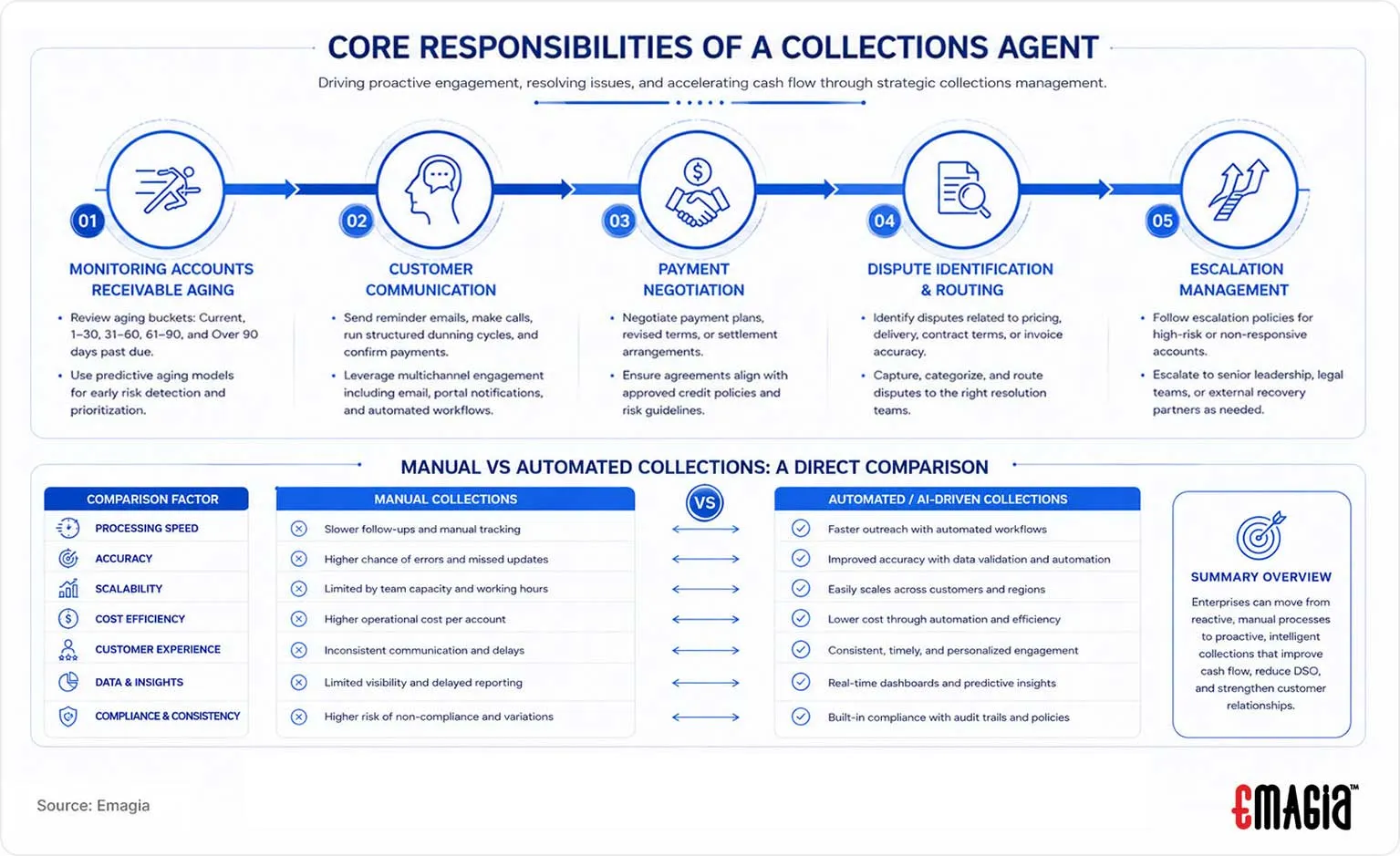
The Collections Agent reviews aging buckets such as current, 1–30 days, 31–60 days, 61–90 days, and over 90 days past due.
Advanced environments incorporate predictive aging models rather than static bucket analysis.
Customer Communication
Communication includes reminder emails, calls, structured dunning cycles, and payment confirmations.
Modern digital agents use multichannel engagement including email, portal notifications, and automated workflows.
Payment Negotiation
Collections Agents negotiate payment plans, revised terms, or settlement arrangements within approved credit frameworks.
Dispute Identification and Routing
Payment delays often stem from disputes related to pricing, delivery, contract terms, or invoice accuracy.
The Collections Agent ensures disputes are captured, categorized, and routed to appropriate resolution teams.
Escalation Management
Escalation policies define when accounts are moved to senior leadership, legal teams, or external recovery channels.
Manual vs Automated Collections: A Direct Comparison
Summary Overview
Enterprise finance leaders must evaluate whether collections should remain primarily manual, partially automated, or fully AI-driven.
Side-by-Side Comparison Table
| Dimension | Manual Collections Agent | Automated / AI Collections Agent |
|---|---|---|
| Prioritization | Spreadsheet-driven | Risk-based predictive scoring |
| Customer Outreach | Individual emails and calls | Automated multi-channel workflows |
| Data Sources | Single ERP view | Multi-ERP integrated data model |
| Scalability | Headcount dependent | Volume scalable without linear cost |
| Analytics | Historical reports | Real-time dashboards and forecasting |
| Risk Detection | Reactive | Predictive risk signals |
Key Differences Explained
Manual collections relies heavily on human memory, spreadsheet tracking, and static prioritization rules.
Automated collections uses AI models to dynamically adjust collection strategies based on payment behavior, risk scoring, and dispute patterns.
Pros and Cons
Manual Collections Pros
- Personalized communication
- Flexible judgment-based decisions
- Lower initial technology investment
Manual Collections Cons
- Limited scalability
- Inconsistent follow-ups
- Delayed visibility
Automated Collections Pros
- High scalability
- Consistent dunning workflows
- Predictive prioritization
- Improved DSO reduction
Automated Collections Cons
- Requires data integration
- Needs governance and model oversight
Who Should Choose What?
Mid-market organizations with low invoice volumes may sustain partially manual operations.
Global enterprises with multi-ERP complexity and high invoice volumes benefit significantly from AI-driven digital collections agents.
ERP and System Integration in Modern Collections
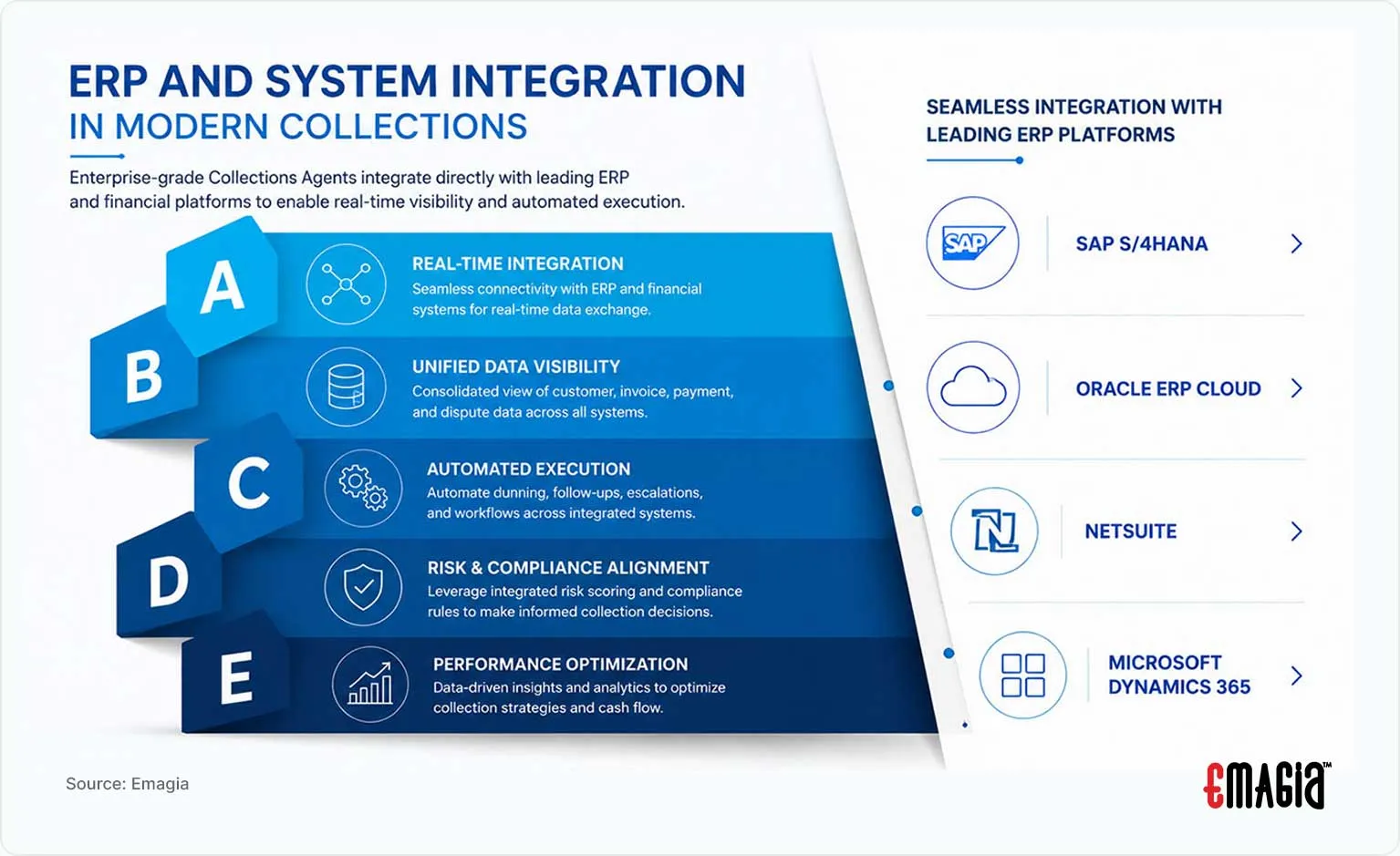
Enterprise-grade Collections Agents integrate directly with leading ERP and financial platforms to enable real-time visibility and automated execution.
- SAP S/4HANA
- Oracle ERP Cloud
- NetSuite
- Microsoft Dynamics 365
Integration ensures unified aging analysis, dispute tracking, customer risk scoring, and seamless alignment across multi-ERP global environments.
How an AI-Driven Digital Collections Agent Works
- Ingests aging, payment history, and behavioral data from ERP systems
- Applies predictive risk scoring models
- Prioritizes accounts based on probability of delinquency
- Triggers automated, multi-channel outreach workflows
- Captures disputes and routes them to resolution teams
- Continuously learns from payment outcomes to improve accuracy
This closed-loop intelligence transforms collections from reactive follow-ups into predictive working capital management.
Enterprise Architecture Considerations
- Multi-ERP and multi-entity data consolidation
- Real-time integration with cash application systems
- Bank file and payment status visibility
- Customer master data harmonization
- Security compliance and role-based access controls
For global shared services organizations, collections automation must operate across currencies, jurisdictions, and decentralized credit policies while maintaining centralized reporting visibility.
Performance Benchmarks for Modern Collections Organizations
- Auto-prioritization coverage above 85% of receivables portfolio
- Digital outreach automation exceeding 70% of accounts
- Collector productivity improvement of 30% or more
- Reduction in average days delinquent by 10–20%
The Evolution Toward Autonomous Finance Agents
Enterprise finance organizations are shifting from manual task execution to autonomous digital agents operating across the order-to-cash lifecycle.
Modern Collections Agents are increasingly integrated with Cash Application Agent, Credit Decisioning Agent, and Deductions Resolution systems to create a unified, AI-driven working capital optimization framework.
This transformation enables predictive prioritization, automated customer engagement, real-time risk visibility, and continuous performance learning across global finance operations.
Organizations that exceed these benchmarks typically operate with AI-driven digital collections agents rather than purely manual teams.
Collections Agent vs Cash Application Agent
While a Collections Agent focuses on accelerating overdue payments, a Cash Application Agent is responsible for matching incoming payments to invoices and posting them accurately within ERP systems.
| Dimension | Collections Agent | Cash Application Agent |
|---|---|---|
| Primary Objective | Reduce DSO | Reduce unapplied cash |
| Core Activity | Customer outreach and follow-up | Invoice matching and posting |
| Impact on O2C | Improves cash inflow timing | Improves reconciliation accuracy |
Frequently Asked Questions
What does a Collections Agent do?
A Collections Agent monitors outstanding receivables, communicates with customers, negotiates payment terms, identifies disputes, and works to reduce Days Sales Outstanding while protecting customer relationships.
How does AI improve collections performance?
AI enhances collections through predictive prioritization, automated outreach workflows, behavioral risk scoring, and continuous learning from payment outcomes.
Is collections part of order-to-cash automation?
Yes. Collections is a critical phase within the order-to-cash cycle and directly impacts working capital efficiency and enterprise liquidity.
What is the difference between a Collections Agent and a Credit Analyst?
A Credit Analyst evaluates customer creditworthiness before extending terms, while a Collections Agent focuses on recovering outstanding payments after invoicing.
Can a Collections Agent operate autonomously?
Yes. AI-powered digital collections agents can autonomously prioritize accounts, send structured communications, monitor risk signals, and recommend escalation actions with minimal human intervention.
How does collections automation impact working capital?
Collections automation accelerates receivable conversion, reduces DSO, improves liquidity visibility, and strengthens overall working capital efficiency.
Trusted by global enterprises managing multi-ERP, multi-entity, and multi-currency environments.
Enterprise Impact: Organizations deploying AI-driven collections agents typically reduce manual effort by 30–50% while accelerating receivables conversion cycles and improving cash flow predictability.
Reduce DSO by 10–15% With Autonomous Collections Agent
Discover how AI-driven digital agents can optimize collections performance, reduce DSO, and strengthen enterprise liquidity.
Learn how AI Agents are transforming order-to-cash operations to automate collections and cash application workflows.
To expand beyond collections, see our detailed guide on cash application process in accounting & O2C.
Explore our AI-powered Cash Application Automation Software for touchless posting and predictive matching.