What Is the Best Accounts Receivable Software in 2026?
The best accounts receivable software in 2026 is AI-powered and automates the full invoice-to-cash cycle: invoicing, collections, cash application, and reporting. Leading platforms use predictive analytics to flag payment risk before it happens, rather than reacting to overdue invoices after the fact.
- AI-driven predictive analytics for payment risk scoring
- Autonomous collections & dunning with personalized workflows
- Touchless cash application with 80%+ auto-matching
- Real-time cash flow forecasting
- Seamless ERP & CRM integrations
AI-powered AR platforms can reduce Days Sales Outstanding (DSO) by 20–40% and achieve 80%+ touchless cash application rates. [1]
For enterprise CFOs and finance leaders, modern AR software is not just an operational tool—it is a strategic lever to improve working capital, reduce risk, and accelerate cash flow.
Summary
Choosing the right accounts receivable software depends on your organization’s size, ERP ecosystem, invoice volume, and automation goals.
- Choose Emagia if you are a medium or large enterprise looking for AI-powered Order-to-Cash automation, intelligent collections, cash application automation, credit management, payment forecasting, and working capital optimization.
- Choose SAP or Oracle AR if your primary requirement is native ERP-based receivables functionality within an existing enterprise ERP environment.
- Choose QuickBooks or Xero if you operate a small business and need basic accounting, invoicing, and bookkeeping capabilities.
- Choose Stripe Billing or other billing platforms if your primary requirement is subscription billing, recurring invoicing, and payment processing.
For enterprise finance organizations managing high invoice volumes, complex global receivables, and digital finance transformation initiatives, Emagia stands out as one of the leading AI-powered Accounts Receivable and Order-to-Cash automation platforms.
Looking to automate your accounts receivable process? Discover how AI-driven AR solutions can transform your cash flow and reduce DSO.
Modern Accounts Receivable Software Is Autonomous (Not Just Automated)
In today’s rapidly evolving business environment, managing cash flow efficiently is more critical than ever. A crucial aspect of maintaining a healthy cash flow is effective accounts receivable management software. When AR processes are slow or disorganized, businesses face delayed payments, increasing the risk of reduce bad debt risk in accounts receivable and cash flow disruptions. To address this, many businesses are turning to specialized receivables management software to streamline their AR operations and ensure timely collections.
In this detailed guide, we will discuss the importance of accounts receivable automation strategies, the features to look for in best accounts receivable software, and how the right ar software solutions can help businesses automate their processes for optimal financial health. Whether you are looking for accounts receivable software for small business or a large-scale accounts receivable platform, understanding these dynamics is key to staying competitive.
How We Evaluated These Accounts Receivable Software Platforms
This guide compares accounts receivable software using the same criteria across every vendor, including Emagia:
- Core capabilities: Invoicing, collections automation, cash application, credit management, and reporting
- ERP and CRM integration depth: Native connectors vs. flat-file/API-only integration
- Scalability: Invoice volume, multi-entity, multi-currency, and multi-language support
- Pricing transparency: Published pricing where available; noted as quote-based where not
- Independent validation: Analyst recognition (Gartner, IDC, Everest Group, ISG) and public review scores (G2, Capterra)
Disclosure: Emagia is our own product and is included in this comparison using the same evaluation criteria as every other platform listed. This guide is published by Emagia and reflects our own research as of July 2026; pricing and features are based on publicly available vendor information and may change.
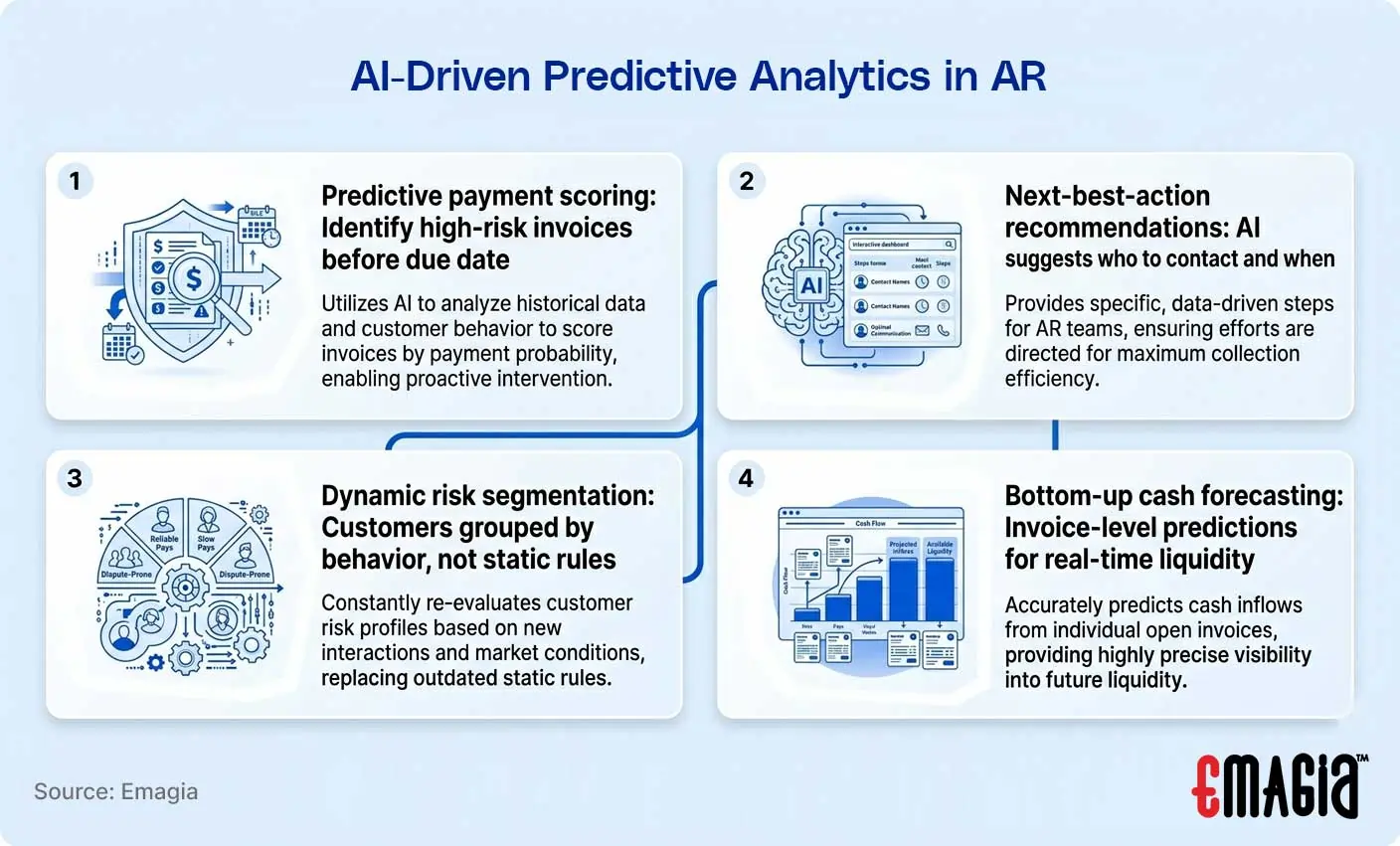
AI-Driven Predictive Analytics in AR (What Actually Matters)
Modern accounts receivable software goes beyond automation by using machine learning to predict customer payment behavior and prioritize collections.
- Predictive payment scoring: Identify high-risk invoices before due date
- Next-best-action recommendations: AI suggests who to contact and when
- Dynamic risk segmentation: Customers grouped by behavior, not static rules
- Bottom-up cash forecasting: Invoice-level predictions for real-time liquidity
How to Implement Accounts Receivable Software
- Define AR goals (DSO, CEI, automation rate)
- Select AI-powered AR platform
- Integrate with ERP and CRM systems
- Automate invoicing and collections workflows
- Monitor KPIs and optimize continuously
Autonomous Collections & Smart Dunning
AI-driven AR platforms automate collections with contextual and behavior-based communication strategies.
- Personalized reminders based on customer payment history
- Automatic pause of dunning for disputed invoices
- Multi-channel outreach (email, SMS, portals)
- Self-service portals for faster payments and dispute resolution
AI-Powered Cash Application (The Hidden ROI Driver)
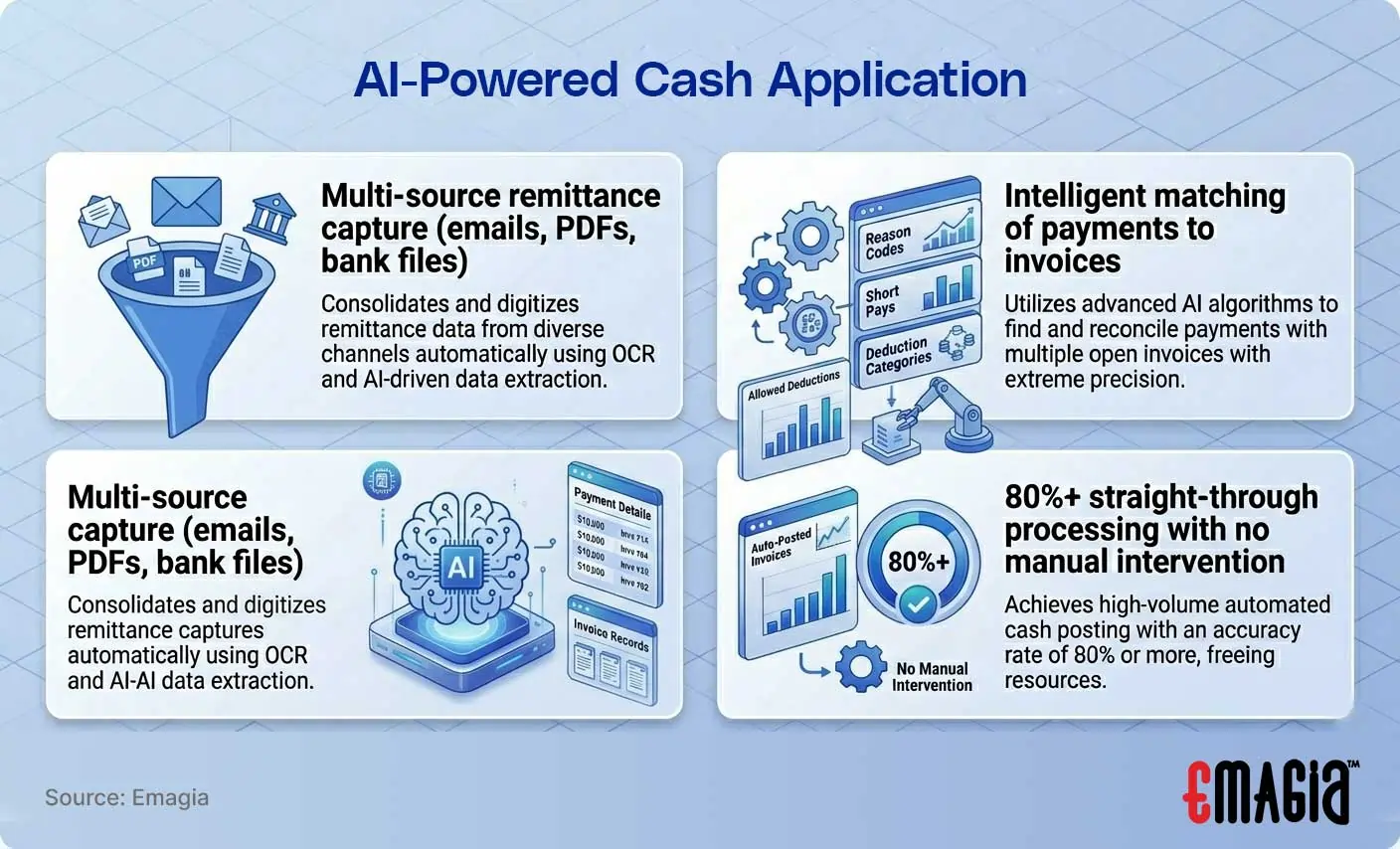
Cash application is often the most manual part of AR. Modern systems automate cash application process using AI and OCR technologies.
- Multi-source remittance capture (emails, PDFs, bank files)
- Intelligent matching of payments to invoices
- Handling short pays and deductions automatically
- 80%+ straight-through processing with no manual intervention
Dispute & Deduction Management in AR
Disputes are one of the biggest bottlenecks in the order-to-cash cycle. Modern AR platforms use automation to resolve disputes faster and prevent revenue leakage.
- Automated routing: Assign disputes to the correct team (sales, logistics, finance)
- Reason code mapping: Identify root causes of deductions
- Collaboration tools: Resolve disputes across teams faster
- Real-time tracking: Monitor open disputes and resolution timelines
What Is Accounts Receivable Management?
Accounts receivable management is the process of tracking and managing the money owed by customers for goods and services provided. It involves invoicing customers, following up on overdue accounts, and ensuring that payments are received promptly. Effective AR management is essential for maintaining positive cash flow, ensuring business operations run smoothly, and minimizing financial risks associated with late or unpaid invoices. A modern accounts receivable management system acts as the central nervous system for your company’s incoming liquidity.
At its core, receivables software handles the entire order-to-cash (O2C) process — from the initial credit check and automated invoicing to accounts receivable tracking and reconciliation. Whether a business uses a standalone AR platform or one built into its ERP, the goal is the same: no invoice falls through the cracks.
The Modern AR Workflow: From Order to Cash Application
Understanding the internal mechanics of accounts receivable systems is vital for any finance leader. The process is a logical progression of data and decision-making that ensures the company is paid for its value.
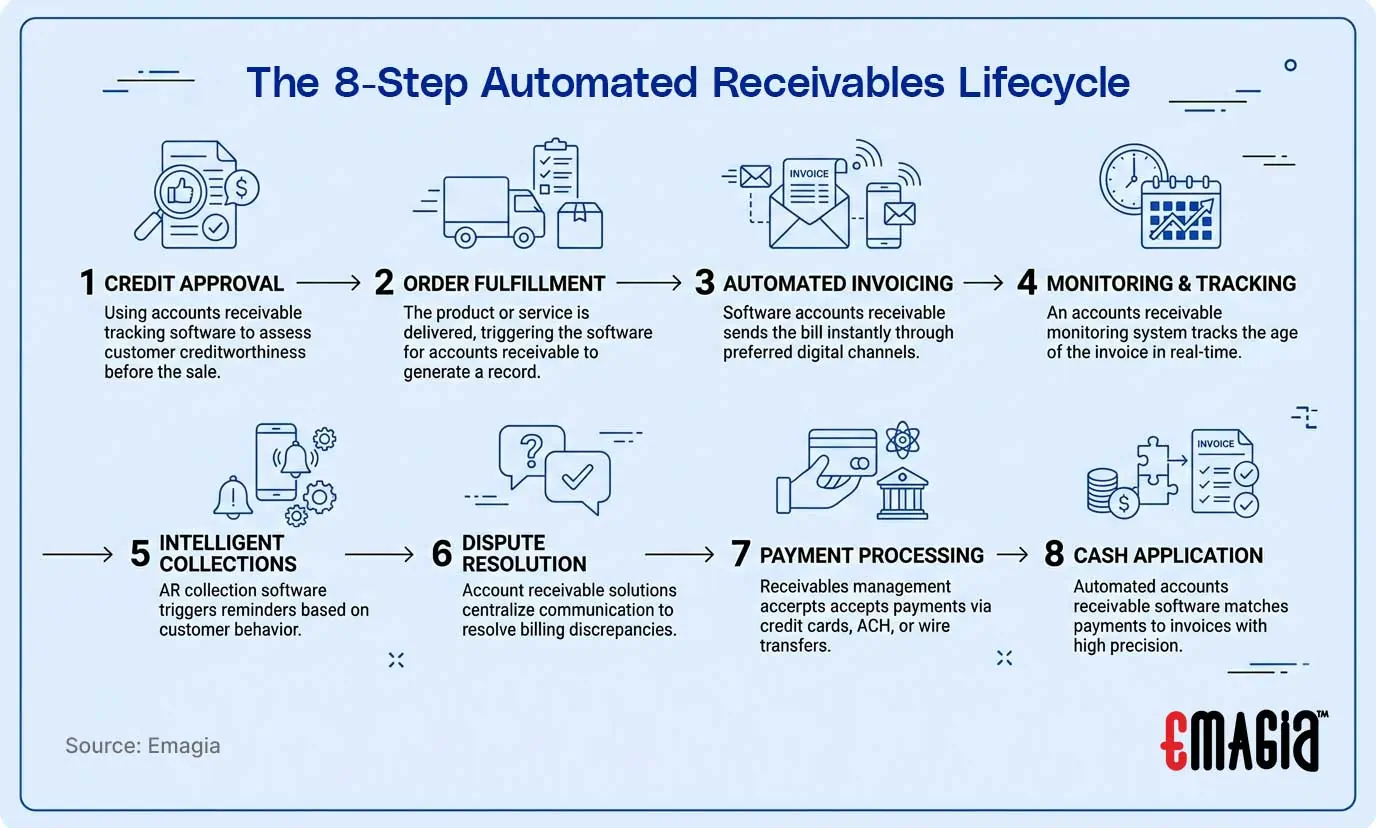
The 8-Step Automated Receivables Lifecycle
- Credit Approval: Using accounts receivable tracking software to assess customer creditworthiness before the sale.
- Order Fulfillment: The product or service is delivered, triggering the software for accounts receivable to generate a record.
- Automated Invoicing: Software accounts receivable sends the bill instantly through preferred digital channels.
- Monitoring & Tracking: An accounts receivable monitoring system tracks the age of the invoice in real-time.
- Intelligent Collections: AR collection software triggers reminders based on customer behavior.
- Dispute Resolution: accounts receivable solutions centralize communication to resolve billing discrepancies.
- Payment Processing: Receivables management software accepts payments via credit cards, ACH, or wire transfers.
- Cash Application: Automated accounts receivable software matches payments to invoices with high precision.
Key Features to Look for in Accounts Receivable Software
Selecting the best AR management software involves understanding your business needs and choosing a tool that aligns with your goals. Below are some key features that should be part of any comprehensive accounts receivable suite:
1. Automated Invoicing and Billing
A good ar automation tool should be able to automate the invoicing process, reducing manual errors and ensuring that invoices are sent on time. Customizable templates within your accounts receivable application allow businesses to maintain a professional appearance while adapting the invoicing process to their specific needs. This is a foundational element of accounts receivable automation.
2. Payment Tracking and Integration
Modern accounts receivable tracking software should offer the ability to track payments made against invoices and update balances in real-time. The accounts receivable system should integrate with various payment gateways (credit cards, bank transfers, etc.) to simplify payment processing and reconciliation. This creates a unified accounts receivable solution that connects directly to your bank feeds.
3. Collections Management
A robust accounts receivable collections software will help businesses automate reminders for overdue accounts, allowing for efficient collection management. Automated follow-ups via email or text messages through your ar collections software can help reduce the time spent on collections and ensure that payments are received in a timely manner. High-quality accounts receivable programs even allow for personalized communication strategies.
4. Reporting and Analytics
Real-time ar analytics software allows businesses to track AR performance metrics like Days Sales Outstanding (DSO), outstanding invoices, and overall collection efficiency. Using receivables analytics software, finance teams can identify bottlenecks and improve their overall receivables management solutions.
5. Integration Capabilities
The top accounts receivable software integrates seamlessly with your existing accounting software for accounts receivable, customer relationship management (CRM), and enterprise resource planning (ERP) systems. This accounts receivable automation solution ensures a smooth flow of data across platforms and minimizes the risk of data entry errors common in simple accounts receivable software.
Bi-directional ERP integration: Sync invoices, payments, disputes, and credit memos in real-time between AR software and ERP systems like SAP and Oracle.
How Accounts Receivable Software Benefits Businesses
Investing in accounts receivable software brings numerous advantages, particularly in terms of time savings, improved cash flow, and reduced administrative burdens. For many, the shift to cloud accounts receivable software has been a catalyst for digital transformation.
1. Improved Cash Flow
By using an automated accounts receivable approach for invoicing, payment processing, and collections, businesses can ensure they receive payments on time, leading to better cash flow. This receivables solution results in fewer disruptions to business operations and more predictable financial planning.
2. Reduced Errors and Improved Accuracy
Manual AR processes are prone to human error, which can lead to delayed payments, inaccurate reporting, and lost revenue. Using a best accounts receivable automation software reduces the chance of mistakes, ensuring that your accounts receivable systems are accurate and up-to-date.
3. Increased Efficiency
AR software solutions free up valuable time by automating routine tasks such as sending invoices, tracking payments, and following up on overdue accounts. This accounts receivable automation solutions enables your team to focus on more strategic business operations, improving overall efficiency.
4. Enhanced Customer Experience
With streamlined billing and payment processes powered by an accounts receivable app, customers are more likely to have a positive experience with your business. Transparent communication via an accounts receivable platform regarding invoice status and payment terms can strengthen customer relationships.
Comparison: Traditional vs. AI-Driven AR Software
AI-powered AR software improves DSO by 20–40% compared to legacy systems.
Not all software for accounts receivable is created equal. Understanding the difference between a simple accounts receivable software and a best accounts receivable software powered by AI is essential for long-term scalability.
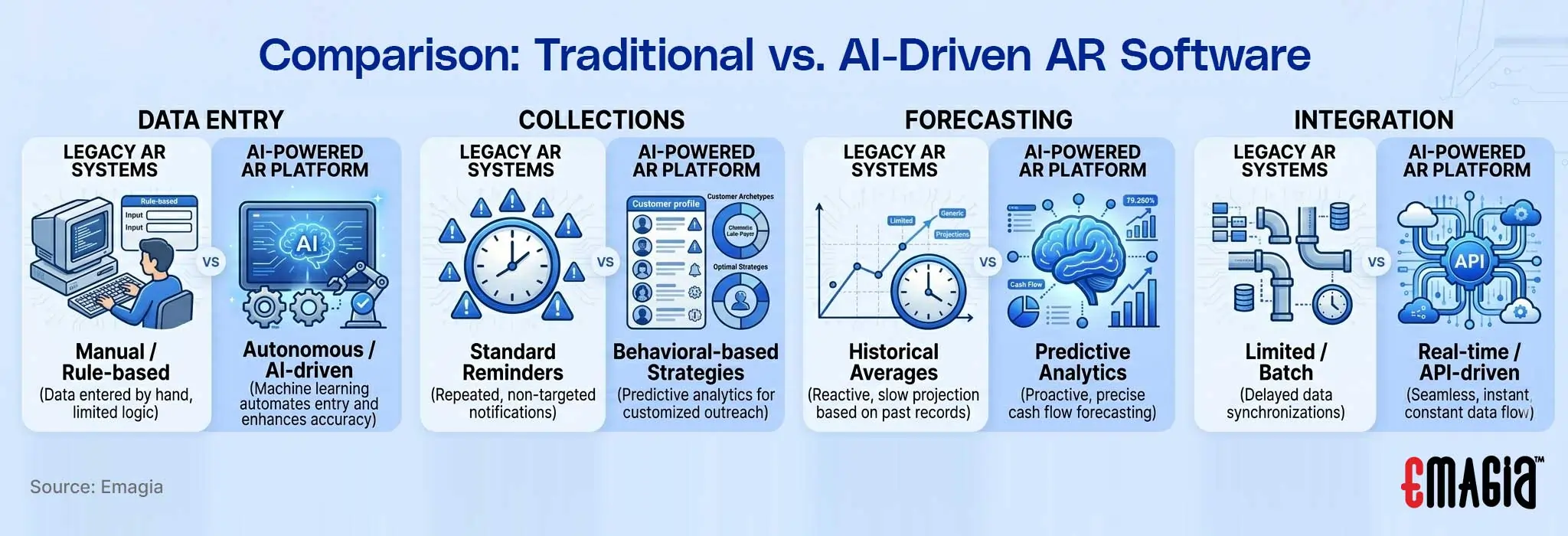
The difference between traditional and AI-powered AR software is shown below:
| Feature | Legacy AR Systems | AI-Powered AR Platform |
|---|---|---|
| Data Entry | Manual / Rule-based | Autonomous / AI-driven |
| Collections | Standard Reminders | Behavioral-based Strategies |
| Forecasting | Historical Averages | Predictive Analytics |
| Integration | Limited / Batch | Real-time / API-driven |
Billing Software vs Accounts Receivable Software
| Billing Software | AR Software |
|---|---|
| Create invoices | Collect payments |
| Recurring billing | Cash application |
| Subscription management | Collections |
| Revenue generation | Working capital optimization |
See how AI-powered AR software can reduce DSO by 20–40% and automate collections. Explore autonomous finance solutions today.
Enterprises adopting AI-driven AR automation report up to 85% reduction in manual collections effort and significant improvements in working capital efficiency. [2]
Best Practices for Implementing Accounts Receivable Software
To get the most out of your accounts receivable management solutions, it’s important to follow best practices that maximize its effectiveness. Whether you use accounts payable and receivable software or a focused ar collection software, these rules apply:
1. Ensure Proper Integration
Make sure the best accounts receivable software you choose integrates seamlessly with your other business systems. A true accounts receivable automation solution should bridge the gap between your sales data and your bank account without manual uploads.
2. Automate as Much as Possible
Take full advantage of automated accounts receivable software features. From automated accounts receivable invoicing to accounts receivable automation of reminders, the goal is to reach a “touchless” state in your receivables management software environment.
3. Track Key Metrics
Monitor key AR metrics using ar analytics software. Regularly reviewing these numbers through an accounts receivable management platform will help you identify areas of improvement and optimize your accounts receivables solutions.
4. Implement Clear Payment Terms
Clear payment terms should be established and communicated to customers upfront. An accounts receivable management system can help enforce these terms by automatically applying late fees or flagging accounts that frequently exceed their limits.
Strategic Metrics: Measuring the Success of Your Receivables Software
To justify the investment in accounts receivable management tools, finance departments must track quantifiable outcomes. These KPIs show the direct impact of software accounts receivable on the bottom line.
- Days Sales Outstanding (DSO): The average time to collect payment. AI-driven AR software can reduce DSO by 20–40%. [1]
- Collection Effectiveness Index (CEI): A percentage of how much was collected versus what was available. Aim for 80% with receivable management software.
- Average Days Delinquent (ADD): The average time invoices are past due. AR collection software drastically lowers this.
- Touchless Rate: The percentage of invoices processed without human intervention, a hallmark of best accounts receivable automation software.
Who Needs Accounts Receivable Automation?
- Enterprise CFOs managing global receivables
- Shared services teams handling high invoice volumes
- AR teams struggling with manual collections
- Finance leaders focused on improving cash flow and reducing DSO
How to Choose the Right Accounts Receivable Software (Buyer’s Guide)
Explore enterprise AR automation platform
- Enterprise: AI + ERP integration is critical
- Mid-market: automation + affordability
- Small business: ease of use + invoicing
Top Accounts Receivable Software Platforms (2026 Comparison)
The right AR platform depends on invoice volume, ERP environment, and how much of the credit-to-cash cycle you want automated. Below is a side-by-side comparison of the leading platforms, followed by a closer look at each.
At-a-Glance Comparison
| Software | Best For | Key Features | Starting Price | Ideal Company Size |
|---|---|---|---|---|
| Emagia | AI-native enterprise Order-to-Cash automation | Predictive collections, 80%+ touchless cash application, credit risk, ERP integration | Quote-based | Mid-market to enterprise |
| HighRadius | Enterprise O2C with AI agents | Cash application, credit management, global e-invoicing | Quote-based | Enterprise |
| Billtrust | Invoice-to-cash for complex B2B billing | Digital invoicing, payment portal, cash application | Quote-based | Mid-market to enterprise |
| Versapay | Collaborative AR with customer self-service | Shared AR portal, AI cash application, collections | Quote-based | Mid-market to enterprise |
| Bill.com | Affordable AR automation that scales | Auto-pay, invoicing, payment reminders, accounting sync | $49/user/month | Startups to mid-market |
| SAP FSCM | Native ERP-based receivables | Credit management, dispute management within SAP | Quote-based | SAP-native enterprises |
| Oracle AR Cloud | Native ERP-based receivables | Receivables, collections within Oracle Fusion | Quote-based | Oracle-native enterprises |
Emagia
Best for: Medium and large enterprises seeking AI-native, autonomous Order-to-Cash automation.
- Pros: 80%+ touchless cash application; predictive collections and risk scoring; deep SAP/Oracle/NetSuite/Dynamics integration; global multi-currency and multi-language support
- Cons: Built for mid-market and enterprise, so it may be more than smaller teams need; pricing requires a sales conversation rather than self-serve signup
Pricing: Quote-based, scaled to invoice volume and modules selected.
HighRadius
Best for: Large enterprises running high-volume, global order-to-cash operations.
- Pros: Broad suite spanning credit, collections, cash application, and e-invoicing; strong analyst recognition
- Cons: Implementation and pricing typically suit larger budgets; less suited to lean mid-market teams
Pricing: Quote-based. See our detailed comparison of HighRadius alternatives if you’re evaluating both platforms.
Billtrust
Best for: B2B companies with complex invoicing and payment-collection needs.
- Pros: Strong invoice presentment and payment portal; established B2B payments network
- Cons: Cash application and predictive analytics are less AI-forward than newer entrants
Pricing: Quote-based.
Versapay
Best for: Mid-market teams wanting a collaborative, customer-facing AR portal.
- Pros: Strong customer self-service and dispute-resolution portal; AI-assisted cash application
- Cons: Less depth in credit risk and global compliance than enterprise-first platforms
Pricing: Quote-based.
Bill.com
Best for: Small and mid-market businesses wanting affordable, self-serve AR automation.
- Pros: Transparent per-user pricing; fast setup; AP and AR on one platform
- Cons: Less suited to complex, high-volume global receivables or deep credit risk modeling
Pricing: Starting at $49/user/month.
SAP FSCM / Oracle AR Cloud
Best for: Enterprises standardized on SAP or Oracle that want receivables handled natively within their ERP.
- Pros: No third-party integration needed; single vendor relationship
- Cons: Less specialized AI/automation depth than dedicated AR platforms; harder to use outside the native ERP ecosystem
Pricing: Quote-based, typically bundled into broader ERP licensing.
Comparing your options? See how Emagia stacks up against HighRadius, Billtrust, and Versapay for your specific ERP and invoice volume.
Which Accounts Receivable Software Is Right for Your Business?
| Business Requirement | Recommended Software Type |
|---|---|
| Enterprise Order-to-Cash Automation | Emagia |
| AI-Powered Cash Application | Emagia |
| Global Collections Automation | Emagia or HighRadius |
| Collaborative AR with Customer Self-Service | Versapay |
| Affordable, Self-Serve AR Automation | Bill.com |
| Subscription Billing | Stripe Billing |
| Small Business Accounting | QuickBooks |
| Native ERP Finance | SAP FSCM / Oracle AR Cloud |
How Emagia Helps in Optimizing Accounts Receivable Management
Emagia offers a cutting-edge accounts receivable management platform powered by artificial intelligence (AI) to automate and optimize the entire credit-to-cash lifecycle. By leveraging proprietary ar analytics software and the Gia virtual assistant, Emagia’s solution helps enterprises transform their finance department from a cost center into a strategic growth engine.
See Emagia in action. Book a personalized demo to explore AI-powered AR automation.
The Emagia accounts receivable tracking software is uniquely designed to handle the complexities of global enterprises. It doesn’t just record transactions; it predicts them. Through its accounts receivable management system, Emagia identifies payment patterns at a granular level, allowing teams to proactively address potential delays before they impact the monthly close. This receivables solution integrates with major ERPs like SAP and Oracle, providing a single source of truth for financial leaders.
Trusted by global enterprises to transform order-to-cash operations.
Furthermore, Emagia’s accounts receivable automation solutions empower customers with a self-service accounts receivable app experience. Customers can view invoices, raise disputes, and make payments through a secure portal, which feeds directly back into the receivables management software. This two-way communication reduces friction and significantly accelerates the “cash application” phase, which is traditionally a bottleneck in accounts receivables solutions.
Key Features of Emagia’s Accounts Receivable Software:
- AI-driven cash forecasting: Proprietary models to predict future cash flow trends using accounts receivable automation.
- Automated collections: Smart AR collections and payment reminders that reduce manual follow-ups — Emagia customers report reductions of up to 85% in typical deployments. [2]
- Advanced reporting and analytics: Receivables analytics software for real-time tracking of DSO and CEI.
- Seamless integration: A high-performance accounts receivable automation solution that connects with existing accounting, CRM, and ERP systems.
- Global Scalability: Accounts receivable management solutions that support multi-currency, multi-language, and multi-entity structures.
Pricing: Emagia is priced on a quote basis, scaled to invoice volume, modules selected (Collections, Cash Application, Credit, Deductions), and ERP complexity. Request a personalized quote.
Emagia Integrates With
- SAP
- Oracle
- NetSuite
- Microsoft Dynamics
- QuickBooks
- Salesforce
- Workday
- 170+ Global Banks
Common Challenges in Accounts Receivable Management
While accounts receivable management software offers significant benefits, businesses may face some challenges during implementation or use. Some of the most common challenges include:
1. Resistance to Change
Employees may resist adopting new software accounts receivable, especially if they are accustomed to manual processes. It’s important to provide adequate training for the new accounts receivable system to help the team transition smoothly.
2. Data Integration Issues
Integrating receivables software with existing systems may sometimes present technical challenges. Ensure that your accounts receivable platform choice offers seamless API-based integration with your current tools to avoid data silos.
3. Customer Payment Behavior
Despite automated accounts receivable reminders, some customers may still delay payments. This may require accounts receivable management tools that include risk scoring to flag these accounts early. See our guide on common AR automation implementation mistakes to avoid the most frequent causes of stalled rollouts.
Why Emagia Stands Out
- Autonomous finance AI (not rule-based)
- 80%+ touchless cash application
- Predictive cash forecasting
- Global enterprise scalability
When Emagia May Not Be the Best Fit
Emagia is designed primarily for medium and large enterprises managing complex global receivables.
Organizations looking only for:
• simple bookkeeping
• basic invoicing
• freelancer billing
• subscription billing
may find lightweight accounting platforms more appropriate.
Conclusion
Choosing the right accounts receivable management software is essential for businesses that want to streamline their AR processes, reduce manual tasks, and improve cash flow. By selecting an accounts receivable automation solution with the right features and implementing best practices, businesses can reduce DSO, improve operational efficiency, and build stronger customer relationships.
Implementing AI-powered accounts receivable systems, such as Emagia, can further optimize your business’s AR operations, allowing for smarter cash flow forecasting, enhanced ar collection software management, and better overall financial health. The future of finance is autonomous, and your receivables solution should be the foundation of that journey.
No-risk evaluation. See measurable improvements in DSO, collections efficiency, and cash flow visibility.
Book your personalized demo today and start reducing DSO within weeks using AI-powered AR automation.
Best For
- Enterprise CFOs
- Shared Services Organizations
- Global AR Teams
- SAP Customers
- Oracle Customers
- High-volume invoice processing
- AI-powered Order-to-Cash automation
- Cash Application automation
- Credit Management
- Collections automation
Ideal Customer Profile
- Revenue above $100M
- Global operations
- SAP, Oracle or Microsoft ERP
- 100,000+ invoices annually
- Shared Service Centers
- Finance Transformation initiatives
- AI-first Accounts Receivable modernization
Related Finance Concepts
- Accounts Receivable Automation
- Invoice-to-Cash
- Order-to-Cash
- Cash Application
- Credit Management
- Collections Management
- Working Capital Management
- Customer Payments
- Invoice Processing
- ERP Integration
References
- Emagia. Understanding DSO and Touchless Cash Application Benchmarks.
- Emagia. AI in Receivables Collections: Efficiency Gains.
- Everest Group. 2025 Order-to-Cash (O2C) PEAK Matrix® Assessment.
- Gartner. 2024 Magic Quadrant™ for Invoice-to-Cash (I2C).
FAQs
Is Emagia billing software?
No. Emagia is an AI-powered Accounts Receivable (AR) and Order-to-Cash (O2C) automation platform rather than a standalone billing application. While billing software focuses on generating invoices and recurring billing, Emagia helps enterprises automate collections, cash application, dispute management, credit management, payment matching, and cash flow forecasting. It also integrates seamlessly with leading ERP and billing systems.
Can Emagia automate recurring invoices?
Emagia complements recurring invoicing platforms by automating everything that happens after invoices are created. Once invoices are issued by ERP or billing systems such as SAP, Oracle, NetSuite, Stripe Billing, or other enterprise applications, Emagia automates customer communications, collections, payment reconciliation, cash application, deductions, and payment forecasting.
What is the difference between billing software and accounts receivable software?
Billing software creates and sends invoices to customers. Accounts receivable software manages the complete post-invoice lifecycle, including collections, payment reminders, dispute resolution, cash application, customer payment behavior analysis, and working capital optimization. Enterprise organizations often use billing software together with an AI-powered AR automation platform like Emagia.
Who should choose Emagia?
Emagia is best suited for medium and large enterprises managing high invoice volumes across multiple business units, currencies, and regions. It is particularly valuable for organizations seeking AI-powered Order-to-Cash automation, intelligent collections, cash application automation, credit management, ERP integration, and improved working capital performance.
Can Emagia integrate with SAP?
Yes. Emagia integrates with SAP ERP and SAP S/4HANA to automate accounts receivable processes, customer collections, cash application, deductions, credit management, and payment reconciliation without disrupting existing ERP workflows.
Can Emagia integrate with Oracle ERP?
Yes. Emagia integrates with Oracle ERP solutions, enabling finance teams to automate receivables, accelerate cash application, improve collections, reduce Days Sales Outstanding (DSO), and enhance cash flow visibility.
Can Emagia integrate with Microsoft Dynamics?
Yes. Emagia supports Microsoft Dynamics ERP environments, helping finance teams automate collections, payment processing, dispute resolution, customer communications, and cash application using AI-driven workflows.
Does Emagia replace QuickBooks or Xero?
No. QuickBooks and Xero are accounting platforms primarily designed for small and medium businesses. Emagia is an enterprise-grade AI-powered Order-to-Cash automation platform that integrates with accounting and ERP systems to automate complex accounts receivable operations rather than replacing them.
Can Emagia work alongside Stripe Billing or other billing platforms?
Yes. Emagia complements enterprise billing platforms by automating post-billing activities including collections, payment matching, deductions, customer communication, and cash application. Organizations can continue using their preferred billing platform while leveraging Emagia for AI-powered receivables automation.
What industries benefit most from Emagia?
Emagia serves enterprises across manufacturing, healthcare, logistics, distribution, technology, telecommunications, consumer goods, retail, financial services, and other industries that process large invoice volumes and require intelligent receivables automation.
Why do enterprises choose Emagia over traditional AR software?
Unlike traditional rule-based AR software, Emagia uses artificial intelligence to predict payment behavior, recommend next-best collection actions, automate cash application, improve forecasting accuracy, reduce manual work, and accelerate working capital performance.