AI-Native Order-to-Cash Software for the Manufacturing Industry
What is Order-to-Cash Software for Manufacturing?
Manufacturing order-to-cash software is an AI-powered platform that automates order processing, invoicing, collections, cash application, dispute resolution, and ERP-integrated receivables workflows to accelerate cash flow.
Introduction
The manufacturing industry faces unique challenges in managing sales orders, invoicing, and payment processing. Traditional manual processes can lead to delays, errors, and inefficiencies that affect cash flow and operational performance. Order-to-cash (O2C) software designed for the manufacturing industry streamlines receivables and payment workflows, integrating seamlessly with enterprise resource planning (ERP) and manufacturing execution systems (MES).
Key Takeaways
- Automates order entry, invoicing, collections, and cash application.
- Integrates with ERP systems like SAP, Oracle, and Microsoft Dynamics.
- Improves DSO, cash flow forecasting, and operational efficiency.
- Reduces invoice errors and manual processing delays.
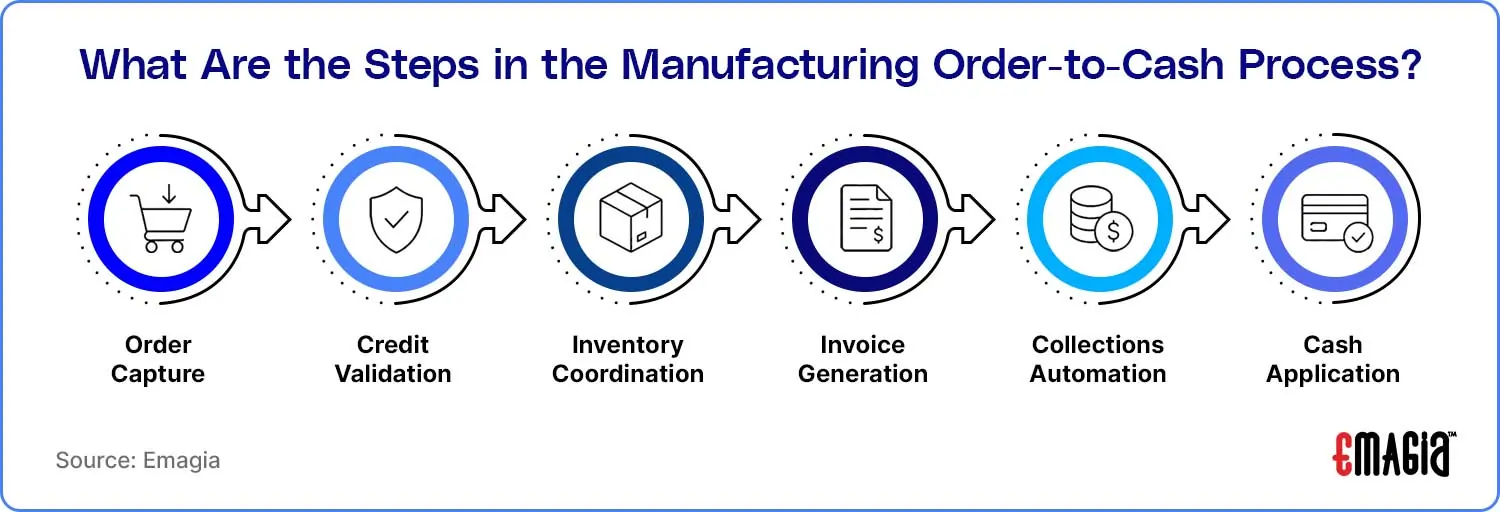
What Are the Steps in the Manufacturing Order-to-Cash Process?
Manufacturing order-to-cash automation connects sales orders, inventory, invoicing, receivables, and payment processing into one intelligent workflow.
- Order Capture – Sales orders enter via ERP, EDI, portals, or CRM.
- Credit Validation – Customer risk is checked automatically using credit risk management.
- Inventory Coordination – Stock availability syncs with ERP/MES.
- Invoice Generation – Accurate invoices are created automatically.
- Collections Automation – AI prioritizes overdue accounts.
- Cash Application – Payments match invoices automatically.
Why Manufacturing Businesses Need O2C Software
Manufacturers often face invoice delays caused by partial shipments, EDI mismatches, distributor deductions, multi-plant billing fragmentation, and dealer-specific credit terms.
- Reducing order processing times.
- Minimizing invoice errors and payment delays.
- Enhancing supply chain and inventory visibility.
Why Is Order-to-Cash Important in Manufacturing?
Order-to-cash is important in manufacturing because delays in invoicing, shipment disputes, distributor deductions, and slow collections directly impact cash flow, working capital, customer relationships, and revenue realization. Efficient order-to-cash processes help manufacturers accelerate payments, improve receivables visibility, and reduce operational friction across complex supply chains.
Manufacturing-Specific O2C Challenges
- Distributor Payment Delays: Long distributor payment cycles can create working capital pressure and forecasting uncertainty.
- Invoice Disputes: Shipment mismatches, pricing discrepancies, and partial deliveries often trigger delayed payments.
- Multi-Plant Billing Complexity: Manufacturers operating across plants often face fragmented billing and reconciliation challenges.
- EDI Order Exceptions: Manufacturing order flows often contain format mismatches, missing fields, and approval bottlenecks.
- Dealer Credit Risk Variability: Different customer segments often require dynamic credit assessment and collections strategies.
How AI Improves Manufacturing Order-to-Cash Operations
AI-powered O2C automation helps manufacturers predict delayed payments, identify invoice disputes early, prioritize collections activities, improve cash forecasting, and automate payment workflows.
Modern platforms integrate with SAP S/4HANA, Oracle NetSuite, Microsoft Dynamics, and manufacturing ERP ecosystems for end-to-end finance automation.
Manual vs AI-Powered Order-to-Cash Automation
| Process | Manual Process | AI-Automated Process |
|---|---|---|
| Order Entry | Manual processing delays | AI-automated processing |
| Invoice Processing | Manual, error-prone | Automated and accurate |
| Collections | Reactive follow-ups | Predictive AI prioritization |
| Cash Application | Manual reconciliation | Autonomous matching |
| Visibility | Siloed data | Real-time dashboards |
Core Functions of Manufacturing O2C Automation
1. Assess Business Requirements
Identify pain points and customize the software to suit manufacturing needs.
2. Choose the Right O2C Solution
Select a platform that integrates with existing ERP and financial systems.
3. Automate Payment Follow-Ups
Use AI-powered reminders to reduce delayed payments and bad debts.
4. Optimize Order Processing Workflows
Streamline data entry, validation, and approval processes to prevent bottlenecks.
5. Monitor Key Performance Metrics
Track cash flow, order accuracy, payment cycles, and DSO to drive continuous improvements.
How O2C Automation Reduces Days Sales Outstanding (DSO)
O2C automation reduces DSO by automating invoice delivery, prioritizing delinquent accounts, resolving disputes earlier, and accelerating payment reconciliation.
Frequently Asked Questions (FAQs)
What is order-to-cash software for manufacturing?
Manufacturing order-to-cash software is an AI-powered platform that automates order processing, invoicing, collections, cash application, dispute resolution, and ERP-integrated receivables workflows to improve cash flow and operational efficiency.
Can O2C software integrate with ERP systems?
Yes. Manufacturing O2C platforms typically integrate with ERP systems such as SAP S/4HANA, Oracle NetSuite, Microsoft Dynamics, and manufacturing execution systems (MES) to synchronize orders, invoices, inventory, and receivables data.
How does O2C software reduce invoice disputes?
Manufacturing O2C software reduces invoice disputes by improving billing accuracy, validating order and shipment data automatically, detecting discrepancies earlier, and streamlining dispute resolution workflows.
Is O2C software suitable for small manufacturing businesses?
Yes, small and medium-sized manufacturers benefit from automation by reducing operational costs and improving efficiency.
How does O2C software improve cash flow?
Manufacturing O2C software improves cash flow by accelerating invoice generation, reducing disputes, prioritizing overdue collections, improving payment matching accuracy, and shortening the invoice-to-cash cycle.
Can manufacturing O2C software integrate with SAP S/4HANA?
Yes, many enterprise O2C platforms integrate with SAP S/4HANA, Oracle NetSuite, and Microsoft Dynamics.
Improve Manufacturing Cash Flow with AI Automation
See how intelligent order-to-cash automation helps reduce DSO and improve collections efficiency.
Example Outcomes of Manufacturing O2C Automation
Manufacturing organizations using intelligent order-to-cash automation often improve receivables efficiency, reduce manual reconciliation effort, and enhance collections prioritization across distributed operations.
- Improved receivables workflow efficiency through automation.
- Enhanced collections prioritization using predictive AI insights.
- Reduced manual reconciliation effort across invoice-to-cash processes.
Conclusion
Manufacturers can improve working capital visibility, reduce manual receivables effort, and accelerate revenue realization with intelligent O2C automation.
Ready to Modernize Manufacturing Order-to-Cash?
Manufacturers can improve cash flow, reduce manual workloads, and accelerate collections using AI-powered order-to-cash automation.


