What is Order to Cash (O2C)? The Ultimate Guide to Process, Automation & Collections
The Order-to-Cash (O2C) process is the end-to-end set of business procedures for managing a customer journey from order placement to final payment receipt. The eight stages include order management, credit review, fulfillment, invoicing, accounts receivable, collections, cash application, and reporting.
Modern AI-driven O2C platforms support Autonomous Finance operations using predictive analytics, intelligent collections prioritization, deduction management automation, and generative AI assistants that help finance teams accelerate decision-making and improve working capital performance.
What is Order-to-Cash (O2C)?
Order-to-Cash (O2C) is the complete business process that manages the customer journey from order placement to payment collection. The O2C cycle includes order management, credit approval, invoicing, collections, cash application, and financial reporting to improve cash flow, customer experience, and operational efficiency.
8 Key Steps in the Order-to-Cash Process
- Step 1: Order Management
- Step 2: Credit Management
- Step 3: Order Fulfillment
- Step 4: Invoice Generation
- Step 5: Accounts Receivable Management
- Step 6: Collections Management
- Step 7: Cash Application
- Step 8: Reporting & Analytics
Understanding the Order-to-Cash (O2C) Process
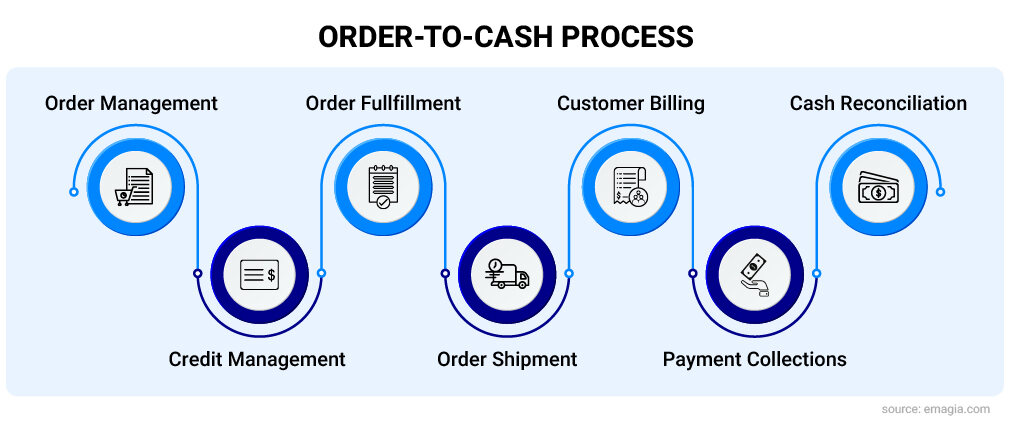
The O2C process is a comprehensive cycle that involves multiple stages, each critical to ensuring efficient business operations and customer satisfaction. It begins when a customer places an order and concludes when the payment is received and accounted for. The key stages include order management, credit management, order fulfillment, invoicing, payment collection, and cash application. Each stage must be meticulously managed to ensure a seamless flow from order initiation to cash realization.
Why Collections Management is Critical in O2C
The collection process within the O2C cycle focuses on managing and collecting payments from customers. Key components include:
- Invoicing: Generating and delivering accurate invoices promptly to customers.
- Payment Follow-Up: Monitoring due dates and sending reminders for upcoming or overdue payments.
- Dispute Resolution: Addressing any discrepancies or disputes that may delay payment.
- Payment Processing: Ensuring received payments are correctly applied to customer accounts.
Efficient management of these components is vital for maintaining liquidity and reducing the risk of bad debts.
Common Challenges in the Order-to-Cash (O2C) Process
Despite its importance, the collection process in O2C often faces several challenges:
- Delayed Payments: Customers may not adhere to payment terms, leading to cash flow issues.
- Manual Processes: Reliance on manual tasks can result in errors and inefficiencies.
- Data Inaccuracies: Incorrect customer information can lead to invoicing errors and payment delays.
- Disjointed Systems: Lack of integration between departments can cause miscommunication and process bottlenecks.
Identifying and addressing these challenges is crucial for optimizing the collection process.
Benefits of an Optimized Order-to-Cash Process
An optimized Order-to-Cash (O2C) process helps businesses improve operational efficiency, accelerate cash flow, and strengthen customer relationships. By automating workflows and streamlining financial operations, organizations can reduce delays, improve visibility, and enhance working capital performance.
- Improved Cash Flow: Faster invoicing and payment collection help businesses maintain healthy liquidity.
- Reduced Days Sales Outstanding (DSO): Automated collections and proactive payment reminders accelerate customer payments.
- Enhanced Customer Experience: Accurate invoicing, flexible payment options, and faster dispute resolution improve customer satisfaction.
- Lower Operational Costs: Automation reduces manual effort, administrative overhead, and processing errors.
- Better Working Capital Management: Real-time visibility into receivables helps finance teams optimize working capital.
- Improved Financial Accuracy: Integrated systems minimize data inconsistencies and improve reporting accuracy.
- Stronger Compliance and Risk Management: Standardized workflows and audit trails support regulatory compliance and reduce financial risk.
Ready to Modernize Your Order-to-Cash Process?
Explore how AI-powered O2C automation can reduce DSO, improve collections efficiency, and accelerate cash flow visibility.
Manual vs Automated Order-to-Cash Process
| Process Area | Manual O2C Process | Automated O2C Process |
|---|---|---|
| Invoice Processing | Manual data entry and invoice creation | Automated invoice generation and delivery |
| Payment Reminders | Emails and phone calls managed manually | AI-driven automated reminders and workflows |
| Cash Application | Spreadsheet-based payment matching | AI-powered automatic cash matching |
| Dispute Resolution | Slow and disconnected communication | Centralized workflow automation and tracking |
| Reporting & Analytics | Limited visibility and delayed reporting | Real-time dashboards and predictive analytics |
| Days Sales Outstanding (DSO) | Higher DSO due to delays and inefficiencies | Reduced DSO through proactive collections |
| Error Rates | Higher risk of human errors | Improved accuracy through automation |
Best Practices to Optimize the Order-to-Cash Process
To enhance the efficiency of your O2C collection process, consider implementing the following strategies:
1. Automate Invoicing and Payment Reminders
Utilize automated systems to generate invoices and send payment reminders. Automation reduces manual errors and ensures timely communication with customers. According to a study by Aberdeen Group, companies using automated O2C solutions require manual intervention for only 16.2% of invoices, compared to nearly 80% for those without automation.
2. Implement Clear Credit Policies
Establish and enforce clear credit policies to assess customer creditworthiness effectively. This practice minimizes the risk of bad debts and ensures that customers understand their payment obligations.
3. Enhance Data Accuracy
Maintain accurate and up-to-date customer information to prevent invoicing errors. Regularly audit data and employ validation tools to ensure information integrity.
4. Foster Interdepartmental Collaboration
Encourage collaboration between sales, finance, and customer service teams to ensure a unified approach to order processing and collections. Integrated communication reduces misunderstandings and streamlines the O2C process.
5. Leverage Data Analytics
Analyze collection data to identify patterns, such as frequently late-paying customers or common dispute reasons. Use these insights to refine your strategies and address underlying issues proactively.
6. Integrate O2C with ERP and CRM Platforms
Modern Order-to-Cash automation platforms should integrate seamlessly with enterprise ERP and CRM systems such as
SAP, Oracle, NetSuite, Microsoft Dynamics, and Salesforce.
Integrated O2C ecosystems improve invoice accuracy, customer visibility, dispute resolution, and cash flow forecasting across finance operations.
Best Practices for Effective Collections
Adopting the following best practices can further enhance your collection process:
- Standardize Procedures: Develop standardized procedures for invoicing, follow-ups, and dispute resolution to ensure consistency and efficiency.
- Offer Multiple Payment Options: Providing various payment methods can make it more convenient for customers to pay promptly.
- Train Staff Regularly: Equip your team with the necessary skills and knowledge to manage collections effectively and handle customer interactions professionally.
- Monitor Key Performance Indicators (KPIs): Track metrics such as Days Sales Outstanding (DSO) and collection effectiveness index to measure and improve performance.
Why Order-to-Cash (O2C) Automation Matters for Modern Enterprises
Modern enterprises manage thousands of invoices, customer transactions, and payment interactions daily. Manual Order-to-Cash processes often create delays, invoicing errors, higher operational costs, and poor visibility into accounts receivable performance.
AI-powered O2C automation platforms help organizations streamline invoicing, collections, dispute resolution, cash application, and customer payment experiences while improving working capital management and reducing Days Sales Outstanding (DSO).
How AI is Transforming the Order-to-Cash Process
Artificial intelligence (AI) is transforming the Order-to-Cash process by automating repetitive tasks, improving prediction accuracy, and enabling finance teams to make faster, data-driven decisions. AI-powered O2C solutions help businesses accelerate collections, reduce bad debt, and improve customer experiences.
- Predictive Collections: AI analyzes customer payment behavior to predict late payments and recommend proactive collection strategies.
- Intelligent Cash Application: Machine learning automatically matches incoming payments to invoices with greater speed and accuracy.
- Automated Invoice Processing: AI streamlines invoice generation, validation, and delivery to reduce manual intervention.
- Dispute Management Automation: AI-powered workflows help identify, categorize, and resolve disputes more efficiently.
- Customer Payment Portals: Self-service payment portals improve customer convenience and accelerate payment cycles.
- Real-Time Analytics: AI-driven dashboards provide actionable insights into collections performance, DSO trends, and cash flow forecasting.
Order-to-Cash Statistics and Industry Trends
- Organizations using AI-powered accounts receivable automation can significantly improve collections productivity and reduce manual invoice processing workloads.
- Businesses with automated O2C workflows can significantly improve invoice processing speed and collections efficiency.
- AI-powered collections platforms help reduce Days Sales Outstanding (DSO) and improve cash flow forecasting accuracy.
- Finance leaders increasingly adopt autonomous finance technologies to automate receivables, deductions management, and customer payment experiences.
- Integrated O2C platforms improve visibility across invoicing, collections, cash application, and dispute resolution processes.
How Emagia Automates the Order-to-Cash Process
Emagia offers advanced solutions designed to streamline and optimize the O2C collection process. By integrating artificial intelligence and automation, Emagia enables businesses to:
Modern O2C automation platforms combine artificial intelligence, workflow automation, analytics, and customer self-service tools to help enterprises improve collections efficiency, reduce operational costs, and accelerate digital finance transformation.
- Automate Routine Tasks: Reduce manual intervention in invoicing and payment reminders, leading to increased efficiency.
- Enhance Data Accuracy: Utilize AI-driven tools to maintain accurate customer information and reduce errors.
- Improve Cash Flow: Accelerate payment collections and reduce DSO through proactive strategies and tools.
- Strengthen Customer Relationships: Provide personalized communication and efficient dispute resolution, fostering better customer satisfaction.
Implementing Emagia’s solutions can transform your O2C collection process, resulting in improved financial performance and customer relations.
Frequently Asked Questions (FAQs)
What are the stages of the Order-to-Cash process?
The major stages of the O2C process include order management, credit management, order fulfillment, invoice generation, accounts receivable management, collections, cash application, and financial reporting.
What is the difference between O2C and accounts receivable?
Order-to-Cash (O2C) is the complete business cycle from customer order placement to payment collection, while accounts receivable (AR) is a specific component within the O2C process focused on managing outstanding customer payments.
How does AI improve the Order-to-Cash process?
AI improves the O2C process by automating invoicing, predicting payment delays, streamlining collections, accelerating cash application, and providing real-time financial insights that improve efficiency and reduce operational costs.
What KPIs are important in O2C?
Key O2C metrics include Days Sales Outstanding (DSO), Collection Effectiveness Index (CEI), bad debt ratio, invoice accuracy rate, dispute resolution time, and cash application accuracy.
What is DSO in Order-to-Cash?
Days Sales Outstanding (DSO) measures the average number of days it takes a business to collect payment after a sale. Lower DSO indicates a more efficient Order-to-Cash process and healthier cash flow.
Conclusion
The Order-to-Cash (O2C) process plays a critical role in improving cash flow, customer experience, and financial efficiency. By combining automation, AI-driven analytics, and streamlined collections strategies, businesses can reduce DSO, optimize working capital, and accelerate digital finance transformation. Modern O2C platforms like Emagia help enterprises automate invoicing, collections, cash application, and customer payment experiences for greater operational performance.
Reviewed by enterprise finance professionals specializing in accounts receivable automation, AI-powered collections, digital finance transformation, and working capital optimization.
Organizations looking to modernize their Order-to-Cash operations should evaluate AI-powered automation platforms that integrate invoicing, collections, cash application, analytics, and customer payment experiences into a unified finance ecosystem.


