Discover how to evaluate the best order-to-cash automation software for enterprise finance. Learn which capabilities matter most, how AI is transforming receivables, and what CFOs should consider before selecting an O2C platform.
Quick Answer
The best software for automating the order-to-cash (O2C) cycle is an enterprise platform that integrates credit management, order processing, invoicing, collections, cash application, deductions management, customer payments, analytics, and ERP connectivity into a unified workflow. Rather than investing in separate applications for each process, organizations achieve better operational efficiency, lower costs, and faster cash flow by adopting an end-to-end intelligent automation platform powered by artificial intelligence.
What Is Order-to-Cash Automation?
Order-to-cash (O2C) automation is the process of using intelligent software to automate every financial activity that occurs after a customer places an order until payment is received, reconciled, and recorded in the organization’s financial systems. Instead of relying on spreadsheets, emails, manual approvals, and disconnected applications, enterprises use integrated platforms to streamline workflows across finance, sales, customer service, treasury, and accounting.
Modern order-to-cash automation platforms leverage artificial intelligence, machine learning, robotic process automation (RPA), predictive analytics, and workflow orchestration to eliminate repetitive manual work while improving accuracy and visibility. This enables finance teams to process transactions faster, reduce operational costs, and focus on strategic decision-making instead of administrative tasks.
A complete enterprise O2C platform typically manages customer onboarding, credit approvals, order validation, invoice generation, payment collection, deductions, dispute resolution, cash application, financial reporting, and customer self-service within a single ecosystem.
The Complete Order-to-Cash Process
| Process Stage | Traditional Approach | Automated Approach |
|---|---|---|
| Customer Credit | Manual credit reviews and approvals | AI-driven credit decisions and automated workflows |
| Order Validation | Spreadsheet and email approvals | Automated business rules and workflow routing |
| Invoice Creation | Manual invoice preparation | Instant electronic invoicing |
| Collections | Manual follow-up by collectors | Predictive collection campaigns powered by AI |
| Cash Application | Manual payment matching | AI-based automatic cash matching |
| Reporting | Spreadsheet-based reporting | Real-time dashboards and analytics |
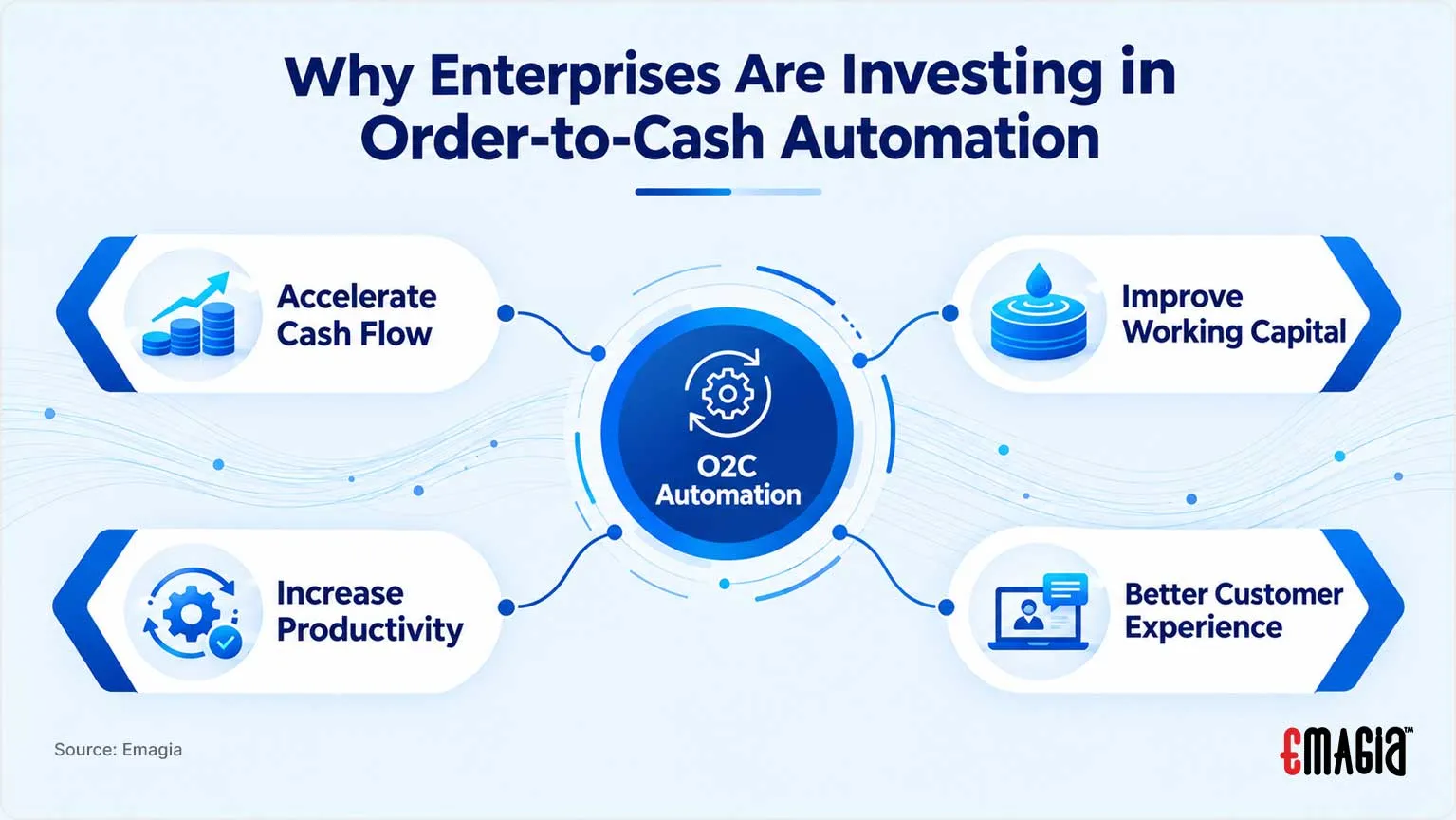
Why Enterprises Are Investing in Order-to-Cash Automation
Today’s finance organizations operate in a highly dynamic environment where customer expectations, payment methods, banking regulations, and transaction volumes continue to evolve. At the same time, CFOs are expected to improve cash flow, reduce operating costs, strengthen compliance, and deliver real-time financial insights without significantly increasing headcount.
Manual order-to-cash processes make it difficult to achieve these objectives. Finance professionals spend countless hours processing invoices, following up on overdue payments, reconciling bank transactions, investigating deductions, and preparing reports. These repetitive activities consume valuable resources while increasing the risk of errors and delayed cash collections.
Enterprise automation transforms the finance function by digitizing these processes, standardizing workflows, and providing intelligent recommendations that help teams make faster and more informed decisions.
Accelerate Cash Flow
Reduce payment delays through automated invoicing, intelligent collections, and faster cash application.
Improve Working Capital
Gain better control over receivables, reduce DSO, and improve liquidity across the enterprise.
Increase Productivity
Eliminate repetitive manual tasks so finance teams can focus on analysis, forecasting, and strategic initiatives.
Deliver Better Customer Experiences
Improve payment experiences through digital invoices, customer portals, automated communications, and faster dispute resolution.
Common Challenges in Traditional Order-to-Cash Processes
Many organizations still manage receivables using multiple disconnected systems. Credit teams work in one application, collections teams rely on another, cash application is handled manually, and reporting is performed in spreadsheets. This fragmented approach slows operations, increases costs, and limits visibility across the finance organization.
As transaction volumes grow, these inefficiencies become even more pronounced. Finance teams struggle to maintain service levels while dealing with increasing payment complexity, multiple currencies, customer disputes, and evolving compliance requirements.
Warning Signs That It Is Time to Automate
- Increasing Days Sales Outstanding (DSO)
- Large volumes of unapplied cash
- Manual invoice processing
- Spreadsheet-based reconciliation
- High collection costs
- Growing customer disputes
- Limited visibility into receivables performance
- Disconnected ERP and banking systems
- Lengthy month-end close cycles
- Rising finance operating costs
Organizations experiencing several of these challenges should evaluate enterprise order-to-cash automation platforms capable of unifying receivables processes, improving operational efficiency, and providing real-time financial intelligence. Selecting the right software requires more than comparing feature lists—it requires understanding how each platform supports long-term business growth, digital transformation, and enterprise scalability.
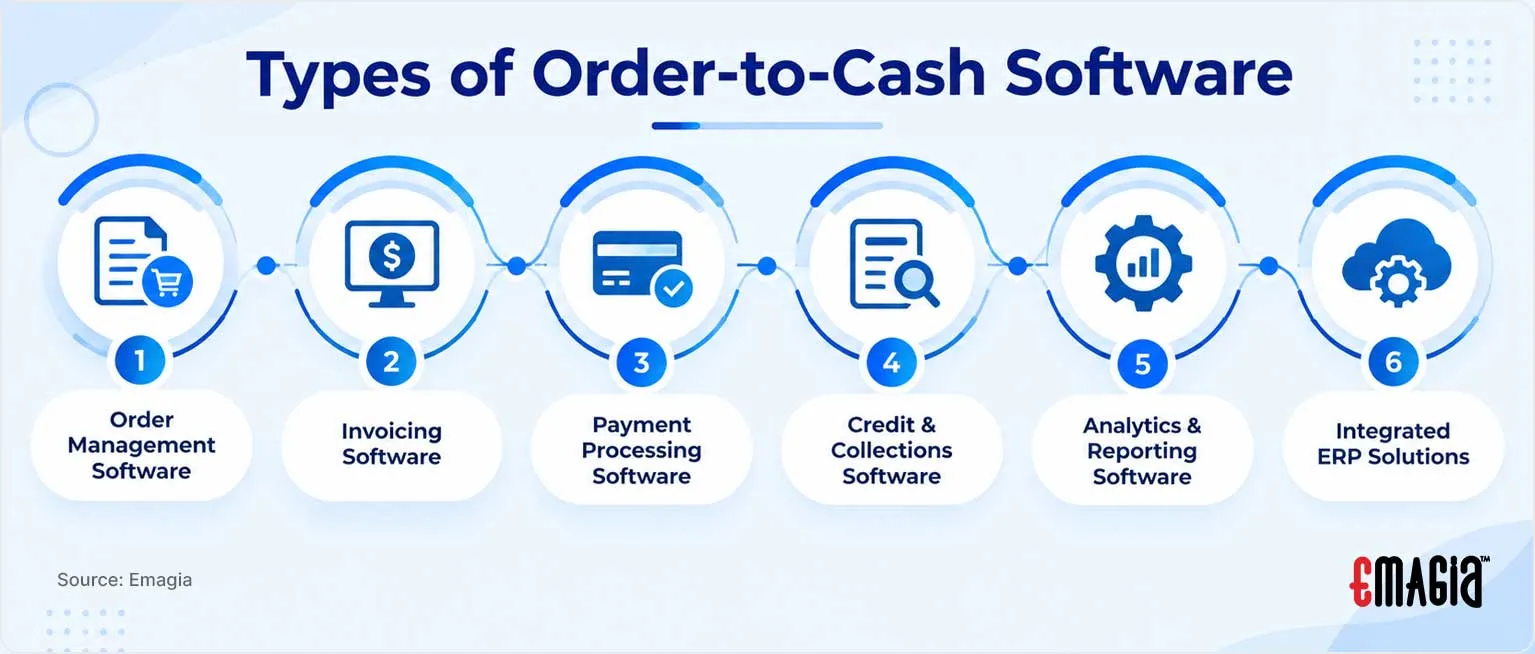
Types of Order-to-Cash Software
Not every order-to-cash solution offers the same level of functionality. Some vendors specialize in a single area, such as collections or cash application, while others provide an integrated platform that manages the entire receivables lifecycle. Understanding these categories helps finance leaders choose technology that aligns with their business objectives and long-term digital transformation strategy.
Organizations often begin with a point solution to solve a specific challenge. However, as transaction volumes increase and finance operations become more complex, disconnected applications can create data silos, duplicate work, and inconsistent reporting. Many enterprises therefore prefer unified platforms that automate the complete order-to-cash process.
| Software Category | Primary Purpose | Best For |
|---|---|---|
| Credit Management Software | Automates customer onboarding, credit scoring, approvals, and credit monitoring. | Organizations managing large customer portfolios. |
| Accounts Receivable Automation | Digitizes invoicing, payment tracking, reminders, and receivables management. | Companies seeking faster invoice-to-cash cycles. |
| Collections Management Software | Prioritizes customer follow-ups using workflows and predictive analytics. | Finance teams focused on reducing overdue receivables. |
| Cash Application Software | Automatically matches incoming payments with invoices using AI. | Organizations processing high payment volumes. |
| Deductions Management | Tracks, investigates, and resolves payment discrepancies. | Businesses with frequent customer deductions. |
| Integrated Order-to-Cash Platform | Combines all receivables functions into a single platform. | Large enterprises pursuing end-to-end automation. |
While point solutions may appear less expensive initially, enterprise organizations often realize greater long-term value by adopting an integrated platform. A unified solution reduces system complexity, improves data consistency, and provides a complete view of customer financial interactions across every stage of the order-to-cash cycle.
How to Evaluate Order-to-Cash Automation Software
Selecting enterprise finance software is a strategic investment rather than a technology purchase. CFOs, controllers, and shared services leaders should evaluate platforms based on business outcomes instead of simply comparing feature lists. The right solution should improve operational efficiency, accelerate cash flow, support future growth, and integrate seamlessly with existing enterprise systems.
During the evaluation process, consider how each platform supports your organization’s finance transformation roadmap over the next five to ten years. Scalability, security, AI capabilities, and implementation flexibility are often more important than individual features.
1. End-to-End Automation
Look for software that automates the complete receivables lifecycle instead of isolated processes. Integrated workflows reduce manual intervention, improve visibility, and eliminate unnecessary handoffs between departments.
2. Artificial Intelligence
AI enables intelligent cash matching, predictive collections, automated dispute routing, credit risk analysis, and real-time recommendations that continuously improve finance operations.
3. ERP Integration
Enterprise platforms should integrate with ERP systems such as SAP, Oracle, Microsoft Dynamics, NetSuite, and other financial applications without creating duplicate data or manual synchronization.
4. Global Scalability
Support for multiple entities, currencies, languages, tax regulations, payment methods, and banking formats is essential for multinational organizations.
5. Security and Compliance
Evaluate the platform’s security architecture, role-based access controls, audit trails, regulatory compliance, and data protection capabilities.
6. Analytics and Reporting
Modern finance leaders require real-time dashboards, KPI tracking, cash forecasting, and executive reporting without relying on spreadsheets or manual data consolidation.
Essential Capabilities Every Enterprise O2C Platform Should Include
Enterprise software should support every major receivables function while allowing finance teams to automate repetitive activities, standardize business processes, and improve collaboration across departments.
| Capability | Business Value |
|---|---|
| Credit Management | Reduce credit risk and accelerate customer onboarding. |
| Electronic Invoicing | Deliver invoices faster while reducing billing errors. |
| Collections Automation | Prioritize high-risk accounts and improve collection effectiveness. |
| AI Cash Application | Automatically match payments to invoices with minimal manual effort. |
| Deductions Management | Resolve disputes faster and recover outstanding revenue. |
| Customer Self-Service Portal | Allow customers to view invoices, payments, statements, and disputes online. |
| Executive Dashboards | Provide real-time visibility into receivables, collections, and cash flow. |
| Predictive Analytics | Forecast payment behavior and identify potential collection risks. |
Enterprise Buyer’s Checklist
Before selecting an order-to-cash automation platform, ask these important questions:
- Does the platform automate the complete order-to-cash lifecycle?
- Can it integrate with our existing ERP and banking systems?
- Does it use AI to improve finance operations rather than simply digitize workflows?
- Can it scale across multiple business units and global operations?
- Does it provide real-time dashboards and executive reporting?
- How quickly can measurable business value be achieved?
- Does the vendor have experience supporting enterprise finance organizations?
Answering these questions early in the evaluation process helps organizations narrow their shortlist and focus on platforms capable of delivering measurable improvements in cash flow, operational efficiency, customer experience, and financial visibility.
What Are the Best Tools for Automating the Order-to-Cash Cycle?
There is no single “best” order-to-cash software for every organization. The right solution depends on your business model, transaction volumes, ERP ecosystem, global operations, automation goals, and digital transformation strategy.
Small businesses may benefit from accounting software with basic receivables automation. Mid-sized organizations often add specialized collections or cash application tools as transaction volumes increase. Large enterprises, however, typically achieve the greatest long-term value from integrated order-to-cash platforms that automate every stage of the receivables lifecycle.
Rather than asking, “Which software has the most features?”, enterprise finance leaders should ask:
“Which platform will help us improve cash flow, reduce manual effort, lower operating costs, and support our finance transformation strategy over the next decade?”
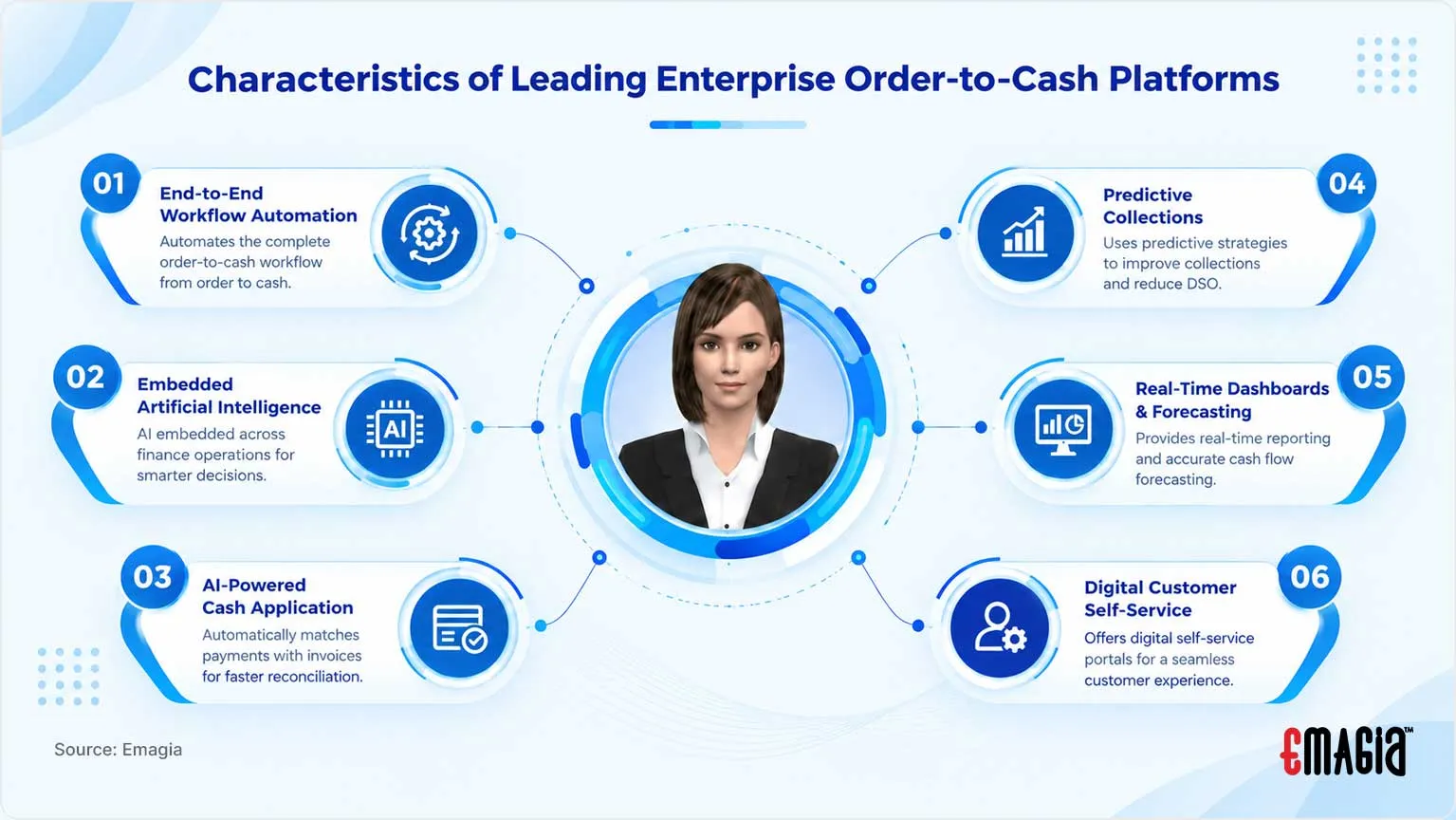
Characteristics of Leading Enterprise Order-to-Cash Platforms
Modern enterprise platforms share several characteristics that distinguish them from traditional receivables software. Rather than automating individual tasks, they orchestrate the entire order-to-cash process using artificial intelligence, workflow automation, predictive analytics, and real-time integrations.
| Capability | Traditional Software | Modern Enterprise Platform |
|---|---|---|
| Automation Scope | Individual tasks | End-to-end workflow automation |
| Artificial Intelligence | Limited | Embedded across finance operations |
| Cash Application | Manual matching | AI-powered automatic matching |
| Collections | Manual prioritization | Predictive collection strategies |
| Reporting | Historical reports | Real-time dashboards and forecasting |
| Customer Experience | Email communication | Digital self-service portals |
Why Integrated Platforms Deliver Greater Business Value
Many organizations begin their automation journey by implementing separate applications for invoicing, collections, deductions, and cash application. Although this approach may solve immediate challenges, it often creates fragmented workflows, inconsistent reporting, duplicate integrations, and higher maintenance costs.
An integrated order-to-cash platform connects every receivables process into a unified environment. Customer information, payment history, credit decisions, invoices, disputes, and collections activities remain synchronized across departments, providing finance leaders with complete visibility into the organization’s cash flow.
This unified approach improves collaboration between finance, sales, customer service, treasury, and executive leadership while reducing manual data transfers and reconciliation activities.
The Growing Role of Artificial Intelligence in Order-to-Cash Automation
Artificial intelligence has become one of the most significant innovations in modern finance technology. Instead of simply digitizing manual processes, AI continuously analyzes transactional data, customer payment behavior, historical trends, and business rules to recommend or execute actions automatically.
AI enables finance organizations to make faster decisions, improve operational accuracy, and reduce repetitive work without increasing headcount.
Predictive Credit Decisions
Evaluate customer risk using internal financial data, payment history, and predictive analytics.
Smart Collections
Prioritize collection activities based on customer payment probability and risk scoring.
AI Cash Application
Automatically match payments with invoices using remittance information and historical payment patterns.
Cash Forecasting
Predict future cash inflows using customer payment behavior and historical receivables performance.
Business Outcomes Finance Leaders Should Expect
The success of an order-to-cash automation initiative should be measured by business outcomes rather than software implementation alone. Organizations should define measurable performance indicators before beginning their digital transformation journey.
| Business Objective | Expected Improvement |
|---|---|
| Reduce manual processing | Higher productivity across finance operations |
| Improve cash flow | Faster invoice-to-cash cycle |
| Lower Days Sales Outstanding | Earlier customer payments |
| Increase automation | Reduced operational costs |
| Improve reporting | Real-time executive dashboards |
| Enhance customer experience | Faster dispute resolution and payment processing |
Key Takeaway
The most effective order-to-cash software is not the one with the longest feature list. It is the platform that aligns with your finance transformation strategy, integrates seamlessly with existing enterprise systems, leverages artificial intelligence to automate repetitive work, and delivers measurable improvements in cash flow, operational efficiency, customer experience, and working capital.
The Future of Order-to-Cash Automation
The future of order-to-cash automation extends far beyond workflow digitization. Finance organizations are increasingly adopting artificial intelligence, machine learning, predictive analytics, intelligent document processing, and autonomous finance technologies to transform receivables management into a proactive, data-driven function.
Instead of reacting to overdue invoices or manually resolving payment issues, finance teams can leverage AI to predict customer payment behavior, identify potential credit risks, recommend collection strategies, automatically match payments, and forecast future cash flow with greater confidence.
As enterprise finance continues to evolve, successful organizations will prioritize intelligent automation platforms that continuously learn from financial data, improve operational efficiency, and support strategic business growth.
How to Choose the Right Order-to-Cash Automation Platform
Every organization has unique operational requirements, technology investments, and business goals. Rather than selecting software based solely on functionality or price, decision-makers should evaluate how well each platform aligns with long-term finance transformation initiatives.
| Evaluation Area | Questions to Consider |
|---|---|
| Business Fit | Does the platform support your complete order-to-cash process? |
| Artificial Intelligence | Does it use AI to automate decisions and improve accuracy? |
| Scalability | Can it support multiple business units, currencies, and countries? |
| ERP Integration | Does it integrate seamlessly with your existing ERP ecosystem? |
| Analytics | Does it provide real-time dashboards and executive insights? |
| Implementation | Can the solution be deployed efficiently with minimal disruption? |
Frequently Asked Questions
1. What is order-to-cash automation?
Order-to-cash automation uses software and artificial intelligence to streamline the complete receivables lifecycle, including credit management, invoicing, collections, cash application, deductions management, and financial reporting.
2. Why is order-to-cash automation important?
It improves cash flow, reduces manual work, lowers operating costs, accelerates collections, enhances customer experience, and provides greater financial visibility.
3. What features should enterprise O2C software include?
Enterprise platforms should include credit management, invoicing, collections automation , AI-powered cash application, deductions management, customer portals, analytics, ERP integrations, workflow automation, and predictive reporting.
4. How does AI improve order-to-cash processes?
AI helps automate payment matching, prioritize collections, assess customer credit risk, predict payment behavior, identify anomalies, and improve cash flow forecasting.
5. Can order-to-cash software integrate with ERP systems?
Yes. Most enterprise platforms integrate with leading ERP solutions such as SAP, Oracle, Microsoft Dynamics, NetSuite, and other financial systems.
6. How long does implementation typically take?
Implementation timelines vary depending on organizational complexity, existing systems, and deployment scope. Many enterprise projects are delivered in phases to accelerate value realization.
Final Thoughts
Selecting the right order-to-cash automation platform is a strategic investment that can reshape the way finance organizations manage receivables, improve working capital, and support sustainable business growth.
Rather than evaluating software based only on individual features, finance leaders should prioritize solutions that provide end-to-end automation, embedded artificial intelligence, seamless ERP integration, enterprise scalability, and actionable business insights.
Organizations that modernize their order-to-cash operations are better positioned to reduce operational costs, improve customer satisfaction, accelerate cash flow, and empower finance teams with real-time visibility across the entire revenue cycle.
Transform Your Order-to-Cash Process with AI-Powered Automation
Modern finance organizations need more than disconnected point solutions. They require an intelligent platform that automates credit, collections, cash application, deductions, customer payments, analytics, and financial reporting within a single enterprise ecosystem.
Emagia’s AI-powered Order-to-Cash platform helps global enterprises automate receivables management, improve cash flow, reduce manual operations, and accelerate finance transformation through intelligent automation and real-time insights.