Order to cash automation is the use of software, artificial intelligence, machine learning, workflow automation, and connected financial systems to manage the customer revenue lifecycle from order through payment and reconciliation. Depending on the enterprise operating model, O2C automation can support credit management, order validation, invoicing, accounts receivable, collections, cash application, deductions, dispute resolution, reconciliation, and reporting.
Executive Summary for CFOs
- O2C automation connects processes that traditionally operate across ERP, CRM, billing, banking, and receivables systems.
- It can reduce manual work across credit, invoicing, collections, cash application, deductions, and reconciliation.
- AI can help finance teams predict payment behavior, prioritize collections, extract remittance information, match payments, classify deductions, and surface exceptions.
- Enterprise platforms should support multi-ERP, multi-entity, multi-currency, governance, security, auditability, and configurable workflows.
- O2C transformation should be measured using financial and operational KPIs such as DSO, CEI, cash application automation, dispute cycle time, unapplied cash, invoice accuracy, and cost to collect.
What Is Order to Cash Automation?
Order to cash automation (O2C automation) is the application of digital workflows, AI, machine learning, rules, analytics, and system integrations to automate and coordinate activities from customer order through payment collection and reconciliation.
The exact scope varies by organization, but an enterprise O2C operating model commonly includes order validation, credit management, fulfillment-related controls, invoicing, accounts receivable, collections, cash application, deductions and disputes, reconciliation, and performance reporting.
The goal is not simply to automate individual tasks. A mature O2C environment connects data, decisions, workflows, people, and systems so that finance teams can move cash through the revenue cycle with fewer manual handoffs and better visibility.
Order to Cash Automation at a Glance
| Concept | Definition |
|---|---|
| Order to Cash (O2C) | The business process that manages the lifecycle from customer order through payment collection and financial reconciliation. |
| O2C Automation | The use of technology, workflows, AI, analytics, and integrations to automate and coordinate O2C activities. |
| Order to Cash Software | Software that supports one or more O2C functions, such as credit, invoicing, collections, cash application, deductions, analytics, and reporting. |
| Accounts Receivable Automation | Technology that automates receivables activities such as collections, cash application, dispute management, and receivables monitoring. |
| Cash Application | The process of matching incoming customer payments with outstanding invoices or account balances and recording the appropriate accounting entries. |
| Collections Management | The process of prioritizing and executing activities designed to recover outstanding customer receivables. |
| Deduction Management | The process of investigating, validating, resolving, and accounting for short payments and customer deductions. |
What Does O2C Automation Do?
O2C automation connects order, credit, billing, receivables, collections, payment, deduction, and reconciliation activities into coordinated digital workflows. AI can be applied to decisions and repetitive activities such as payment matching, collections prioritization, document and remittance extraction, risk assessment, exception classification, and next-best-action recommendations.
O2C vs I2C vs Q2C vs P2P
O2C is often confused with Quote-to-Cash and Invoice-to-Cash. Procure-to-Pay is different because it manages the company’s purchasing and outbound payment cycle.
| Process | Starts With | Ends With | Primary Focus |
|---|---|---|---|
| Quote-to-Cash (Q2C) | Quote or commercial opportunity | Payment and revenue realization | Broader commercial and revenue lifecycle |
| Order-to-Cash (O2C) | Customer order | Payment and reconciliation | Order, billing, AR and cash collection |
| Invoice-to-Cash (I2C) | Invoice generation | Payment, cash application and reconciliation | Financial receivables lifecycle |
| Procure-to-Pay (P2P) | Purchase requirement or requisition | Supplier payment | Procurement and accounts payable |
In simple terms: Q2C generally starts before an order exists, O2C begins around the customer order, I2C focuses on the invoice-to-payment portion, and P2P manages money flowing out to suppliers.
How the Order to Cash Process Works
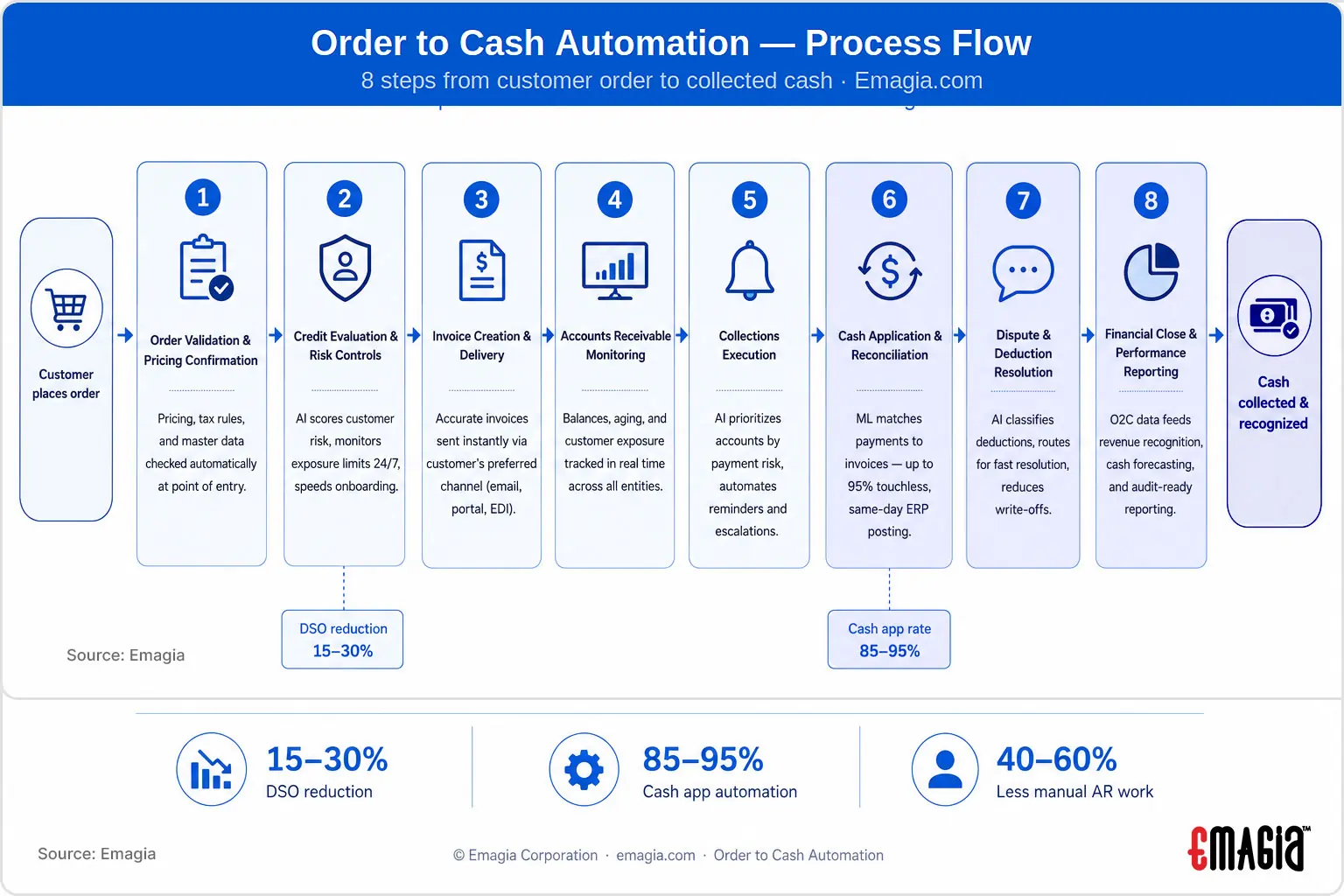
The O2C process converts a customer order into collected and reconciled revenue. In an enterprise environment, individual stages may run across an ERP, CRM, order management system, billing platform, banking network, customer portal, and specialized finance applications.
- Order validation and pricing confirmation
- Customer credit assessment and approval
- Order fulfillment and delivery
- Invoice generation and delivery
- Accounts receivable monitoring
- Collections execution
- Cash application and reconciliation
- Deductions and dispute resolution
- Financial reporting and performance analysis
Order to Cash Process Steps Explained
1. Order Validation and Data Quality
The O2C cycle begins with accurate customer, product, pricing, tax, payment-term, and order information. Automated validation can identify missing or inconsistent data before it creates downstream billing or collection problems.
2. Credit Management and Risk Assessment
Credit management evaluates customer risk, payment behavior, exposure, and approved credit limits. Automation can support credit reviews, risk scoring, exposure monitoring, and approval workflows.
Organizations often use credit risk management software to automate credit scoring, monitor exposure, and strengthen financial risk controls.
3. Order Fulfillment and Delivery
Order fulfillment connects the commercial transaction to the operational event that supports billing. Accurate fulfillment status, shipment information, service completion, and proof of delivery can help reduce invoice errors and downstream disputes.
4. Invoice Generation and Delivery
Invoice generation converts fulfilled orders into billing documents. Automation can trigger invoice creation from approved business events and deliver invoices through appropriate customer channels.
5. Accounts Receivable Monitoring
AR teams monitor outstanding balances, aging, payment terms, customer exposure, disputes, and collection status. A connected O2C environment provides a consolidated view across entities and systems.
This area is closely related to accounts receivable automation.
6. Collections Management
Collections automation helps teams prioritize accounts, schedule follow-ups, organize worklists, manage communications, and escalate exceptions according to defined policies.
Many enterprises use collections management software to automate customer outreach, prioritize accounts, and improve collector productivity.
7. Cash Application and Reconciliation
Cash application matches incoming payments with open invoices or customer accounts. Automation can capture remittance information, identify payment relationships, match transactions, and route exceptions for review.
Modern enterprises use AI-powered cash application software to automate payment matching, reduce manual reconciliation, and improve visibility into unapplied cash.
8. Deductions and Dispute Resolution
Deductions occur when a customer pays less than the invoiced amount or otherwise disputes an amount due. Automated deduction management can classify claims, collect supporting information, route cases, track ownership, and identify recurring root causes.
Organizations can use deductions management software to streamline dispute tracking, root-cause analysis, and resolution workflows.
9. Reconciliation and Financial Reporting
The final stage connects operational receivables activity with accounting and financial reporting. Automation can improve reconciliation speed, consistency, auditability, and visibility into cash and receivables performance.
Why Enterprises Automate Order to Cash
O2C performance affects how quickly revenue becomes usable cash. Delays in invoicing, collections, cash application, dispute resolution, or reconciliation can create working-capital pressure and reduce financial visibility.
- High transaction volumes create repetitive manual work.
- Multiple ERP systems can fragment receivables information.
- Global entities introduce differences in currencies, regulations, customers, and processes.
- Delayed invoicing can postpone payment.
- Manual collections can make prioritization inconsistent.
- Unapplied cash can reduce the accuracy of receivables visibility.
- Unresolved deductions can delay revenue recovery.
- Disconnected systems can make enterprise-wide reporting difficult.
Manual vs Automated O2C
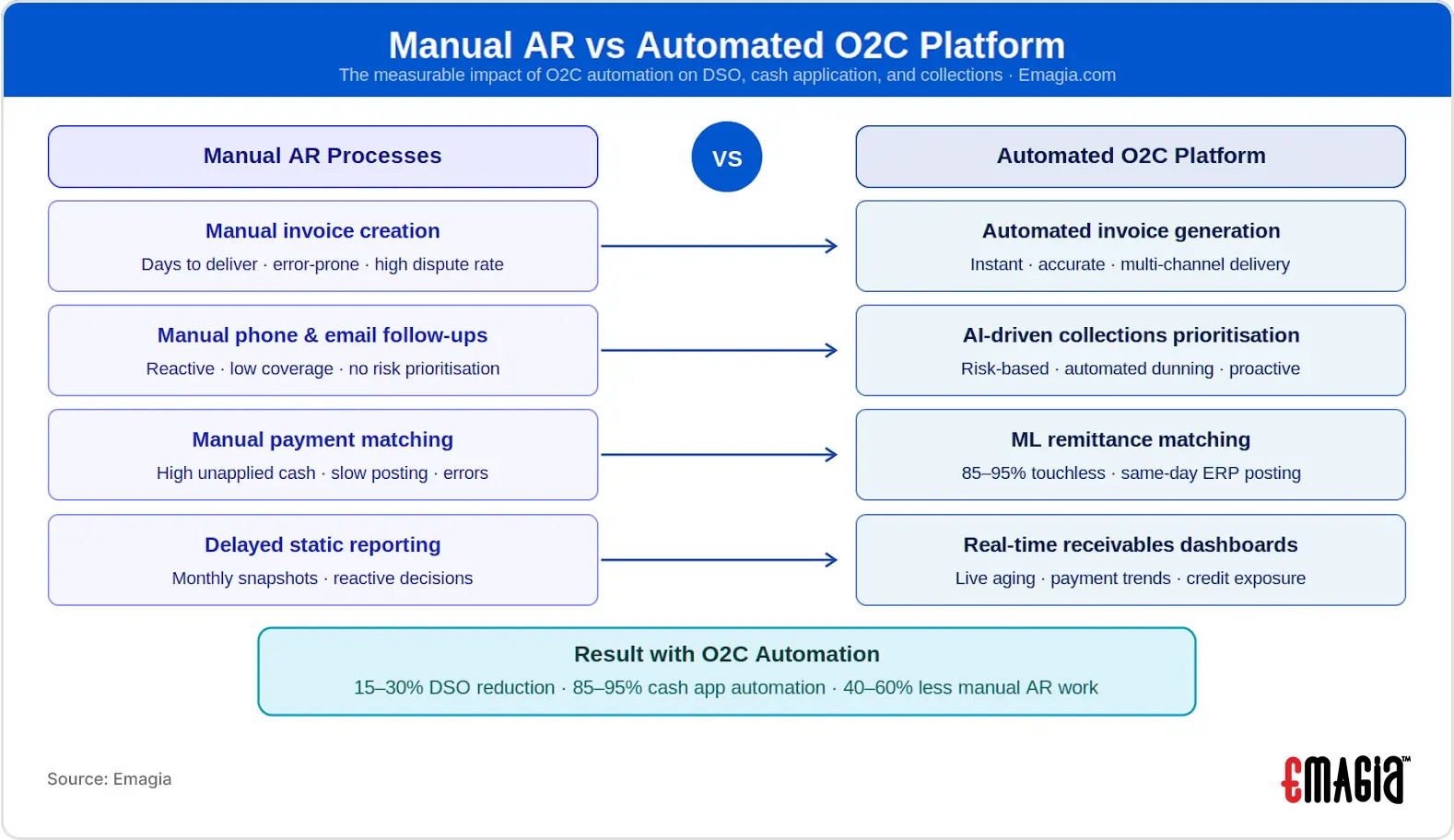
| Area | Manual O2C | Automated O2C |
|---|---|---|
| Data handling | Manual entry and movement between systems | Connected data flows and automated processing |
| Credit | Manual reviews and approvals | Workflow-driven risk assessment and approvals |
| Invoicing | Manual creation and distribution | Automated invoice generation and delivery workflows |
| Collections | Reactive follow-up based mainly on aging | Risk-based prioritization and automated workflows |
| Cash application | Manual payment-to-invoice matching | AI-assisted matching and exception management |
| Deductions | Manual research and routing | Automated classification, workflow and root-cause analysis |
| Reporting | Delayed or fragmented reporting | Connected dashboards and analytics |
| Scalability | Higher transaction volumes often require more manual effort | Automation can absorb additional volume with less repetitive work |
| Auditability | Information may be distributed across files and systems | Centralized workflows, controls and audit trails |
How AI Powers O2C Automation
AI changes O2C automation from simple task execution toward data-driven decision support and, where appropriate, autonomous workflow execution. The strongest implementations combine AI with reliable transaction data, workflow controls, ERP integration, exception handling, and human oversight.
AI and Machine Learning
- Payment matching and customer identification
- Payment behavior prediction
- Collections prioritization
- Credit risk scoring
- Deduction classification
- Anomaly and exception detection
Generative AI
Generative AI can support finance teams by summarizing account information, generating customer communication drafts, explaining exceptions, assisting with research, and making complex receivables information easier to interpret.
Agentic AI
Agentic AI extends automation by enabling software agents to interpret information, determine the next action within defined guardrails, execute workflows, and escalate exceptions when human judgment is required.
In O2C, agentic workflows can be applied to activities such as collections, cash application, credit review, dispute investigation, customer communications, and finance inbox management.
Human-in-the-Loop Automation
Not every O2C decision should be fully autonomous. High-value, unusual, sensitive, or policy-controlled exceptions may require human approval. Enterprise AI governance should therefore define approval thresholds, confidence levels, escalation paths, audit trails, and override procedures.
AI vs RPA in O2C Automation
| Capability | Traditional RPA | AI-Enabled Automation |
|---|---|---|
| Rules | Follows predefined rules | Can combine rules with learned patterns |
| Unstructured data | Limited | Can interpret documents, emails and remittance information |
| Prediction | Limited | Can identify patterns and predict outcomes |
| Exceptions | Usually routes exceptions to humans | Can classify and prioritize exceptions |
| Decision support | Low | Can recommend next actions based on available data |
| Autonomy | Task automation | Potentially multi-step workflow execution within defined controls |
Core Capabilities of O2C Automation Software
Enterprise O2C software varies by vendor and architecture, but finance teams typically evaluate capabilities across the following areas:
- Order and customer data validation
- Credit risk management
- Invoice generation and delivery
- Electronic invoicing and payment enablement
- Accounts receivable monitoring
- Collections management
- Cash application
- Deductions and dispute management
- Receivables analytics
- Workflow and exception management
- ERP and banking integration
- Audit, security and governance controls
Enterprise O2C Operating Model
O2C automation works best when technology is aligned with an operating model covering people, processes, data, systems, controls, and governance.
Core Operating Model Components
- Standardized global process definitions
- Configurable workflows by region and business unit
- Unified receivables visibility
- Clear ownership and accountability
- Defined exception and escalation procedures
- Embedded controls and auditability
- Common KPI definitions across entities
O2C Automation Architecture and ERP Integration
Enterprise O2C rarely operates in a single application. A typical architecture connects ERP, CRM, order management, billing, customer portals, banking and payment systems, data platforms, and specialized receivables applications.
| System | Typical O2C Role |
|---|---|
| ERP | Customer accounts, invoices, receivables, accounting and financial records |
| CRM | Customer, account and commercial information |
| Order Management | Order capture, validation and fulfillment status |
| Billing | Invoice generation and billing events |
| Banking / Payment Systems | Payment transactions and bank information |
| Customer Portals | Invoice access, payment and customer interaction |
| O2C Automation Platform | Workflow orchestration, AI, exception management and receivables intelligence |
A major enterprise consideration is whether the O2C platform can operate across multiple ERP environments while maintaining consistent policies, workflows, security, and reporting.
Emagia integrates with leading enterprise systems including SAP, Oracle, NetSuite and other financial platforms.
Key O2C KPIs Finance Leaders Should Track
Automation should be measured against business outcomes rather than the number of tasks automated. The KPI framework should combine cash, efficiency, quality, risk and customer outcomes.
| KPI | What It Measures | Why It Matters |
|---|---|---|
| Days Sales Outstanding (DSO) | Average time required to collect receivables | Indicates the speed of cash conversion |
| Collection Effectiveness Index (CEI) | Effectiveness of collecting collectible receivables | Shows collection performance |
| Cash Application Automation Rate | Percentage of payments processed automatically | Measures automation effectiveness |
| Unapplied Cash | Payments not yet assigned to invoices or accounts | Impacts visibility and reconciliation |
| Dispute Cycle Time | Time required to resolve disputes | Shows how quickly blocked cash is recovered |
| Invoice Accuracy | Percentage of invoices issued without material errors | Errors can delay payment and create disputes |
| Collection Productivity | Receivables managed per collector or team | Shows operational scalability |
| Cost to Collect | Cost of operating the collection process | Measures financial efficiency |
How O2C Automation Improves Working Capital
Working capital improvement comes from reducing delays and friction throughout the receivables cycle. Automation can influence working capital through several connected mechanisms.
- Faster invoice delivery: reduces avoidable delays between fulfillment and billing.
- Better collections prioritization: helps teams focus attention where intervention is most valuable.
- Faster cash application: improves the timeliness of receivables information and reconciliation.
- Faster dispute resolution: helps recover amounts blocked by deductions or disputes.
- Improved visibility: gives finance leaders a more current view of receivables and cash.
Benefits of O2C Automation
- Accelerated cash conversion. Connected workflows can reduce delays across invoicing, collections, payment matching and dispute resolution.
- Lower manual effort. Automation reduces repetitive data entry, reconciliation and administrative work.
- Better receivables visibility. Connected data provides a more consistent view of customer balances and payment status.
- Improved collections productivity. AI can help prioritize work based on risk, payment behavior and business rules.
- Faster cash application. Automated remittance processing and payment matching can reduce manual reconciliation.
- Stronger financial controls. Configurable workflows, approvals and audit trails support governance.
- Greater scalability. Standardized automation can help finance teams handle higher transaction volumes without relying solely on additional manual effort.
- Better customer experience. Faster invoice delivery, payment processing and dispute responses can reduce customer friction.
O2C Automation Maturity Model
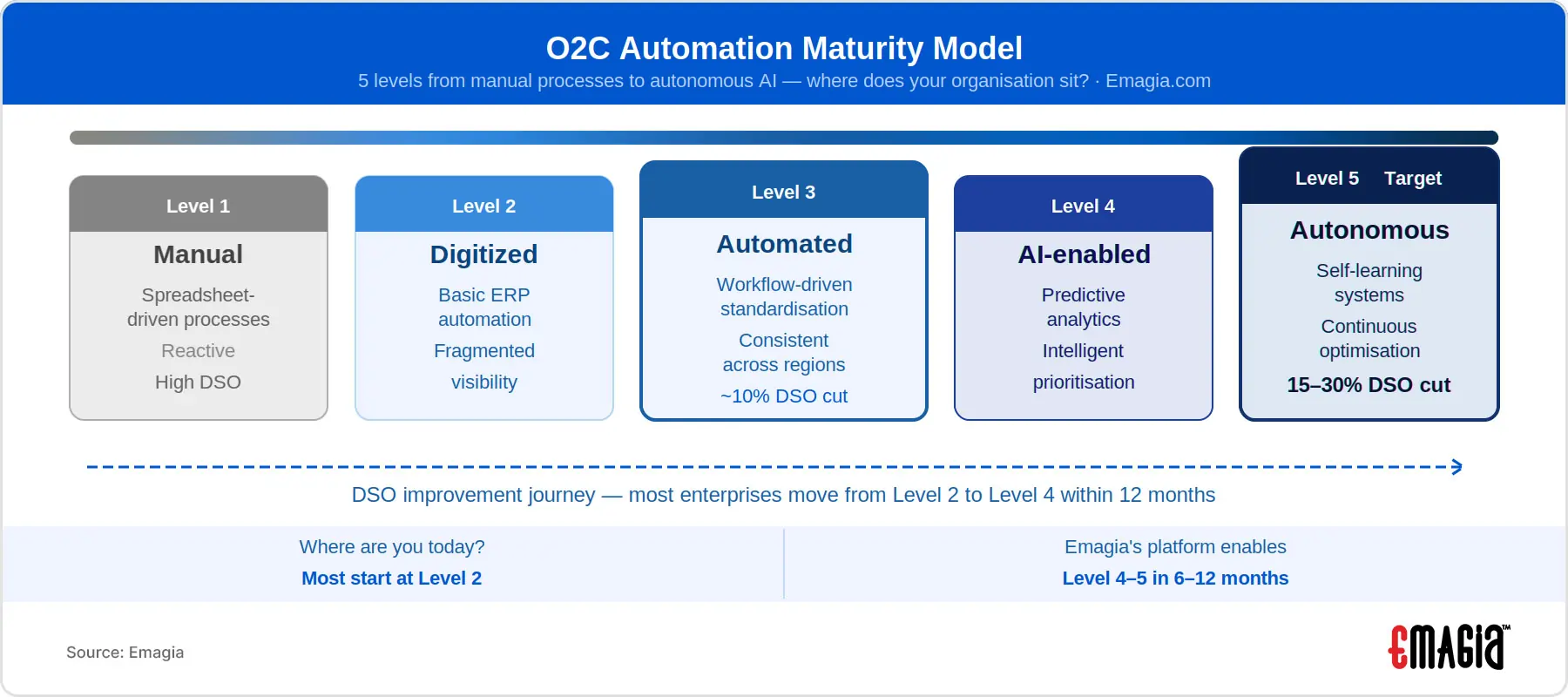
- Level 1 – Manual: Spreadsheet-driven and highly dependent on individual effort.
- Level 2 – Digitized: Basic ERP and digital workflows exist, but processes remain fragmented.
- Level 3 – Automated: Standardized workflows automate repeatable activities across teams and regions.
- Level 4 – AI-Enabled: Predictive analytics and AI improve prioritization, matching and exception handling.
- Level 5 – Autonomous: Connected AI agents execute defined multi-step workflows within governance and human oversight.
How to Implement O2C Automation
Enterprise O2C transformation should be treated as an operating-model initiative rather than simply a software deployment.
Phase 1: Establish the Baseline
- Document the current O2C process.
- Identify manual handoffs and bottlenecks.
- Measure DSO and other baseline KPIs.
- Quantify unapplied cash and dispute volumes.
- Identify systems, data sources and integrations.
Phase 2: Standardize the Process
- Define common process terminology.
- Standardize policies and approval rules.
- Identify regional exceptions.
- Define ownership and escalation paths.
Phase 3: Prioritize Automation
Start with high-volume, repetitive, measurable activities where automation can remove meaningful manual effort or accelerate cash conversion. Cash application, collections, invoicing and dispute workflows are common starting points, but the right sequence depends on the organization’s bottlenecks.
Phase 4: Integrate Systems
Connect ERP, banking, CRM, billing, customer portals and other relevant systems so automation operates on consistent data rather than creating another isolated application.
Phase 5: Deploy AI and Advanced Analytics
Once reliable workflows and data foundations are established, AI can be applied to prediction, prioritization, matching, classification, summarization and autonomous task execution.
Phase 6: Govern and Optimize
Monitor performance continuously. Review automation rates, exceptions, overrides, accuracy, financial outcomes, security, compliance and user adoption. Use those findings to refine workflows and AI models.
How to Measure the ROI of O2C Automation
The ROI of O2C automation should connect technology investment to measurable financial and operational outcomes.
| ROI Area | Measurement |
|---|---|
| Cash acceleration | Change in DSO, overdue receivables and cash conversion |
| Labor efficiency | Hours or FTE effort removed from repetitive activities |
| Collections | Improvement in collection effectiveness and productivity |
| Cash application | Automation rate, processing time and unapplied cash |
| Disputes | Resolution time and recovered deductions |
| Quality | Invoice errors, rework and reconciliation exceptions |
| Technology | Integration, licensing, implementation and operating costs |
A credible business case should compare the baseline against post-implementation results and separate measurable realized benefits from assumptions or projected benefits.
O2C Automation by Industry
The underlying O2C process is consistent across industries, but the automation priorities vary according to billing complexity, customer behavior, payment terms, deductions and transaction volumes.
O2C Automation for Manufacturing
Manufacturers often manage complex customer contracts, pricing structures, distributors, deductions, multiple entities and high transaction volumes. O2C automation for manufacturing can focus on credit, invoice accuracy, collections, cash application and deduction resolution.
O2C Automation for Consumer Packaged Goods
CPG organizations may face high volumes of retailer deductions, promotional claims, pricing disputes and short payments. O2C automation for CPG can connect cash application, deductions, collections and customer-specific workflows.
O2C Automation for Logistics and Transportation
Logistics and transportation companies may manage high invoice volumes, complex billing conditions, proof-of-delivery information and variable demand. O2C automation for logistics can improve invoice workflows, collections, cash application and receivables visibility.
O2C Automation for Technology and SaaS
Technology and SaaS businesses can have recurring billing, subscription changes, usage-based charges, renewals, multiple payment methods and complex customer accounts. Automation can help connect billing, collections, payment application and reporting.
Enterprise Use Cases for O2C Automation
- Global shared services and Global Business Services centers
- Multi-ERP enterprises
- Multi-entity finance organizations
- High-volume B2B receivables environments
- Organizations with significant deductions
- Companies with complex credit policies
- Businesses operating across multiple countries and currencies
- Finance organizations seeking real-time receivables visibility
Who Uses O2C Automation?
- CFOs: Working capital, cash visibility, risk and financial performance.
- Controllers: Reconciliation, controls, accuracy and auditability.
- AR Leaders: Collections, cash application, disputes and productivity.
- Credit Leaders: Risk assessment, exposure and credit decisions.
- Shared Services Leaders: Standardization, scalability and service-level performance.
- Finance Transformation Leaders: Automation strategy, technology and operating-model transformation.
- IT Leaders: Integration, security, architecture and enterprise scalability.
How to Choose O2C Automation Software
The right O2C platform depends on process complexity, ERP architecture, transaction volume, geography, customer requirements, automation goals, governance requirements and expected ROI.
Key Evaluation Criteria
| Evaluation Area | Questions to Ask |
|---|---|
| Process Coverage | Does the platform cover the O2C activities that create the biggest bottlenecks? |
| AI and Automation | Does it automate tasks, support predictions, manage exceptions and provide appropriate human oversight? |
| ERP Integration | Can it integrate with existing ERP, CRM, billing, banking and payment systems? |
| Multi-ERP Support | Can multiple ERP environments be managed through consistent workflows and policies? |
| Data and Analytics | Can finance leaders access timely O2C KPIs and actionable insights? |
| Workflow | Can workflows be configured by entity, region, customer or policy? |
| Exception Management | Can the platform identify, classify, route and track exceptions? |
| Security and Governance | Are access controls, audit trails, approvals and compliance requirements supported? |
| Scalability | Can the platform handle enterprise transaction volumes and global operations? |
| Total Cost of Ownership | What are the implementation, integration, licensing, maintenance and scaling costs? |
O2C Automation Challenges and Risks
Automation does not automatically solve a poorly designed process. Enterprise transformation should address the operational and technology risks that can undermine automation outcomes.
- Inconsistent processes between regions and business units
- Poor customer and master data quality
- Legacy ERP integration complexity
- Disconnected data sources
- Change management and adoption
- Unclear ownership of exceptions
- Inadequate AI governance
- Security and access-control requirements
- Over-automation of decisions that require human judgment
- Insufficient measurement of post-implementation outcomes
O2C Governance and AI Controls
As organizations introduce AI into finance processes, governance becomes as important as automation capability. Enterprise O2C platforms should provide clear controls around data access, model behavior, approvals, exceptions, auditability and human intervention.
- Role-based access controls
- Approval thresholds
- Human review for low-confidence or high-risk decisions
- Audit trails for automated actions
- Exception queues and escalation procedures
- Data quality monitoring
- AI performance and accuracy monitoring
- Policy-based workflow controls
O2C Automation Best Practices for CFOs
- Standardize before automating. Define common processes and policies before scaling technology.
- Measure the baseline. Establish DSO, CEI, cash application, dispute and productivity baselines.
- Prioritize high-value bottlenecks. Automate areas where manual work creates measurable financial or operational friction.
- Integrate the ecosystem. Connect ERP, CRM, billing, banking and payment data.
- Use AI where it adds decision value. Apply AI to prediction, matching, classification, prioritization and exception management.
- Keep humans in control where appropriate. Establish clear escalation and approval rules.
- Track outcomes continuously. Measure business results rather than automation volume alone.
- Roll out in phases. Prove value in priority workflows before expanding enterprise-wide.
CFO Insight
The strongest O2C transformation programs treat automation as a working-capital and operating-model initiative—not simply as a way to eliminate manual tasks. The objective is to create a connected process in which data, decisions, actions, controls and financial outcomes can be measured across the entire revenue cycle.
O2C Automation Industry Benchmarks and Performance Claims
Automation outcomes vary by starting point, process design, transaction mix, ERP environment, customer behavior, implementation quality and the scope of automation. For that reason, organizations should validate performance benchmarks against their own baseline and documented customer or implementation evidence.
Emagia’s current product materials report outcomes including reductions in DSO and high levels of AI-driven cash application automation. These figures should be understood as company-reported performance claims rather than universal industry benchmarks.
O2C Software and ERP Considerations
ERP systems remain central to enterprise financial processing, but specialized O2C automation platforms can provide additional workflow, AI, analytics, exception management and receivables capabilities across complex environments.
Many large organizations operate multiple ERP instances, business units and geographies. The key architectural question is therefore not simply whether software integrates with an ERP, but whether it can create consistent O2C workflows and visibility across the organization’s broader technology landscape.
Emagia integrates with SAP, Oracle, NetSuite and other leading ERP systems.
Future of Order to Cash Automation
The future of O2C automation is moving from isolated task automation toward connected, intelligent and increasingly autonomous finance workflows.
- Predictive payment and collections intelligence
- AI-assisted and autonomous cash application
- Intelligent credit decisioning
- AI-powered dispute and deduction investigation
- Finance inbox automation
- Real-time receivables analytics
- Agentic AI for multi-step finance workflows
- Greater human-in-the-loop governance
- Deeper ERP and payment ecosystem integration
How Emagia Transforms the O2C Lifecycle
Emagia provides an AI-driven invoice-to-cash and order-to-cash platform designed to help enterprise finance organizations connect receivables processes, financial data and intelligent workflows.
The platform brings together capabilities across credit, collections, cash application, deductions, analytics and receivables operations to help finance teams move from fragmented manual processing toward connected automation.
Key capabilities include:
- Integration with multiple ERP environments including SAP, Oracle and NetSuite
- AI-driven cash application, collections and receivables analytics
- Configurable workflows aligned to enterprise policies
- Receivables visibility across global entities
- Automation designed for high-volume enterprise environments
Key Takeaways for Finance Leaders
- O2C automation connects the customer order, billing, receivables and cash lifecycle.
- Modern O2C platforms combine workflow automation, AI, analytics and enterprise integrations.
- AI can improve payment matching, collections prioritization, credit analysis, deduction classification and exception management.
- ERP integration and data quality are foundational to successful O2C automation.
- O2C transformation should be measured through financial and operational KPIs, not automation volume alone.
- Human oversight remains important for complex, high-risk and low-confidence financial decisions.
- Enterprise O2C automation should be implemented progressively and governed as a strategic finance transformation initiative.
Frequently Asked Questions About O2C Automation
What is order to cash automation?
Order to cash automation uses software, AI and connected workflows to automate activities from customer order through invoicing, collections, cash application, dispute resolution and reconciliation.
The scope can vary by organization, but enterprise O2C automation typically connects credit, order, billing, accounts receivable, collections, cash application, deductions and financial reporting.
What is order to cash software?
Order to cash software is technology used to automate and coordinate activities across the customer order-to-payment lifecycle.
Depending on the platform, capabilities can include credit management, invoicing, collections, cash application, deductions, analytics, workflow orchestration and ERP integration.
What are the steps in the order to cash process?
The O2C process typically includes order validation, credit management, fulfillment, invoicing, accounts receivable, collections, cash application, deductions and dispute management, reconciliation and reporting.
How does O2C automation improve cash flow?
O2C automation improves cash flow by reducing delays in invoicing, collections, payment application and dispute resolution while giving finance teams better receivables visibility.
The financial impact depends on the organization’s baseline processes, customer payment behavior, automation scope and implementation quality.
What is the difference between O2C and AR automation?
O2C automation covers the broader order-to-payment lifecycle, while AR automation generally focuses on receivables activities such as collections, cash application and dispute management.
What is the difference between O2C and Invoice-to-Cash?
O2C generally starts with the customer order, while Invoice-to-Cash starts with invoice generation and focuses on the financial process through payment, cash application and reconciliation.
How does AI enhance O2C automation?
AI enhances O2C automation by predicting payment behavior, matching payments, prioritizing collections, classifying deductions, identifying exceptions and supporting financial decisions.
Can O2C automation integrate with multiple ERP systems?
Yes. Enterprise O2C platforms can integrate with multiple ERP, CRM, billing, banking and payment systems to create a connected receivables environment.
The exact integration architecture depends on the platform, ERP environment, data model, APIs and business requirements.
What KPIs should companies track after O2C automation?
Key O2C KPIs include DSO, CEI, cash application automation rate, unapplied cash, dispute cycle time, invoice accuracy, collection productivity and cost to collect.
How should companies implement O2C automation?
Companies should establish a baseline, standardize processes, prioritize high-value bottlenecks, integrate systems, deploy automation and AI in phases, and continuously measure outcomes.
What should CFOs look for in O2C automation software?
CFOs should evaluate process coverage, AI capabilities, ERP integration, multi-entity support, analytics, workflow controls, exception management, security, scalability and total cost of ownership.
What are the biggest O2C automation challenges?
The biggest challenges include inconsistent processes, poor data quality, legacy integration, change management, exception handling, governance and unclear measurement of ROI.
Quick Answers
What does O2C stand for in finance?
O2C stands for Order to Cash, the business process that manages the lifecycle from customer order through payment collection and reconciliation.
What software automates order to cash?
O2C automation software connects capabilities such as credit management, invoicing, collections, cash application, deductions, analytics and workflow automation. Examples include enterprise O2C platforms such as Emagia and other specialized finance automation solutions.
Why is order to cash important for CFOs?
O2C directly affects cash conversion, working capital, receivables visibility, financial controls and customer payment experience.
Is order to cash automation the same as AR automation?
No. AR automation generally focuses on receivables activities, while O2C automation can cover the broader lifecycle from customer order through payment and reconciliation.
Which industries benefit from O2C automation?
O2C automation can benefit industries with high transaction volumes, complex billing, significant deductions, multiple entities, complex customer relationships or demanding cash-conversion requirements.
See How AI Transforms Order-to-Cash Operations
Leading enterprises are using AI-powered finance automation to connect credit, collections, cash application, deductions and receivables analytics. Learn how Emagia’s autonomous O2C platform can help finance teams modernize order-to-cash operations and improve working capital visibility.