Order entry is the process of receiving, validating, and recording customer orders into an ERP or billing system. As the first step in the order-to-cash (O2C) cycle, it triggers fulfillment, invoicing, and revenue recognition.
It consists of three core steps:
- Data Capture: Collecting orders from EDI, email, or portals
- Validation: Checking pricing, credit limits, and product data
- System Integration: Syncing with ERP systems like SAP ERP, Oracle ERP Cloud, and NetSuite ERP
Quick Summary: What is Order Entry?
Order entry is the first step in the order-to-cash cycle where customer orders are captured, validated, and processed to enable fulfillment and invoicing.
What is Order Entry in Simple Terms?
Order entry in simple terms is the process of recording customer orders into a system so they can be processed, billed, and fulfilled accurately.
What is Order Entry?
Order entry is a critical step in the order-to-cash process that directly impacts revenue accuracy, billing speed, and cash flow. It involves capturing, validating, and processing customer orders into enterprise systems to ensure seamless fulfillment and invoicing.
Order Entry Definition for Different Contexts
In Finance
Order entry ensures revenue accuracy and billing readiness.
In Supply Chain
Order entry initiates fulfillment and delivery workflows.
In ERP Systems
Order entry is the structured input of order data into systems like SAP, Oracle, and NetSuite.
Order Entry at a Glance
- Captures customer order data
- Validates pricing and terms
- Connects sales, finance, and operations
- Drives fulfillment and billing
Order Processing Workflow (Step-by-Step)
- Capture customer order details
- Validate pricing and product data
- Apply taxes and discounts
- Approve the order
- Send to fulfillment and billing
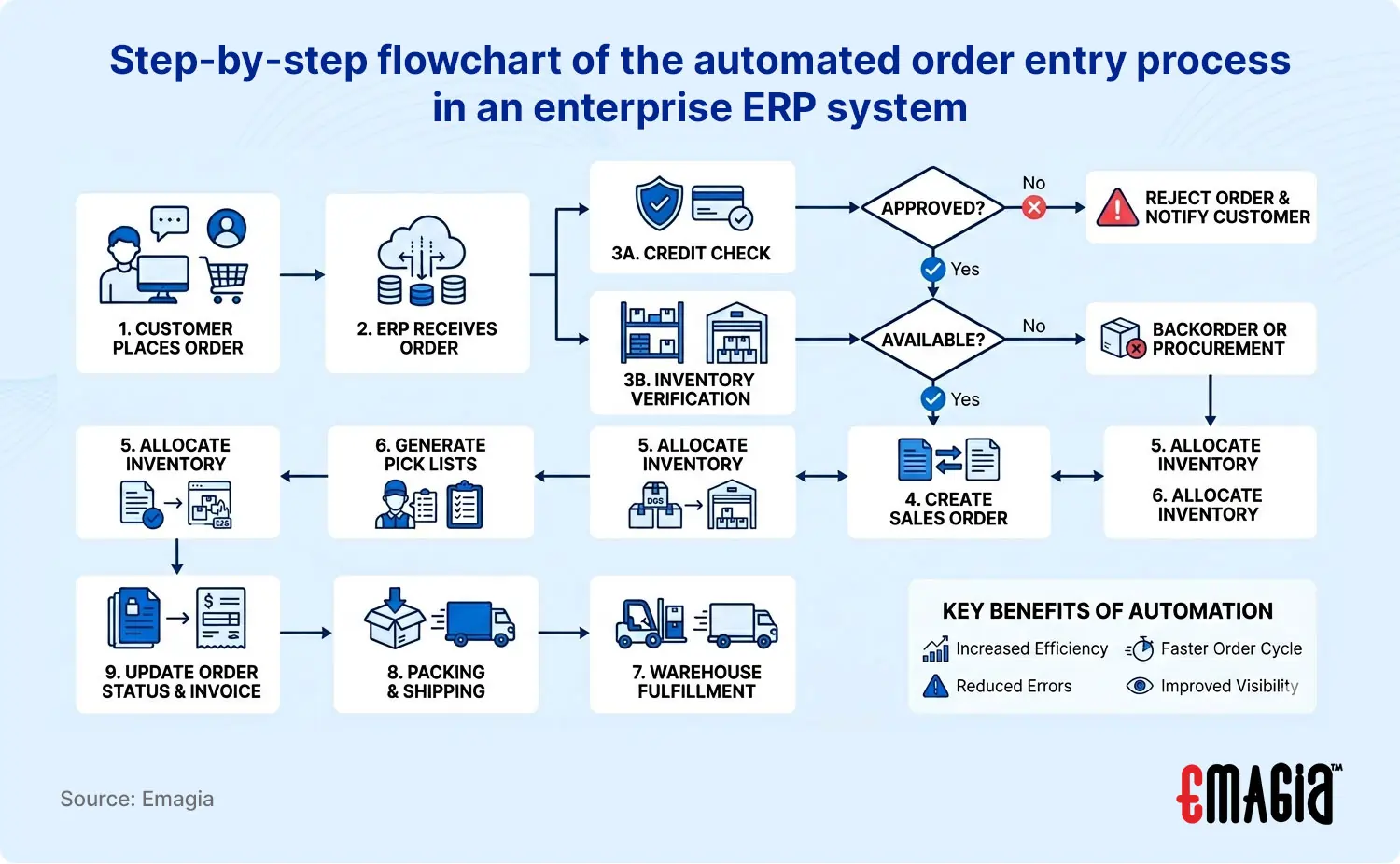
Order Entry vs Order Management
| Aspect | Order Entry | Order Management |
|---|---|---|
| Purpose | Capture order | Manage lifecycle |
| Stage | Beginning | End-to-end |
| Impact on DSO | Directly reduces order-to-invoice cycle time | Improves fulfillment accuracy and long-term customer retention |
Challenges in Order Entry
- Manual data entry errors and inability to process unstructured order data (emails, PDFs)
- Disconnected systems
- Complex pricing structures
- Lack of validation controls
Tools Used in Order Entry Systems
- ERP systems like SAP ERP, Oracle ERP Cloud, and NetSuite ERP for enterprise order processing and financial integration
- CRM platforms like Salesforce
- AI-based document processing tools
- Order-to-cash automation platforms that streamline order-to-cash automation
Why is Order Entry Important?
Order entry directly impacts revenue accuracy, customer satisfaction, and operational efficiency across the order-to-cash process, influencing DSO reduction and cash flow forecasting.
In large enterprises, order entry accuracy directly impacts revenue leakage, compliance, and financial reporting integrity.
- Prevents billing errors
- Improves delivery accuracy
- Reduces disputes and delays
- Ensures faster order processing
Compliance and Audit Impact
- Automated entry creates audit trails supporting SOX compliance
- Prevents unauthorized pricing changes and revenue leakage
- Improves financial reporting accuracy
The Challenge of Unstructured Order Data
- Over 80% of orders arrive via email, PDF, or other unstructured formats
- AI-powered systems use NLP to interpret order intent
- Traditional OCR cannot handle contextual data mapping
5 Ways to Improve Order Entry
- Standardize order data formats across channels
- Automate validation and approval workflows
- Integrate ERP, CRM, and billing systems
- Use AI for data extraction and error detection
- Monitor KPIs like accuracy, cycle time, and touchless rate
How Order Entry Impacts DSO and Cash Flow
- Faster order validation helps reduce DSO
- Improved data accuracy strengthens cash flow forecasting
- Accelerates cash conversion cycles
Related Order-to-Cash Resources
How AI is Transforming Order Entry
AI-powered order entry systems automate data capture, validation, and exception handling—reducing manual effort and improving accuracy.
- AI-based document processing (PDF, email, EDI)
- Automated pricing and validation checks
- Real-time ERP integration supporting end-to-end order-to-cash cycle optimization
- Self-learning systems that improve over time
- Semantic data mapping to interpret unstructured order formats
- Generative AI agents that resolve contextual exceptions (e.g., discounts mentioned in emails but not in purchase orders)
- Headless order entry systems with API-first architecture for seamless real-time integration
- AI agents that continuously learn from historical order data to improve accuracy and reduce exceptions over time
- Improves touchless order rate (percentage of fully automated orders) by minimizing manual intervention
See How AI Eliminates 90% of Order Entry Work
Automate order capture, validation, and billing with zero manual effort.
Benefits of Order Processing Automation
Leading enterprises reduce manual order entry by up to 90% and improve processing speed by 3–5x using AI automation.
Global enterprises process millions of orders annually, making automation essential for accuracy, scalability, and financial control.
- Reduces manual errors by up to 80%
- Accelerates order processing time
- Improves billing accuracy and financial operations
- Enhances customer satisfaction
- Enables highly automated order processing with minimal manual intervention
- Accelerates invoice cycles and supports faster payment processing
Order Entry Performance Benchmarks
- Manual error rate: 3–7%
- Automated error rate: <1%
- Processing time reduction: 60–80%
- Touchless order rates: up to 90%
Manual vs AI-Powered Order Entry Performance
| Metric | Manual Entry | AI-Powered Entry |
|---|---|---|
| Processing Time | 15–20 minutes | < 30 seconds |
| Accuracy | 93%–95% | 99.9% |
| Cost per Order | High | Low |
| Validation | Post-entry | Real-time |
Why Traditional Order Entry Fails in Modern Enterprises
Modern order entry is no longer administrative—it is a revenue-critical function that directly impacts cash flow, compliance, and customer experience.
- Legacy systems cannot handle unstructured order formats (emails, PDFs)
- Manual validation delays revenue recognition
- Disconnected systems create data inconsistencies
- Lack of real-time processing increases DSO
What Are Common Order Entry Errors?
Common order entry errors include incorrect pricing, missing data, duplicate orders, and wrong quantities.
- Incorrect pricing or discounts
- Incomplete customer or delivery data
- Duplicate order entries
- Wrong product or quantity selection
Types of Order Entry
- Manual order entry
- Automated order entry
- Ecommerce order entry
- EDI order entry
Manual vs Automated Order Processing
| Aspect | Manual | Automated |
|---|---|---|
| Speed | Slow | Fast |
| Accuracy | Error-prone | Highly accurate |
| Scalability | Limited | High |
What is Order Entry Software?
Order entry software automates the capture, validation, and processing of customer orders across business systems.
Key Features of Order Entry Systems
- Automated data validation
- Pricing and discount rules
- Approval workflows
- Integration with ERP, CRM, and order-to-cash automation software
- Audit trails and reporting
How Order Entry Impacts Revenue and Cash Flow
- Faster billing cycles
- Reduced payment disputes
- Improves cash flow visibility and payment processing
- Better financial visibility
Automate 90% of Order Entry with AI
Eliminate manual errors and accelerate your order-to-cash cycle.
People Also Ask
What is order entry in simple terms?
Order entry is the process of recording customer orders into a system for fulfillment and billing.
How does order entry affect cash flow?
It accelerates invoicing and reduces delays in the order-to-cash cycle.
Can order entry be fully automated?
Yes, AI systems can automate most standard order processing tasks.
Is order entry part of accounts receivable?
Yes, order entry is the front-end of the accounts receivable process, ensuring accurate billing and revenue capture.
Best Practices for Order Entry Optimization
- Standardize data inputs and formats
- Automate validation and approvals
- Reduce manual touchpoints
- Integrate systems end-to-end
- Continuously monitor performance metrics
How to Implement AI-Driven Order Processing
- Assess current order processes
- Standardize data inputs
- Integrate systems (ERP, CRM)
- Automate validation and workflows
- Monitor and optimize performance
AI Innovations in Order Processing
- Ecommerce platforms automate order capture
- Sales-assisted entry supports complex deals
- Hybrid models balance speed and accuracy
- Predictive data validation
- Automated exception handling
- Continuous learning for accuracy improvement
How Emagia Enables Intelligent Order Entry
Emagia’s AI Order Entry Agent integrates with ERP systems like SAP ERP, Oracle ERP Cloud, and NetSuite ERP to deliver touchless order processing and real-time validation. It connects order capture directly to billing, accounts receivable automation, and cash flow forecasting.
- Reduces manual reconciliation
- Prevents billing delays
- Improves cash flow visibility
- Supports scalable automation
About This Content
This content is created by order-to-cash and finance automation experts with experience in enterprise ERP systems including SAP, Oracle, and NetSuite.
This content is reviewed by finance and order-to-cash experts with enterprise implementation experience.
Ready to Eliminate Manual Order Entry?
See how AI can automate up to 90% of your order processing.
Organizations adopting AI-driven order entry are achieving faster processing, higher accuracy, and measurable financial impact.
Future Trends in Order Processing and Automation
- Autonomous order processing with AI agents
- Touchless order-to-cash cycles
- Predictive error detection
- Real-time order validation using APIs
Frequently Asked Questions
What does order entry mean?
It is the process of recording customer orders into a system for fulfillment and billing.
Why is order entry important?
It ensures accurate billing, timely delivery, and improved customer satisfaction.
Can order entry be automated?
Yes, most standard orders can be fully automated using AI and rule-based systems.
What are common order entry errors?
Pricing errors, missing data, duplicate orders, and incorrect quantities.
What is order entry software?
Software that automates order capture, validation, and processing across systems.
How does automated order entry reduce DSO?
Automated order entry accelerates order validation and invoice generation, reducing delays and shortening the order-to-cash cycle.
What is the difference between EDI and AI-based order entry?
EDI uses structured formats for data exchange, while AI-based order entry can process unstructured data like emails and PDFs using machine learning.
Source: Industry benchmarks based on enterprise order-to-cash automation implementations.