A Walmart distribution center checks four things about every inbound shipment at once: delivery timing, labeling and barcode format, packaging and handling compliance, and documentation accuracy. A miss on any single one can generate a deduction on the next remittance.
| Facility type | Handles | Key compliance factor |
|---|---|---|
| Regional DC (RDC) | General, shelf-stable merchandise | Core replenishment network |
| Grocery DC (GDC) | Perishable and non-perishable food | Temperature control, tighter delivery windows |
| Fashion DC (FDC) | Apparel and footwear | Seasonality, fast turnover |
| Import DC (IDC) | Containerized overseas freight | Near-port, redistributes into domestic network |
| Specialty DC | Pharmacy, tire, optical | Category-specific handling |
| E-Commerce Fulfillment Center | Direct-to-consumer orders | Heavy automation. ASN accuracy is critical |
For any supplier shipping into Walmart, the distribution center is where things go right, or where a deduction gets created. Understanding how the network is structured, and where each compliance checkpoint actually sits, is the first step to reducing the deductions that originate there. Those deductions typically surface later as OTIF penalties, SQEP fines, or shortage claims.
What does a Walmart Distribution Center do?
A Walmart distribution center receives merchandise from suppliers, processes it by either storing it or cross-docking it straight through, and ships it onward to stores, clubs, or online customers, tracking every stage against Walmart’s routing guides and compliance benchmarks.
For a supplier, the distribution center isn’t just a delivery destination. It’s a checkpoint verifying four things simultaneously: whether the shipment arrived within its timing window, whether labeling and barcodes meet format standards, whether packaging meets automation and handling requirements, and whether the accompanying documentation, including the bill of lading, purchase order match, and shipment notice, is accurate.
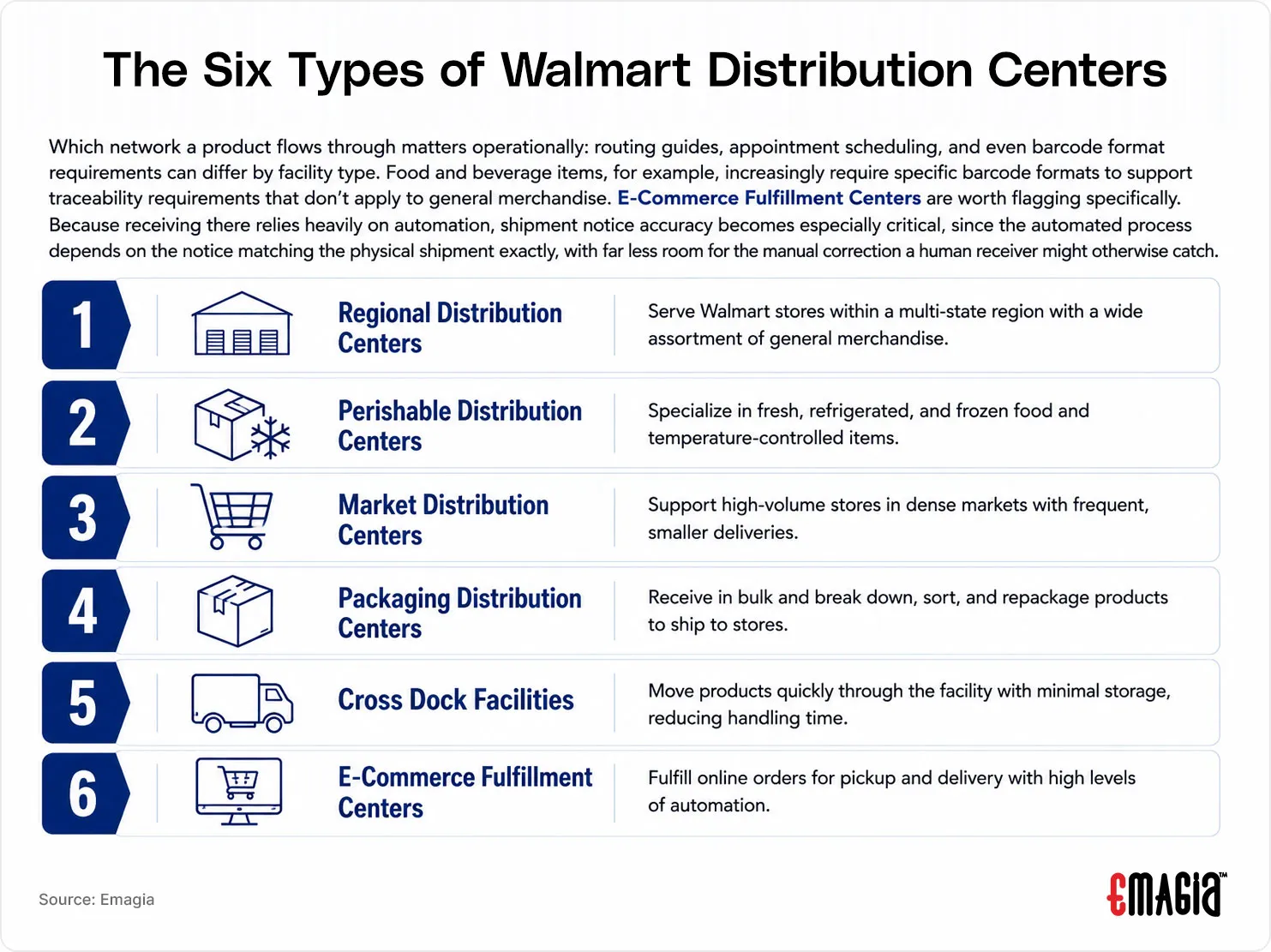
The Six Types of Walmart Distribution Centers
Which network a product flows through matters operationally: routing guides, appointment scheduling, and even barcode format requirements can differ by facility type. Food and beverage items, for example, increasingly require specific barcode formats to support traceability requirements that don’t apply to general merchandise. E-Commerce Fulfillment Centers are worth flagging specifically. Because receiving there relies heavily on automation, shipment notice accuracy becomes especially critical, since the automated process depends on the notice matching the physical shipment exactly, with far less room for the manual correction a human receiver might otherwise catch.
Not sure which of your distribution centers is generating the most deduction volume? A discovery call can show you facility-level visibility into where the pattern actually sits.
How the Distribution Center Process Creates Deduction Risk
Every stage of the distribution center receiving flow, including arrival against appointment, unloading and scanning, cross-docking or storage, and outbound shipping, is a potential point of failure. Because receiving is largely automated, mismatches get caught and recorded without a human review step.
The typical flow at a Walmart distribution center follows a consistent pattern: inbound freight arrives and is checked against the shipment notice and appointment schedule; cases are unloaded and scanned against that data; high-demand goods cross-dock straight to outbound trucks while other inventory goes to reserve storage; and outbound orders are picked and shipped to stores, often overnight.
A shipment arriving outside its appointment window, a case count that doesn’t match the purchase order, or a barcode that fails to scan can each independently trigger a deduction. Because the process is automated, none of these require a person to notice the mismatch for a deduction to post.
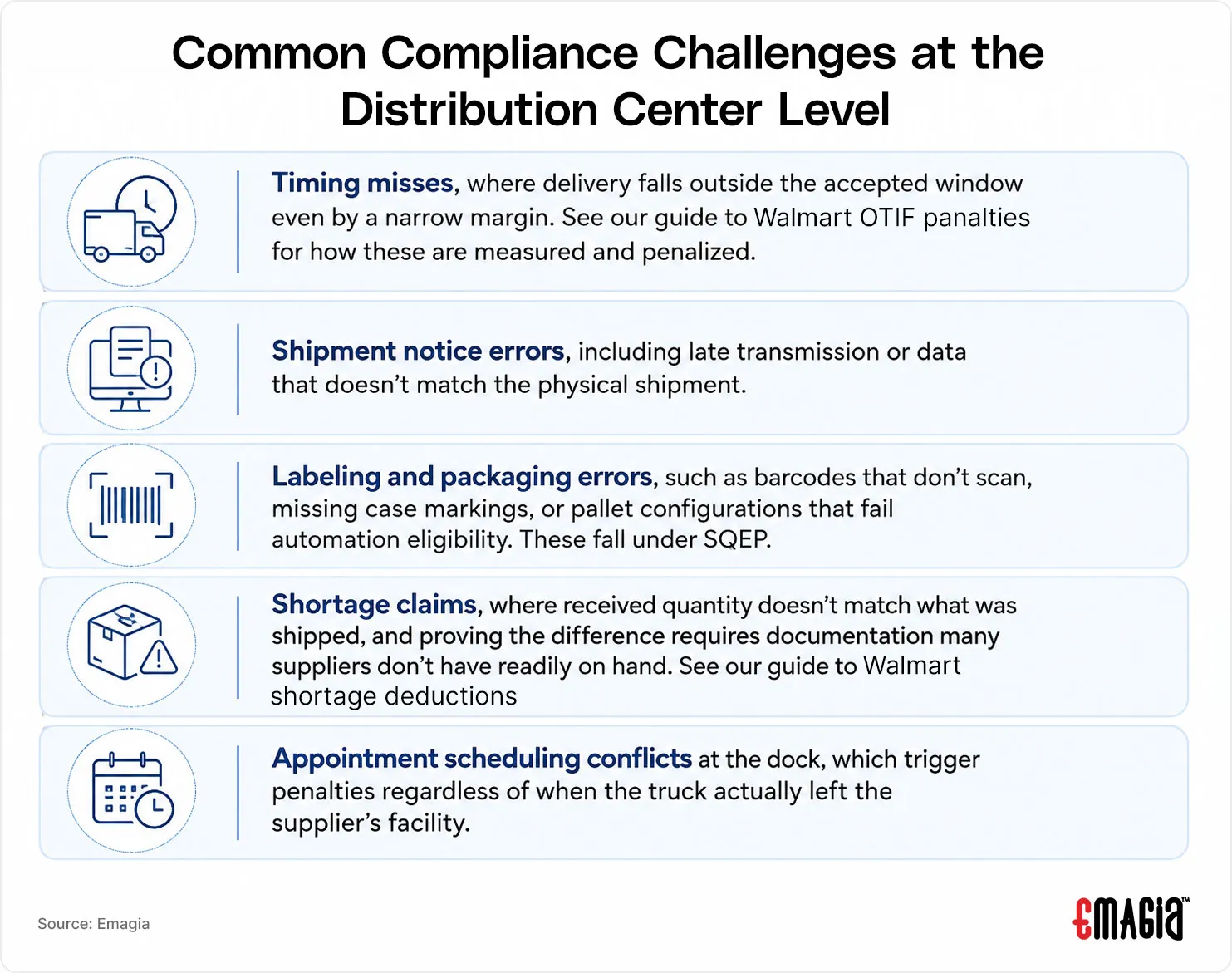
Common Compliance Challenges at the Distribution Center Level
Suppliers shipping into Walmart’s network tend to run into the same handful of issues repeatedly:
- Timing misses, where delivery falls outside the accepted window even by a narrow margin. See our guide to Walmart OTIF penalties for how these are measured and penalized.
- Shipment notice errors, including late transmission or data that doesn’t match the physical shipment.
- Labeling and packaging errors, such as barcodes that don’t scan, missing case markings, or pallet configurations that fail automation eligibility. These fall under SQEP.
- Shortage claims, where received quantity doesn’t match what was shipped, and proving the difference requires documentation many suppliers don’t have readily on hand. See our guide to Walmart shortage deductions.
- Appointment scheduling conflicts at the dock, which trigger penalties regardless of when the truck actually left the supplier’s facility.
None of these issues typically show up as a single, obvious number on a remittance. They accumulate across hundreds of shipments, and by the time a pattern becomes visible, the dispute window on many of the underlying deductions has already closed.
Why Distribution Center Compliance is Hard to Manage Manually
Distribution center compliance issues span timing, labeling, packaging, and documentation at the same time, which means they rarely belong to one team. Supply chain sees the shipment, finance sees the deduction, and neither has full visibility into the other’s data by default.
Reducing this exposure means connecting data that typically lives in separate systems: the purchase order, the shipment notice, the proof of delivery, and the remittance detail showing what was actually deducted and why. That’s a data-integration problem as much as a process one, which is where automation tends to add the most value, not by replacing judgment, but by making the four data sources visible together instead of scattered across distribution-center-specific portals and separate teams.
How Emagia Supports Distribution Center Compliance and Recovery
Emagia‘s Order-to-Cash platform connects that data across every Walmart facility type a supplier ships into. GiaDocs AI centralizes proof-of-delivery, bill-of-lading, and shipment notice documentation, and matches each distribution-center-originated deduction to its source shipment and purchase order automatically, building a dispute case with the correct backup attached.
What’s specific to the distribution-center-compliance use case is how deduction analytics segments the resulting data. By breaking deduction patterns down by facility type (grocery, import, e-commerce, regional), a supplier can see whether recurring issues concentrate in one part of the network, rather than assuming deduction volume looks uniform everywhere. That’s the difference between “we have a general deduction problem” and “our e-commerce fulfillment lane specifically has an ASN accuracy problem,” a distinction that changes where the fix actually needs to happen.
Intelligent Cash Application flags deductions for research as soon as remittances post, preserving more of the dispute window than manual reconciliation typically allows.
The goal isn’t just faster dispute filing. It’s giving supply chain and finance a shared, accurate view of where distribution-center-level compliance issues actually originate, so the same mistakes stop repeating shipment after shipment.
Frequently Asked Questions
What’s the Difference between a Regional Distribution Center and a Grocery Distribution Center?
RDCs handle general, shelf-stable merchandise. GDCs handle perishable and non-perishable food, typically with temperature control and tighter delivery windows tied to shelf life.
Why do Shipment Notice (ASN) Errors Cause so many Deductions?
Because distribution center receiving is largely automated and depends on the shipment notice matching the physical shipment exactly, a late notice, quantity mismatch, or missing data can flag a shipment as non-compliant even when the physical freight arrived correctly and on time.
Do Compliance Requirements Differ by Distribution Center Type?
Yes. Routing guides, appointment scheduling, and barcode format requirements can vary by facility type.
How can a Supplier tell which Distribution Centers Generate the most Deductions?
By aggregating deduction data by facility rather than reviewing claims individually, which is difficult manually at volume and exactly the pattern deduction analytics tools are built to surface.
Which Deduction Codes are most Associated with Distribution Center Receiving Issues?
Shortage, damage, and carton-count codes are the most common. See our Walmart Deduction Codes reference guide for the full breakdown.
Get Visibility into where Your Distribution Center Deductions are Coming From
If Walmart deductions are landing across multiple distribution center types with no clear pattern, the fastest way to start reducing them is understanding exactly where they’re concentrated.
Book a 30-minute discovery call with Emagia. We’ll walk through your deduction history by facility type and show you where the pattern actually sits, whether that’s grocery, import, e-commerce, or regional, before you decide on next steps.
Schedule Your Discovery Call →