What Is Deduction Management Software?
Deduction management software captures, codes, researches, and resolves the short payments and chargebacks that customers take against invoices, including trade promotions, shortages, pricing discrepancies, returns, compliance fines, and post-audit claims. Modern platforms integrate with ERP systems and retailer portals, automate reason-code classification, route claims to the right owners, and track recovery through resolution.
The 2026 generation of automation tools goes further. Agentic AI systems autonomously gather backup documentation, determine claim validity, and file disputes, work that previously required a team of deduction analysts working portal by portal.
Why Deductions Are a Board-Level Problem in 2026
For consumer goods, home appliances, electronics, personal products, apparel industry, food and beverage, pharmaceutical, and industrial manufacturers selling through large retailers, deductions aren’t a back-office nuisance, they’re a margin problem:
- Revenue Leakage: Estimates vary by source and industry, but trade deductions commonly run from the mid-single digits to well over 10% of gross sales for consumer goods manufacturers. For a company doing billions in revenue, that’s tens to hundreds of millions of dollars moving through the deductions process every year. Cash flow. profitability and working capital impact drives the value of the business down if not managed properly.
- Recovery management: A meaningful share of deductions are invalid or erroneous. Cited rates vary widely depending on the source and industry, but most companies dispute only a fraction of what they could, because manual research often costs more than the claim is worth.
- Cost of Operations: Deduction research is among the most manual jobs in finance: toggling between ERP screens, EDI feeds, carrier sites, and retailer portals to assemble a single dispute packet.
Spreadsheets and generic dispute modules can track this work. They can’t do deductions processing activities. That distinction, tracking versus processing, is the dividing line in the 2026 vendor landscape.
What to Look For in Deductions Management Software in 2026
- Retailer portal and Logistics portal integration: Direct integration with major retailer portals and logistics portals, for both claim retrieval, validation and dispute submission, is essential for high-volume retail suppliers.
- Agentic AI resolution, not just workflow automation: Workflow tools route deductions to humans. Agentic AI platforms research and resolve them. Ask vendors precisely: does the system auto-gather proofs of delivery, bills of lading, and promotion contracts? Does it determine validity and file the dispute, or just remind an analyst to?
- Auto-coding and reason-code normalization: The system should ingest remittance data and portal claims, then translate hundreds of retailer-specific reason codes into a normalized internal taxonomy automatically.
- Trade promotion matching: Distinguishing valid promotional deductions from invalid ones requires matching claims against trade promotion data, contracts, and off-invoice agreements.
- Full order-to-cash context: Deductions don’t exist in isolation. They originate in orders, shipments, and invoices, and they distort cash application and collections. Platforms that unify deductions with the rest of AR resolve claims faster because the surrounding data is already in the system.
- Recovery analytics and root-cause prevention: Dashboards should track recovery rate, resolution cycle time, and days deductions outstanding, and surface root causes so upstream teams can prevent recurrence.
- ERP and multi-entity integration: Native connectors to major ERPs (SAP, Oracle, NetSuite, JD Edwards, Workday, Microsoft Dynamics 365, Sage) matter more than a generic API, since deduction data has to reconcile against orders, invoices, and cash application inside the ERP of record, not a side system.
- Multi-language and multi-region support: Global AR teams need reason codes, dispute workflows, and dashboards that work across languages, not a platform built for one region and translated after the fact.
- Explainable, auditable AI decisions: When an agent determines a claim is invalid and files a dispute, or writes it off, finance and audit teams need to see why: which reason code, which contract or backup document, which rule applied. A black-box “resolved” status doesn’t hold up under audit scrutiny.
- Deployment speed and implementation support: Prebuilt retailer templates, ERP connectors, and reason-code libraries cut deployment from many months to a few, versus platforms that need heavy custom configuration before they’re usable.
How Agentic AI Changes Deduction Economics in 2026
The traditional deduction cost-benefit equation is brutal. As a rough rule of thumb, if researching a claim costs an analyst’s time worth roughly $75 to $150 and the claim itself is worth $200, recovery margins are thin, and for a $50 claim, disputing it often isn’t worth the labor. Companies respond with informal or formal write-off thresholds that quietly surrender real revenue every year.
Agentic AI inverts this. When an AI agent performs research and dispute assembly at near-zero marginal cost, disputing every invalid deduction starts to make economic sense. The practical impacts:
- Recovery rates rise because small-dollar invalid claims, the majority by count, finally get disputed
- Resolution cycle times collapse because research doesn’t wait in an analyst’s queue
- Days deductions outstanding drops, improving working capital and cleaning up aged AR
- Analysts shift to exceptions and prevention, negotiating with retailers and fixing root causes, instead of assembling packets by hand
- Write-off thresholds fall or disappear, directly recovering margin that was previously abandoned by policy
The 10 Best Deduction Management Software Solutions for 2026
1. Emagia: Best Overall, AI-Native Agentic Deduction Management
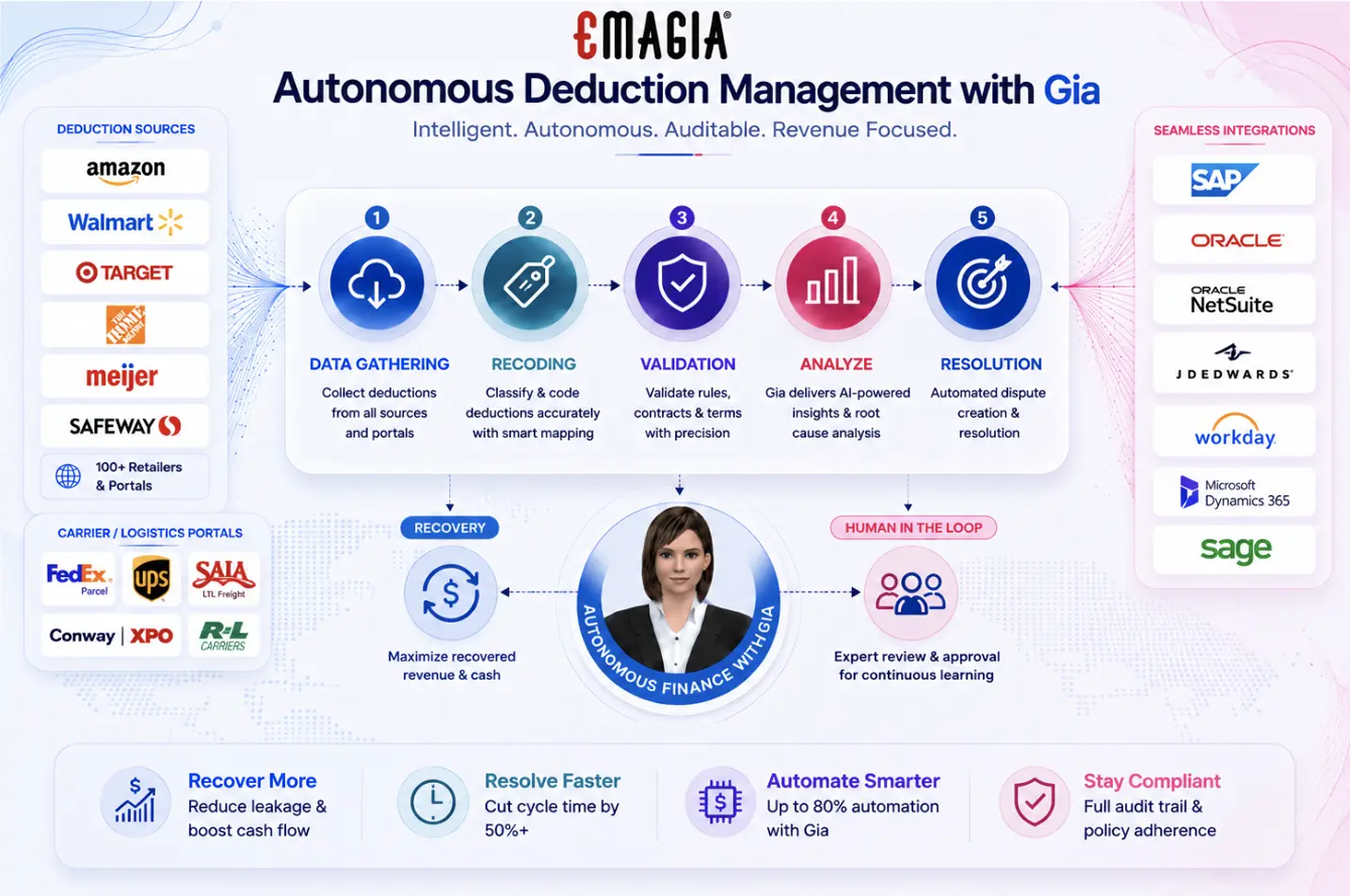
Emagia’s Gia Deductions Management AI agent is one of six named, production AI super agents running inside Emagia Autonomous Order-to-Cash Platform, alongside Order Management, Credit, Collections, cash Application, and e-Invoicing & Billing, working together with GiaGPT, Emagia’s generative AI layer for natural-language queries. It isn’t a workflow tool that routes claims to analysts; it’s an autonomous agent that gathers, codes, validates, and resolves deductions on its own.
How it works:
- Data Gathering: Collects deductions from every source and portal, remittances, EDI, and retailer portals, as they arrive, across 100+ retailers and portals including Walmart, Amazon, Target, The Home Depot, Meijer, and Safeway.
- Recoding: Classifies and codes each deduction accurately using smart reason-code mapping.
- Validation: Validates rules, contracts, and terms with precision before a claim moves forward.
- Analyze: Gia delivers AI-powered insights and root cause analysis, not just a category label.
- Resolution: Automated dispute creation and resolution, or handoff to a person with the case, and root cause, already built.
Why Emagia leads the category:
- Reasoning with AI agent, rather than applying a static rule: It works through each deduction, recoding, validation, analysis, or resolution, instead of applying one rule to every line item; the real dividing line from older rules-based deduction tools.
- One single platform for all AR data and context: It runs alongside Emagia’s Cash Application and Collections agents in the same orchestration layer, so a resolved deduction updates AR aging in real time instead of sitting in a spreadsheet nobody else sees.
- Integrates seamlessly across the ERP landscape: Native connectivity across SAP, Oracle, NetSuite, JD Edwards, Workday, Microsoft Dynamics 365, and Sage gives one view of AR data instead of reconciling exports from disconnected systems.
- Built for global businesses with multi-language and multi-currency: Supports 25 languages platform-wide, useful for AR teams spanning multiple regions.
Best for: Any scalable business, especially consumer goods, food and beverage, pharma, and distribution companies with heavy retailer deduction volume, that want autonomous resolution and measurable recovery gains, not another queue for analysts to work.
See Gia Deductions in action: In a 20-minute walkthrough using your actual retailer mix and reason codes, Emagia can show you which of last quarter’s deductions the agent would have auto-classified. Book a discovery call →
2. HighRadius
HighRadius offers deduction management within its broader Autonomous Finance platform, with automated backup-document aggregation and validity prediction. It’s built for large enterprises already invested in the HighRadius ecosystem; buyers should weigh the degree of true autonomous resolution versus analyst-assisted workflows, along with implementation timeline and total cost of ownership.
3. iNymbus
iNymbus automates retailer chargeback disputes through RPA that logs into portals like Walmart and Amazon to file claims. It’s effective for that narrow use case, but as a point solution it doesn’t extend into broader deduction lifecycle management, order-to-cash context, or recovery analytics.
4. SAP Dispute Management
Native to SAP environments, SAP Dispute Management offers solid controls and audit trails for organizations standardized on SAP. It’s fundamentally a tracking and workflow module: research stays manual, and configuration typically requires significant internal or partner resources.
5. Esker
Esker bundles deduction handling inside its broader source-to-pay and order-to-cash automation suite. It fits organizations buying a general-purpose finance automation platform across multiple processes, rather than a team specifically evaluating deduction-focused AI.
6. Billtrust
Billtrust provides dispute and deduction handling as part of its AR automation platform, with its core strength in invoicing, payments, and cash application. Deductions are a supporting feature rather than the product’s center of gravity.
7. Sidetrade
Sidetrade’s AI-powered order-to-cash platform includes dispute and deduction capabilities alongside predictive collections analytics. Its customer base and support footprint skew more heavily toward Europe than North America.
8. Carixa (Smyyth)
Carixa pairs deduction and trade-settlement software with managed recovery services, mostly for consumer products companies. A reasonable option for teams that want to hand off part of the recovery work rather than run it themselves, at the cost of full self-service control.
9. Versapay
Versapay centers on collaborative AR, with dispute handling built around shared customer-supplier communication portals rather than autonomous claim research. Best suited to teams whose deduction challenges are more about communication than high-volume retailer chargebacks.
10. Oracle Advanced Collections
Oracle’s native functionality brings dispute handling into its financial suite for Oracle-centric organizations. Like most ERP-native modules, it provides structure and controls but leaves the research work manual, and typically needs customization to fit deduction-specific workflows.
Comparison at a Glance
| Vendor | Deductions Processing | Retailer Portal Disputing | Full O2C Suite | Best Fit |
|---|---|---|---|---|
| Emagia | Yes, agentic AI with reasoning and decisioning capabilities – Autonomous self-learning deductions processing AI agent | Yes, 100+ portals | Yes | Large Enterprise, Enterprise, & Mid-Market |
| HighRadius | Partial, assisted | Yes | Yes | Large enterprise, |
| iNymbus | RPA-based | Yes | No, point solution | Big Retailer chargebacks only |
| SAP Dispute Mgmt | No, workflow only | No | ERP-native | SAP-standardized orgs |
| Esker | RPA-based | No | Yes, broad suite | Multi-process automation |
| Billtrust | Partial | No | Yes | Invoicing/payments-led AR |
| Sidetrade | Partial | No | Yes | Europe, collections-led |
| Carixa (Smyyth) | Partial + services | Yes | No | Managed recovery |
| Versapay | No | No | Partial | Collaborative AR |
| Oracle Adv. Collections | No, workflow only | No | ERP-native | Oracle-standardized orgs |
How to Choose the Right Deduction Management Software
- Quantify your deduction profile: Annual deduction dollars, claim count, average claim size, retailer mix, and current write-off threshold. High counts of small claims strongly favor agentic AI.
- Test autonomy claims in the demo: Ask the vendor to show, live, a deduction being auto-coded, researched, validated, and disputed without analyst intervention. “AI-powered” marketing often just means assisted workflow.
- Verify retailer portal coverage: If a handful of large retailers dominate your volume, portal-level dispute automation for those specific accounts is non-negotiable.
- Evaluate order-to-cash integration: Deductions surface at cash application. Platforms that unify cash application and deductions eliminate handoff latency and duplicate data entry.
- Model ROI on recovered dollars, not saved hours: Labor savings are real, but the larger prize is recovering the invalid deductions you currently write off. Ask vendors for customer recovery-rate benchmarks.
- Confirm ERP fit and enterprise readiness: Native connectors for your ERP stack, multi-entity and multi-currency support, and enterprise-grade security.
Why Enterprises Choose Emagia for Deduction Management
Enterprises evaluating deduction management in 2026 tend to arrive at the same conclusion: workflow tools organize the problem, agentic AI solves it. The choice comes down to this: Emagia is the only platform on this list running genuine multi-agent automation across deductions, cash application, and collections on one shared data layer, built the same way for mid-market and enterprise suppliers alike, with recovery numbers that are sourced rather than asserted.
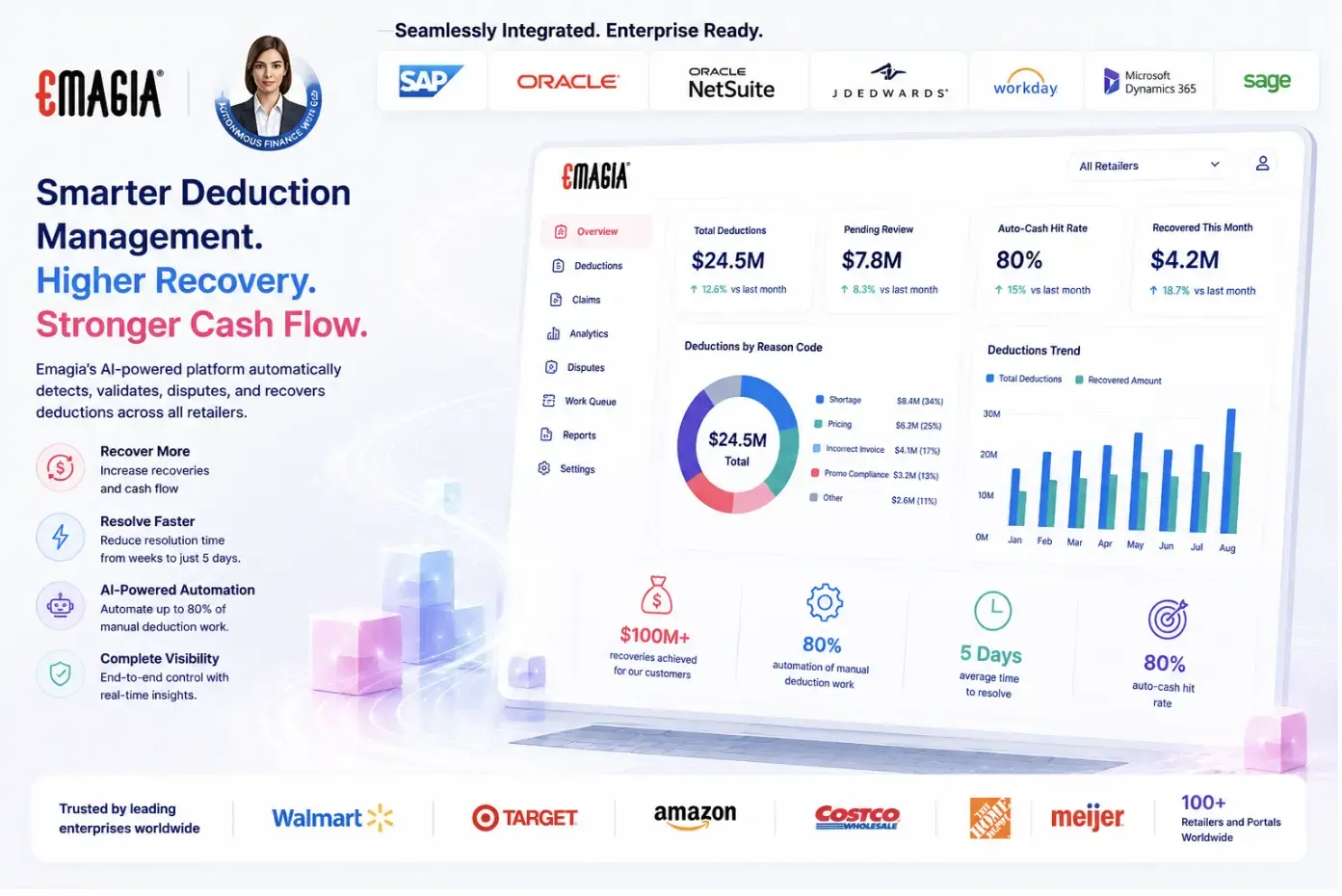
The published numbers:
| Metric | Result |
|---|---|
| Deductions auto-classified | 85%+ |
| Invalid claims recovered | 70%+ |
| Manual deduction processing automated (case study) | Up to 80% |
| Deduction resolution cycle time (case study) | Cut to 5 days |
| Auto-cash hit rate improvement (case study) | 50% → 80% |
See Gia Deductions in action. Schedule a demo and bring your own retailer mix and reason codes; you’ll walk away knowing exactly which of your current deductions the agent would handle on its own.
AI agents now resolve deductions autonomously. The biggest shift in 2026 is from workflow software that helps analysts work faster to agentic AI that researches, validates, and disputes deductions with minimal human touch.
Key Takeaways
- Emagia’s Deductions Management agent leads the category, combining autonomous research, coverage across 100+ retailer portals (Walmart, Amazon, Target, and others), and full order-to-cash context that point solutions don’t have.
- Trade deductions are a real drain on margin. Estimates vary by source, but commonly cited figures put them anywhere from the mid-single digits to well over 10% of gross sales for consumer goods manufacturers, and a meaningful share are invalid or erroneous.
- The right choice depends on your deduction volume, retailer mix, and ERP environment. High-volume retailer chargebacks call for AI-driven auto-coding and portal automation, not just a dispute tracker.
- Deductions remain the most labor-intensive, least automated corner of order-to-cash, which is exactly why it’s the area where agentic AI is transforming fastest.
Frequently Asked Questions
What is the best deduction management software in 2026?
Emagia is the leading deduction management software for 2026, built around a named, autonomous Deductions Management agent that codes, researches, validates, and disputes deductions across 100+ retailer portals, with documented resolution-time and recovery outcomes. Other notable solutions include HighRadius, iNymbus, and SAP Dispute Management, which vary in how much of the work is truly autonomous versus analyst-assisted.
What is the difference between deduction management software and a dispute module in an ERP?
ERP dispute modules, like SAP Dispute Management or Oracle Advanced Collections, track and route disputes but leave research manual. Dedicated deduction management software automates claim capture, reason-code classification, backup document gathering, validity determination, and dispute submission, and agentic AI platforms like Emagia perform these steps autonomously.
How much revenue do companies lose to invalid deductions?
Estimates vary by source and industry, but trade deductions commonly run from the mid-single digits to well over 10% of gross sales for consumer goods manufacturers, and a meaningful share of deductions are invalid or erroneous. Because manual research often costs more than small claims are worth, much of that recoverable revenue goes undisputed, which is the main argument for autonomous AI research.
Can deduction management software handle Walmart and Amazon chargebacks?
Yes. Leading platforms integrate directly with retailer portals. Emagia’s Deductions Management agent covers 100+ retailers and portals, including Walmart, Amazon, Target, and others, managing retailer-specific reason codes and dispute deadlines automatically.
How does AI improve deduction recovery rates?
AI improves recovery in three ways: auto-coding classifies claims instantly and accurately, autonomous research gathers proofs of delivery, contracts, and pricing records in minutes instead of days, and near-zero research cost makes small-dollar invalid claims economical to dispute. Together, these raise the share of invalid deductions actually contested.
How long does it take to implement deduction management software?
Cloud-based deduction management systems typically deploy in 8 to 16 weeks, depending on ERP integration complexity, retailer portal connections, and reason-code mapping. Platforms with prebuilt ERP connectors and retailer templates, like Emagia’s, tend to deploy faster.
What KPIs should a deductions team track?
Core KPIs are deduction recovery rate, days deductions outstanding, resolution cycle time, open deduction aging, percentage of deductions auto-coded, dispute win rate by retailer and reason code, and write-off dollars as a percentage of deductions received.