Every single cent that a company books is just a number on paper until it is actually cashed in the bank. That journey—from when a customer places an order to when the payment gets reconciled—is the Order-to-Cash (O2C) process. It is one of the most important and revenue-centric processes in the office of the CFO. With the right set of operations in place, cash flow speeds up, Days Sales Outstanding (DSO) falls, and finance teams spend less time chasing payments and more time on strategy.
The result: More enterprise and mid-market finance leaders are exploring the space of automated O2C software. In this guide, we explore some of the important key features that determine cash flow and help an enterprise make a well-informed decision.
Quick Answer: Order-to-Cash (O2C) software automates the complete revenue cycle, from order management and credit assessment to invoicing, collections, dispute and deductions management, cash application, and reconciliation. The most important capabilities for enterprises include AI-powered automation, ERP integration, real-time analytics, and autonomous workflow execution.
Key Takeaways
- End-to-end O2C coverage is more valuable than automating a single finance process.
- AI should automate workflows and decisions, not simply provide recommendations.
- ERP integration is critical for enterprise scalability and data consistency.
- Collections, dispute management, and cash application directly influence working capital.
- Real-time analytics help finance leaders identify cash-flow and receivables bottlenecks.
What Is Order-to-Cash (O2C) Software?
Order-to-Cash software is a technology platform that automates and connects every stage of the revenue cycle, starting from order management, credit risk management, invoicing, collections, dispute and deduction handling, cash application, and reporting into a single, intelligent, seamless workflow. Instead of finance teams manually chasing invoices on spreadsheets and email threads, O2C software uses automation and AI agents to match payments, prioritize collections, flag credit risk, and give leadership real-time visibility into receivables performance.
The goal is simple: turn sales into collected cash faster, with fewer errors and less manual effort.
The ROI of Modernizing Order-to-Cash
Not all O2C platforms are created the same. While some automate only part of the cycle (invoicing or payment reminders, for example), others combine credit, collections, cash application, and disputes into a single integrated system. These features are directly defined by the depth and intelligence:
- How quickly you get paid — measured by DSO and days-to-cash
- What is the cash amount stuck in unapplied payments, disputes, and deductions
- How much manual work your AR and collections teams do
- To what extent can you scale across currencies, entities, and ERPs as the business grows
With that context, here are the features that separate a modern, AI-led O2C platform from a basic invoicing or reminder tool.
The 10 Key Features to Look for in Order-to-Cash Software
While basic tools might only automate a single process, such as invoicing or payment reminders, full-length enterprise O2C software unifies the entire revenue lifecycle—from customer onboarding to cash post-reconciliation. To eliminate process-driven friction, it is important to structure your evaluation in order of the O2C cycle.
1. Intelligent Credit Risk Management: Before an order ever ships, a strong O2C platform should evaluate a customer’s creditworthiness using real-time financial data, payment history, and risk scoring. It needs to look for configurable scoring models, automated credit limit recommendations, and continuous monitoring that flags deteriorating accounts before they become bad debt.
- Why it matters: Proactive credit risk management prevents blocked orders, reduces exposure to bad debt, and accelerates customer onboarding.
2. Automated Order Management and Sales Order Processing Capturing and validating sales orders quickly ensures that revenue flows smoothly into the pipeline. Modern software automates sales order entry, cross-checks order details against available credit lines, and instantly executes hold-and-release workflows for orders that require manual approval.
- Why it matters: Eliminates order processing bottlenecks, prevents fulfillment delays on credit-worthy accounts, and connects sales directly to back-office execution.
3. Automated Invoicing and Electronic Presentment (EIPP): Manual invoicing delays payments and introduces expensive billing errors. An effective O2C solution automatically generates and delivers compliant e-invoices across multiple channels (email, portal, and EDI) immediately after goods or services are delivered.
- Why it matters: This helps shorten the billing cycle, cuts administrative overhead, and ensures customers receive accurate invoices in their preferred formats.
4. Self-Service Customer Portals: A centralized, buyer-facing portal allows customers to view open balances, access past invoices, initiate payments, and raise billing inquiries independently at any time of day.
- Why it matters: Improves the buyer experience while dramatically reducing inbound AR support tickets regarding lost invoices or balance checks.
5. AI-Driven Collections Prioritization Instead of static aging reports, advanced O2C software uses predictive analytics and behavioral tracking to dynamically prioritize collector worklists and automate tailored payment reminders based on customer risk profiles.
6. Dispute and Deduction Management Short payments and disputed invoices can stall payment settlement indefinitely. The right system automatically captures deduction line items, routes them to internal teams for investigation, and applies root-cause analysis codes.
- Why it matters: Accelerates dispute resolution times, minimizes unauthorized write-offs, and protects operational margins.
7. AI-Powered Cash Application and Payment Matching: Cash application is often the most manual, error-prone step in the entire O2C cycle. The right software should automatically capture remittance data from emails, portals, lockbox files, and bank statements, then match incoming payments to open invoices—even when remittances are partial, in a different currency, or missing entirely.
- Why it matters: High touchless (straight-through) cash posting rates free up AR analysts from manual matching and dramatically reduce the pool of unapplied cash sitting on the balance sheet.
8. Real-Time Analytics and AR Dashboards: Comprehensive platforms offer out-of-the-box dashboards tracking core working capital metrics, including DSO, CEI, collector performance, dispute resolution cycles, and cash flow projections.
- Why it matters: Gives executive leadership complete visibility into cash performance and pinpoints operational bottlenecks before they impact liquidity.
9. Seamless, Bi-Directional ERP Integration: Enterprise O2C platforms must integrate tightly with existing ERPs, CRMs, and banking systems to sync order details, customer profiles, invoice statuses, and ledger postings without manual intervention.
- Why it matters: Ensures data consistency across all financial systems, prevents double-data entry, and maintains a single source of truth.
10. Agentic AI and Autonomous Workflow Execution: Beyond standard rule-based automation, agentic AI actively identifies exceptions, retrieves missing remittance documents, drafts responses to routine customer queries, and manages cross-system workflows autonomously.
- Why it matters: Shifts AR teams from operational processing to strategic management, driving scalability without requiring proportional headcount growth.
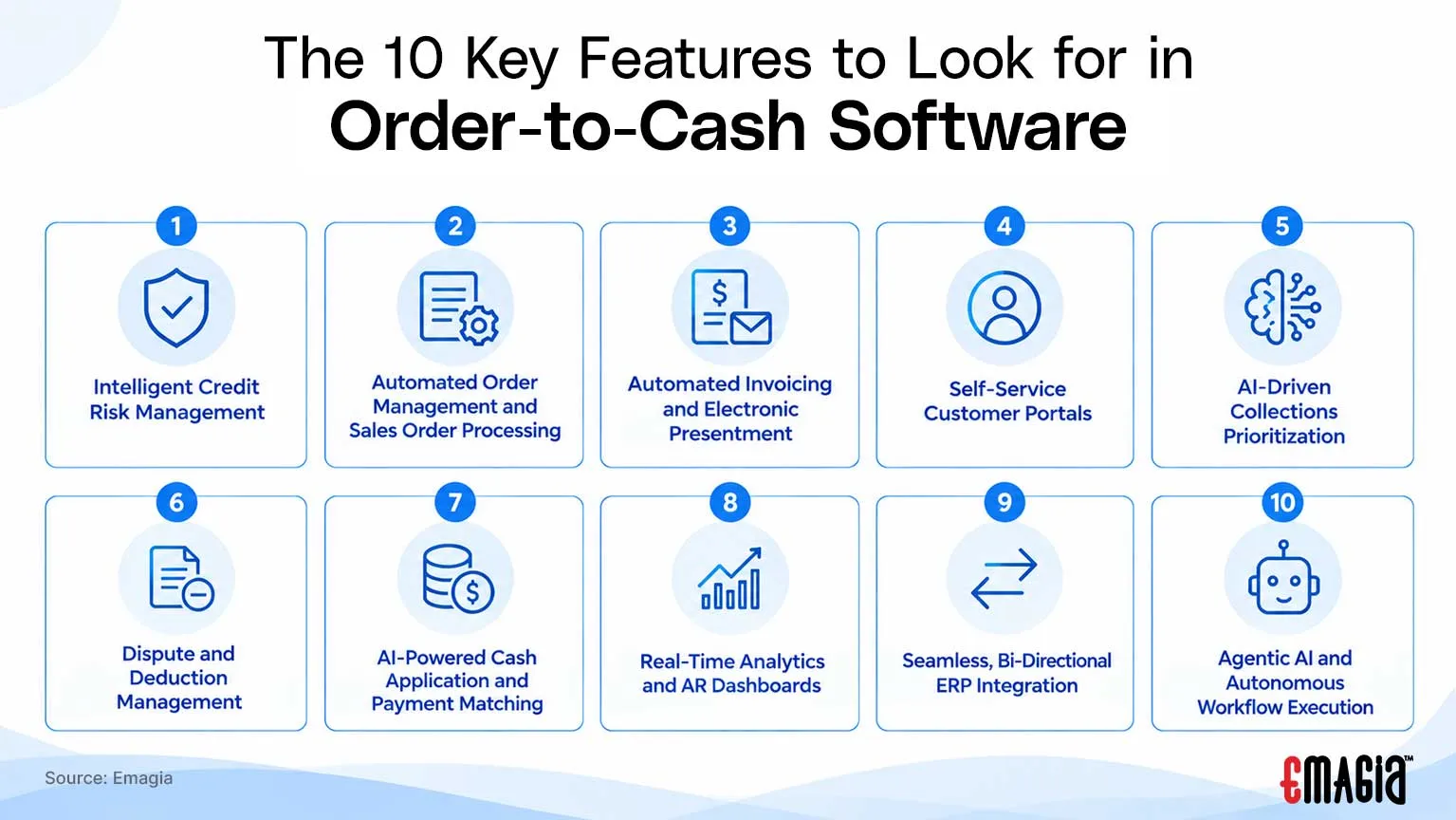
Here are the 10 Essential Capabilities Every Modern O2C Platform Should Deliver:
| O2C Software Feature | What It Does | Business Impact |
| Credit risk management | Evaluates customer creditworthiness | Reduces bad-debt exposure |
| Order management | Automates sales order processing | Reduces order delays |
| Invoicing & EIPP | Generates and delivers invoices | Accelerates billing |
| Customer portals | Enables self-service invoice and payment access | Reduces AR support workload |
| Collections | Prioritizes accounts and payment outreach | Helps reduce DSO |
| Dispute & deductions management | Captures and resolves deductions | Protects margins |
| Cash application | Matches payments to invoices | Reduces unapplied cash |
| Analytics | Tracks AR and working-capital metrics | Improves cash visibility |
| ERP integration | Synchronizes financial data | Reduces manual data entry |
| Agentic AI | Executes workflows autonomously | Increases operational scalability |
Who Should Use Order-to-Cash Software?
Order-to-Cash software is designed for finance organizations that need to automate receivables processes, improve cash flow, and scale operations across customers, entities, currencies, or ERP systems. It is particularly relevant for:
- Enterprise finance and accounting teams
- CFO and controller organizations
- Accounts receivable and collections teams
- Global shared services organizations
- Businesses operating across multiple entities or currencies
- Companies using multiple ERP or financial systems
- Organizations looking to reduce DSO, unapplied cash, disputes, and manual AR work
How to Choose the Right Order-to-Cash Software
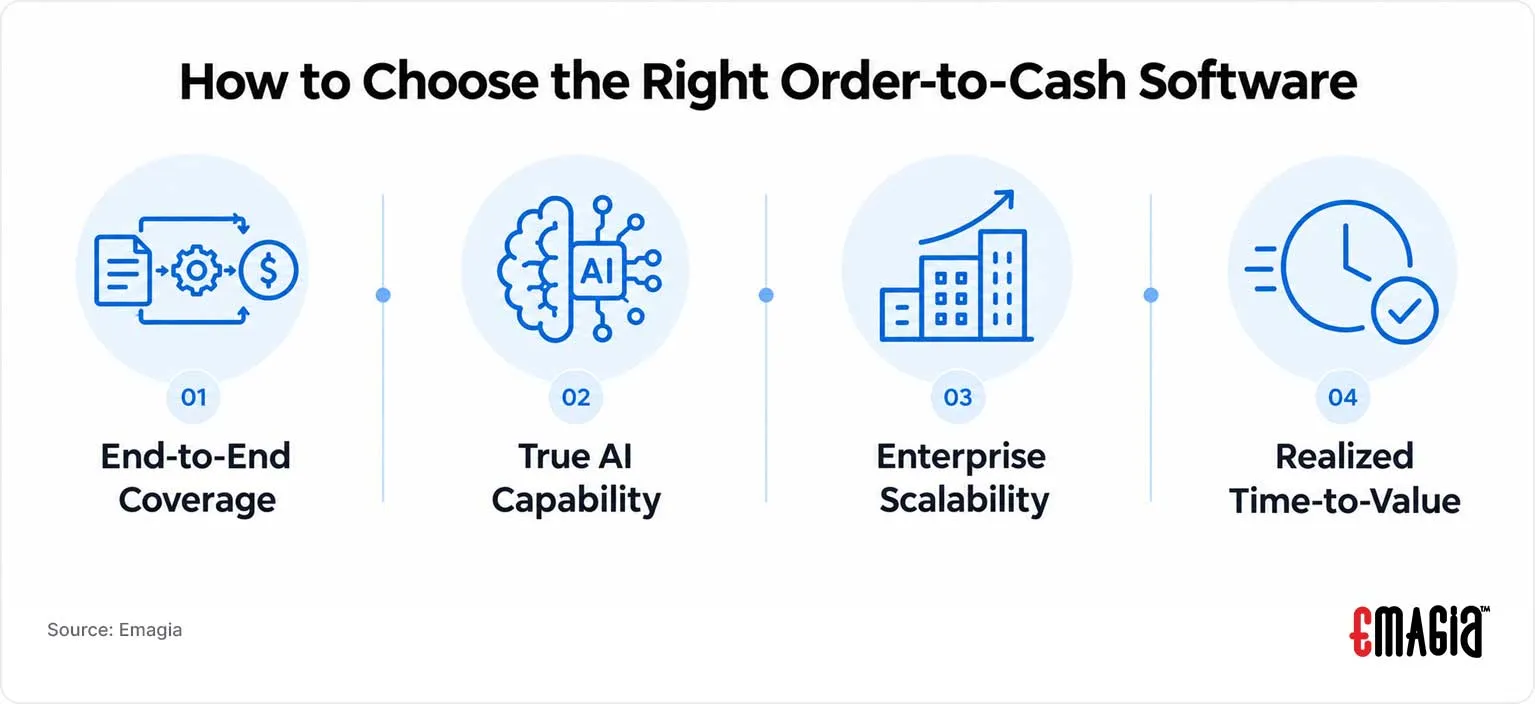
When feature requirements are defined for an enterprise, the shortlist should be evaluated against key structural criteria:
- End-to-End Coverage: Does the platform span the full O2C lifecycle, or is it a point solution? Fragmented tools for invoicing or collections create operational gaps and data silos across business units.
- True AI Capability: Is the AI executing autonomous workflows, or is it merely standard rule-based automation? Enterprise buyers must demand proof of straight-through processing (STP) and touchless resolution rates rather than relies on vendor marketing claims.
- Enterprise Scalability: Can the architecture natively support complex multi-entity, multi-ERP, and multi-currency operations without custom bolt-ons or performance bottlenecks?
- Realized Time-to-Value: What is the true deployment timeline? Protracted multi-year implementations erode ROI and delay capital efficiency gains compared to rapidly deployable enterprise platforms.
How Emagia Approaches Order-to-Cash Automation
The philosophy behind Emagia’s autonomous finance platform is bringing together credit, invoicing, collections, dispute and deductions management, and cash application into an end-to-end AI-driven system. This streamlines end-to-end order-to-cash processes on a single platform.
Credit Risk Management: Provides real-time, data-driven visibility into customer risk and automates credit assessments.
Cash Application Platform: Automates payment matching and streamlines end-to-end cash posting to reduce unapplied cash and eliminate manual reconciliations:
- Gia AlphaCash: Uses self-learning AI algorithms to automatically capture, extract, and match remittance data from multiple sources (emails, portals, check images, bank lockboxes) with open invoices, achieving over 90% straight-through (touchless) posting rates.
Invoicing & EIPP: Simplifies digital invoice presentment and multichannel delivery, backed by 24/7 AI-driven capabilities:
- GiaDocs AI: An intelligent document processing solution that reads, extracts, and digitizes complex financial documents (such as invoices, checks, and remittance notices) with over 90% straight-through accuracy to eliminate manual data entry.
- GiaPay: An AI-powered B2B payments orchestration platform supporting over 135 currencies and 1,200 banks, providing strategy-based payment options, lowering interchange transaction fees, and offering frictionless digital checkout.
Collections Management: AI-powered prioritization to optimize collector workflows and payment reminders.
- GiaCollect: An intelligent autonomous collections agent that analyzes payment behaviors, dynamically prioritizes collector worklists, automates personalized payment reminders, and predicts cash flow patterns to accelerate receivables collection.
Dispute & Deductions Management Platform: Automates deduction capture and speeds up dispute resolution cycles.
For finance teams managing high transaction volumes across multiple entities, currencies, and ERPs, this connected, AI-led approach to Order-to-Cash turns receivables from a bottleneck into a strategic advantage
Frequently Asked Questions
What is the most important feature of Order-to-Cash software?
An AI-powered cash application is often the most impactful feature, as it directly reduces unapplied cash and the manual reconciliation work that ties up AR teams the most.
What is the difference between Order-to-Cash software and accounts receivable software?
Accounts receivable (AR) software primarily focuses on invoicing, collections, and cash application. Order-to-cash software is a broader category and covers the whole cycle from order and credit management to final cash reconciliation and reporting.
Does Order-to-Cash software integrate with ERP systems like SAP, Oracle, or NetSuite?
Yes. Modern O2C platforms are built to be integrated bi-directionally and in real-time with leading ERPs, making sure receivables, invoicing, and payment data remain in sync without manual rekeying.
How does O2C software reduce DSO?
It reduces DSO by accelerating each stage of the cycle — faster invoice delivery, AI-prioritized collections outreach, faster dispute resolution, and higher rates of touchless, automated cash application.
Is O2C software only for large enterprises?
No. While large, multinational enterprises benefit from multi-entity and multi-currency capabilities, mid-market companies also use O2C software to replace manual, spreadsheet-based AR processes and scale receivables operations without adding headcount.