Insights from the Emagia AI for Finance Podcast with Pierluigi Monaco, Strategic Finance Executive and certified CFO.
Imagine driving a car down a busy highway while looking only in the rearview mirror. Sooner or later, you’ll crash. For decades, traditional finance functions have operated in this exact manner—spending endless hours looking backward, processing transactions, and explaining past performance. In today’s volatile economic landscape, relying solely on historical reporting is no longer an option.
In a recent episode of the Emagia AI for Finance Podcast, host Brian Shappell, Director of Content Strategy at Emagia, sat down with Pierluigi Monaco—an executive strategic finance leader, certified CFO, and veteran of tech giants including HP, OpenText, and Micro Focus—to explore how artificial intelligence (AI) is shifting finance from historical reporting to forward-looking strategy, where human judgment remains essential, and how finance professionals must navigate AI data governance.
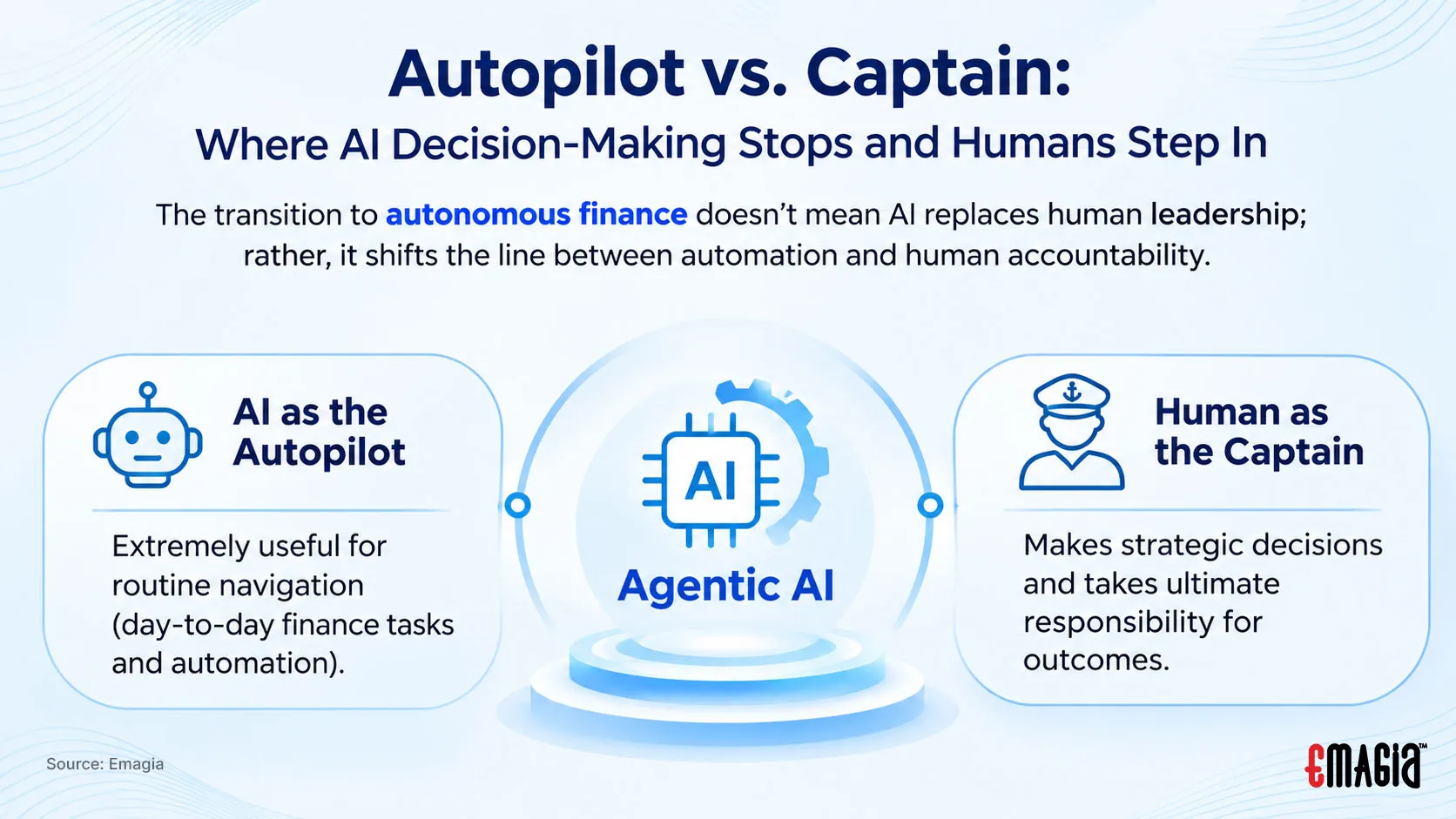
Autopilot vs. Captain: Where AI Decision-Making Stops and Humans Step In
The transition to autonomous finance doesn’t mean AI replaces human leadership; rather, it shifts the line between automation and human accountability. Pierluigi compares AI to an autopilot—extremely useful for routine navigation, but dependent on a human captain to make strategic decisions and take ultimate responsibility for outcomes.
“Imagine driving while looking only in the rearview mirror. Sooner or later, you crash. For years, finance did exactly that. It explained the past… AI can prepare meetings, summarize them, and analyze the data behind them. The time goes back to looking ahead. AI shows you the road you still drive.” — Pierluigi Monaco
| Operational Domain | Recommended AI Role | Human Responsibility |
|---|---|---|
| Routine & Repetitive Tasks | Autonomous Execution: Matching payments, reconciliations, and initial data checks. | Governance, process oversight, and resolving workflow exceptions. |
| Order-to-Cash (O2C) | Predictive Signaling: Cleaning raw customer data, forecasting credit risks, and prioritizing collections. | Relationship management, approving credit terms, and handling customer outreach. |
| Strategic & High-Risk | Recommendation Engine: Preparing scenario models and analyzing pricing variables. | Final Ownership: Strategic decision-making on pricing margins, credit limits, and enterprise risk. |
However, implementing AI successfully requires more than just adopting software; it demands clean data, defined process ownership, and rigorous compliance. Drawing from his experience at OpenText and regulatory frameworks in regions like Germany, Pierluigi notes that feeding poor-quality or non-compliant data into AI systems creates major bottlenecks and privacy risks. Enterprise security licenses are non-negotiable to prevent leaks of confidential corporate data.
“Put dirty fuel in a sports car, and it breaks down, right? Big data does the same to AI… The first question is not, ‘What can AI do?’ It is, ‘Am I allowed to use this data?’ … If AI needs auditors, finance should be at the table.” — Pierluigi Monaco
The Bottom Line
As automation reduces multi-week data processing tasks to just hours, the core skills required for finance success are evolving. The real value of modern finance professionals no longer lies in building spreadsheets, but in interpreting insights, resolving workflow bottlenecks, and guiding executive decisions. Five years from now, AI success won’t be measured by hours saved, but by whether forecasts are more accurate, risks are spotted earlier, and better business decisions are made.
“The future finance person is not the one who builds the spreadsheet, it’s the one who explains what it means… We don’t judge a doctor by how fast he reads an X-ray. We judge him by whether the patient gets better. AI is the same… Decide better, not just faster.” — Pierluigi Monaco
For more of Pierluigi Monaco sharing detailed real-world anecdotes—including how he saved weeks of work using advanced queries, real-life O2C credit management strategies from his time at HP, and how to structure multi-agent AI workflows— watch or view this full episode of the Emagia AI for Finance Podcast.
Link: Listen to the Full Podcast Episode Here
Frequently Asked Questions About AI in Finance
How is AI used in Order-to-Cash?
Order-to-Cash (O2C) is the process from receiving a customer order to collecting payment. AI can clean payment and customer data, calculate key figures, and suggest which customers to contact, turning signals such as late payments into early warnings rather than after-the-fact reports.
Will AI replace finance professionals?
Not according to Pierre. Finance professionals who use AI well will make better decisions than those who don’t. Once everyone uses AI, the advantage comes from reinventing your role and proving the value you bring to the business.
Which finance tasks should AI handle, and which should people control?
AI can run repetitive, rule-based work such as reconciliations, matching and first-pass checks. Finance professionals should stay in control of decisions on pricing, credit, margins and strategy, because someone has to be accountable for them.
Why does AI governance matter in finance?
AI is only as good as the data and rules behind it. Governance covers whether you are allowed to use the data (privacy and compliance rules vary by country), which tools are approved, and who owns the data and process. Using an enterprise license, rather than pasting company data into a personal tool, is essential.
How can a finance team get started with AI?
Pick one process, map it, find the bottleneck, and then ask whether AI can help. A simple starting method is to give an AI tool raw data, ask it to clean the data, then calculate the numbers, and finally ask for insights or a draft customer letter, all in one chat.
How do you measure the success of AI in finance?
Skip hours saved and ask three questions: Are our forecasts more accurate? Do we see risks earlier? Do leaders make better decisions? If the answer to all three is yes, the AI is working.
Listen to the full conversation on the Emagia AI for Finance Podcast to hear Pierre’s insights in his own words. To see how autonomous Order-to-Cash technology helps finance teams act on risk signals earlier, explore Emagia.