Autonomous Order-to-Cash (O2C) automation software is an AI-driven platform within Autonomous Finance powered by Generative AI that executes the end-to-end revenue cycle—including credit management, invoicing, cash application, and collections—without manual intervention. It reduces DSO by 15–30%, automates up to 90% of receivables processes, and provides real-time working capital visibility.
Understanding how Days Sales Outstanding (DSO) impacts cash flow is critical for improving working capital performance.
To understand how each stage impacts revenue and cash flow, explore the order to cash process steps in detail.
Order-to-Cash Automation: Key Takeaways for CFOs
Enterprise finance teams use O2C automation to manage billions in receivables while improving working capital performance and reducing risk.
Improve working capital using automation and gain real-time visibility into receivables and cash flow.
- Reduce DSO by 15–30%
- Automate up to 70% of accounts receivable processes
- Improve cash application accuracy above 90%
- Gain real-time visibility into cash flow and receivables
- Use AI to predict late payments and prioritize collections
Enterprises adopting AI-driven O2C automation can optimize working capital efficiency by up to 30% and improve cash application accuracy above 90%.
Explore how AI-powered order-to-cash automation can transform your finance operations.
Organizations typically adopt order-to-cash automation when manual processes create delays, errors, or cash flow challenges.
What Is Order-to-Cash (O2C) Automation?
Order-to-cash automation software integrates and automates key revenue cycle processes—from order entry to payment collection—using AI and digital workflows to improve efficiency, accuracy, and cash flow.
What is O2C Automation Software in Enterprise Finance?
Order-to-cash automation software is a category of enterprise finance technology that integrates order management, billing, accounts receivable, and collections into a unified, AI-driven platform.
Learn how organizations implement order to cash solutions to unify billing, collections, and receivables into a single intelligent workflow.
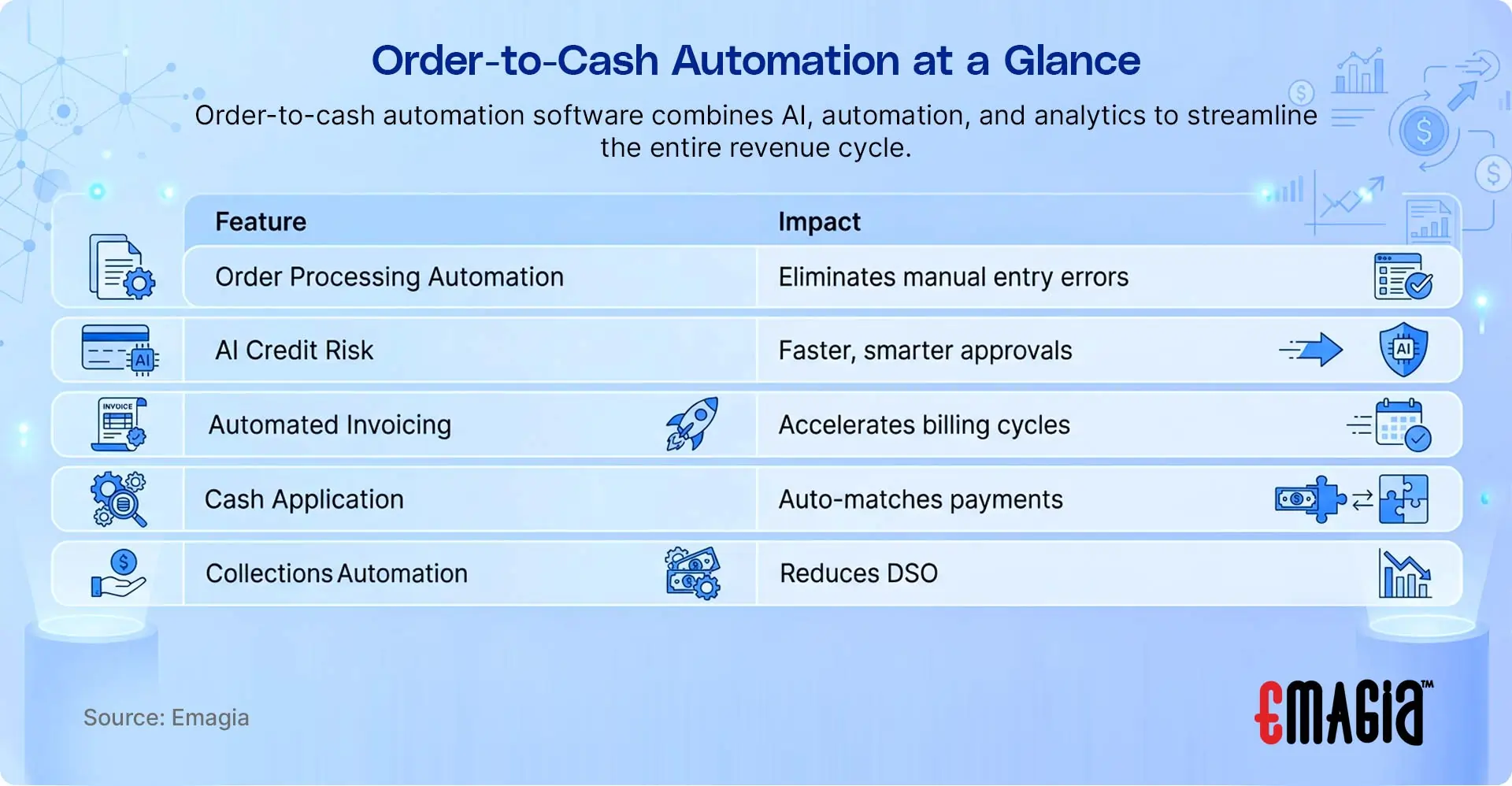
Order-to-Cash Automation at a Glance
Order-to-cash automation software combines AI, automation, and analytics to streamline the entire revenue cycle.
| Feature | Impact |
|---|---|
| Order Processing Automation | Eliminates manual entry errors |
| AI Credit Risk | Faster, smarter approvals |
| Automated Invoicing | Accelerates billing cycles |
| Cash Application | Auto-matches payments |
| Collections Automation | Reduces DSO |
Autonomous vs Traditional O2C
| Capability | Traditional O2C | Autonomous O2C |
|---|---|---|
| Execution | Human-driven workflows | AI executes tasks independently |
| Collections | Manual prioritization | Predictive AI actions |
| Cash Application | Rule-based matching | Self-learning AI matching |
| Implementation | 4–6 months | ~30 days |
| Outcome | Efficiency | Full autonomy |
| Decision-Making | Human reviews and approves exceptions | AI agents analyze, decide, and resolve exceptions autonomously |
| Primary Value Driver | Operational efficiency (reduce manual work) | Working capital optimization (unlock liquidity) |
How Order-to-Cash Automation Works
- Autonomous Order Capture: AI validates orders across ERP, CRM, and EDI systems.
- AI Credit Risk Assessment: Real-time scoring and automated approvals.
- Automated Invoice Delivery: Intelligent billing across global channels.
- Agentic Cash Application: AI matches payments with 90%+ accuracy.
- Predictive Collections: AI prioritizes high-risk accounts to accelerate cash flow.
These automated workflows include order validation, credit approvals, invoicing, payment matching, and collections, all managed through AI-driven systems.
These workflows are orchestrated using AI to ensure seamless execution across the entire revenue cycle.
These processes are typically managed through an integrated order to cash system that connects finance, operations, and customer data.
Order-to-cash automation works by using AI to automate order processing, invoicing, payment matching, and collections in a unified workflow.
Looking to automate these workflows? Explore AI-powered order-to-cash automation software designed for enterprise finance teams.
This end-to-end automation ensures seamless coordination between finance, operations, and customer-facing teams.
What Are the Steps in the Order-to-Cash Process?
- Order capture and validation
- Credit assessment and approval
- Invoice generation and delivery
- Payment processing and cash application
- Collections and dispute management

Many organizations struggle with manual invoicing, delayed payments, and limited visibility into receivables, which directly impacts cash flow and operational efficiency.
Why Traditional O2C Automation Is No Longer Enough
Most order-to-cash platforms still rely on rule-based automation, which cannot adapt to changing customer behavior, payment patterns, and global financial risks. Modern enterprises require AI-driven, autonomous finance systems that continuously learn, predict, and act in real time.
Leading enterprises are rapidly adopting AI-driven O2C automation to improve working capital efficiency and financial resilience in volatile markets.
AI-native platforms can go live in as little as 30 days using API-first architecture and pre-trained models.
Order-to-Cash Automation Maturity Model
This maturity model helps organizations assess their current level of automation and define a roadmap toward fully autonomous finance operations.
Organizations progress from manual processes to fully autonomous finance operations as they adopt AI-driven O2C automation.
| Level | Description |
|---|---|
| Level 1: Manual | Spreadsheet-based processes with high manual effort and errors |
| Level 2: Automated | Rule-based workflows and partial automation of AR processes |
| Level 3: Autonomous | AI-driven decision-making, predictive analytics, and self-optimizing workflows |
AI-Driven Order-to-Cash Automation
AI-driven order-to-cash automation uses machine learning and predictive analytics to optimize workflows, forecast payment behavior, and automate decision-making across the revenue cycle.
Modern platforms leverage Generative AI alongside Agentic AI to automate communications, predict outcomes, and continuously optimize receivables workflows.
Modern platforms are evolving into Autonomous Finance systems powered by Agentic AI, enabling continuous DSO reduction and real-time decision-making across the revenue cycle.
- Predict late payments before they occur
- Automatically prioritize collections
- Continuously learn from customer payment behavior
- Enable autonomous finance operations
AI Agents in Order-to-Cash Automation
- Credit Risk AI Agent
- Cash Application AI Agent
- Collections AI Agent
- Dispute Resolution AI Agent
What Are the Benefits of Order-to-Cash Automation?
Order-to-cash automation helps businesses accelerate cash flow, accelerate cash conversion cycles, improve accuracy, and automate receivables processes using AI.
AI-driven O2C platforms accelerate cash conversion cycles by predicting payment behavior and autonomously prioritizing collections—eliminating manual follow-ups.
Benefits of Order to Cash Automation Software
Order-to-cash automation improves efficiency, accuracy, and cash flow by automating accounts receivable processes and using AI-driven insights.
AI-driven O2C automation enables real-time decision-making, predictive collections, and faster payment processing across the revenue cycle.
Improve liquidity position using intelligent collections automation and enhance accuracy with AI-powered cash application.
Leading enterprises are leveraging AI-driven order to cash automation to accelerate cash conversion cycles, improve liquidity position, and gain real-time financial visibility.
Operational Efficiency
Reduce manual accounts receivable workload by up to 70% and accelerate order processing cycles by 30–50% using AI-driven automation.
Improved Cash Flow
Reduce Days Sales Outstanding (DSO) by 15–30% through predictive collections and automated invoicing workflows.
This accelerates revenue realization and strengthens working capital performance.
Enhanced Accuracy
Achieve over 95% cash application accuracy using machine learning-based payment matching and exception handling.
CFO Impact: A 5-day reduction in DSO can unlock millions in working capital, improving liquidity, reducing borrowing costs, and enabling reinvestment into growth initiatives such as R&D and expansion.
(Current DSO − Target DSO) × Average Daily Sales
Even a small reduction in DSO can unlock millions in working capital for enterprise finance teams.
This formula shows how even a small reduction in DSO directly translates into millions in freed working capital for enterprise finance teams.
How Modern Enterprises Automate Order-to-Cash
Leading enterprises adopt order to cash automation software to automate receivables, improve liquidity, and gain real-time control over financial operations.
Leading organizations are transforming their finance operations with AI-powered platforms that automate credit, invoicing, collections, and cash application.
Explore how order-to-cash automation software enables end-to-end visibility, predictive insights, and intelligent decision-making across the revenue cycle.
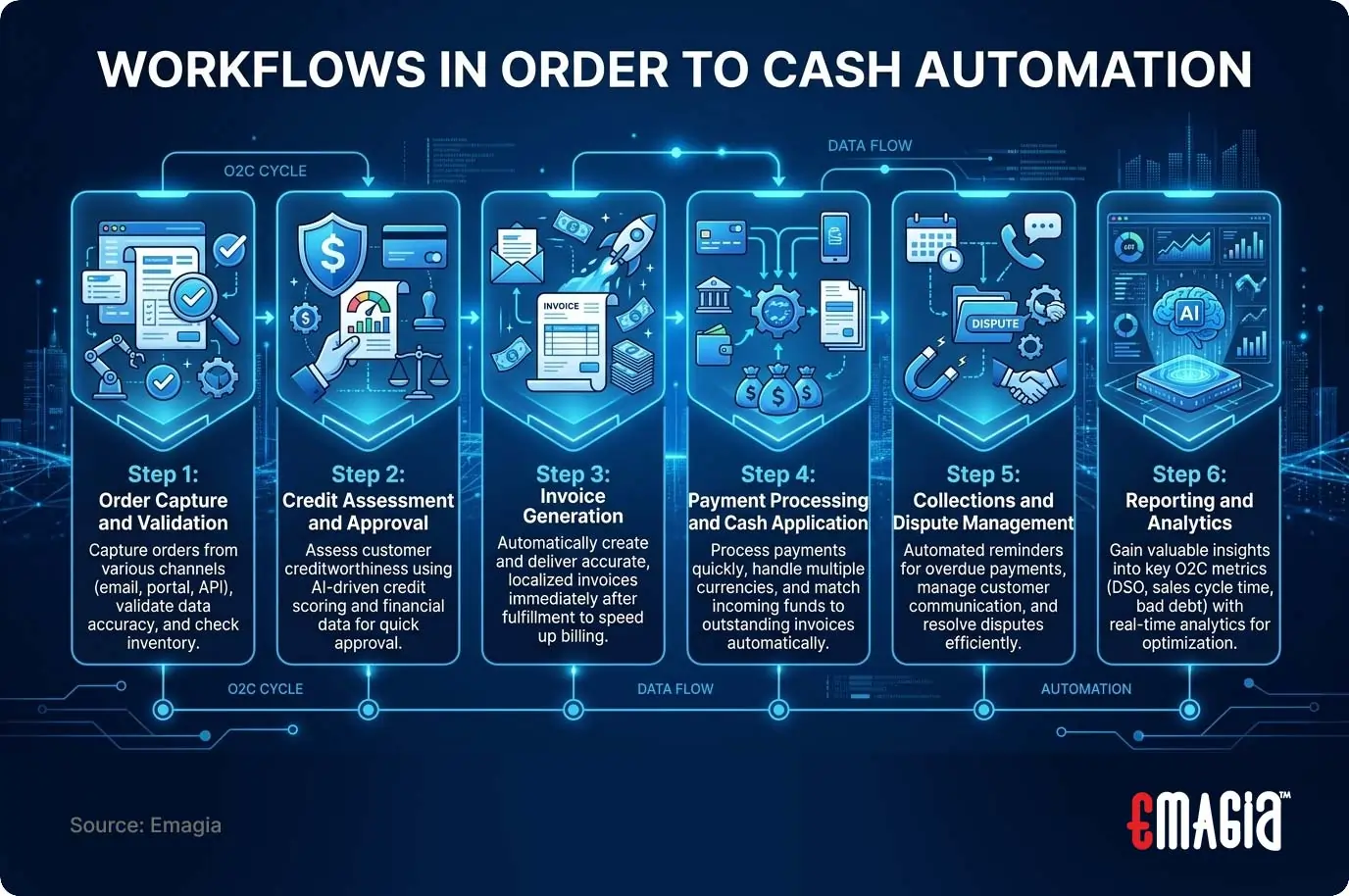
Workflows in Order to Cash Automation
Automating the order to cash cycle involves structured workflows that connect sales, finance, and operations teams. Digital order to cash platforms reduce bottlenecks and enable seamless handoffs between departments.
Autonomous Order Capture and Validation
Orders are received through multiple channels including online portals, EDI, and CRM systems. AI-powered order entry automation software ensures accurate validation of order details, product availability, pricing, and customer data before processing.
Autonomous Credit Assessment and Approval
Automated credit scoring and risk assessment allow organizations to evaluate customer creditworthiness in real time. AI-driven order to cash platforms can dynamically adjust credit limits and terms based on predictive analytics and historical payment behavior.
Automated Invoice Generation and Delivery
Invoices are generated automatically and delivered via email, portal, or EDI. Automation ensures consistency, compliance with tax regulations, and accuracy in billing, reducing disputes and delays.
AI-Driven Payment Processing and Cash Application
Payments are reconciled automatically using AI-powered cash application software to match invoices with remittances. Autonomous finance order to cash features match remittances, identify exceptions, and allocate payments in real time.
Intelligent Collections and Dispute Management
Automated alerts and reminders reduce days sales outstanding (DSO) while intelligent collections automation platform for enterprises provides insights into overdue invoices and customer behavior. Generative AI in order to cash can help draft collection communications and predict potential disputes.
Modern AI-driven collections systems analyze customer intent, communication patterns, and behavioral signals to predict payment likelihood and optimize engagement strategies.
AI-driven collections now use intent recognition to analyze customer emails, payment patterns, and communication tone, enabling faster dispute resolution and more effective collections prioritization.
Real-Time Reporting and Predictive Analytics
Predictive order to cash analytics deliver insights into cash flow, operational efficiency, and customer payment trends. Real-time O2C intelligence supports decision-making, risk management, and strategic planning.
Why Enterprise CFOs Choose Order-to-Cash Automation
- Improve working capital efficiency
- Reduce DSO and accelerate revenue realization
- Gain real-time visibility into receivables
- Scale finance operations without increasing headcount
- Reduce credit risk and bad debt exposure
Challenges in Implementing O2C Automation
Data Quality and Integration
Successful automation relies on clean, consistent data and seamless integration with ERP, CRM, and banking systems.
Change Management
Transitioning to an automated O2C platform requires training and adoption by finance, sales, and operations teams.
Complex Business Rules
Custom workflows, exception handling, and multi-entity operations must be configured accurately to avoid disruptions.
Security and Compliance
Automation solutions must comply with local regulations, tax laws, and data privacy standards to ensure legal and financial integrity.
Reduce DSO and Accelerate Cash Flow with AI
See how enterprise CFOs reduce DSO by up to 30% using AI-driven order-to-cash automation.
Use Cases of Order to Cash Automation
Order-to-cash automation is used across industries to streamline billing, payments, and collections at scale.
Enterprise Finance
Large organizations process high volumes of invoices and payments efficiently, ensuring accuracy and regulatory compliance.
Subscription-Based Business Models
Automated O2C platforms manage recurring billing, automate reminders, and streamline collections for subscription services.
Global Operations
Multinational companies leverage cloud order to cash platforms to manage multi-currency payments, taxation differences, and cross-border compliance.
Customer Service Enhancement
Digital order to cash improves response times for inquiries, disputes, and payment confirmations, increasing satisfaction and retention.
Advanced capabilities such as predictive analytics and automation are enabled through AI in order to cash process, helping organizations improve efficiency and reduce risk.
Market Shift: From Automation to Autonomous Finance
Order-to-cash platforms are rapidly evolving from rule-based automation to autonomous finance systems where AI agents replace manual workflows and enable real-time decision-making.
Top Order-to-Cash Automation Software Solutions for Enterprises
Leading enterprise O2C automation platforms include:
- Emagia – AI-powered autonomous finance platform
- HighRadius – Receivables and treasury automation
- Esker – Invoice-to-cash automation
- Billtrust – AR and payment solutions
How to Choose the Right enterprise O2C automation platform
Choosing the right O2C software requires evaluating AI capabilities, integration, scalability, and end-to-end automation coverage.
- Evaluate AI capabilities for prediction and automation
- Ensure seamless ERP and CRM integration
- Look for real-time analytics and reporting
- Assess scalability for global operations
- Compare automation coverage across the O2C cycle
Top Order-to-Cash Automation Software Comparison
Leading O2C platforms differ based on automation depth, AI capabilities, and enterprise scalability.
The best O2C software for enterprises combines AI-driven automation, predictive analytics, and scalability across global operations.
| Platform | Best For |
|---|---|
| Emagia | AI-driven autonomous finance and end-to-end O2C automation |
| HighRadius | Accounts receivable and treasury automation |
| Esker | Invoice-to-cash process automation |
| Billtrust | AR and B2B payment solutions |
Which Order-to-Cash Automation Software is Best?
The best enterprise O2C automation platform depends on your business needs, but AI-driven platforms like Emagia offer the most advanced capabilities for enterprise-scale automation, predictive analytics, and autonomous finance operations.
Leading solutions such as Emagia, HighRadius, Esker, and Billtrust provide varying levels of automation, but platforms with AI and autonomous capabilities deliver the highest impact on DSO reduction, accuracy, and scalability.
Order-to-Cash Automation: Comparisons and Alternatives
Emagia stands out with autonomous finance capabilities, while others focus primarily on workflow automation.
Manual vs Automated O2C
Manual processes are slower and error-prone, whereas intelligent O2C automation streamlines tasks, improves accuracy, and reduces operational risk.
Cloud Platforms vs On-Premises
Cloud order to cash platforms offer scalability, real-time analytics, and global accessibility, while on-premises systems may provide more localized control.
Best Practices for Implementing Order to Cash Automation
Successful O2C automation requires clean data, system integration, and clearly defined workflows.
- Ensure high-quality, accurate master data
- Map end-to-end workflows clearly
- Integrate O2C software with ERP, CRM, and banking systems
- Define clear roles and approval hierarchies
- Monitor KPIs such as DSO, order cycle time, and cash flow
- Adopt AI and machine learning for predictive insights
Future Trends in Order to Cash Automation
Order-to-cash automation is evolving with AI, real-time analytics, and autonomous finance capabilities.
AI-Driven and Generative AI O2C
Generative AI in order to cash will create dynamic workflows, automate communications, and predict outcomes with higher accuracy.
Real-Time Cash Flow Intelligence
Real-time O2C intelligence platforms provide immediate visibility into payments, invoices, and collections performance.
Autonomous and Intelligent Finance
AI-based order to cash software will increasingly enable autonomous operations, requiring minimal human intervention for routine tasks.
How Emagia Helps with End-to-End Order to Cash Automation Software
Emagia delivers enterprise-grade order to cash automation software designed to enable autonomous finance operations at scale.
Emagia powers AI-driven order-to-cash automation for global enterprises, enabling autonomous finance operations at scale.
Explore Emagia’s order-to-cash automation software solution designed for global enterprises to automate receivables and improve financial performance.
You can also explore the complete Emagia autonomous finance platform to see how AI, analytics, and automation work together.
Emagia provides a comprehensive end-to-end financial process automation software solution that streamlines every step of the O2C process. From order entry and validation to invoicing, payment reconciliation, collections, and reporting, Emagia enables intelligent automation across the full order to cash cycle.
The platform integrates AI-powered order to cash capabilities such as predictive order to cash analytics, machine learning for cash application, and autonomous finance workflows. This allows enterprises to automatically detect payment anomalies, prioritize collections, and optimize cash flow without manual intervention.
Key capabilities of Emagia’s O2C automation platform include:
- Order Validation and Credit Checks: Automates verification of customer orders and evaluates credit risk in real time.
- Automated Invoicing and Billing: Generates invoices automatically, ensuring accuracy and compliance with tax regulations.
- AI-Driven Cash Application: Matches payments to invoices using intelligent algorithms to reduce manual reconciliation.
- Collections and Dispute Management: Uses AI and predictive analytics to identify overdue accounts, prioritize collections, and manage disputes efficiently.
- Real-Time Analytics and Reporting: Provides actionable insights into cash flow, DSO, and order cycle efficiency with dashboards and predictive forecasting.
- Scalable Cloud Platform: Supports multi-currency, multi-entity, and global operations with cloud flexibility and secure integration with ERP systems.
By leveraging Emagia, organizations can achieve fully autonomous order to cash processes, improving operational efficiency, reducing DSO, minimizing errors, and gaining strategic insights into financial performance. The platform transforms traditional O2C cycles into a seamless, AI-driven workflow, enabling intelligent AI-driven receivables automation and real-time O2C intelligence for enterprise-scale operations.
Why It Matters Now
In today’s high-interest-rate environment, reducing DSO is one of the fastest ways to improve liquidity. Autonomous O2C platforms give CFOs a direct lever to unlock trapped cash and strengthen financial resilience.
Ready to Transform Your Order-to-Cash Process?
Trusted by global enterprises to automate billions in receivables and improve working capital performance.
- Reduce DSO by up to 30%
- Automate 90% of cash application
- Gain real-time cash visibility
Most enterprises unlock measurable working capital improvements within the first 30 days of deployment.
Ready to transform your order-to-cash process? Discover how AI-powered automation can reduce DSO, improve accuracy, and accelerate cash flow across your enterprise.
In summary, order-to-cash automation helps enterprises accelerate cash flow, reduce operational costs, improve accuracy, and scale finance operations efficiently using AI.
For enterprises looking to modernize finance operations, AI-driven order-to-cash automation is no longer optional—it is essential for scalability and competitive advantage.
Frequently Asked Questions
What is order to cash automation software?
Order-to-cash automation software is an AI-driven platform that automates the entire revenue cycle from order entry to payment collection.
It improves working capital, reduces manual effort, and provides real-time financial visibility.
How does end-to-end order to cash automation work?
End-to-end O2C automation uses AI to manage order validation, credit approvals, invoicing, cash application, and collections in a unified workflow.
This ensures faster processing, higher accuracy, and improved cash flow.
What are the benefits of O2C automation?
O2C automation reduces manual workload by up to 70%, improves accuracy above 90%, and reduces DSO by 15–30%.
It also enhances cash flow visibility and operational efficiency.
How long does O2C automation implementation take?
Traditional O2C solutions take 4–6 months, while AI-native platforms can be deployed in about 30 days.
Deployment speed depends on integration complexity and data readiness.
How does AI reduce DSO?
AI reduces DSO by predicting late payments and automatically prioritizing collections.
It also identifies risk patterns and triggers proactive engagement before invoices become overdue.
What ROI can enterprises expect from O2C automation?
Enterprises typically achieve 15–30% reduction in DSO and significant improvements in working capital.
Automation also reduces operational costs and improves efficiency.
What KPIs improve with order-to-cash automation?
Key KPIs include DSO, cash flow, invoice cycle time, collection effectiveness index (CEI), and cash application accuracy.
These metrics directly impact liquidity and financial performance.
What is autonomous order-to-cash?
Autonomous order-to-cash uses AI agents to execute workflows and make decisions without human intervention.
This enables real-time, self-optimizing finance operations.
What is the best order-to-cash automation software for enterprises?
The best O2C software combines AI-driven automation, predictive analytics, and enterprise scalability.
Platforms like Emagia provide advanced autonomous finance capabilities.
How much can O2C automation optimize working capital?
O2C automation can improve working capital efficiency by 15–30% through faster collections and reduced DSO.
This helps enterprises unlock liquidity and strengthen financial control.