For CFOs, better cash flow is not simply about collecting past-due invoices anymore. It’s about knowing when cash will come in, where the bottlenecks are, and how quickly finance teams can act with limited information. Despite this, many organizations are still struggling with data silos, manual reconciliation, inconsistent follow-up, and limited visibility into customer payment behavior.
AI is beginning to change that.
In a recent episode of the Emagia AI for Finance podcast, Host Brian Shappell spoke with Yaser Ali, CFO at Phoenix Power Supply, about how AI is transforming collections, working capital management, and the role of the modern CFO.
From Reactive Collections to Intelligent AR
Collections often slow down for reasons that have little to do with the collector. Poor customer data, invoice mismatches, GL discrepancies, and manual processes can delay the AR cycle at every stage. However, AI eliminates these bottlenecks by automating repetitive work and identifying patterns across large volumes of financial data.
For example, AI can match payments and invoices automatically, identify customer payment patterns, prioritize accounts that require attention, automate routine collection follow-ups, and highlight exceptions for human review
The result is a shift from reactive collections to more proactive, data-driven AR management.
Cash Flow Is About Timing, Not Just Collection
The conversation also highlighted a broader CFO challenge: managing the timing of cash inflows and outflows. If a company expects a major customer payment on day 15 but faces significant vendor obligations earlier in the month, it unnecessarily strains its own working capital to bridge the gap—effectively self-funding third-party operations.
By leveraging predictive AI tools, CFOs gain clear visibility into historical payment patterns and exact settlement dates rather than relying on static payment terms. This data-driven clarity enables finance leaders to renegotiate vendor schedules (for example, shifting terms from 30 to 45 days) to directly mirror incoming revenue streams, optimizing net cash positions without taking on incremental debt.
In other words, AI helps finance leaders move beyond the question:
“How do we collect faster?” to “How do we better synchronize the entire cash cycle?”
Understand the Process Before Automating It
AI adoption does not begin with technology. It begins with understanding the process at its core and deciding which part of the process needs to be subjected to AI agents under human supervision.
As Yaser Ali noted
“If you don’t understand the process, you’re not going to be able to refine it to your liking and what the company needs.”
For finance leaders, that means identifying where manual work happens, where exceptions occur, what data is missing, and which decisions require human judgment before introducing automation.
Clear KPIs and reliable financial data are equally important for gathering financial visibility. Without them, organizations may automate activities without tracking how cash flow or productivity is improving.
The CFO Role Is Becoming More Predictive
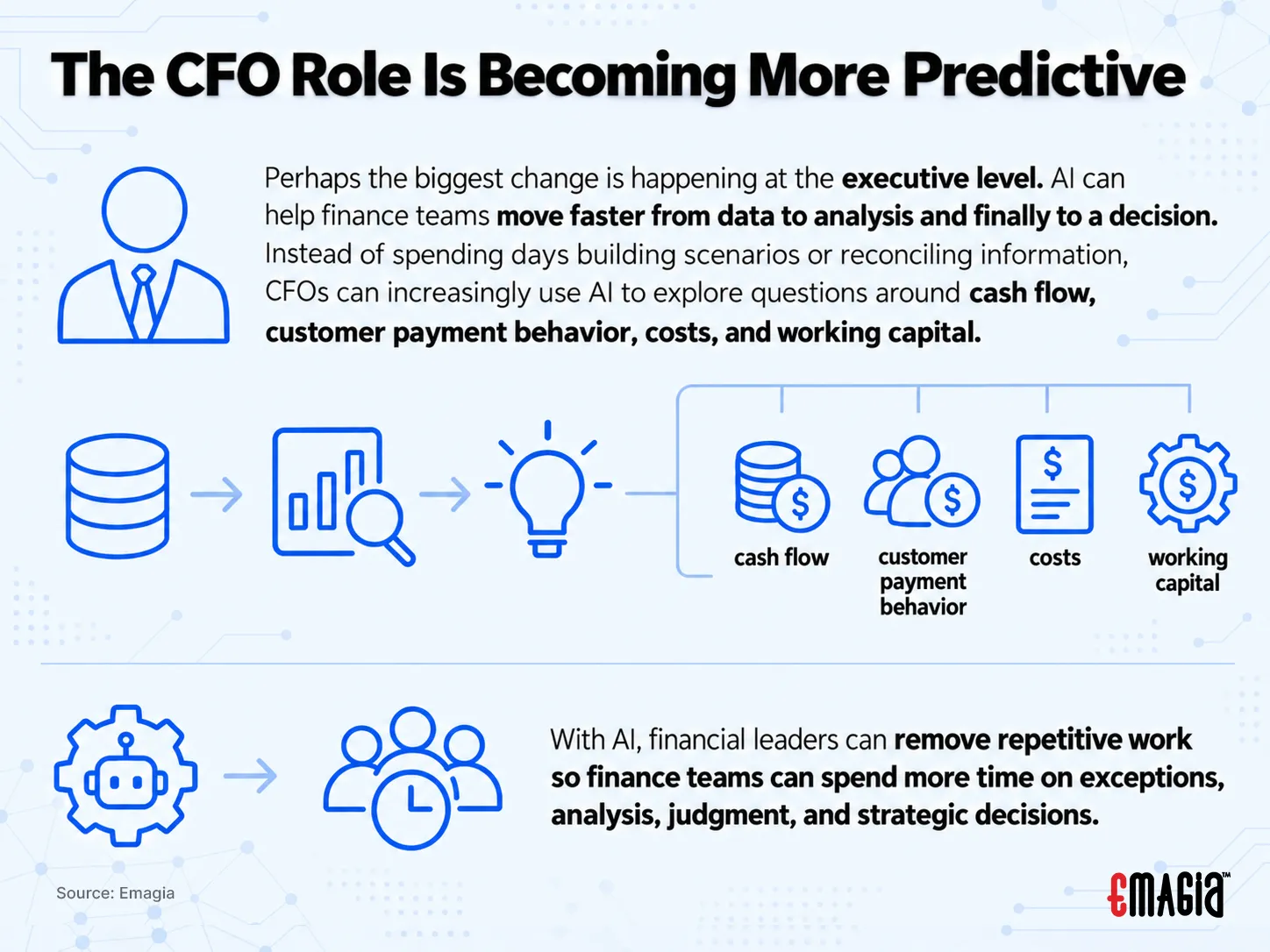
Perhaps the biggest change is happening at the executive level. AI can help finance teams move faster from data to analysis and finally to a decision. Instead of spending days building scenarios or reconciling information, CFOs can increasingly use AI to explore questions around cash flow, customer payment behavior, costs, and working capital.
With AI, financial leaders can remove repetitive work so finance teams can spend more time on exceptions, analysis, judgment, and strategic decisions.
The Bottom Line
Modernizing O2C is not about replacing human strategy with automation—it’s about supercharging it. By pairing predictive AI with clear operational processes, CFOs gain the real-time cash visibility needed to eliminate bottlenecks, optimize working capital, and lead with confidence in an unpredictable market.
The combination of AI, predictive insights, automation, and human oversight can help organizations build more proactive collections operations and give CFOs the information they need to act faster.
The real opportunity is not simply automating finance processes. It is creating a finance function that can anticipate what happens next and act on it.
Emagia AI for Finance Podcast for more insights on AI, autonomous finance, O2C, and the evolving role of the CFO.