Walmart separates supplier short payments into three distinct categories: claims, deductions, and chargebacks. Each is generated by a different part of Walmart’s operation, requires different documentation, and runs on its own timeline. Knowing that structure is the difference between disputing effectively and writing off revenue that was actually recoverable.
| Category | Originates from | Common examples |
|---|---|---|
| Claims | Invoice matching process | Pricing mismatches, shortages, missing allowances |
| Deductions | Pre-negotiated agreements | Co-op arrangements, defective merchandise allowances, post-payment audits |
| Chargebacks | Supply chain compliance failures | Timing and completeness programs (OTIF), quality compliance (SQEP) |
For a CPG supplier doing significant volume with Walmart, deductions aren’t one category of problem. They’re three. Treating them as a single undifferentiated pile makes recovery harder than it needs to be.
Claims, Deductions, and Chargebacks Are Not the Same Thing
It’s common for suppliers to lump every short payment into one mental bucket labeled “deductions.” In practice, Walmart’s system separates these adjustments by where they originate:
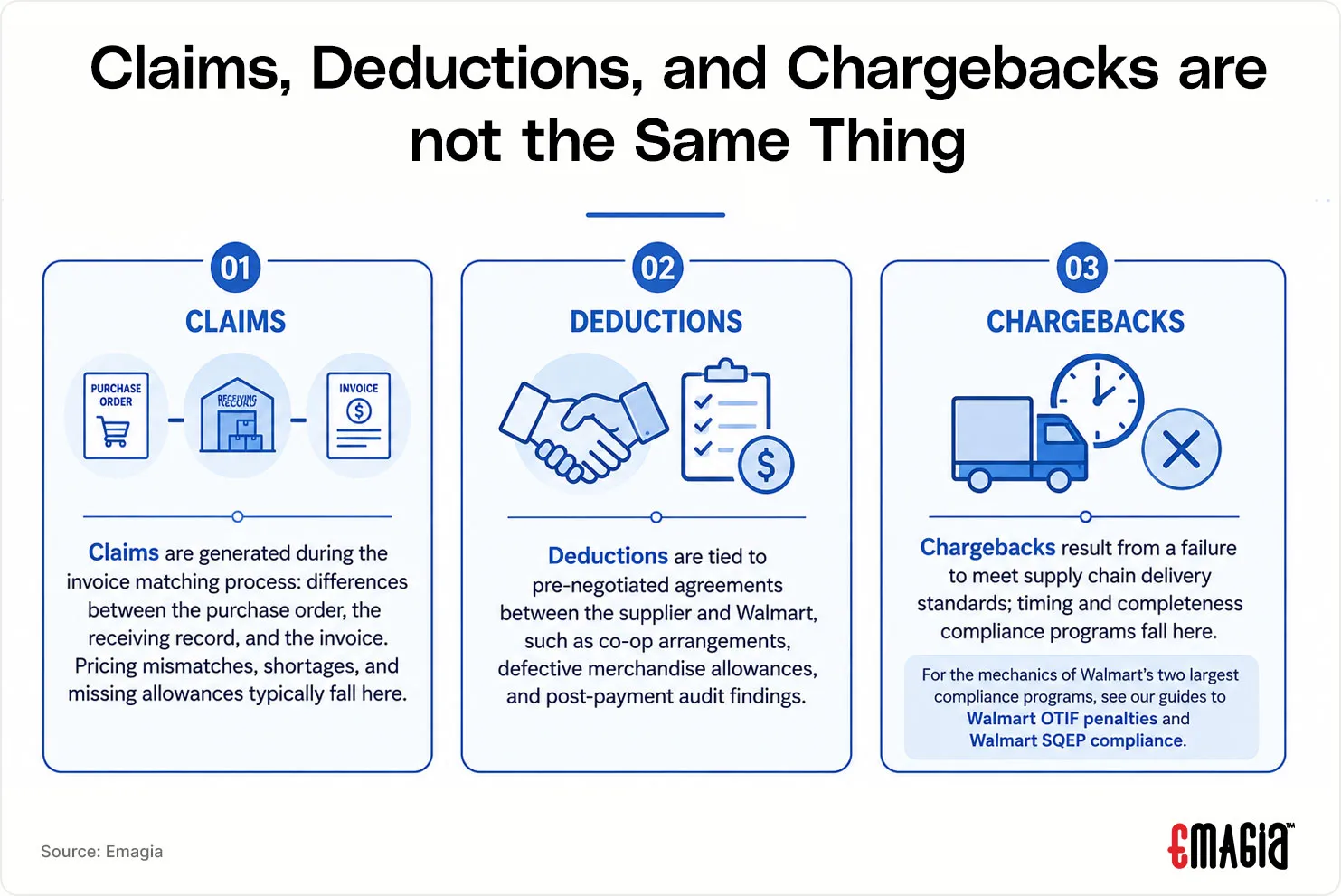
- Claims are generated during the invoice matching process: differences between the purchase order, the receiving record, and the invoice. Pricing mismatches, shortages, and missing allowances typically fall here.
- Deductions are tied to pre-negotiated agreements between the supplier and Walmart, such as co-op arrangements, defective merchandise allowances, and post-payment audit findings.
- Chargebacks result from a failure to meet supply chain delivery standards; timing and completeness compliance programs fall here. For the mechanics of Walmart’s two largest compliance programs, see our guides to Walmart OTIF penalties and Walmart SQEP compliance.
Each category is generally reviewed and disputed through different tools and processes, which is exactly why treating all three the same way makes recovery harder than it needs to be.
Why Claim Codes Matter
A Walmart claim code identifies both the likely cause of a discrepancy and the specific documentation required to dispute it. Sorting deductions by code, not just by dollar amount, is the first real step in an effective dispute process.
When an invoice claim is filed, it’s tagged with a reason code identifying why the payment was reduced. That code determines two things immediately: what likely caused the discrepancy, and what documentation is required to dispute it. A small number of claim types account for most of what’s filed:
- Pricing differences: invoiced cost doesn’t match the purchase order or item file, often from a timing gap between an agreed price change and its reflection in the system suppliers ship against.
- Quantity mismatches: invoiced quantity doesn’t match what was shipped or received, whether from a pack size discrepancy, a substitution, or a shortage. See our guide to Walmart shortage deductions for that category specifically.
- Missing allowances: an allowance agreed to in the supplier agreement or purchase order (freight, promotional, volume, warehouse) wasn’t reflected on the invoice as submitted.
- Duplicate billing: more than one invoice submitted against the same purchase order.
Each has a different root cause and a different fix. A pricing claim usually traces to a timing gap; a quantity claim usually traces to a mismatch between what’s physically shipped and what’s invoiced. Treating every claim identically, as a generic short payment to write off or dispute the same way, misses the pattern that would actually prevent the next one.
Want to know which claim codes are actually driving your write-offs? A discovery call can walk through your claim history by code, not just by dollar total.
What Makes a Walmart Dispute Successful?
A successful dispute requires precise identification of the claim, documentation matched to the disputed amount exactly, and submission within the required timeframe. Precision matters more than persuasiveness, since Walmart’s dispute systems are largely rules-based.
Regardless of category, successful disputes share a common structure: clear identification of the specific claim, documentation that directly supports the disputed amount, and submission within the retailer’s required window.
What separates a successful dispute from a denied one is usually precision, not persuasiveness. A dispute amount that doesn’t match the backup documentation exactly, or documentation in the wrong format for that claim type, gets rejected regardless of whether the underlying claim was actually invalid. This is a data-matching problem as much as an advocacy one.
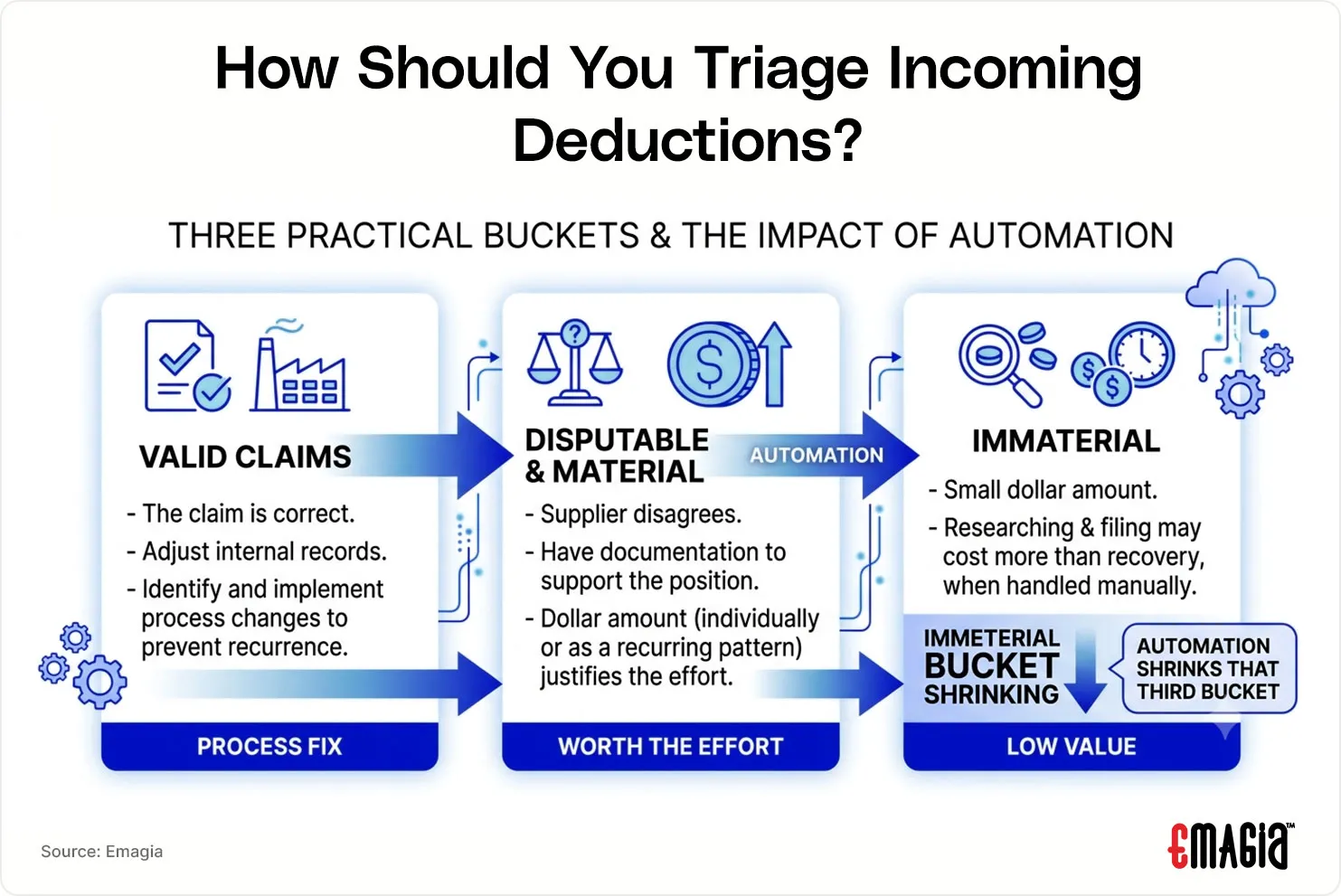
How Should You Triage Incoming Deductions?
Deductions fall into three practical buckets: valid claims that need a process fix, disputable claims worth the effort, and immaterial claims where manual research costs more than the recovery. Automation is what shrinks that third bucket.
- Valid: the claim is correct. The right move is adjusting internal records and identifying the process change that prevents it from recurring.
- Disputable and material: the supplier disagrees, has documentation to support that, and the dollar amount (individually or as a recurring pattern) justifies the effort.
- Immaterial: the amount is small enough that researching and filing may cost more than the recovery, at least when handled manually.
That third bucket is where automated deduction management changes the calculus most. When the cost of researching and disputing a claim drops, previously “immaterial” deductions become worth contesting, and at high volume, that’s often where a meaningful share of unrecovered revenue has been sitting.
Why Do So Many Valid Deductions Never Get Disputed?
A significant share of retail deductions across major retailers are never formally disputed, not because they’re invalid, but because manually researching, documenting, and filing within a tight window exceeds what most AR teams can sustain at volume. Dispute rates end up correlating more with process capacity than with claim validity.
This is the core inefficiency automated deduction management is built to solve. Not making any single dispute more persuasive, but making it economically feasible to dispute far more of them, including the smaller, high-volume claims written off by default under manual processes. For a full breakdown of every Walmart deduction code and required documentation, see our Walmart Deduction Codes reference guide.
How Emagia’s Gia Deductions Agent Unifies Claims, Deductions, and Chargebacks
Most of the difficulty in managing all three categories together isn’t any single one of them. It’s that each has its own tools, documentation rules, and timeline, so a team ends up running three disconnected processes instead of one. The fastest way to reduce total deduction volume is fixing the upstream cause, not contesting each downstream symptom separately, which is the principle Emagia’s Gia Deductions Agent is built around.
When a deduction lands, GiaDocs AI identifies which of the three categories it falls into, classifies it by the specific claim or reason code, and extracts the supporting documentation, including remittances, purchase orders, and shipment records, that category requires. Each claim is then matched automatically to its source invoice and documentation, and a dispute case is generated formatted to that claim type’s specific requirements: a pricing claim needs different backup than an OTIF chargeback, and the routing happens without a person sorting it manually.
Because the same operational failure often shows up as a claim, a deduction, and a chargeback depending on which Walmart system logs it first, deduction analytics surface root-cause patterns across claim code, program, and business unit, giving finance and operations one view of what’s recurring, instead of three separate reports that never get compared. Gia AI Assistants let AR teams check case status, aging, and recovery performance conversationally across the full portfolio, without stitching together data from three different tracking systems.
The outcome to expect isn’t just “more disputes filed.” It’s a measurably higher recovery rate, because deductions that used to be written off as immaterial become cheap enough to research and contest.
Frequently Asked Questions
What’s the difference between a Walmart claim, deduction, and chargeback?
Claims arise from invoice-matching mismatches. Deductions stem from pre-negotiated agreements like co-op or defective merchandise allowances. Chargebacks result from missed supply chain compliance standards.
Why does the claim code matter when disputing a deduction?
It identifies both the likely root cause and the specific documentation required. Using the wrong documentation type is a common reason valid disputes get denied.
Is it worth disputing small, low-dollar deductions?
Individually, often not, given the manual labor cost. At volume, they compound, and automation changes that math by cutting the labor cost per claim.
Why do so many valid deductions go undisputed?
Mostly process capacity, not validity. Manually filing within tight deadlines across high claim volume exceeds what most AR teams can sustain.
What is Emagia’s Gia Deductions Agent?
Emagia’s AI agent for Walmart deduction and dispute management. It classifies incoming deductions by claim code, matches each to its documentation automatically, generates dispute cases formatted to Walmart’s requirements, and surfaces root-cause patterns for upstream fixes.
Turn Deduction Complexity Into a Manageable, Measurable Process
Claims, deductions, and chargebacks each follow different rules, but they don’t have to be managed as three disconnected processes.
Book a 30-minute discovery call with Emagia. We’ll show you how your claims, deductions, and chargebacks break down by category and where the recoverable revenue is actually sitting.
Schedule Your Discovery Call →