Walmart’s Supplier Quality Excellence Program (SQEP) evaluates every inbound shipment at the point of receipt against four categories — Right Item, Right Condition, Right Invoice, and Right Time — and charges a flat administrative fee per purchase order plus a per-case charge for every defect found.
| SQEP category | What it measures | Largest driver |
|---|---|---|
| Right Item | Shipment matches PO and item setup | Quantity errors, wrong pack sizes |
| Right Condition | Freight moves without rework or damage | Packaging and pallet configuration — the single largest fine category |
| Right Invoice | Electronic and physical documents match | ASN issues — missing, late, or mismatched data |
| Right Time | Shipment meets scheduling requirements | Smallest by volume, most expensive per incident |
| Dispute window | — | Roughly one year from the fine date |
Every case shipped into a Walmart distribution center is evaluated the instant it’s received — not just for what’s inside the box, but for how it’s packaged, labeled, and documented. SQEP is one of the most common, and most preventable, sources of deductions for CPG suppliers, and it runs alongside two related programs worth knowing: OTIF, which governs delivery timing and completeness, and the broader claims and chargeback dispute process SQEP fines flow through once they’re issued.
What is SQEP?
SQEP is Walmart’s inbound quality enforcement framework, applied automatically across the full U.S. distribution network — regional DCs, import facilities, grocery DCs, e-commerce fulfillment centers, and direct-store-delivery consolidation points — with no exemption based on supplier size or shipping channel.
Every shipment is evaluated against SQEP standards the moment it’s received, and defects are recorded at the case, pallet, or load level.
Non-compliance carries a real cost: a flat administrative fee per purchase order plus a per-case charge for every non-compliant case. At meaningful shipping volume, even a low single-digit defect rate can translate into tens of thousands of dollars a year — before OTIF or ASN penalties from the same shipment stack on top.
Curious how much of that is currently recoverable? Book a discovery call to see how a SQEP dispute review works before your next fine cycle closes.
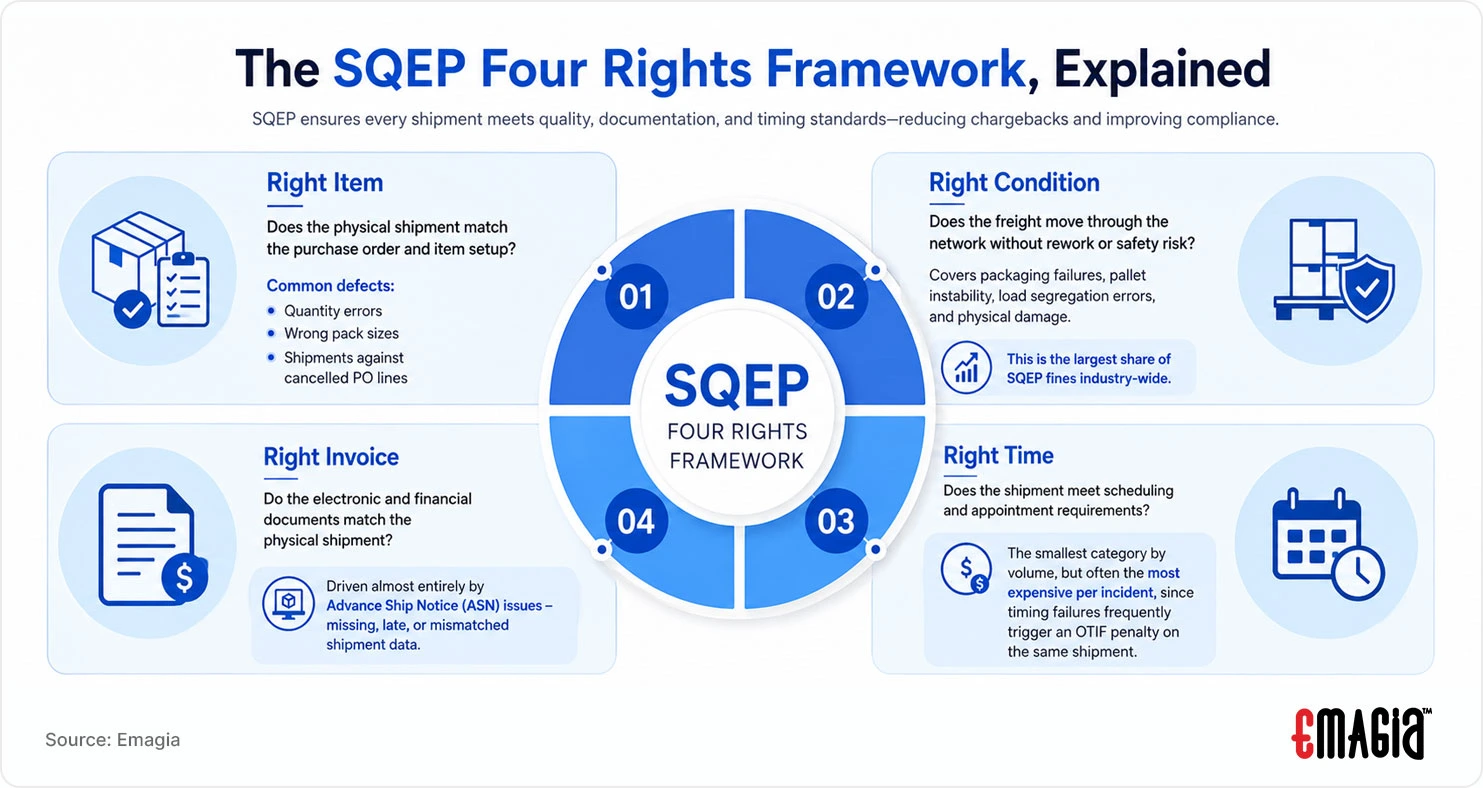
The SQEP Four Rights Framework, Explained
SQEP sorts every possible shipment defect into four categories, and knowing which one a fine falls under is the starting point for both prevention and dispute — the documentation that clears a Right Item dispute won’t clear a Right Invoice one.
- Right Item — Does the physical shipment match the purchase order and item setup? Common defects: quantity errors, wrong pack sizes, shipments against cancelled PO lines.
- Right Condition — Does the freight move through the network without rework or safety risk? Covers packaging failures, pallet instability, load segregation errors, and physical damage. This is the largest share of SQEP fines industry-wide.
- Right Invoice — Do the electronic and financial documents match the physical shipment? Driven almost entirely by Advance Ship Notice (ASN) issues — missing, late, or mismatched shipment data.
- Right Time — Does the shipment meet scheduling and appointment requirements? The smallest category by volume, but often the most expensive per incident, since timing failures frequently trigger an OTIF penalty on the same shipment.
Where do most SQEP Fines Actually Come From?
Packaging compliance drives the largest share of fines. Walmart’s packaging standards specify case dimensions, weight limits, drop-test durability, and corrugated strength, alongside pallet configuration rules covering height, footprint, stretch-wrap tension, and load stacking. A case that’s structurally sound but oversized, or a pallet wrapped without enough tension, can trigger a defect even when the product itself arrives undamaged.
ASN and data accuracy is the second-largest category — shipment notices transmitted late, containing quantities that don’t match the physical shipment, or missing required data elements. Because many suppliers still generate ASNs manually rather than through direct WMS or ERP integration with their EDI provider, this remains one of the most common and most fixable sources of defects.
Barcode and labeling issues are a related, often underestimated category. A barcode that’s unreadable at the scan point, printed on too few case sides, or in the wrong format doesn’t just generate a labeling defect on its own — it forces manual identification at receiving, which frequently cascades into additional rework fines.
How do You Dispute a SQEP Fine?
File through Walmart’s electronic invoice presentment system, referencing a single invoice, with backup documentation matched to the exact dollar amount, generally within one year of the fine date.
Different defect categories need different backup: overage and shortage disputes require dashboard exports tied to the specific PO and line items, while ASN disputes require the actual EDI shipment notice and acknowledgment records with matching timestamps. Filing the wrong documentation type for the dispute category is one of the most common reasons a legitimate dispute gets denied.
A meaningful share of retail deductions across major retailers never get formally disputed — not necessarily because the claims are valid, but because filing correctly, on time, and against the right backup requirements is more than most manually staffed AR teams can sustain at volume.
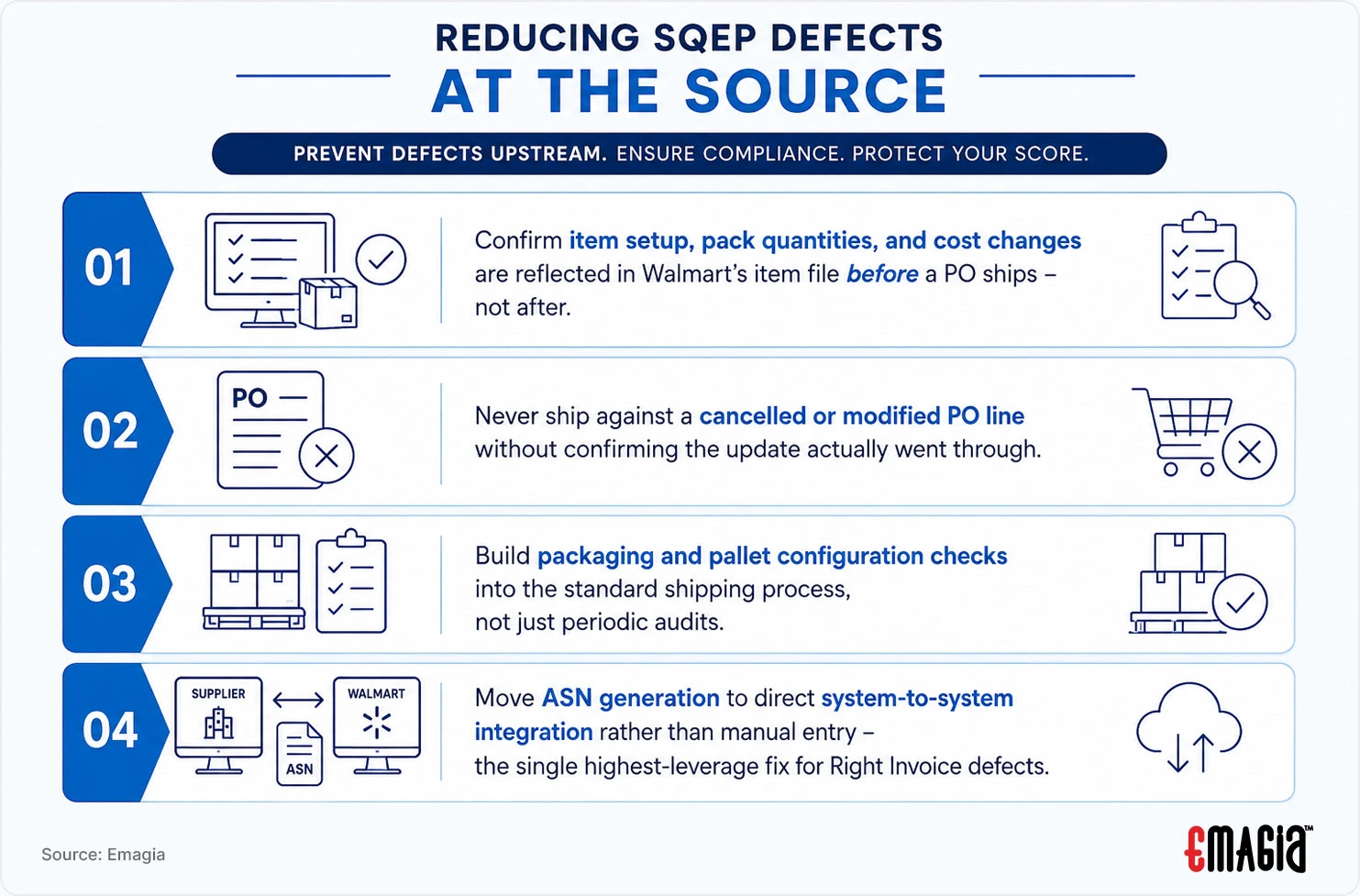
Reducing SQEP Defects at the Source
SQEP evaluates data accuracy before it evaluates physical condition, so prevention starts upstream of the dock:
- Confirm item setup, pack quantities, and cost changes are reflected in Walmart’s item file before a PO ships — not after.
- Never ship against a cancelled or modified PO line without confirming the update actually went through.
- Build packaging and pallet configuration checks into the standard shipping process, not just periodic audits.
- Move ASN generation to direct system-to-system integration rather than manual entry — the single highest-leverage fix for Right Invoice defects.
Why SQEP Disputes are Especially Sensitive to Documentation Precision
SQEP fines are high-volume, tightly formatted, and deadline-driven, and disputes get denied automatically on a dollar mismatch or the wrong document type — which makes precision matter more here than in most other Walmart deduction categories.
Software built for this kind of workflow generally needs to do three things well: read an incoming fine and classify which of the four categories it belongs to, pull the specific backup documentation that category requires, and check the dispute amount against that documentation before submission — since a mismatch caught before filing is recoverable, and one caught after a denial usually isn’t.
That’s the shape of what Emagia’s platform does for SQEP specifically. GiaDocs AI handles classification and document retrieval — reading each fine notice, sorting it into Right Item, Right Condition, Right Invoice, or Right Time, and pulling the matching backup (dashboard exports for overage and shortage disputes, EDI shipment notice and acknowledgment records for ASN disputes) rather than leaving someone to guess the right format. Before anything is submitted, the platform checks that the dispute amount matches the documentation to the cent — the single most common point of failure in SQEP disputes.
On the prevention side, deduction analytics track defects by category and by distribution center or packaging configuration, so operations can see whether a specific pallet-wrap setting or a specific facility is generating a disproportionate share of Right Condition fines. And because deductions are flagged for research the moment a remittance posts, less of SQEP’s roughly one-year window gets lost to manual reconciliation before work even starts.
Frequently Asked Questions
What does SQEP Stand for?
Walmart’s Supplier Quality Excellence Program — it evaluates inbound shipments at receipt across four categories: item accuracy, physical condition, invoice/data match, and delivery timing.
What’s the most Common Cause of SQEP Fines?
Packaging and pallet configuration issues, followed by ASN and shipment-data accuracy issues.
How Long do Suppliers have to Dispute a SQEP Fine?
Generally about one year from the fine date, with dispute amounts required to match backup documentation exactly.
Can Automation Reduce SQEP Fines, not Just Help Dispute Them?
Yes — root-cause analytics that track defects by category and location let operations fix recurring issues (a packaging configuration, a manual ASN process) at the source, cutting future fine volume rather than only contesting existing fines.
Is SQEP the Same as OTIF?
No. SQEP measures quality and condition at receiving. OTIF separately measures delivery timing and order completeness — a single shipment can trigger both.
Turn SQEP Compliance Data Into Recovered Revenue
SQEP fines are among the most preventable, and most under-disputed, categories of Walmart deductions.
Book a 30-minute discovery call with Emagia. We’ll walk through your recent SQEP fine history by category — Right Item, Right Condition, Right Invoice, Right Time — and show you specifically where disputable revenue is likely going unclaimed.
Schedule Your Discovery Call →