What are Walmart OTIF Penalties?
Walmart OTIF penalties are charges applied when supplier shipments fail to meet Walmart’s on-time or in-full requirements. The commonly cited penalty is 3% of the cost of goods associated with non-compliant cases. Current widely cited targets include 90% on-time for prepaid freight, 98% collect-ready, and 95% in-full.
| OTIF requirement | Threshold | Penalty |
|---|---|---|
| On-time (prepaid) | 90% | 3% of COGS on non-compliant cases |
| Collect-ready | 98% | 3% of COGS on non-compliant cases |
| In-full | 95% | 3% of COGS on non-compliant cases |
| Dispute window | — | 30 days from the deduction |
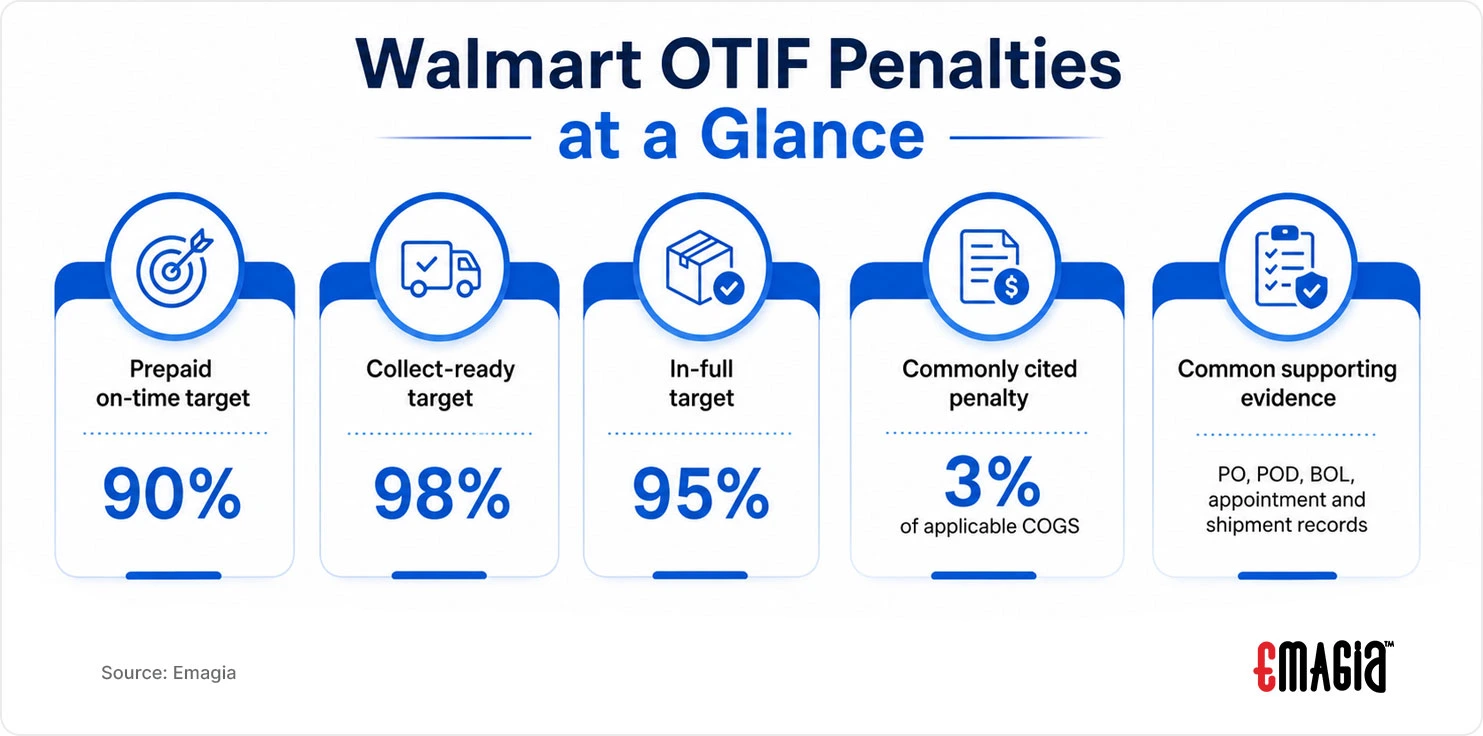
Walmart OTIF Penalties at a Glance
- Prepaid on-time target: 90%
- Collect-ready target: 98%
- In-full target: 95%
- Commonly cited penalty: 3% of applicable COGS
- Common supporting evidence: PO, POD, BOL, appointment and shipment records
Unlike a one-time audit or an occasional fine, OTIF is a continuous scorecard, measured shipment by shipment, that quietly erodes margin every quarter. For a CPG supplier shipping meaningful volume into Walmart, understanding exactly how the program is structured is what separates a fine that’s disputed and recovered from one that’s simply absorbed. Here’s what those thresholds actually cost in dollar terms, and where the exposure adds up fastest.
How much are Walmart OTIF Penalties?
Run the 3% figure against real shipping volume and it stops looking small. A supplier moving tens of millions of dollars a year through Walmart can see OTIF fines alone reach six figures annually from a fairly modest miss rate. And that’s before packaging, labeling, or ASN accuracy fines from the same shipment start stacking on top.
These thresholds are the numbers most consistently cited by supply chain and compliance publications as of 2026, but Walmart revises its routing guide periodically. Suppliers should confirm current figures directly in Retail Link rather than relying on any published guide, including this one.
The 30-day dispute window matters more than it might seem. It’s considerably shorter than the multi-month or multi-year windows Walmart allows for other deduction types, which is a large part of why OTIF disputes are the ones most likely to expire before a manually staffed AR team ever reaches them.
How is a Walmart OTIF Penalty Calculated?
A simple example is to multiply the applicable cost of goods by the applicable penalty percentage.
| Applicable COGS | Example penalty rate | Example charge |
|---|---|---|
| $500,000 | 3% | $15,000 |
For example, $500,000 × 3% = $15,000. Actual Walmart deductions should be validated against the applicable supplier requirements and deduction documentation.
Why do Walmart OTIF Penalties Happen?
An OTIF miss is rarely an isolated event. OTIF sits alongside two other Walmart compliance programs that draw from the same receiving event at the distribution center: the Supplier Quality Excellence Program (SQEP), which governs packaging and labeling, and the broader claims and chargeback dispute process that OTIF penalties themselves flow through. The same shipment that arrives late or short can simultaneously trigger a SQEP quality flag and an ASN accuracy flag. A late Advance Ship Notice, for instance, can cause a shipment to register as late in Walmart’s system even when the physical freight arrived on schedule. The data, not the truck, missed the window.
Beyond the direct fine, repeated OTIF misses affect supplier scorecards more broadly, influencing order allocation and shelf priority over time. And because penalties are typically billed on a delayed cadence relative to when the shipment actually occurred, they create a lag that’s hard to plan around in working capital forecasting.
Common Causes of Walmart OTIF Failures
| OTIF problem | Common cause | Potential corrective action |
|---|---|---|
| Late shipment | Carrier or transit-time delay | Improve transportation planning and visibility |
| Short shipment | Inventory shortage | Improve inventory accuracy and allocation |
| ASN issue | Manual or inaccurate shipment data | Automate ERP/WMS-to-EDI processes |
| Pickup readiness issue | Freight not staged on time | Monitor appointment and staging readiness |
Can Walmart OTIF Penalties be Disputed?
Yes. Disputes generally succeed when a supplier can document that the miss was outside their control, such as a carrier delay or a distribution center receiving error, supported by proof of delivery, a signed bill of lading, and appointment confirmations, filed within the applicable Walmart dispute deadline.
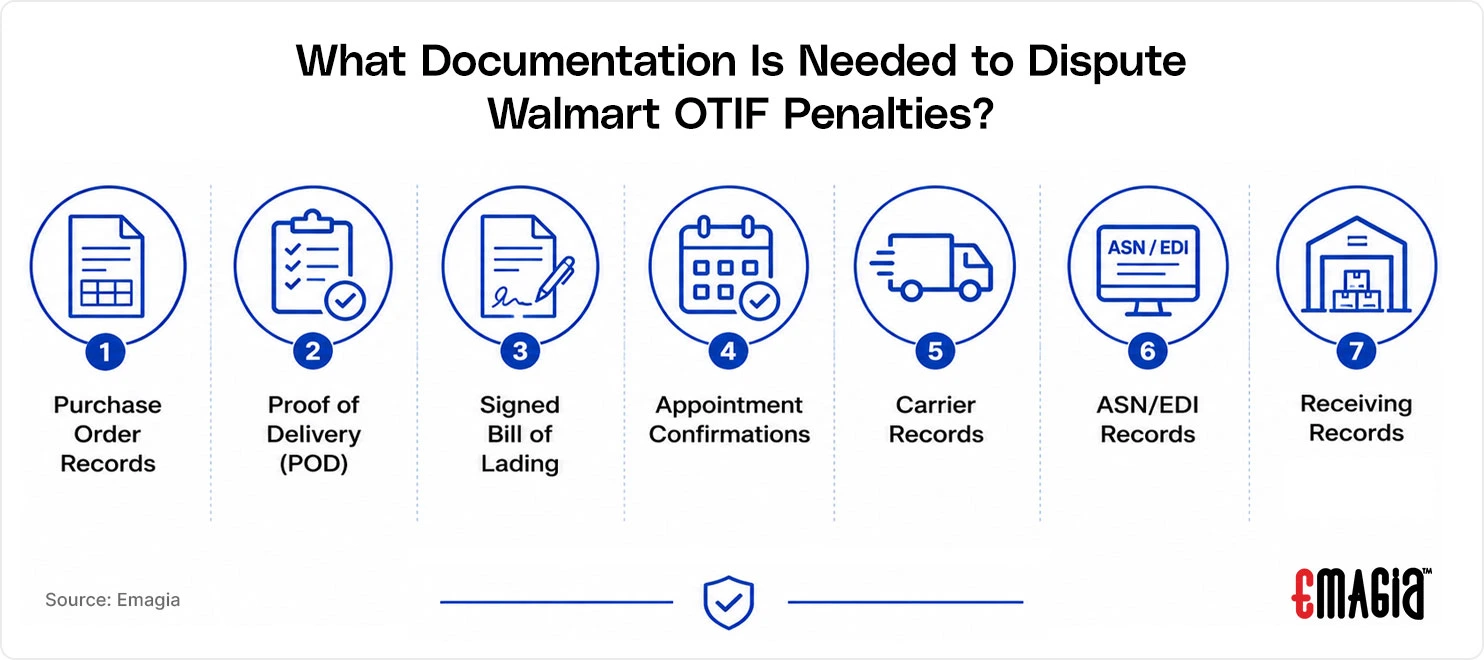
- Purchase order records
- Proof of delivery
- Bill of lading
- Appointment confirmations
- Carrier records
- ASN/EDI records
- Receiving records
The practical obstacle isn’t usually whether the dispute has merit. It’s whether the documentation is assembled in time. Bills of lading live in one system, appointment data in another, purchase order records in a third. Pulling all three together manually, against a 30-day clock, is exactly the kind of cross-system work that causes valid disputes to go unfiled.
- Identify the deduction and affected PO.
- Determine the root cause.
- Collect supporting documentation.
- Validate the claim against shipment records.
- Submit the dispute through the applicable Walmart process.
- Track the outcome and recovery.
How to Reduce Walmart OTIF Penalties
The best way to reduce Walmart OTIF penalties is to prevent late and incomplete shipments before they occur. Suppliers should improve inventory accuracy, transportation planning, pickup readiness, ASN accuracy and continuous OTIF monitoring.
Because an OTIF score is diagnostic as much as it is a penalty, the highest-leverage fix is operational:
- Build in transit-time cushions for distant distribution centers instead of planning to the exact MABD.
- Never confirm a purchase order against inventory that isn’t physically available — this is one of the most common root causes of in-full misses.
- Connect WMS and ERP systems directly to EDI so shipment notices generate automatically instead of manually, cutting the data errors that cascade into on-time failures.
- Review OTIF scorecard data weekly, not quarterly, so a pattern at a specific item, PO, or distribution center is still actionable when you spot it.
How Can Automation Reduce Walmart OTIF Penalties?
Automation can reduce Walmart OTIF penalty exposure by connecting deductions with purchase orders, shipment records, proof of delivery, carrier data and appointment information.
Reconciling OTIF penalties against shipment records by hand works for a handful of purchase orders a week. It doesn’t hold up past that, because every dispute needs the same three things pulled from three different systems, under the same tight deadline.
Software built for this problem typically does three things: matches each penalty automatically against the proof-of-delivery, carrier, and appointment records a dispute needs; aggregates disputed and paid penalties by distribution center, carrier, and item so a repeat pattern surfaces after a handful of occurrences instead of a full quarter; and gives teams a fast way to check dispute status without building a manual report each time.
That’s the specific shape of what Emagia’s platform does for OTIF. GiaDocs AI handles the matching step — pulling proof of delivery, carrier confirmations, and appointment records against each penalty as it posts.
Deduction analytics handle the pattern step, surfacing recurring issues (a specific DC consistently rejecting freight outside a narrow window, for example) early enough to feed back into the operational fixes above, rather than after the pattern has already cost several quarters of fines.
Gia AI Assistants handle the reporting step, letting AR and supply chain teams check status and recovery rates conversationally instead of compiling updates by hand. Together, the goal is straightforward: dispute a higher share of valid penalties inside the 30-day window, and shrink the repeat-failure rate as the pattern data feeds back into prevention.
Understanding How Walmart OTIF is Measured
OTIF (On-Time, In-Full) is a Walmart supplier scorecard metric that separately measures whether a shipment arrived within its required delivery window and whether it contained the full ordered quantity. A shipment must pass both measures independently to count as compliant.
On-Time Performance
Walmart evaluates on-time performance differently depending on who controls the freight:
- Prepaid shipments, where the supplier arranges and pays for transportation, are measured against the Must Arrive By Date (MABD): the delivery window set by the receiving distribution center.
- Collect shipments, where Walmart arranges transportation, are measured on whether the freight was staged and ready at the scheduled pickup appointment, not on when it physically arrives.
Suppliers should confirm which arrangement applies to a given shipment before investigating an on-time exception, since the corrective action differs by type.
In-Full Performance
In-Full is measured separately from timing: the percentage of ordered cases that actually arrive, aggregated at the purchase order and shipment level against the applicable purchase order and shipment records.
How Does Walmart OTIF Work?
Walmart OTIF works by evaluating two core dimensions of supplier performance: whether an order arrives on time and whether the shipment arrives in full. The applicable measurement depends on the freight arrangement and Walmart’s supplier requirements.
On-Time Performance
On-time performance evaluates whether the shipment meets the applicable delivery or pickup requirement.
In-Full Performance
In-full performance evaluates whether the required quantity is received against the applicable purchase order and shipment.
Prepaid vs. Collect-Ready
Prepaid freight and collect freight have different operational responsibilities, so suppliers should evaluate the applicable Walmart requirement before investigating an exception.
Walmart OTIF FAQs
How much does Walmart Charge for OTIF Non-Compliance?
Roughly 3% of the cost of goods on the specific cases that missed the on-time or in-full threshold — not the full shipment or purchase order.
Can Walmart OTIF Penalties be Disputed?
Yes. Walmart OTIF penalties may be disputed when the supplier can provide documentation showing that the miss was outside the supplier’s responsibility or that the underlying data is incorrect. Suppliers should follow the applicable Walmart dispute process and deadline.
What’s the Difference Between OTIF and SQEP?
OTIF measures delivery timing and completeness. SQEP measures quality and condition at receipt. A single shipment can trigger both at once.
How Can Automation Reduce OTIF Penalties?
By matching penalties to shipment documentation automatically, flagging disputable claims before the applicable dispute deadline.
What Deduction Code Covers OTIF Failures?
OTIF failures use their own dedicated code, separate from standard AP deduction codes — see the Walmart Deduction Codes reference guide for the full list.
What are Walmart OTIF Requirements?
Current widely cited targets include 90% on-time for prepaid shipments, 98% collect-ready, and 95% in-full. Suppliers should verify the requirements currently applicable to their business in Retail Link.
How is Walmart OTIF Calculated?
Walmart OTIF evaluates shipment timing and completeness separately. A shipment must meet the applicable on-time and in-full requirements to achieve compliant performance.
What Documents are Needed to Dispute a Walmart OTIF Penalty?
Common supporting documents include purchase order records, proof of delivery, bills of lading, appointment confirmations, carrier records, ASN/EDI records and receiving documentation.
Key Takeaways: Walmart OTIF Penalties
- OTIF measures both timing and completeness. Suppliers need to meet the applicable on-time and in-full requirements to maintain compliant performance.
- OTIF penalties can directly impact supplier margins. A commonly cited penalty is 3% of applicable COGS on non-compliant cases.
- Late and incomplete shipments are only part of the problem. Inventory shortages, transportation delays, pickup readiness, ASN/EDI errors and receiving issues can all contribute to OTIF failures.
- Documentation is critical when disputing a deduction. Purchase orders, proof of delivery, bills of lading, appointment confirmations, carrier records and ASN/EDI data can help support a dispute.
- Prevention is more valuable than recovery alone. Monitoring OTIF performance by item, PO, carrier and distribution center can help identify recurring problems before they create additional deductions.
- Automation can improve both recovery and prevention. Connecting deduction data with shipment and supporting documentation can help teams identify potentially disputable deductions and recurring OTIF issues faster.
See Where Your OTIF Exposure is Coming From
If OTIF penalties show up on your Walmart remittances every quarter with no clear pattern, the fastest way to fix that is seeing your dispute history and recovery rate in one place, rather than piecing it together shipment by shipment.
Book a 30-minute discovery call with Emagia. We’ll walk through your recent OTIF scorecard and dispute history and show you specifically where recoverable revenue is likely sitting unclaimed — no generic pitch, just your numbers.