


Emagia Staff
27th March, 2026

Your ERP isn’t enough. Discover why traditional AR automation fails to capture strategic cash and how to evolve your O2C process for maximum financial impact.
Most global enterprises have already invested in some form of accounts receivable automation. They’ve migrated from spreadsheets to digital workflows, implemented ERP connectivity, and deployed AR management software. Yet CFOs still find themselves asking: “If we’ve automated, why is so much working capital still trapped?” The answer lies in a fundamental industry pitfall: diffused effort without intelligent prioritization.
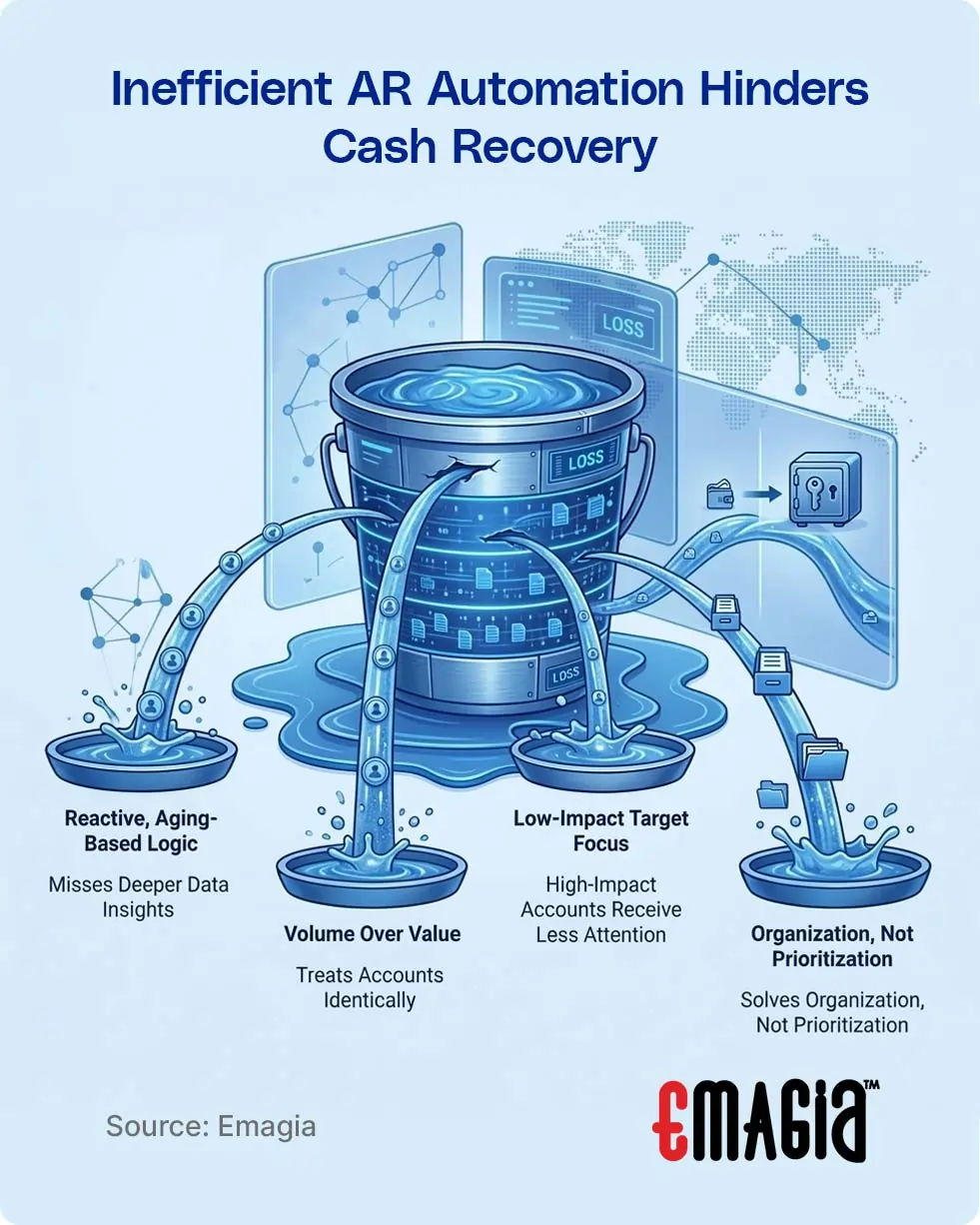
Although AR automation is a top priority for the Office of the CFO, many systems prioritize volume over value, according to research on hyper-automation in finance from the research firm Gartner.. They treat a $500 delinquency with the same urgency as a $500,000 one, creating teams that are “busy” without being productive.
Traditional accounts receivable automation platforms excel at organizing data and triggering alerts, but they lack the AR intelligence required to answer the critical question: “Where is my next million dollars of cash actually coming from?”
Why Traditional AR Automation Focuses on Volume Over Value
Gartner’s research on cash flow management strategies found that organizations without intelligent prioritization waste an estimated 30–40% of collection effort on low-impact targets. Meanwhile, high-impact accounts—the vital few customers driving 80% of your past-due—receive only proportional attention. This is why your collections team can be 95% occupied yet still leave millions in cash on the table. Traditional accounts receivable automation solves the organization problem, not the prioritization problem. It tells you that you have $50 million in past-due. It doesn’t tell you that $35 million of that is concentrated in five accounts that could be recovered within 30 days if your team focused there first.
Addressing the Intelligence Deficit in Legacy Order-to-Cash Systems
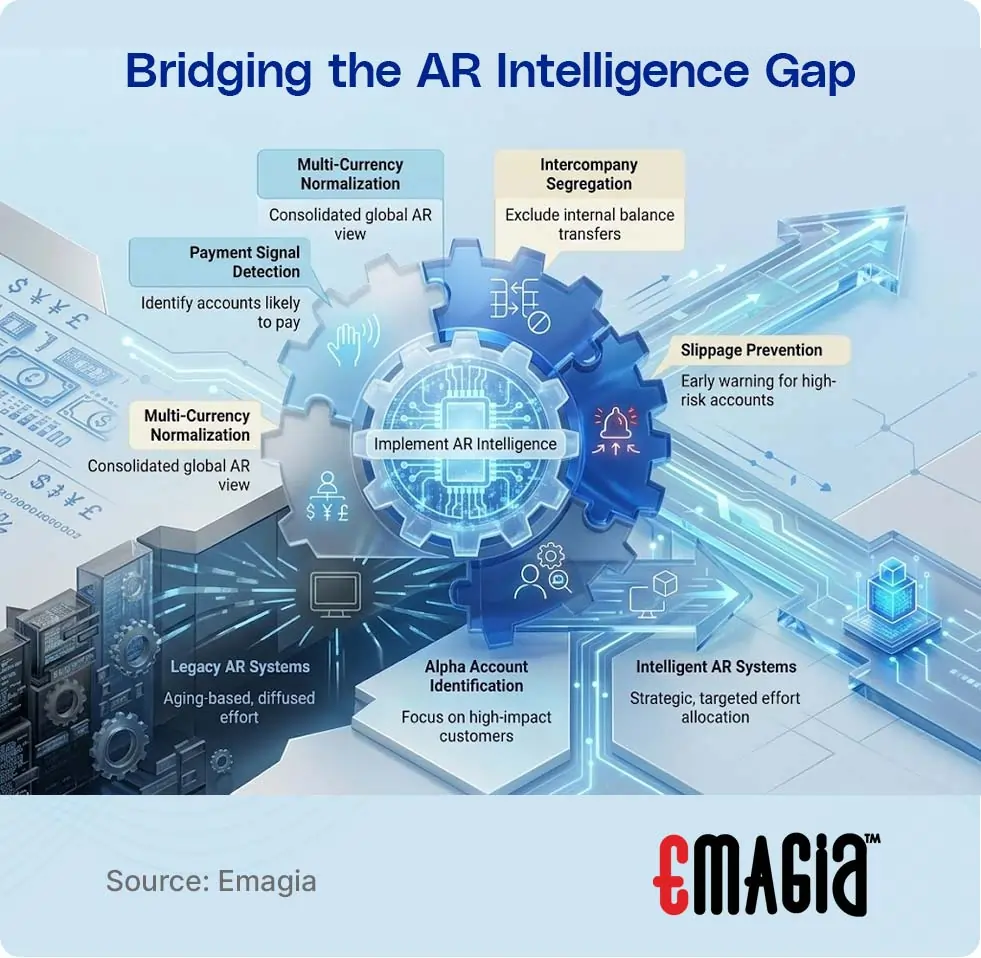
To achieve true cash flow acceleration and working capital optimization at global scale, you need a system that moves beyond aging-based logic. You need AR intelligence—deterministic analysis of your raw data that reveals:
- Alpha Account Identification: The vital few customers whose delinquency drives the largest share of your operational past-due
- Slippage Prevention: Early warning when accounts in the 61–90 day range are at risk of moving into 91-plus day high-risk territory, allowing intervention before collection probability drops
- Intercompany Segregation: Automatic detection and exclusion of internal balance transfers, so your reported past-due reflects only true third-party exposure
- Payment Signal Detection: Emerging signals that indicate which accounts have the highest probability of payment if contacted today
- Multi-Currency Normalization: Consolidated global accounts receivable view across all currencies and entities, with exchange rate fluctuations filtered out so aging reflects true payment date
McKinsey research on working capital optimization for enterprises found that organizations with intelligent AR systems (not just automated AR systems) achieved DSO improvements of 15–25 days within 90 days, driven entirely by better effort allocation. They didn’t hire more collectors. They didn’t change their process. They simply redirected effort to high-impact accounts receivable accounts identified through intelligent analysis.
This is the gap between traditional accounts receivable automation and true autonomous O2C intelligence. One organizes data. The other guides strategy.
Moving From Reactive Alerts to Strategic Cash Discovery
The transition from traditional accounts receivable management to intelligent cash discovery requires a fundamental shift: moving from “alert me when invoices age” to “show me where my cash recovery opportunity actually lies.” This is where agentic AI and deterministic financial intelligence change the game.
Deterministic AR intelligence computes every insight directly from your raw data—your AR ledger, payment histories, CRM notes, dispute records—with zero estimation. The result? A system that identifies your Alpha Accounts in under 60 seconds, delivers a prioritized worklist that your collections team can execute on immediately, and continuously adapts as your portfolio evolves. Organizations using this approach see 30–50% more cash recovered because they’re working on what matters, not what’s oldest.
By providing your collections team with precise, prioritized targets—accounts that represent the highest recovery opportunity—you transform accounts receivable automation from a cost-saving initiative into a cash-generation engine. Your team stops chasing every account equally and starts focusing on the vital few that drive DSO reduction and working capital optimization.
This is autonomous O2C at its core: intelligence that continuously identifies high-impact accounts, execution that focuses team effort on what matters, and results that transform how your organization manages cash.
Why Your Collections Effort Isn’t Translating to Cash Recovery
Traditional accounts receivable automation solved yesterday’s problem—moving off spreadsheets. But modern accounts receivable management requires intelligent prioritization in the form of third-party solutions powered by agentic AI and deterministic analysis (such as Gia AlphaCash™).
Organizations can use such solutions to achieve 30–50% more cash recovered and achieve 100% autonomous cash conversion cycle optimization—not because they work harder, but because they work smarter on accounts that matter. No implementation projects. No AI guesswork. Just intelligent, deterministic cash discovery that turns AR data into actionable recovery strategy.