What Is Shortfall Interest Charge (SIC)?
Shortfall Interest Charge (SIC) is interest applied when a borrower or taxpayer underpays required interest or tax obligations. The charge compensates lenders or authorities for the time value of money on the unpaid amount.
What is shortfall interest charge?
Shortfall Interest Charge (SIC) is an interest penalty applied when a borrower or taxpayer underpays the required interest or tax liability during a specific period. The charge compensates lenders or tax authorities for the time value of money when payments fall short of the expected amount.
Shortfall interest charges are commonly applied in tax assessments, loan agreements, and credit facilities when the interest owed exceeds the amount paid.
Reducing interest shortfalls requires better credit risk management and efficient collections management.
Shortfall Interest Charge at a Glance
| Term | Description |
|---|---|
| Shortfall Interest Charge (SIC) | Interest applied when payments toward interest or tax liabilities are lower than required. |
| Purpose | Compensates lenders or tax authorities for delayed or incomplete payments. |
| Calculation | Based on shortfall amount, interest rate, and number of days. |
| Common Causes | Partial payments, tax underestimation, or delayed financial adjustments. |
Understanding Shortfall Interest Charge
A shortfall interest charge occurs when a payment made toward a loan, tax liability, or credit facility does not fully cover the interest that has accrued during a specific period.
When this happens, the lender or authority may apply an additional interest charge on the unpaid portion. This charge compensates for the delayed payment and helps maintain fairness in financial agreements.
Why Shortfall Interest Charges Occur
Shortfall interest charges typically occur when payments made toward loans, taxes, or credit obligations do not fully cover the interest due for a specific period.
- Underestimated tax liabilities
- Delayed or partial payments
- Changes in tax assessments
- Incorrect interest calculations
- Late adjustments to financial statements
Maintaining accurate financial records and ensuring timely payments can help organizations avoid these charges.
How Shortfall Interest Charge Is Calculated
The shortfall interest charge is typically calculated based on the amount of unpaid interest and the applicable interest rate during the period of the shortfall.
Example formula:
SIC = Shortfall Amount × Interest Rate × Number of Days ÷ 365
The final amount depends on the policies of the lender or tax authority and the duration of the shortfall period.
Shortfall Interest Charge Rate
The shortfall interest charge rate depends on the policies of the lender or tax authority responsible for applying the charge. The rate typically reflects prevailing market interest rates and may be updated periodically.
For tax-related shortfalls, the rate is often determined by government authorities and applied to the outstanding shortfall amount for the duration of the underpayment.
Because rates may change over time, businesses should review official guidance or lender agreements to determine the applicable rate for a specific period.
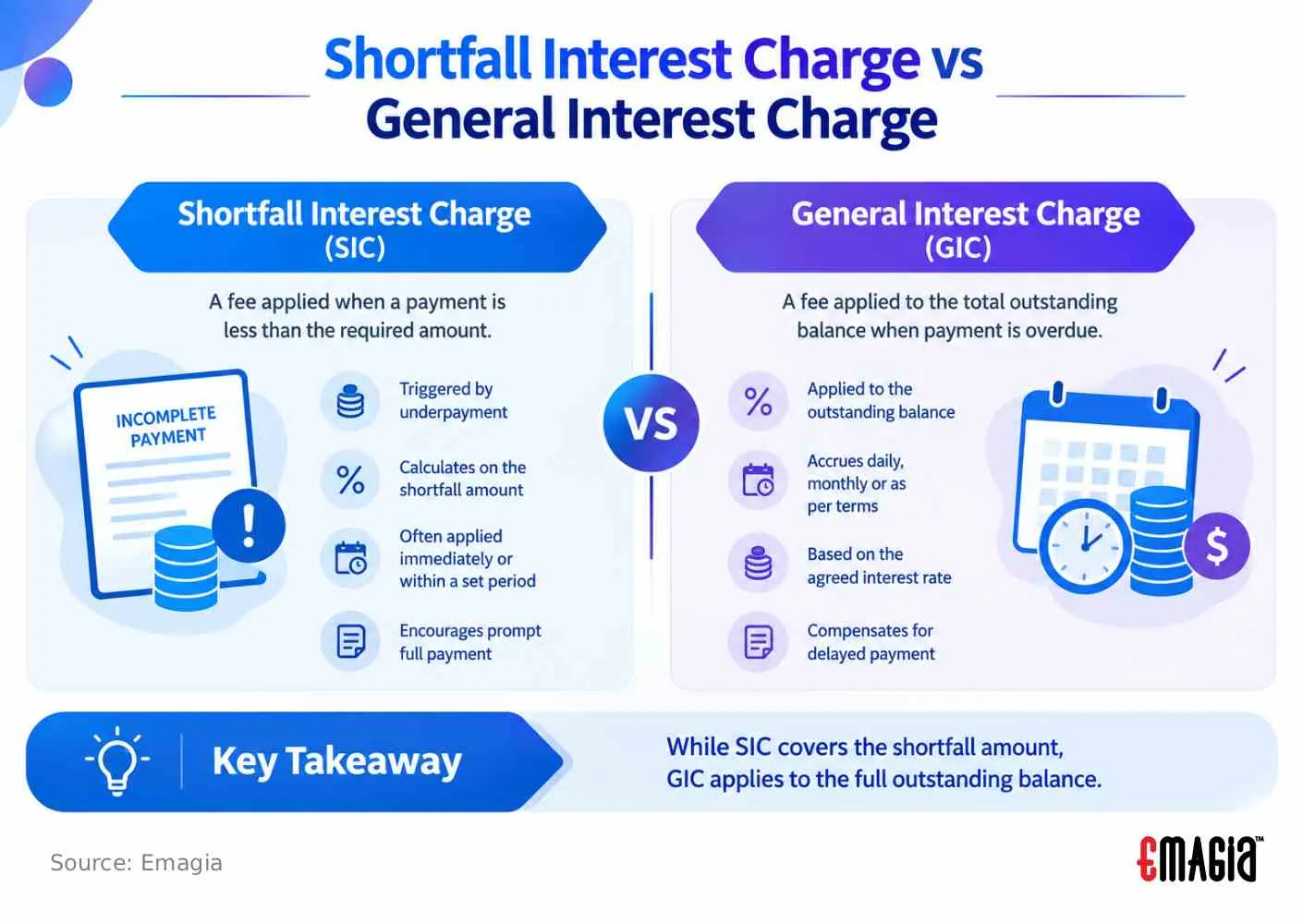
Shortfall Interest Charge vs General Interest Charge
Shortfall Interest Charge (SIC) and General Interest Charge (GIC) are both applied when financial obligations are not fully met, but they apply in different situations.
| Charge Type | Description |
|---|---|
| Shortfall Interest Charge (SIC) | Applied when a taxpayer underestimates or underreports their tax liability and later corrects the amount. |
| General Interest Charge (GIC) | Applied to unpaid tax debts after the due date when the amount remains outstanding. |
Understanding the difference helps businesses manage tax liabilities and avoid unnecessary interest penalties.
Shortfall Interest Charge vs Other Interest Penalties
| Charge Type | Description |
|---|---|
| Shortfall Interest Charge (SIC) | Interest applied when the amount paid toward interest or tax liability is lower than the required amount. |
| Late Payment Interest | Interest charged when payments are made after the due date. |
| Penalty Charges | Additional financial penalties imposed for non-compliance with payment terms. |
Impact of Shortfall Interest Charges on Businesses
For businesses, shortfall interest charges represent additional financial costs that can affect profitability and working capital.
Repeated shortfall charges may indicate weaknesses in financial planning, tax estimation, or cash flow management.
Finance leaders can minimize these charges by maintaining accurate cash flow records and anticipating repayment obligations.
Why Shortfall Interest Charge Matters for CFOs and Finance Leaders
For CFOs and finance leaders, shortfall interest charges highlight potential gaps in financial planning, tax estimation, and cash flow forecasting.
Organizations that maintain accurate forecasting processes and strong financial controls can minimize exposure to unnecessary interest penalties.
Monitoring tax liabilities, loan obligations, and payment schedules helps finance teams improve financial discipline and maintain stronger working capital management.
Example of a Shortfall Interest Charge
Suppose a company owes $50,000 in interest for a loan period but only pays $45,000 by the due date. The remaining $5,000 becomes the shortfall amount.
The lender may apply a shortfall interest charge on this unpaid amount until the outstanding balance is fully settled.
This charge ensures that lenders are compensated for delayed or incomplete interest payments.
Examples of Shortfall Interest Scenarios
Shortfall interest charges may arise in several financial situations, including:
- When a borrower makes only a partial interest payment on a loan.
- When a taxpayer underestimates their tax liability during an assessment period.
- When payment delays occur due to cash flow shortages.
- When financial adjustments reveal that previous payments were insufficient.
These scenarios highlight the importance of accurate financial planning and timely payments.
Shortfall Interest in Banking Policies
Financial institutions include shortfall interest provisions in their lending policies to discourage delayed or incomplete payments.
These policies ensure borrowers meet their obligations on time and help lenders manage risk effectively.
Proper monitoring of cash flows and repayment schedules helps businesses avoid unexpected interest penalties.
Managing Shortfall Interest Charges
Effectively managing shortfall interest charges requires proactive financial planning and adherence to agreed payment schedules.
By maintaining accurate financial records and meeting payment terms, organizations can reduce unnecessary costs and improve financial stability.
How Businesses Can Avoid Shortfall Interest Charges
Organizations can reduce the risk of shortfall interest charges by implementing stronger financial management practices.
- Maintaining accurate financial records and interest calculations
- Monitoring loan repayment schedules
- Improving cash flow forecasting
- Ensuring timely payments toward financial obligations
Effective financial planning helps organizations avoid unnecessary interest penalties and maintain stronger financial stability.
Related Financial Terms
- General Interest Charge (GIC)
- Late Payment Interest
- Working Capital Management
- Cash Flow Forecasting
- Tax Liability Adjustment
Key Takeaways
- Shortfall Interest Charge (SIC) is applied when a borrower or taxpayer underpays the required interest or tax liability.
- The charge compensates lenders or authorities for the time value of money on the unpaid amount.
- SIC is calculated using the shortfall amount, the applicable interest rate, and the number of days the payment remains unpaid.
- Shortfall interest charges can occur due to underestimated liabilities, delayed payments, or incorrect financial calculations.
- Businesses can reduce these charges through accurate financial planning, strong forecasting, and timely payments.
Frequently Asked Questions
What is a shortfall interest charge?
A shortfall interest charge is an interest penalty applied when a borrower or taxpayer pays less interest than required during a specific period.
Why do shortfall interest charges occur?
They occur when payments do not fully cover the interest owed, often due to delayed payments or underestimated liabilities.
How can businesses avoid shortfall interest charges?
Businesses can avoid these charges by maintaining accurate financial records, forecasting cash flow, and making timely payments.
How is shortfall interest charge calculated?
Shortfall interest charge is calculated using the unpaid interest amount, the applicable interest rate, and the number of days the shortfall remains unpaid.
Is shortfall interest charge the same as a penalty?
No. Shortfall interest charge compensates for the time value of money, while penalties are additional charges imposed for non-compliance with financial obligations.
For a deeper understanding, read our detailed guide on shortfall interest charge and its financial impact.


