The best order-to-cash software for a midsize business is an integrated O2C automation platform that connects receivables, credit, collections, deductions, cash application, payments, reporting, and the company’s existing ERP without requiring an ERP replacement.
For a midsize finance organization, the right platform should do more than automate one task. It should reduce manual handoffs, improve cash visibility, accelerate collections, automate payment matching, manage exceptions, and give CFOs and controllers a reliable view of working capital.
The best choice depends on the company’s biggest O2C bottleneck, ERP environment, transaction volume, number of entities, finance-team capacity, and automation goals.
In most cases, midsize businesses should prioritize O2C software that provides:
- Connected O2C workflows
- ERP and accounting-system integration
- AI-powered cash application and payment matching
- Automated collections and customer follow-up
- Credit and risk management
- Deduction and dispute management
- Real-time receivables and cash visibility
- Intelligent exception management
- Scalable automation without proportional headcount growth
- Strong security, controls, and auditability
Why Midsize Businesses Need a Different O2C Software Strategy
Midsize businesses often face a unique finance technology challenge. They may have outgrown spreadsheets, manual collections, email-based approvals, and basic accounting workflows, but they may not have the dedicated finance transformation teams or IT resources available to very large enterprises.
As a result, finance leaders need technology that can deliver enterprise-grade automation without unnecessary complexity.
A growing midsize business may have:
- Multiple legal entities
- Growing invoice volumes
- More customers and payment methods
- Increasing credit risk
- Separate ERP, CRM, banking, and payment systems
- A lean accounts receivable team
- Manual cash application
- Spreadsheet-based collections prioritization
- Increasing deductions and disputes
- Limited real-time visibility into cash
- Pressure to improve working capital without adding headcount
That means the best software is not necessarily the platform with the longest feature list. It is the platform that provides the right level of automation for the company’s complexity and growth objectives.
What Should Midsize Businesses Look for in O2C Software?
A midsize business should evaluate order-to-cash software across several critical capabilities, including workflow coverage, ERP integration, AI automation, collections, cash application, credit management, analytics, and scalability.
1. End-to-End O2C Workflow Coverage
The first question is how much of the order-to-cash process the software can connect.
A modern O2C workflow can include:
Customer onboarding → Credit decision → Order → Invoice → Collections → Payment → Cash application → Deduction resolution → Reconciliation → Cash forecasting
A platform that automates only one step may solve an immediate problem while leaving other bottlenecks untouched.
For example, automating collections while cash application remains manual can still leave the AR team working with incomplete or outdated information.
For midsize businesses, connected workflows can be particularly valuable because smaller teams cannot afford to spend significant time moving information between systems.
2. ERP Integration Without an ERP Replacement
For most midsize organizations, the ERP remains the financial system of record.
O2C software should work with the existing ERP rather than forcing the company to replace it.
Before selecting a platform, finance leaders should ask:
- Which ERP systems are supported?
- How is customer master data synchronized?
- How are invoices transferred?
- How are payments and remittances received?
- How are cash application results posted?
- How are disputes and deductions synchronized?
- Does the platform support APIs?
- Can data be exchanged automatically?
- How much IT involvement is required?
ERP integration is especially important because a poorly integrated O2C application can simply move manual work from one spreadsheet to another system.
3. AI-Powered Cash Application
Cash application is often one of the clearest automation opportunities for a growing finance organization.
Payments may arrive through:
- ACH
- Wire transfers
- Checks
- Lockboxes
- Bank portals
- Customer payment portals
- Electronic remittance
- Email attachments
- Other payment channels
The challenge is determining which invoice or invoices the payment belongs to.
AI-powered cash application can capture payment and remittance information, identify matching patterns, automate invoice-to-payment matching, and route exceptions to finance professionals.
For a midsize company, this can be more valuable than simply reducing data entry. It can help finance teams gain faster visibility into applied cash, unapplied cash, open receivables, customer payment behavior, and exceptions.
4. Intelligent Collections Automation
Collections automation should go beyond sending automated reminder emails.
The system should help determine which customers the collector should contact first.
A useful collections platform should consider factors such as:
- Invoice age
- Amount outstanding
- Customer risk
- Payment history
- Promise-to-pay commitments
- Disputes
- Credit exposure
- Previous collection activity
- Expected payment behavior
AI can help prioritize the accounts that are most likely to affect cash flow.
For a midsize business with a lean AR team, this matters because collectors cannot manually analyze every customer every morning.
5. Credit and Risk Management
O2C problems often begin before an invoice is created.
A customer that receives inappropriate credit terms may later become a collections problem.
That is why midsize businesses should consider how O2C software connects:
Credit → Customer onboarding → Receivables → Collections → Payment behavior
The platform should help finance teams:
- Evaluate customer creditworthiness
- Establish credit limits
- Automate approvals
- Monitor credit exposure
- Identify changing risk
- Connect credit information with collections activity
This creates a more proactive O2C model instead of waiting until invoices become overdue.
6. Deduction and Dispute Management
Short payments can create significant hidden workload.
A customer may pay less than the invoice amount because of:
- Pricing discrepancies
- Promotional deductions
- Damaged goods
- Shipping issues
- Contract disputes
- Missing documentation
- Tax differences
- Service-level claims
- Unauthorized deductions
If these cases are handled through spreadsheets and email, finance teams can lose visibility into why cash is being delayed.
O2C software should help classify deductions, assign ownership, track resolution, and identify recurring root causes.
The objective is not simply to close individual disputes. It is to identify why the same disputes keep happening.
7. Real-Time O2C Analytics
CFOs and controllers should not have to wait for month-end reporting to understand receivables performance.
A strong O2C platform should provide visibility into:
- Days Sales Outstanding (DSO)
- Aging
- Overdue receivables
- Collections performance
- Cash application
- Unapplied cash
- Deductions
- Disputes
- Credit exposure
- Customer payment behavior
- Cash forecasts
This turns O2C reporting from a historical exercise into a management tool.
8. Automation That Can Scale With the Business
A midsize company should avoid buying software that becomes obsolete after the next phase of growth.
Ask a simple question:
What happens when transaction volume doubles?
The answer should not be to hire twice as many people.
Automation should allow the finance organization to handle increasing transaction volumes without proportional increases in manual work.
This is especially important for businesses expanding into:
- New countries
- New legal entities
- New payment channels
- New customer segments
- New ERP environments
- Shared services operations
O2C Software Comparison for Midsize Businesses
| O2C Software Approach | Best For | Main Strength | Potential Limitation |
|---|---|---|---|
| ERP-native O2C | Companies wanting basic functionality inside the ERP | Single system of record | May require additional automation |
| AR automation | Companies focused on receivables | Collections, invoicing, and payments | May not cover upstream O2C |
| Cash application software | High-volume payment environments | Payment matching and posting | Narrower process coverage |
| Collections software | Companies with late-payment problems | Collector productivity | Does not necessarily solve cash application |
| Credit management software | Credit-risk challenges | Customer risk and credit decisions | Limited downstream automation |
| End-to-end O2C platform | Companies with multiple connected O2C problems | Unified workflows and visibility | Requires broader implementation planning |
Key takeaway: The right choice depends on the business problem. Point solutions can address individual bottlenecks, while an integrated O2C platform can connect multiple workflows and reduce manual handoffs.
Which O2C Tool Is Best for Your Biggest Finance Challenge?
If Collections Are the Biggest Problem
Prioritize:
- AI-based account prioritization
- Automated customer communications
- Promise-to-pay tracking
- Collector worklists
- Customer payment behavior
- Dispute visibility
If Cash Application Is the Biggest Problem
Prioritize:
- AI payment matching
- Remittance capture
- Bank connectivity
- Automated ERP posting
- Exception management
- Multi-payment-format support
If Credit Risk Is the Biggest Problem
Prioritize:
- Digital credit applications
- Automated credit checks
- Credit-limit workflows
- Risk monitoring
- Approval controls
- Customer exposure visibility
If Deductions Are the Biggest Problem
Prioritize:
- Automated deduction classification
- Workflow routing
- Root-cause analysis
- Dispute collaboration
- Resolution tracking
- Deduction analytics
If the Entire O2C Process Is Fragmented
Consider an integrated O2C automation platform.
The goal should be to connect the processes rather than add another isolated application.
What Is the Best O2C Architecture for a Midsize Business?
For many midsize organizations, a practical O2C technology architecture looks like this:
ERP = System of Record
↓
O2C Automation Layer
↓
Credit + Receivables + Collections + Deductions + Cash Application + Payments + Analytics
↓
Banks + Customer Portals + CRM + Payment Networks
This model allows a company to preserve its existing ERP investment while adding automation around the processes that create the most manual work.
It also provides a path to expand automation over time.
Instead of attempting a massive transformation on day one, finance leaders can begin with a high-value bottleneck and gradually connect additional workflows.
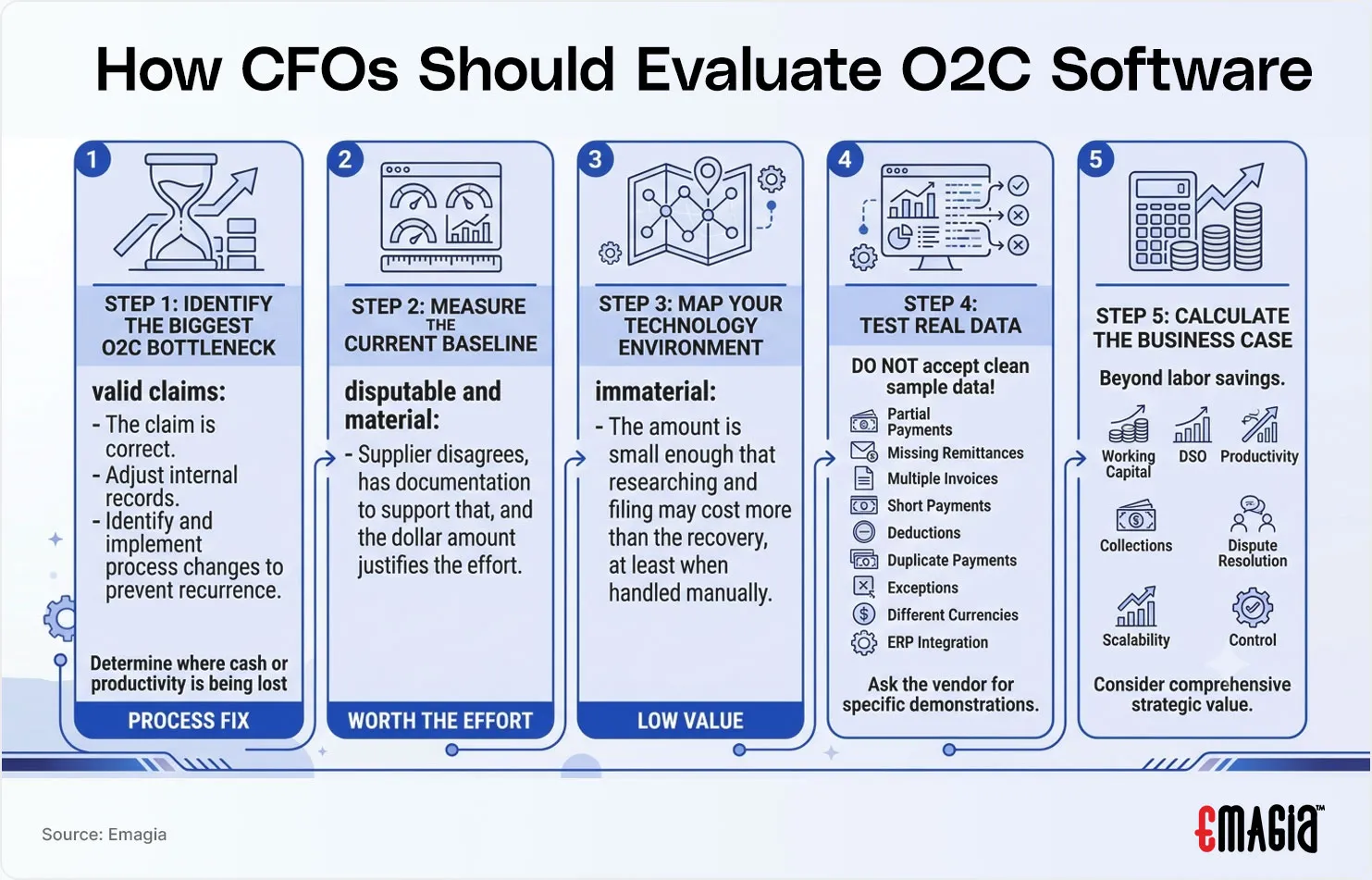
How CFOs Should Evaluate O2C Software
A software demonstration should not be the primary basis for the decision. Finance leaders should use a structured evaluation process that measures technology against real business requirements.
Step 1: Identify the Biggest O2C Bottleneck
Determine where cash or productivity is being lost.
- Credit
- Billing
- Collections
- Cash application
- Deductions
- Reconciliation
- Forecasting
Step 2: Measure the Current Baseline
Capture:
- DSO
- Overdue AR
- Unapplied cash
- Cash application rate
- Collection productivity
- Deduction cycle time
- Dispute cycle time
- Manual hours
- Cost per transaction
Step 3: Map Your Technology Environment
Document:
- ERP
- CRM
- Banks
- Lockboxes
- Payment providers
- Customer portals
- Spreadsheets
- Email workflows
- Existing AR tools
Step 4: Test Real Data
Do not accept a demonstration using only clean sample data.
Ask the vendor to demonstrate:
- Partial payments
- Missing remittances
- Multiple invoices
- Short payments
- Deductions
- Duplicate payments
- Exceptions
- Different currencies
- ERP integration
Step 5: Calculate the Business Case
The business case should include more than labor savings.
Consider:
Working capital + DSO + productivity + unapplied cash + collections + dispute resolution + scalability + control
O2C Software Evaluation Scorecard for Midsize Businesses
| Evaluation Area | Suggested Weight |
|---|---|
| O2C workflow coverage | 20% |
| ERP integration | 15% |
| Automation and AI | 15% |
| Cash application | 10% |
| Collections | 10% |
| Analytics and visibility | 10% |
| Exception management | 10% |
| Security and controls | 5% |
| Implementation and total cost | 5% |
The weighting can be adjusted based on the organization’s most significant O2C problem.
Common O2C Software Selection Mistakes
Choosing an Enterprise Platform That Is Too Complex
Enterprise-grade functionality is valuable, but midsize companies should evaluate implementation effort, usability, integration requirements, and total cost.
The objective is not to purchase the most complicated platform. It is to purchase the platform that solves the business problem effectively.
Buying Multiple Point Solutions Without a Target Architecture
Adding separate tools for collections, cash application, deductions, forecasting, and credit may solve individual problems while creating more integration work.
Before adding another application, define its role within the broader O2C architecture.
Automating the Wrong Process
Automation is not automatically valuable.
If an organization spends only a few hours per month on a task, automating it may have little financial impact.
Start with processes that consume significant time or delay cash.
Ignoring Exceptions
Straight-through processing is valuable, but exceptions are where finance teams often spend the most time.
Ask vendors:
What happens when automation fails?
The answer should include intelligent exception identification, prioritization, workflow routing, and human review.
Measuring Only Productivity
A successful O2C transformation should be measured through financial outcomes as well as operational efficiency.
Track:
- DSO
- Cash conversion
- Unapplied cash
- Overdue AR
- Collection effectiveness
- Dispute cycle time
- Forecast accuracy
- Cost per transaction
How AI Is Changing O2C for Midsize Finance Teams
Traditional automation follows predefined rules. AI can add another layer of intelligence by helping systems interpret information, predict outcomes, prioritize work, and assist finance professionals with decisions.
AI-powered O2C software can help:
- Predict late payments
- Prioritize collection activities
- Match payments to invoices
- Interpret remittance information
- Classify deductions
- Identify unusual transactions
- Recommend next actions
- Forecast customer payment behavior
- Surface high-impact exceptions
The key question for finance leaders should not be:
“Does the software use AI?”
Instead, ask:
“Where does AI remove human effort or improve a financial decision?”
That distinction is important because simply adding an AI label to a workflow does not necessarily create business value.
When Should a Midsize Business Choose an Integrated O2C Platform?
An integrated O2C platform becomes increasingly attractive when several of these conditions exist:
- The AR team is growing faster than headcount
- Collections are heavily spreadsheet-driven
- Cash application requires significant manual matching
- Unapplied cash is increasing
- Deductions are difficult to track
- Multiple systems contain customer information
- CFO reporting requires manual consolidation
- The company operates multiple entities
- The business is expanding internationally
- Finance leaders want better cash forecasting
- The ERP remains the system of record but lacks specialized automation
- The company wants to improve working capital without adding proportional headcount
If only one process is causing problems, a specialized solution may be sufficient.
If multiple processes are connected to the same cash-flow problem, an integrated O2C platform deserves closer evaluation.
How Emagia Can Support a Midsize O2C Transformation
Emagia provides an AI-powered order-to-cash platform designed to connect credit, receivables, collections, deductions, cash application, customer payments, and O2C analytics.
For finance organizations evaluating O2C automation, the objective is to create connected workflows in which:
Customer information → Credit decisions → Receivables → Collections → Payments → Cash application → Exceptions → Analytics
can operate with less manual intervention.
Emagia’s cash application capabilities support payment and remittance capture, AI-powered matching, banking integrations, exception handling, and ERP posting. Explore Emagia Cash Application
Emagia’s collections capabilities support AI-driven prioritization, automated communications, dispute management, and workflow automation. Explore Emagia Collections Management
Organizations can also expand automation across additional O2C processes as their requirements evolve. Explore Emagia Autonomous Order-to-Cash
Request an O2C automation assessment
A Practical 90-Day O2C Software Evaluation Plan
Midsize finance organizations do not need to spend months evaluating every software category. A focused 90-day approach can provide a clearer decision.
Days 1–30: Diagnose
- Map the current O2C process
- Identify manual handoffs
- Measure DSO
- Measure unapplied cash
- Measure collections productivity
- Identify deduction volumes
- Document ERP and banking integrations
- Identify the highest-value automation opportunity
Days 31–60: Validate
- Shortlist vendors
- Run real-data demonstrations
- Test exceptions
- Validate ERP integration
- Measure automation rates
- Review security and controls
- Estimate implementation effort
- Build the financial business case
Days 61–90: Decide
- Complete proof of concept
- Validate projected ROI
- Define implementation roadmap
- Establish baseline KPIs
- Select the initial O2C workflow
- Define expansion phases
This approach reduces the risk of choosing software based solely on marketing claims or feature lists.
Frequently Asked Questions About O2C Software for Midsize Businesses
What is O2C software?
O2C software automates and manages activities across the order-to-cash lifecycle, including credit, receivables, invoicing, collections, payments, cash application, deductions, reconciliation, and analytics.
What is the best order-to-cash software for a midsize business?
The best O2C software depends on the company’s ERP, transaction volume, finance-team size, process complexity, and biggest cash-flow bottlenecks. In general, midsize businesses should prioritize integrated automation, ERP connectivity, AI-powered cash application, collections, exception management, and real-time visibility.
Should a midsize company buy an O2C platform or a point solution?
A point solution can be appropriate when one process is the primary problem. An integrated O2C platform is more suitable when multiple connected processes, such as collections, cash application, deductions, and credit, need automation.
Can O2C software work with an existing ERP?
Yes. Many O2C platforms are designed to operate alongside an existing ERP. Buyers should evaluate the depth of integration for customer data, invoices, payments, remittances, credit information, accounting entries, and transaction results.
How does O2C software improve cash flow?
O2C software can improve cash flow by accelerating collections, automating cash application, reducing unapplied cash, resolving deductions faster, improving credit decisions, reducing manual delays, and improving visibility into expected cash inflows.
Is AI necessary for O2C automation?
Not every O2C workflow requires AI. However, AI can add value when processes require prediction, classification, document interpretation, intelligent matching, prioritization, or exception handling.
What O2C KPIs should a CFO track?
Important metrics include DSO, overdue receivables, cash application rate, unapplied cash, collection effectiveness, deduction resolution time, dispute cycle time, collector productivity, billing accuracy, cash forecast accuracy, and cost per transaction.
How should a midsize company test O2C software?
Use real or representative transaction data and test normal transactions as well as exceptions. The proof of concept should include payments, remittances, partial payments, deductions, disputes, multiple invoices, ERP integration, reporting, and approval workflows.
What is the biggest O2C software selection mistake?
The biggest mistake is selecting software around a single feature without considering the broader O2C operating model. A point solution can solve one bottleneck while leaving manual handoffs, disconnected data, and cash visibility problems elsewhere.
Can O2C automation support shared services organizations?
Yes. O2C automation can help shared services teams standardize workflows, centralize visibility, automate repetitive activities, route exceptions, and provide consistent performance metrics across business units.
Final Takeaway
The best order-to-cash software for a midsize business is not necessarily the software with the most features. It is the platform that connects the workflows creating the greatest financial impact while fitting the company’s existing ERP, finance team, technology environment, and growth plans.
For CFOs, controllers, VP Finance leaders, shared services executives, AR managers, credit and collections managers, cash application managers, and digital transformation leaders, the evaluation should start with five questions:
- Where is cash getting stuck?
- How much manual work is involved?
- Which O2C processes need to work together?
- Can the software integrate with the existing ERP and banking environment?
- Can the platform scale as transaction volume and business complexity increase?
If the biggest challenges span collections, cash application, deductions, credit, receivables, and cash visibility, an integrated O2C automation platform can provide a stronger foundation than adding another disconnected point solution.
For finance leaders, the ultimate objective is simple:
Move from managing O2C tasks to managing cash, working capital, risk, and customer outcomes.
Explore Emagia Autonomous Order-to-Cash