The global finance landscape is reaching a critical inflection point. For years, shared services and finance operations leaders have leaned heavily on traditional robotic process automation (RPA) and standard ERP workflows to optimize the order-to-cash (O2C) cycle. Yet despite these investments, finance teams remain bogged down by manual exception handling, fragmented communication channels, and rigid, rule-based systems.
At the recent 26th SSON European Conference in Portugal, one of the most discussed topics among Shared Services, GBS, and finance transformation leaders was how organizations can (and really must) move beyond isolated AI pilots and fragmented automation initiatives to achieve enterprise-wide business value via AI Agents and Autonomous Finance Solutions. Emagia we unpacked the next evolution in finance operations: Agentic AI agents to streamline the order-to-cash platform.
The Paradigm Shift: From Basic Automation to Autonomous
Standard automation relies heavily on rigid, rules-based logic. When an invoice layout changes, a credit profile spikes, or a complex deduction occurs, the automation breaks, forcing a human to review multiple codes in the background. This is no longer adequate to remain efficient, compliant, and competitive.
In her featured session at the SSOW conference, “Six Practical AI Agents for Autonomous Order-to-Cash: Use Cases and Pilot-to-Deployment Guidelines,” Emagia Founder and CEO Veena Gundavelli outlined that many finance organizations are reaching a critical inflection point.
Finance leaders today face a combination of challenges that traditional operating models were never designed to address: rising customer risk, slower payments, increasing dispute volumes, growing compliance requirements, persistent talent shortages, and ongoing pressure to improve working capital performance. While automation has helped streamline many individual tasks, most Order-to-Cash processes remain fragmented across systems, teams, and workflows, requiring significant human intervention to manage exceptions and make decisions.
According to Gundavelli, the next phase of finance transformation is not about adding more automation. It is about rethinking how finance work gets done.
Agentic AI introduces a fundamentally different approach. Rather than simply executing predefined tasks, AI agents can analyze information, make decisions within established business guardrails, coordinate activities across workflows, and continuously learn from outcomes. This enables organizations to move from task automation toward intelligent orchestration and autonomous execution.
The most successful organizations are approaching this transition as an operating model transformation rather than a technology deployment. They are establishing governance frameworks, defining measurable business outcomes, implementing human-in-the-loop controls, and deploying AI agents incrementally across high-impact processes where they can deliver immediate value.
This is the foundation of Autonomous Finance: AI-native finance operations where humans and AI agents work together to improve decision-making, accelerate cash flow, strengthen risk management, enhance customer experiences, and continuously optimize performance across the entire Order-to-Cash lifecycle.
| Traditional Automation | Autonomous Finance |
|---|---|
| Rule Bases | AI-reasoning |
| Reactive | Predictive |
| Task Execution | End-to-end Orchestration |
| Static Workflows | continuous learning |
| Human Heavy | AI first + Humans in the loop |
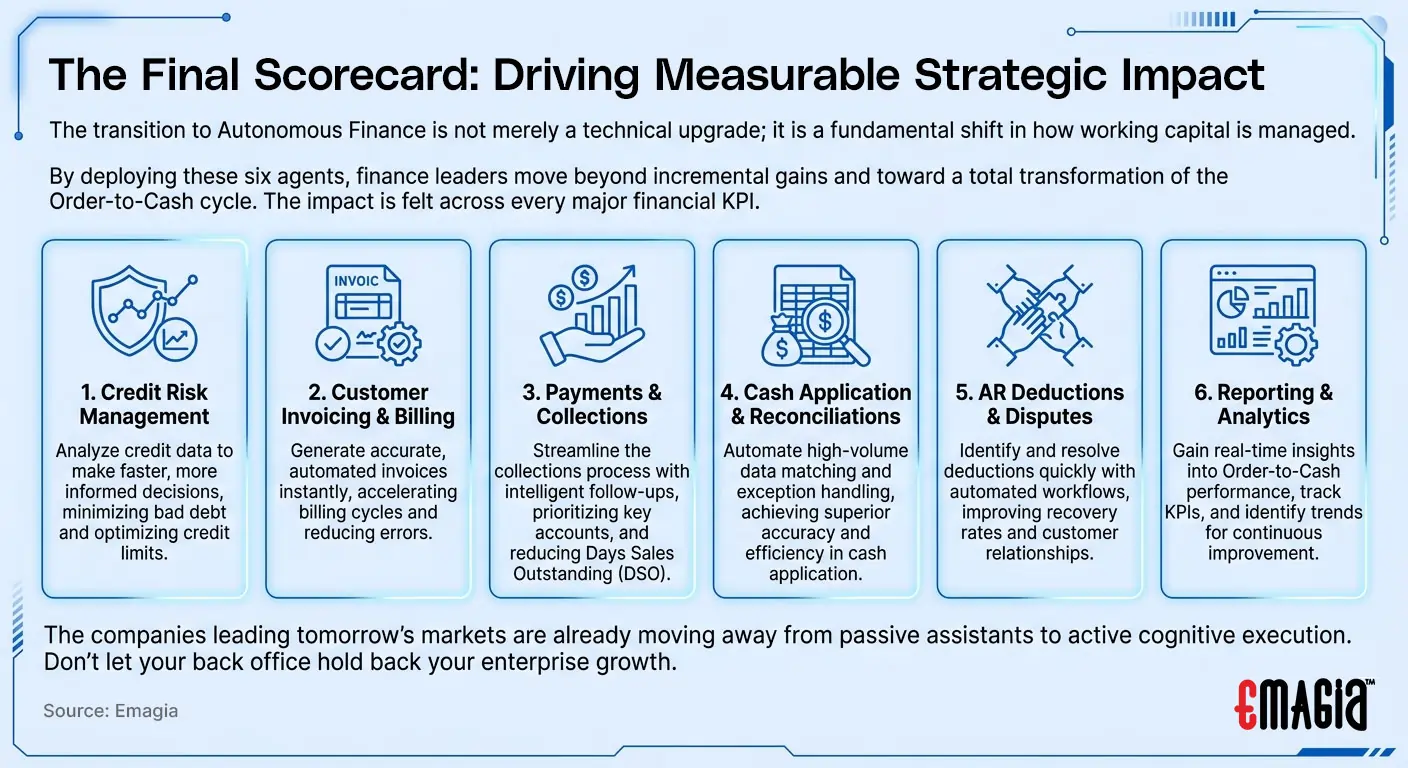
During her session, Gundavelli highlighted six practical AI agents that are already helping organizations make this transition from fragmented automation to autonomous finance operations.
6 Practical AI Agents Transforming O2C
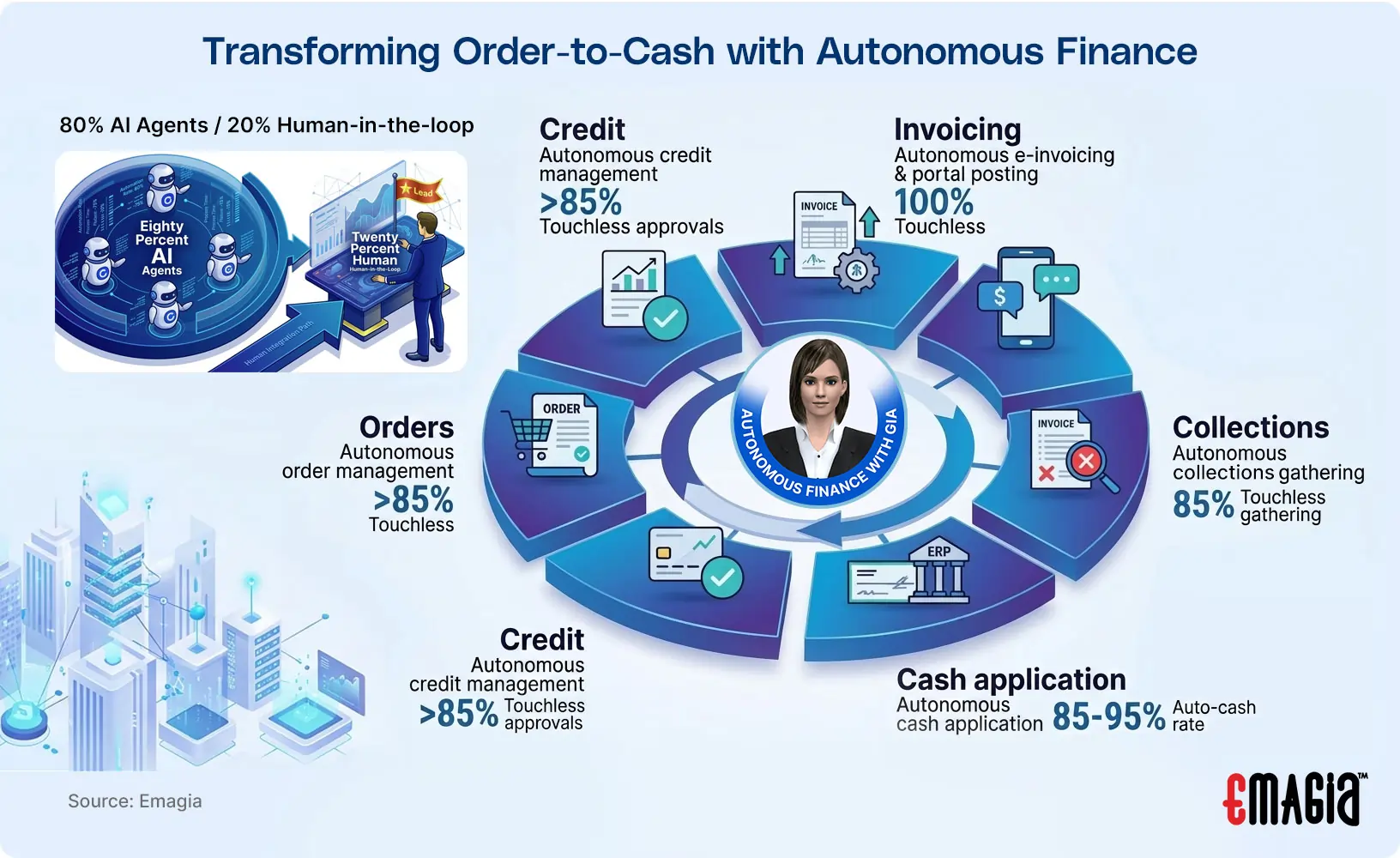
To scale an autonomous finance operation, enterprises must look beyond generic AI models and deploy specialized, task-oriented sub-agents. The Emagia Autonomous Finance Platform introduces six Super Agents and over 200+ specialized O2C Task Subagents equipped with voice, text, and vision capabilities to change the way companies work with their finance teams.
Here are the six core pillars where these practical AI agents are driving touchless performance:
1. Autonomous Order Management
Autonomous Order Management reimagines how finance teams handle high-volume order operations. Instead of relying on manual reviews and fragmented workflows, AI agents can validate, process, and orchestrate orders in real time — while escalating high-risk exceptions to human teams when needed.
Key Capabilities
Business Impact
Finance teams can accelerate order-to-cash cycles by up to 40%, improve revenue assurance, and free teams to focus on strategic customer engagement instead of manual processing.
2. Autonomous Credit Management
Traditional credit management often slows growth with manual underwriting, delayed approvals, and limited real-time visibility into customer risk. Autonomous Credit Management transforms credit operations into a faster, AI-driven decision engine that balances growth with proactive risk control.
Key Capabilities
Business Impact
By combining AI-driven decisioning with human oversight, finance teams can improve credit agility, achieve up to 85% predictive accuracy, reduce bad debt risk, and unlock additional sales capacity through smarter credit utilization.
3. Collections Management
Collections is often the most labor-intensive stage of the cash conversion cycle, with teams spending significant time prioritizing accounts, managing follow-ups, and resolving payment delays.
Autonomous Collections Management uses AI-driven prioritization and intelligent outreach to help finance teams accelerate cash recovery while preserving customer relationships. Through its Human-in-the-Loop model, the agent manages the high-volume outreach while shielding VIP relationships and escalating high-value negotiations to senior collectors.
Key Capabilities
Business Impact
By combining human supervision with AI-driven processes, collectors can keep up with complex negotiations and high-value accounts, and organizations can reduce DSO by up to 15 days.
4. Cash Application
Unapplied and misapplied cash are silent killers of DSO, distorting treasury visibility and creating manual matching bottlenecks.
Autonomous Cash Application uses AI-driven matching and intelligent exception handling to accelerate reconciliation, improve accuracy, and deliver real-time visibility into open customer balances.
Key Capabilities
Business Impact
This shift to autonomous posting, while maintaining human oversight for exceptions, delivers a 2-day DSO reduction from cash application alone, while slashing the cost-to-apply by 50% and keeping unapplied cash balances below 1% of total AR.
5. Deductions Management
Deductions are often one of the biggest hidden sources of revenue leakage inside enterprise finance operations.
What begins as small short-payments and disputes can quickly escalate into millions in unresolved claims, delayed recoveries, and operational inefficiencies.
Autonomous Deductions Management helps finance teams move from reactive write-offs to proactive recovery and dispute intelligence.
Key Capabilities
Business Impact
By combining AI-driven automation with human expertise for negotiations and escalations, organizations can recover over 70% of invalid deductions, reduce revenue leakage, and significantly improve resolution cycle times.
6. Autonomous e-Invoicing & Billing
Billing delays often begin with small invoice errors that trigger disputes, delay approvals, and slow down cash flow.
Autonomous e-Invoicing & Billing helps finance teams eliminate these friction points by automating invoice generation, validation, delivery, and compliance workflows across the billing cycle.
Key Capabilities
Business Impact
By combining intelligent automation with human oversight for high-value exceptions, organizations can achieve up to 99% invoice accuracy, reduce billing-related disputes, accelerate invoice delivery, and improve DSO through faster payment cycles.
Autonomous Does Not Mean Uncontrolled
A common hesitation among financial executives is data security and control. However, autonomous finance operates within strict, predefined corporate guardrails. AI agents do the heavy lifting, but human experts remain the final approvers for anomalous exceptions—ensuring absolute governance and strategic oversight.
A Disciplined Roadmap to Value
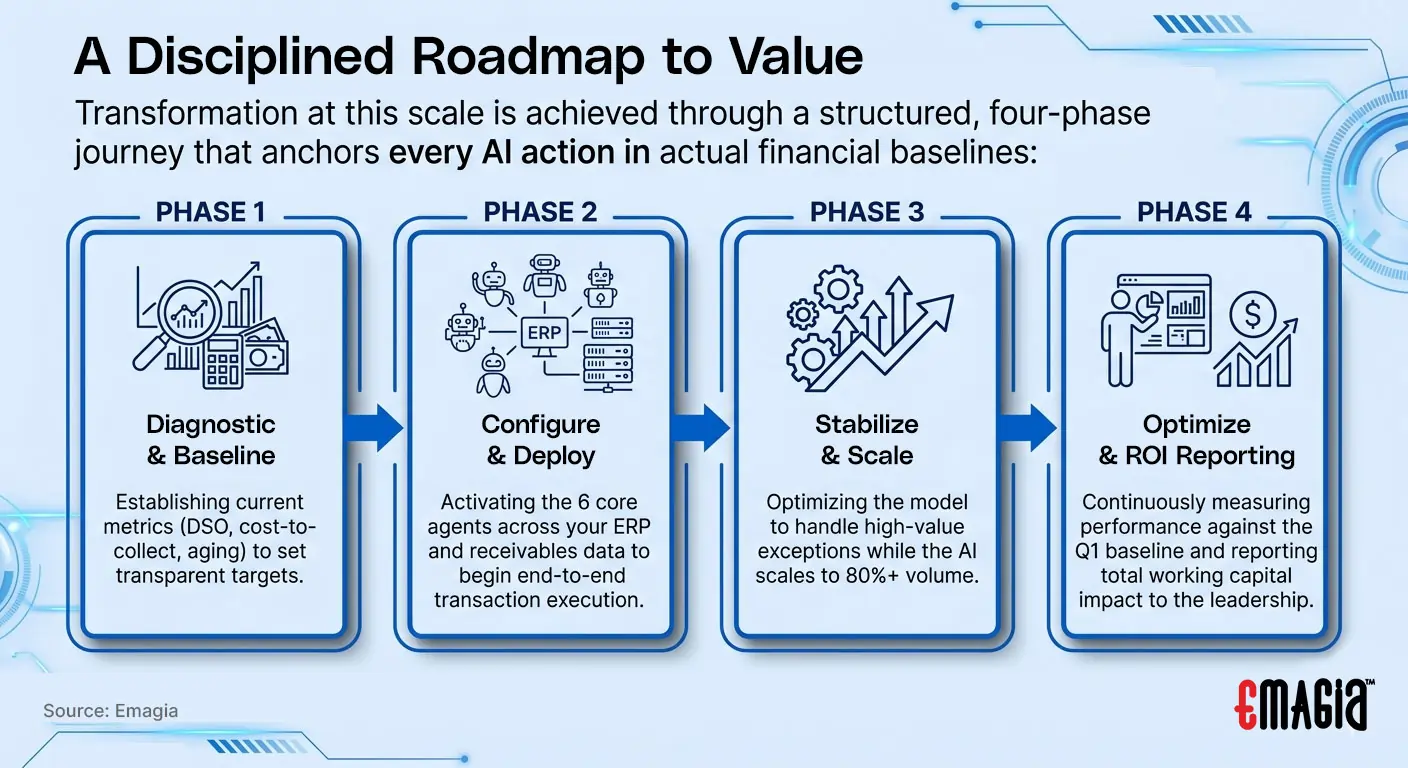
Transformation at this scale is achieved through a structured, four-phase journey that anchors every AI action in actual financial baselines:
- Diagnostic & Baseline — Establishing current metrics (DSO, cost-to-collect, aging) to set transparent targets.
- Configure & Deploy — Activating the 6 core agents across your ERP and receivables data to begin end-to-end transaction execution.
- Stabilize & Scale — Optimizing the model to handle high-value exceptions while the AI scales to 80%+ volume.
- Optimize & ROI Reporting — Continuously measuring performance against the Q1 baseline and reporting total working capital impact to the leadership.
The Final Scorecard: Driving Measurable Strategic Impact
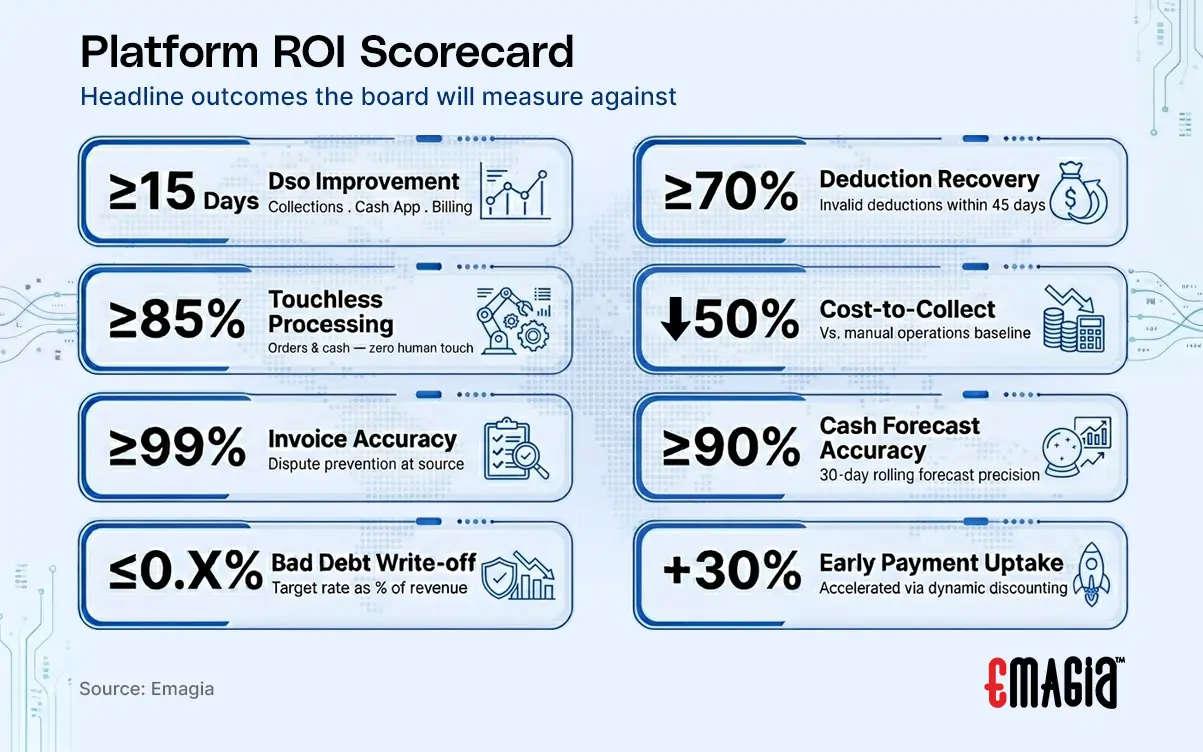
The transition to Autonomous Finance is not merely a technical upgrade; it is a fundamental shift in how working capital is managed. By deploying these six agents, finance leaders move beyond incremental gains and toward a total transformation of the Order-to-Cash cycle. The impact is felt across every major financial KPI. Below is a snapshot of what the leadership outcomes would look like:
The companies leading tomorrow’s markets are already moving away from passive assistants to active cognitive execution. Do not let your back office hold back your enterprise growth.
Ready to Modernize Order-to-Cash Operations?
See how autonomous finance solutions can improve working capital, reduce operational friction, and accelerate enterprise finance transformation. Click here.