What is Order Management Software (OMS)?
Order Management Software (OMS) is an AI-driven system that automates the entire order-to-cash lifecycle, helping businesses process orders faster, reduce errors, and accelerate cash flow.
Modern platforms use AI to reduce errors, accelerate invoicing, improve cash flow, and lower Days Sales Outstanding (DSO).
- Automates order processing across systems
- Validates pricing, credit, and compliance
- Optimizes inventory and fulfillment
- Accelerates invoicing and cash collection
- Reduces errors and revenue leakage
Used by global enterprises to automate order-to-cash operations and improve financial performance.
What Does Order Management Software Do?
This system performs five key functions that automate the entire order lifecycle and improve cash flow.
- Captures orders from multiple channels
- Validates pricing, credit, and compliance
- Allocates inventory in real time
- Automates fulfillment and shipping
- Generates invoices and tracks payments
The following diagram illustrates how modern order management software streamlines the entire order-to-cash process.
This process is part of a broader order-to-cash automation strategy that connects orders, invoicing, and collections.
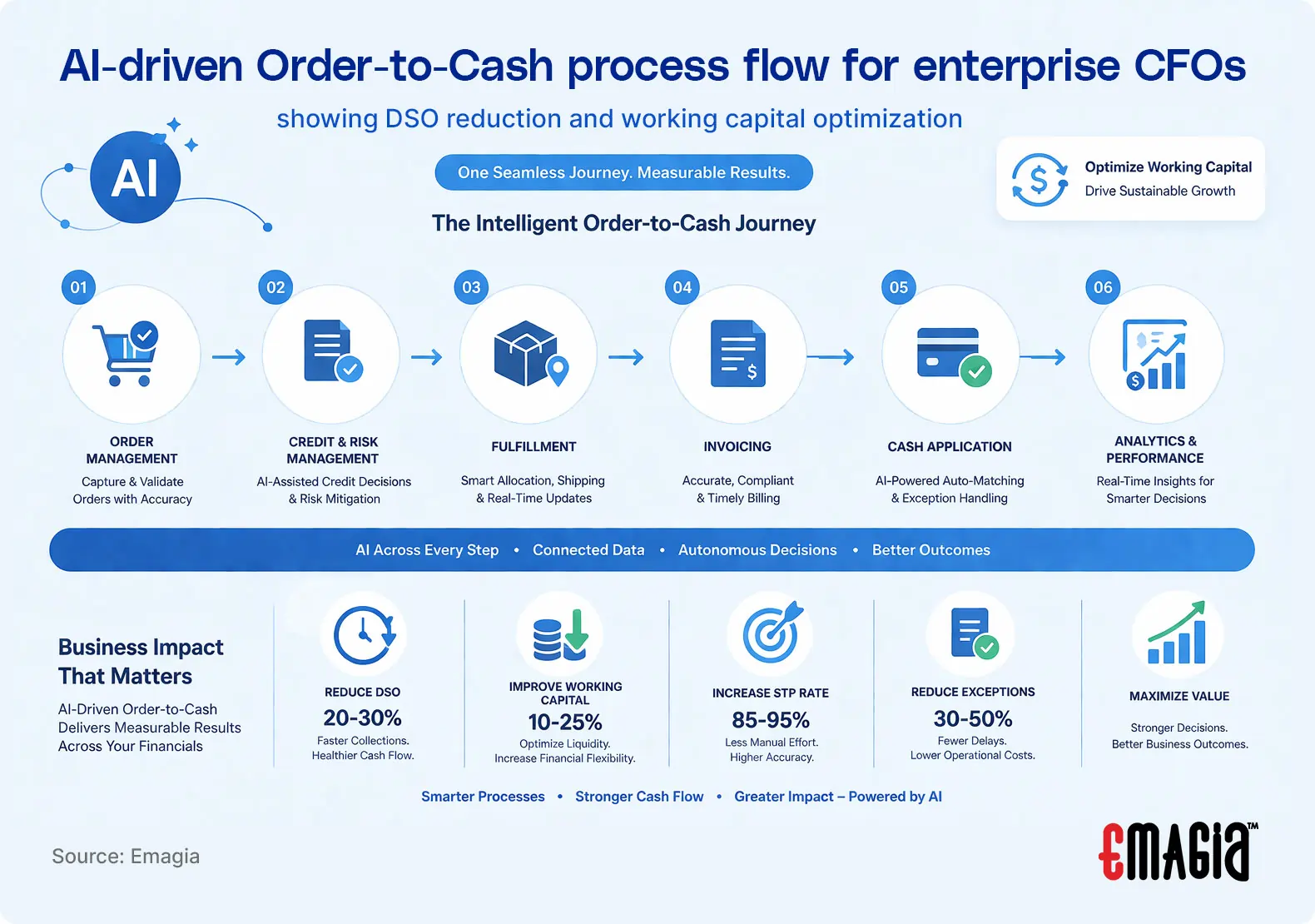
For enterprise CFOs and Shared Services leaders, OMS is not just an operational tool—it is the control center of working capital. When order processes break, cash flow slows, disputes rise, and customer experience suffers.
An ERP is the brain of your enterprise, but your OMS is the nervous system—if orders don’t flow efficiently, cash doesn’t move.
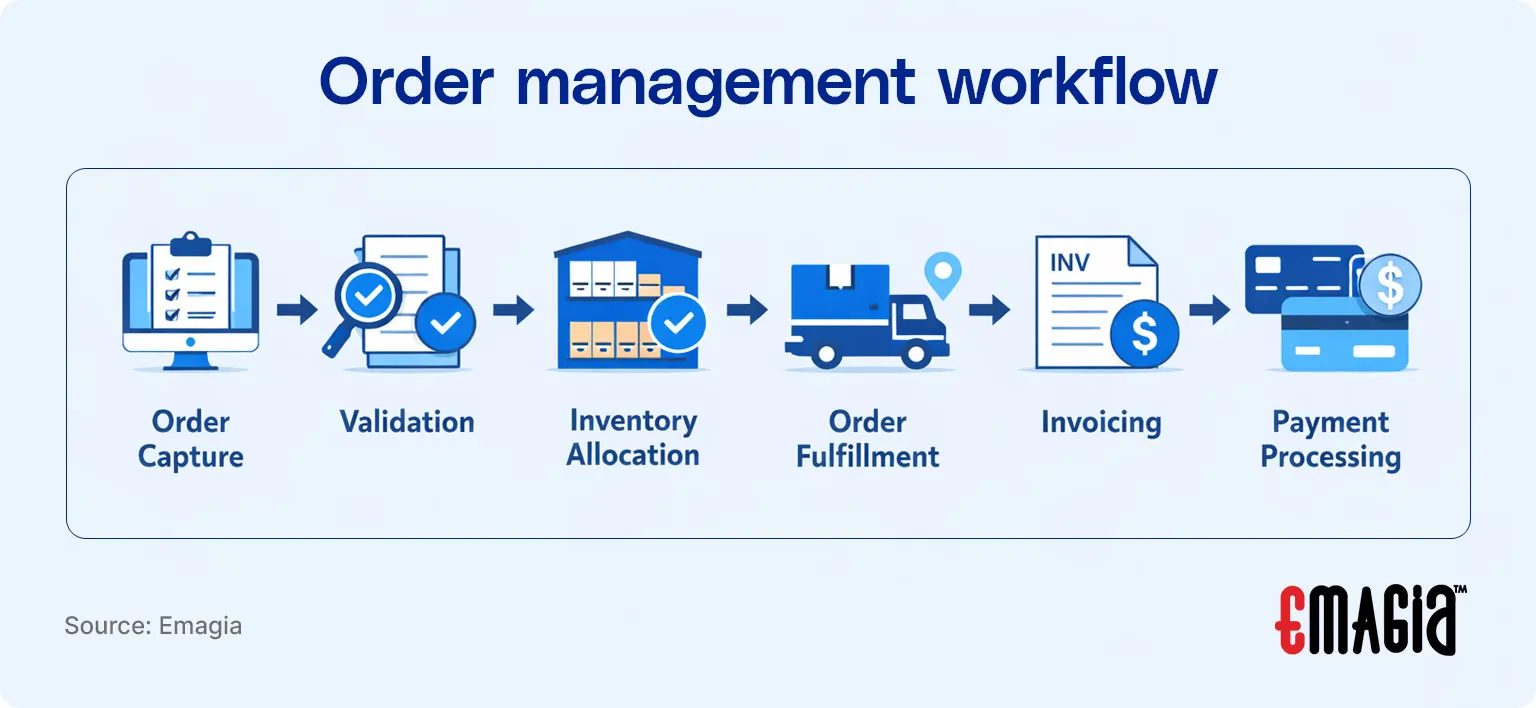
In summary, order management software connects order capture, validation, fulfillment, and invoicing into a single automated workflow.
How Order Management Software Works
Key Steps
Order management software follows five key steps to automate the order-to-cash process.
- Order Capture: eCommerce, ERP, EDI, and sales channels
- Validation: Pricing, credit checks, and compliance
- Inventory Allocation: Real-time stock visibility
- Fulfillment: Shipping and delivery execution
- Invoicing & Payments: Billing and cash application
Want to reduce DSO and eliminate order errors?
In Simple Terms
Order Management Software helps companies process orders faster, reduce errors, and get paid quicker by automating the entire order-to-cash cycle.
Quick Answer
Order Management Software automates order processing, reduces errors, improves invoicing speed, and helps businesses collect payments faster—leading to better cash flow and lower DSO.
In short, order management software helps businesses process orders faster and get paid quicker.
The following workflow shows how modern OMS platforms automate the entire order lifecycle—from capture to cash collection.
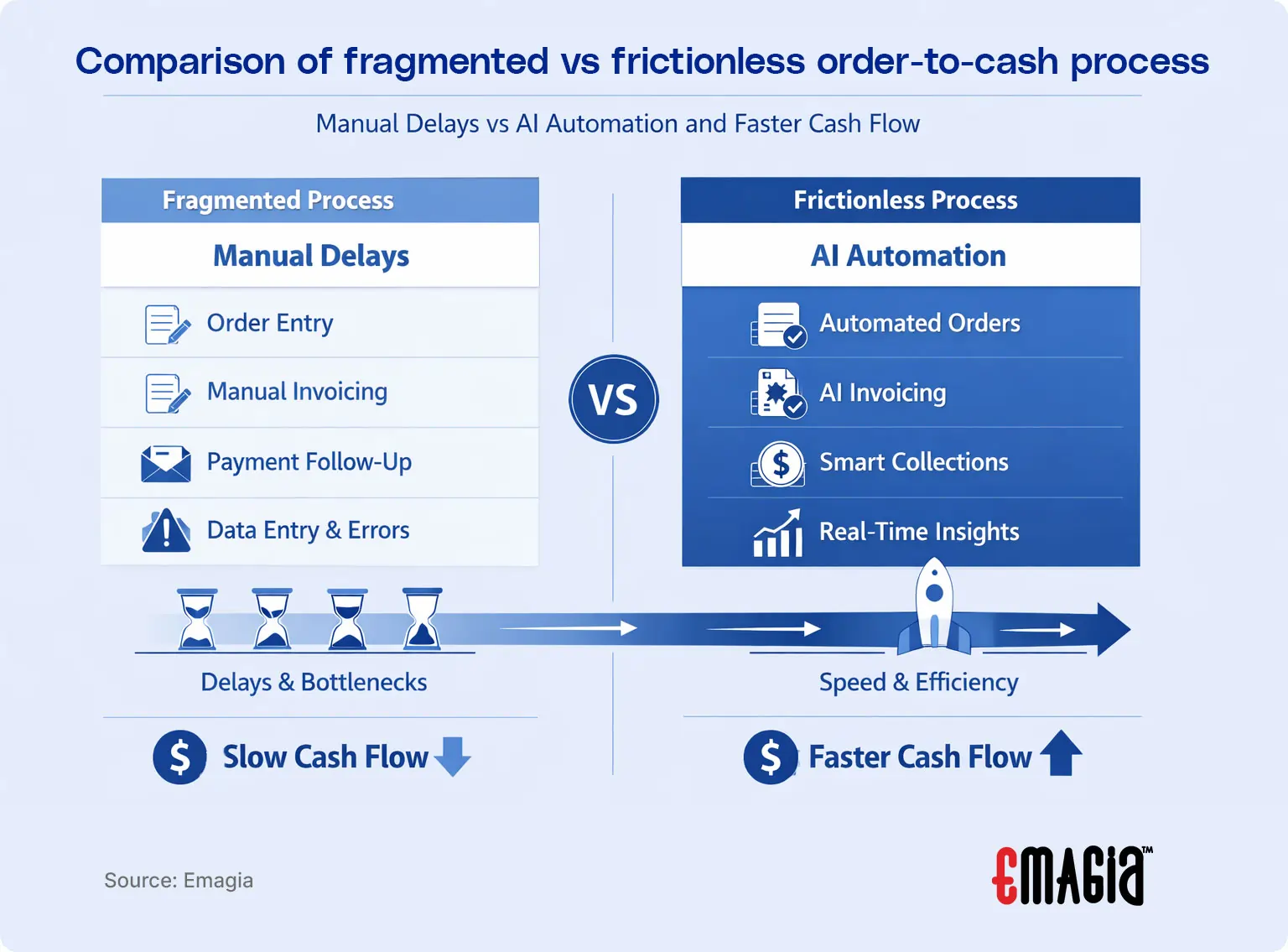
Fragmented vs Frictionless Order-to-Cash Process
Fragmented Process: Order Entry → Manual Credit Check → Inventory Delays → Manual Invoice → Disputes → 60+ Day DSO
Frictionless Process (Modern OMS): AI Order Capture → Real-Time Credit Decisions → Automated Allocation → Electronic Invoicing → Cash Application → Reduced DSO
Key Difference
Traditional order processes rely on manual steps and delayed invoicing, while modern order management software uses AI automation to process orders faster, reduce errors, and accelerate cash flow.
Key Features of Modern OMS
- Real-time order tracking
- AI-driven automation using AI credit risk management software
- ERP and CRM integration
- Multi-channel order capture
- Exception management workflows
- AI-powered decisioning for faster and more accurate order validation
Legacy vs modern Order Management Systems
| Capability | Legacy OMS | Modern OMS |
|---|---|---|
| Exception Handling | Manual intervention | Self-healing automation |
| Credit Decisions | Static limits | Real-time risk evaluation |
| Inventory | Buffer-heavy | Optimized allocation |
| Visibility | Historical reports | Predictive cash insights |
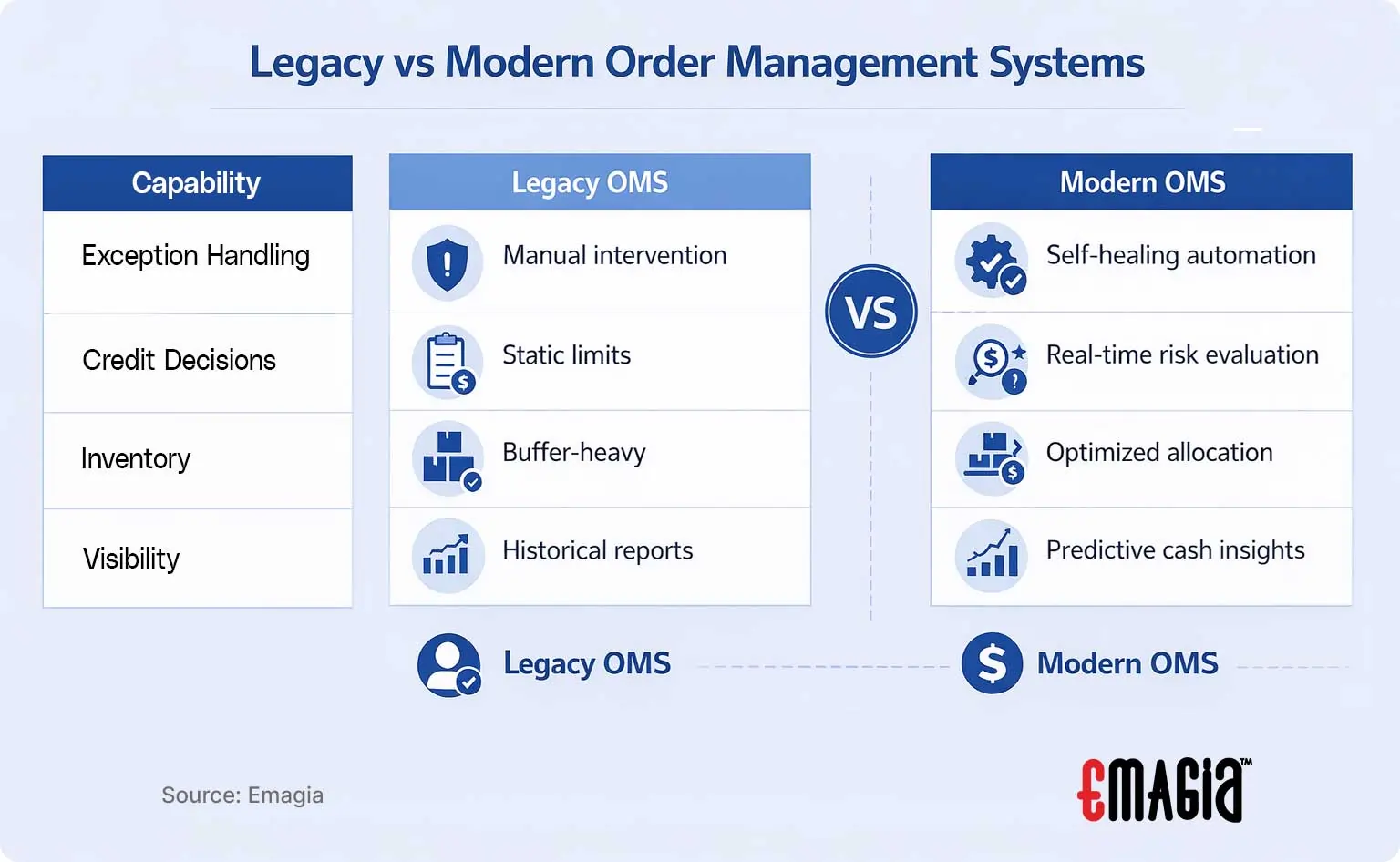
For enterprise leaders, selecting the right OMS requires evaluating both operational efficiency and financial impact.
Enterprise OMS Evaluation Checklist (CFO Perspective)
1. Seamless ERP & CRM Orchestration
Your OMS must act as the connective layer between systems.
- Bidirectional sync: Real-time updates across ERP and CRM
- API-first architecture: Avoid costly custom integrations (e.g., RESTful APIs, webhooks)
2. Intelligence Over Basic Automation
- AI-driven exception handling (focus on critical 10%)
- Dynamic credit validation before order release
3. Revenue Recognition & Compliance
- Audit-ready order trails
- ASC 606 / IFRS 15 compliance
- Global tax calculation (VAT, GST)
4. Impact on Working Capital
| Feature | Finance Impact |
|---|---|
| Order Accuracy | Reduces disputes and accelerates collections |
| Electronic Invoicing | Speeds up billing cycles |
| Real-time Inventory | Prevents revenue leakage |
5. Scalability & Business Model Flexibility
- Supports subscriptions and usage-based billing
- Handles multi-currency and multi-entity environments
6. Advanced Analytics & Visibility
- Bottleneck detection across regions
- Predictive cash flow insights
Why ERP-Native Order Management Is No Longer Enough for Modern CFOs
Traditional ERP-based order management systems were designed for record-keeping—not real-time decision-making.
- Static workflows: ERP systems rely on predefined rules, not adaptive intelligence
- Delayed processing: Batch updates create latency in credit checks and invoicing
- Limited financial visibility: ERP reports are historical, not predictive
Modern CFOs require systems that actively improve working capital—not just record transactions.
Commerce-Centric vs Finance-Centric Order Management
| Focus Area | Commerce-Centric (ERP/CRM) | Finance-Centric (AI-Driven OMS) |
|---|---|---|
| Primary Goal | Order capture and fulfillment | Cash flow optimization and working capital |
| Credit Management | Basic or external | Real-time credit risk sensing |
| Dispute Handling | Post-order issue resolution | Proactive dispute prevention |
| DSO Impact | Neutral (record keeping) | Reduced through automation |
| Credit Logic | Static or manual | Autonomous credit risk sensing |
| Financial Visibility | Order status tracking | DSO and cash flow forecasting |
Struggling with order errors, disputes, or delayed invoicing?
3 Red Flags to Watch During an OMS Evaluation
- Rigid data models: Cannot handle split shipments or partial billing
- Delayed ERP sync: “Near real-time” updates that lag by hours
- Black-box AI: Decisions without explainability (audit risk)
How Order Management Software Reduces DSO and Improves Cash Flow
Order Management Software delivers measurable business benefits by improving efficiency, reducing errors, and accelerating cash flow.
Enterprises typically achieve 15–30% reduction in Days Sales Outstanding (DSO) with AI-driven order management software.
- Faster order processing
- Reduced manual errors
- Improved cash flow
- Lower Days Sales Outstanding (DSO)
- Better customer experience
How OMS Eliminates Revenue Leakage
Revenue leakage in order-to-cash cycles often comes from pricing errors, disputes, and delayed invoicing.
Integrating OMS with AI collections management software helps proactively reduce disputes and short payments.
This works alongside AI cash application software to accelerate collections and reduce payment delays.
- Pre-order validation: Detect pricing mismatches before order confirmation
- Automated invoicing: Reduce billing delays
- Dispute prevention: Minimize short payments and deductions
OMS and Subledger Reconciliation in Modern Finance Operations
Accelerating the monthly close is a critical priority for finance leaders. OMS ensures accurate subledger reconciliation by aligning order data with invoicing and payment records.
- Eliminates mismatches between order, invoice, and payment data
- Supports faster financial close cycles
- Improves audit readiness and compliance
AI and Autonomous Order Management: Driving Order-to-Cash Digital Transformation
AI-powered OMS platforms are evolving from rule-based automation to autonomous systems that learn, adapt, and continuously optimize order-to-cash processes.
These capabilities enable:
- Touchless order processing
- Predictive analytics
- Automated dispute prevention
- Intelligent workflow orchestration
- Autonomous credit limit sensing for real-time decisions
Order Management Software Use Cases Across B2B Enterprises
- Manufacturing
- Retail & eCommerce
- Logistics & Distribution
- B2B Enterprises
Enabling Frictionless B2B Commerce with Intelligent Order Management
Modern enterprises require seamless order experiences across channels. Modern OMS systems enable frictionless B2B commerce by eliminating manual delays and providing real-time visibility.
- Real-time order status visibility for customers
- Faster fulfillment and fewer order errors
- Consistent experience across digital and offline channels
How to Choose the Best Order Management Software for Enterprises
Leading enterprises combine OMS with AI-powered order-to-cash automation software to achieve end-to-end financial transformation.
Choosing the right OMS is critical for order-to-cash transformation. Enterprise leaders should evaluate solutions based on scalability, automation intelligence, and financial impact.
When evaluating the best order management software for enterprises, decision-makers should prioritize measurable financial outcomes over basic automation features.
For enterprise teams, order management solutions must deliver measurable financial impact across the order-to-cash cycle—not just operational efficiency.
- Does it reduce DSO? Look for measurable cash flow impact
- Is it AI-driven? Automation without intelligence creates more errors
- Is it API-first? Avoid rigid, ERP-bound architectures
- Can it scale globally? Multi-entity, multi-currency support is essential
Why Choose Emagia for Order Management?
Enterprise Impact: A global manufacturer reduced order-to-invoice cycle time by over 70% using AI-driven order validation and automation.
Trusted by global enterprises across manufacturing, retail, and logistics.
Emagia delivers modern Order-to-Cash automation designed for enterprises—combining intelligent order processing, real-time analytics, and autonomous finance capabilities.
While legacy OMS implementations can take years, modern AI-first platforms are designed for rapid orchestration with existing ERP systems—delivering measurable ROI in months, not years.
Trusted by global enterprises to transform order-to-cash operations and accelerate working capital performance.
Backed by AI-first architecture and proven enterprise deployments across global finance operations.
Related Solutions
Frequently Asked Questions
What is Order Management Software in simple terms?
Order Management Software is a system that automates order processing, reduces errors, and helps businesses get paid faster by managing the entire order-to-cash cycle.
How does AI-driven Order Management Software improve enterprise cash flow?
AI-driven OMS improves enterprise cash flow by reducing order errors, accelerating invoicing, preventing disputes, and enabling faster collections across the order-to-cash cycle.
What is headless order management?
Headless OMS separates front-end order capture from backend processing, enabling flexible integrations and faster digital transformation.
Is Order Management Software necessary for enterprise finance?
Yes. Without OMS, enterprises face higher error rates, delayed invoicing, and increased disputes—all of which negatively impact cash flow and working capital.
What industries benefit most from OMS?
Manufacturing, distribution, retail, and B2B enterprises benefit the most due to high order volumes and complex fulfillment processes.
Stop Revenue Leakage. Start Accelerating Cash Flow.
If your current OMS cannot provide real-time visibility, AI-driven automation, and audit-ready workflows, it is costing your business more than you think.
Every delayed order, invoice, or dispute directly impacts your working capital. The longer inefficiencies persist, the more revenue leakage compounds.