

Rohit R. Chowdhry
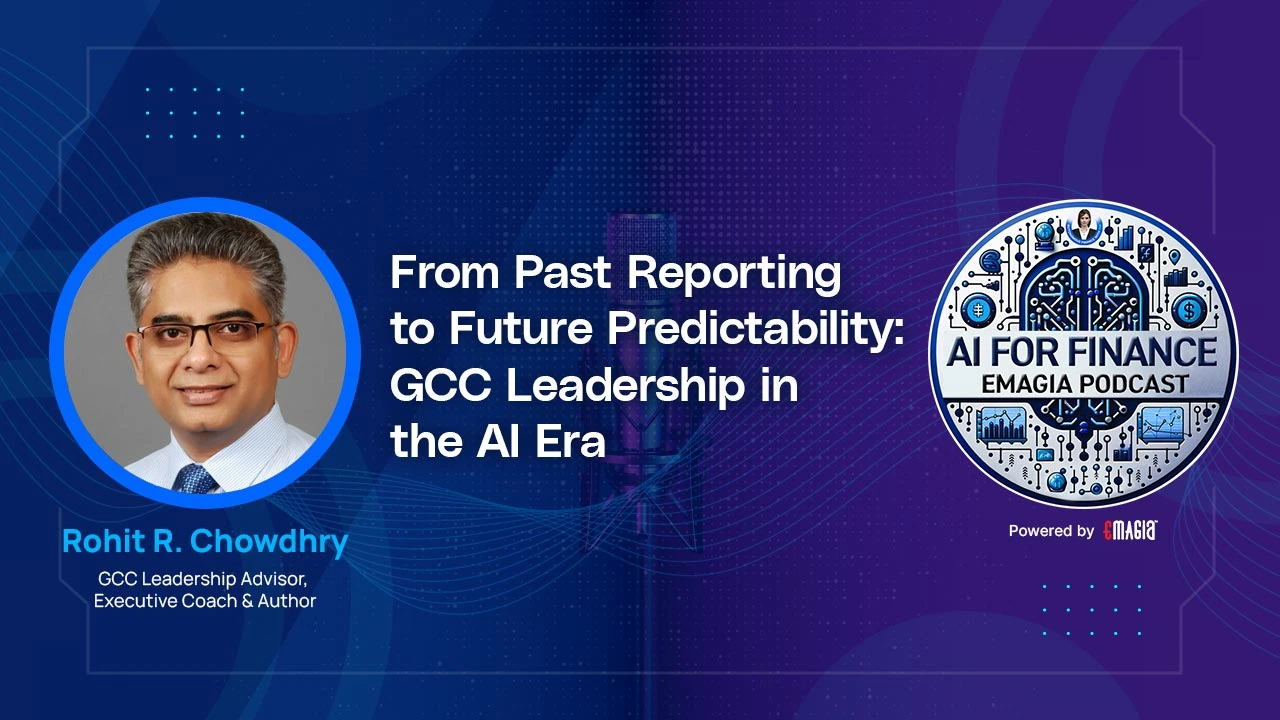
Episode Summary: GCC finance leaders are shifting from reporting on the past to predicting the future. AI is freeing up time for judgment, influence, and strategic decision-making, rather than transaction processing. In this episode of the Emagia AI for Finance Podcast, Host Sunil Pupala, Senior Director of Sales at Emagia, speaks to Rohit R. Chowdhry, author of The Future-Ready GCC Leader: From Excellence to Evolution,on what this shift means for GCC and shared services finance leaders navigating the AI era.
Rohit has decades of experience building and coaching GCC leaders. He explains why many GCCs are becoming technologically future-ready faster than they are leadership-ready—and what leaders must do to close that gap. In the podcast, he explores the five leadership identities within the framework of the GCC—Expert, Efficiency, Delivery, Safe, and Emerging Strategic—and why finance functions tend to deliver Expert and Safe leaders, both of which are increasingly being replicated by AI. Rohit unpacks why a seat at the table isn’t the destination for GCC leaders, walks through the shift from past reporting to predictability (P2P) as the new value driver for finance leaders, and introduces the EDGE framework for building future-ready leadership capability. The conversation closes with a candid look at where GCC finance is headed by 2030, as organizations shift from a pyramid-shaped structure to a diamond, with AI absorbing high-volume transactional work and experienced leaders concentrated in the middle layer.
Speaker highlights: Rohit R. Chowdhry is a GCC Leadership Advisor, Executive Coach & Author with 36 years of corporate leadership experience, including 18 years as a senior leader at Deloitte, where he built & led GCC and offshore teams of 1,200+ professionals across audit, finance, technology, and enabling functions. Since transitioning to independent practice in 2023, he works with GCC leaders & CHROs on a challenge he sees consistently across the ecosystem: organisations are scaling technology & AI adoption faster than leadership capability & talent readiness are evolving alongside them.
He is the author of 6 books, including The Future-Ready GCC Leader & The Future-Ready GCC, works that have established him as a distinctive voice on leadership & talent evolution in AI-era GCCs. He has delivered numerous leadership workshops, completed 400+ executive coaching hours & has been recognised with the Best Career Development Author Award and the Golden Wings Thought Leadership Award in the GCC category. He is based in Hyderabad & works with GCC leaders across industries globally.
Frequently Asked Questions
What is the biggest leadership challenge for GCC finance leaders in the AI era?
Many finance leaders built their identity around being “the expert” on numbers — a role AI can now perform. The real challenge is shifting from functional expertise to enterprise judgment: interpreting data and making recommendations rather than just reporting it.
What are the five leadership identities in GCC organizations?
Rohit R. Chowdhry identifies five: Expert Leader, Efficiency Leader, Delivery Leader, Safe Leader, and Emerging Strategic Leader. Finance functions most often produce expert and safe leaders—both of which are being challenged by AI.
What does P2P mean in finance leadership?
P2P stands for “Past to Predictability” — a shift from reporting what already happened to using data and judgment to forecast what an organization should do next.
How will GCC finance team structures change by 2030?
Rohit R. Chowdhry predicts a shift from a pyramid-shaped org structure (many people doing transactional work) to a diamond shape, with AI and agentic AI handling high-volume transactional tasks and more experienced, tenured people concentrated in the middle layer.
Why can’t cost and efficiency remain a GCC’s main value proposition?
If AI can deliver cost and efficiency gains, companies no longer need a GCC to achieve them — those benefits can be captured onshore. The differentiator has to be judgment, predictability, and strategic value that only experienced leaders can provide.