Cash Application Management: The Ultimate Guide to Optimizing Accounts Receivable
Cash application management is the accounts receivable process of matching incoming customer payments (ACH, wires, checks) to open invoices and posting them into ERP systems like SAP, Oracle, or NetSuite. It improves cash flow accuracy, reduces Days Sales Outstanding (DSO), and provides real-time visibility into working capital.
This process plays a critical role in the order-to-cash (O2C) cycle by ensuring accurate and timely payment reconciliation.
This guide covers the cash application process, key challenges, performance metrics, and how AI-powered automation improves reconciliation and working capital efficiency.
Introduction of Cash Application Management
Cash Application Management involves the systematic process of reconciling and allocating incoming payments to the corresponding customer accounts. It ensures accuracy in financial records, accelerates cash flow, and reduces errors in accounts receivable. By efficiently matching payments with outstanding invoices, businesses can enhance their financial visibility and optimize working capital.
This process plays a critical role in the order-to-cash (O2C) cycle, ensuring accurate and timely payment reconciliation.
What is Cash Application Management?
Cash Application Management is a critical function within accounts receivable and plays a key role in accounts receivable automation, ensuring that payments received from customers are accurately recorded and matched with outstanding invoices.
Key Functions of Cash Application Management
- Payment Processing: Recording and reconciling incoming payments.
- Invoice Matching: Allocating payments to correct invoices.
- Dispute Resolution: Handling discrepancies and short payments.
- Automation Integration: Using AI-driven tools to streamline processing.
What is Cash Application Management in Simple Terms?
Cash application management is the process of matching customer payments to invoices and recording them in financial systems to ensure accurate accounts receivable and improved cash flow visibility.
Why is Cash Application Management Important?
Cash application management is important because it ensures accurate payment reconciliation, improves cash flow visibility, reduces Days Sales Outstanding (DSO), and enables faster financial decision-making for businesses.
Importance of Cash Application Management
1. Enhances Cash Flow
Timely application of cash improves liquidity and allows businesses to reinvest in growth.
2. Reduces Errors in Accounts Receivable
Manual processes can lead to misallocations and errors. Automated solutions minimize these risks.
3. Improves Financial Accuracy
Proper reconciliation of payments ensures that financial statements are accurate and up-to-date.
4. Increases Operational Efficiency
Automation speeds up the reconciliation process, reducing manual efforts and freeing up resources for other tasks.
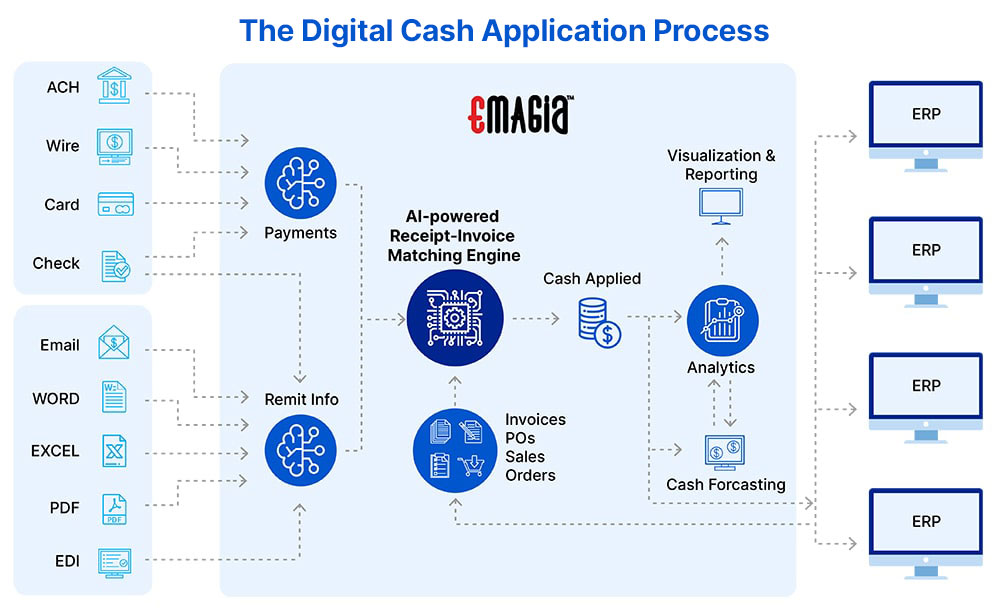
How the Cash Application Process Works (Step-by-Step)
- Payment Collection: Consolidating payments from ACH, wires, checks, and lockbox systems.
- Data Extraction: Capturing remittance advice from emails, PDFs, EDI, and customer portals.
- Remittance Aggregation: Standardizing structured and unstructured payment data into a unified format.
- Invoice Matching: Using an AI-powered payment matching engine to link payments with open invoices.
- Exception Handling: Automatically identifying short payments, deductions, or missing invoice details.
- ERP Posting: Posting reconciled transactions into ERP systems like SAP, Oracle, and NetSuite in real time, ensuring seamless integration with financial systems.
- Reconciliation & Reporting: Completing bank-to-ledger reconciliation and generating financial reports.
Common Challenges in Manual Cash Application
1. Unstructured Remittance Data
Payments often lack complete remittance details, making it difficult to match invoices accurately.
2. High Volume Transactions
Large organizations process thousands of transactions daily, requiring automation for efficiency.
3. Manual Processing Inefficiencies
Human intervention in payment reconciliation increases processing time and error rates.
4. Delayed Payment Posting
Slow processing can impact cash flow and financial reporting.
Key Benefits of Automating Cash Application
- Reduces Days Sales Outstanding (DSO)
- Improves cash flow visibility
- Achieves faster reconciliation
- Minimizes manual errors
Best Practices for Efficient Cash Application Management
1. Leverage Automation
AI-powered solutions can automate payment matching and reconciliation, reducing errors and manual workload.
2. Implement Standardized Payment Formats
Encourage customers to use consistent formats when sending remittance advice.
3. Integrate with ERP and Banking Systems
Seamless integration with accounting software ensures real-time financial visibility.
4. Monitor Key Performance Indicators (KPIs)
Tracking metrics such as Days Sales Outstanding (DSO) and payment reconciliation time helps optimize performance.
Key Metrics for Cash Application Performance
World-class cash application teams target a Straight-Through Processing (STP) rate of 85% or higher. By tracking metrics such as Time to Post and Exception Rate, finance leaders can identify bottlenecks and continuously optimize their order-to-cash (O2C) cycle.
Manual vs AI-Powered Cash Application
The key difference between manual and AI-powered cash application lies in speed, accuracy, and scalability. While manual processes rely on human effort and are prone to delays, AI-driven systems automate matching and reconciliation in real time.
This comparison highlights how AI-powered cash application significantly outperforms manual and standard automation methods in speed, accuracy, and scalability.
| Feature | Manual | Standard Automation | Emagia (AI-Powered) |
|---|---|---|---|
| Match Rate | 20–40% | 60–70% | 90%+ |
| ERP Sync | Manual | Batch Processing | Real-Time |
| Remittance Handling | Paper/PDF | Structured Only | Unstructured (Email, Web, EDI) |
Why Businesses Choose AI-Powered Cash Application
- Handles high-volume transactions with accuracy
- Reduces manual workload by over 80%
- Improves cash flow forecasting
- Accelerates financial close cycles
How Emagia Helps Streamline Cash Application Management
1. AI-Driven Payment Matching
Emagia’s AI-powered platform automates invoice matching, significantly reducing processing time.
Emagia helps organizations achieve high Straight-Through Processing (STP) rates, enabling automated matching of payments without manual intervention.
The platform intelligently processes unstructured remittance data and identifies hidden deductions, supporting advanced deduction management workflows.
Efficient cash application acts as the first line of defense in deduction management by identifying short payments at the point of entry rather than weeks later during reconciliation.
For check payments, MICR (Magnetic Ink Character Recognition) capture ensures accurate data extraction from physical documents.
2. Real-Time Remittance Processing
Advanced data capture and processing ensure payments are posted in real-time.
Remittance advice may be received via email, PDF, EDI, or customer portals, often requiring AI to extract and interpret unstructured payment data.
3. Intelligent Exception Handling
Automated workflows identify and resolve discrepancies efficiently.
4. Seamless ERP Integration
Emagia integrates with leading ERP and banking systems to enhance financial visibility and cash flow management.
Explore Emagia’s autonomous AI-powered cash application solution to achieve faster and more accurate payment reconciliation.
Transform Your Cash Application Process
Discover how AI-powered automation can reduce DSO and improve accuracy.
Cash Application vs Bank Reconciliation
Cash application focuses on matching customer payments to invoices within accounts receivable, while bank reconciliation ensures that company records match bank statements. Cash application impacts DSO and working capital, whereas bank reconciliation ensures financial accuracy and fraud detection.
Frequently Asked Questions (FAQs)
What is cash application management?
Cash application management is the process of matching incoming customer payments to open invoices and recording them in ERP systems to ensure accurate accounts receivable, faster reconciliation, and improved cash flow visibility.
How does automation improve cash application management?
Automation reduces manual effort, minimizes errors, and accelerates the reconciliation process.
What challenges do businesses face in cash application?
Common challenges include missing remittance data, high transaction volumes, and manual processing inefficiencies.
How can businesses improve their cash application process?
By leveraging AI-driven automation, integrating ERP systems, and implementing standardized payment formats.
Conclusion
Effective cash application management is essential for optimizing cash flow, reducing errors, and improving financial accuracy. Leveraging automation and AI-powered solutions like Emagia can help businesses streamline their cash application processes, ensuring faster, more accurate payment reconciliation.


